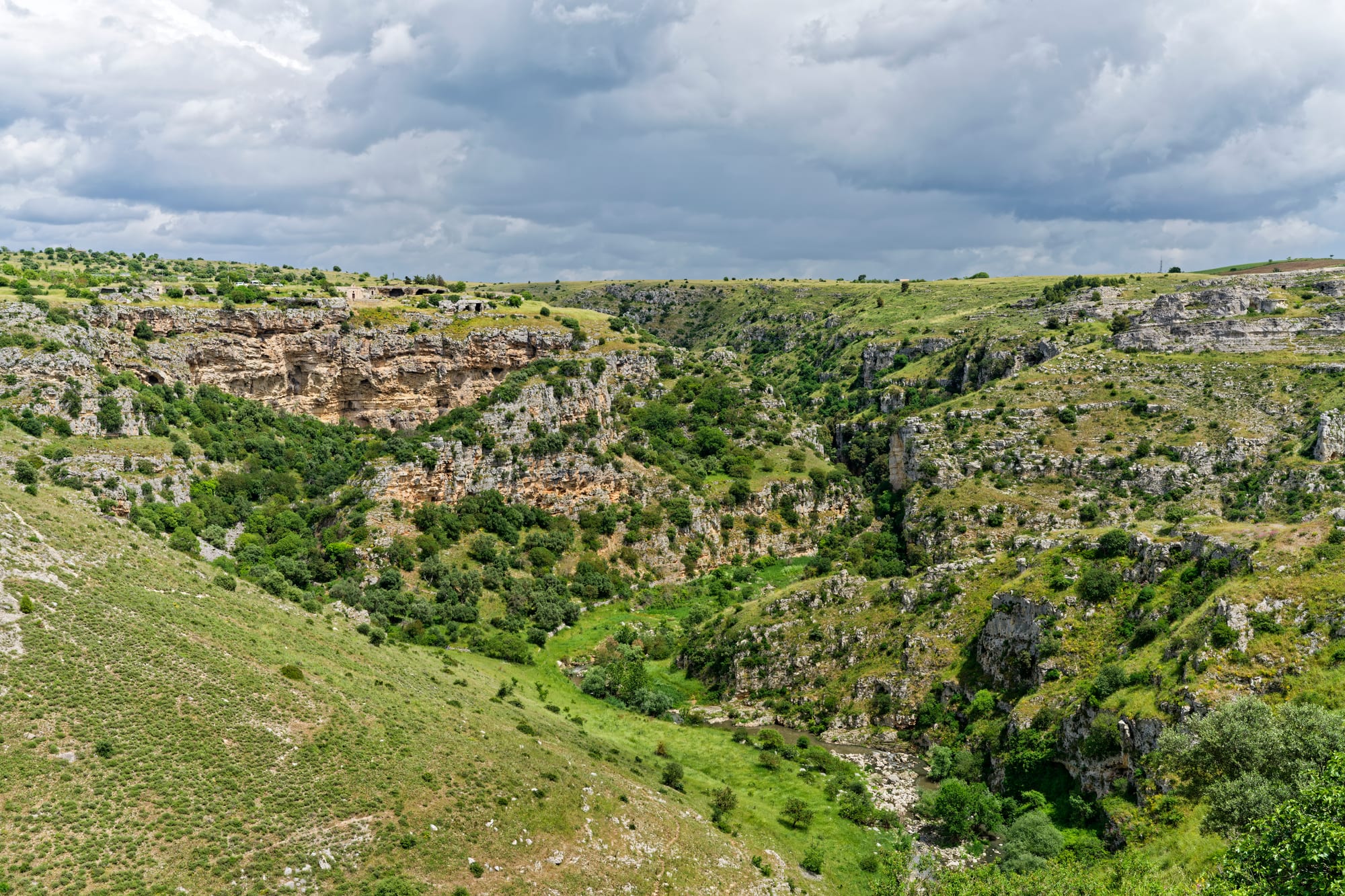
A green limestone ravine with pale cliffs pocked by cave openings under a heavy, cloudy sky

Italy

Basilicata

The ravine of the Gravina at Matera, whose cliffs are riddled with ancient cave dwellings and rock churches. (Maksimsokolov / Wikimedia Commons · CC BY-SA 4.0)

A small, mountainous and thinly populated region in the instep of Italy's boot, touching both the Tyrrhenian and Ionian seas — known for the cave city of Matera, the sharp peaks of the Lucanian Dolomites around Castelmezzano, the Pollino mountains in the south and the short, steep coast at Maratea.

Explore Basilicata

History

In ancient times the interior was held by the Lucanians, an Oscan-speaking people, while Greek colonists founded Metapontum and Heraclea on the Ionian coast; the philosopher Pythagoras is said to have died at Metapontum. Rome absorbed the area after long wars, and the poet Horace was born at Venusia, today's Venosa, in 65 BC. The land's early name, Lucania, survives in the region's adjective, lucano.

The name Basilicata appears in the Middle Ages and is usually linked to Byzantine officials who governed the area. The Normans made Melfi an early base in the 11th century, and the Holy Roman Emperor Frederick II issued his law code, the Constitutions of Melfi, there in 1231. For centuries afterwards the region was a poor, remote province of the Kingdom of Naples, dominated by great landowners.

After unification, the south's brigand war of the 1860s was fought hard in these hills, led by figures such as Carmine Crocco, and emigration emptied villages. In 1935–36 the Fascist regime exiled the painter and writer Carlo Levi to Aliano; his book Christ Stopped at Eboli made the region's poverty known across the world. In the 1950s the state moved the inhabitants of Matera's overcrowded cave districts into new housing. The Sassi were later restored, listed by UNESCO in 1993 and crowned when Matera became European Capital of Culture in 2019. The Irpinia earthquake of 1980 also struck the region's west.

Culture & Customs

Basilicata's people call themselves lucani and share a quiet, rural reserve, with dialects that change from valley to valley. Several villages in the Pollino, such as San Paolo Albanese and San Costantino Albanese, belong to the Arbëreshë community, descendants of Albanians who settled in southern Italy from the 15th century and still speak their language and keep Byzantine-rite traditions.

The festivals are old and physical. Matera's Festa della Bruna on 2 July honours the Madonna della Bruna with a procession of an elaborate papier-mâché cart, which the crowd then tears to pieces for souvenirs. In the forests around Accettura, the Maggio festival in spring ceremonially "marries" a tall oak trunk to the crown of a holly tree, a ritual thought to predate Christianity, and similar tree feasts take place in other villages.

Traditions of the countryside endure in crafts such as Matera's cuccù, painted clay whistles shaped like cockerels, and in papier-mâché. The region's story of poverty and emigration is felt everywhere, and many families have relatives in northern Italy, Switzerland or the Americas.

Daily Life

Basilicata has only about 530,000 people, and the population is falling. Potenza, the hilltop capital, has about 64,000 residents and Matera about 60,000; the rest live in small towns spread across steep, eroded hills, some of them, like Craco, abandoned after landslides.

The economy has changed since the 1990s. The Stellantis car plant at Melfi is one of Italy's major factories, and the oil fields of the Val d'Agri are among the largest onshore fields in Europe, bringing royalties and environmental disputes. Farming — durum wheat, olives, fruit on the Metaponto plain and vineyards on Monte Vulture — remains widespread, and tourism, once almost absent, now centres on Matera.

Life is slow and family-centred, with long lunches and early evenings in the small towns. Depopulation, the departure of young graduates, and the balance between oil revenues and a clean environment are the main public issues.

Food

Lucanian food is peasant cooking built from wheat, legumes, pork, peppers and sheep's cheese. The signature ingredient is peperoni cruschi, sweet red peppers from Senise that are dried and then flash-fried until crisp, crumbled over pasta or eaten as a snack. Hand-made pasta shapes include strascinati and cavatelli, often served with a ragù of pork or with breadcrumbs and peppers.

Pork is central: lucanica, a spiced sausage whose name recalls ancient Lucania, is mentioned by Roman writers, and soppressata is cured from the leanest cuts. In Matera, crapiata is a soup of mixed legumes and grains traditionally cooked in August, and the pane di Matera, a large durum-wheat loaf, has protected status. Cheeses include canestrato di Moliterno, a hard cheese with protected status, and caciocavallo podolico from the milk of the local Podolica cattle.

The region's best-known wine is Aglianico del Vulture, a deep red from the volcanic slopes of Monte Vulture. Amaro Lucano, a herbal digestif, is made near Pisticci and drunk across Italy.

Attractions & Natural Wonders

Matera is the centrepiece. Its two cave districts, the Sasso Caveoso and the Sasso Barisano, climb a ravine wall with houses, cisterns and rock churches such as Santa Maria de Idris; a restored cave house shows how families lived with their animals, and the Palombaro Lungo is a huge underground cistern beneath the main square. Across the ravine, the Murgia Materana park has more rock churches and the classic view of the town.

In the centre of the region the Lucanian Dolomites rise in sharp sandstone pinnacles, with Castelmezzano and Pietrapertosa built into the rock and joined in summer by the Volo dell'Angelo, a zip line strung between them. To the north, Monte Vulture holds the Monticchio lakes in its old craters, with Melfi's Norman castle and Venosa's unfinished abbey church of the Holy Trinity nearby.

The south is mountain country: the Pollino National Park, Italy's largest, has high meadows, gorges and the Bosnian pines that cling to its limestone summits. On the Tyrrhenian side, Maratea combines a hill town, a small harbour and coves below the white statue of Christ the Redeemer on Monte San Biagio. On the Ionian coast, Metaponto keeps the columns of a Greek temple known as the Tavole Palatine, and inland the ghost town of Craco and Carlo Levi's Aliano stand among eroded clay hills.

Cities in Basilicata

Planning basics

Budget

Basilicata is one of the cheapest regions of Italy. Matera has become popular and its cave hotels can be pricey, especially in summer, but rooms, meals and transport elsewhere cost well below the national average. The main expense is a hire car, which is close to essential outside Matera.

Daily Budget Midrange
USD 110–230 (cave hotel in Matera or country agriturismo, restaurant dinners, a hire car)
Daily Budget Shoestring
USD 50–90 (B&B, trattoria meals, regional buses)

Stay a night in the Sassi but base the rest of the trip in cheaper inland towns or agriturismi.

Safety

Basilicata has low crime and is one of Italy's quietest regions. The real hazards are road ones — steep, narrow, poorly lit mountain roads, fog in winter and animals crossing — along with summer heat in Matera, slippery stone steps in the Sassi and changeable weather in the Pollino.

Wear good shoes for the Sassi, carry water, and check mountain weather before walking. Check current official travel advice before travelling.

Climate

Much of Basilicata is mountain and hill country, so it is cooler and snowier than its southern position suggests. Potenza, one of Italy's highest regional capitals, has cold winters, while Matera is hot in summer and the Ionian plain around Metaponto is hot and dry. The Maratea coast has a mild Mediterranean climate.

Summer
hot on the Ionian plain and in Matera, 30–35°C; pleasant in the mountains, 20–28°C
Winter
cold inland, often near 0°C in Potenza with snow on the Pollino and Apennines; mild on the coasts

Transportation

There is no airport; Bari is the usual gateway, and a private railway and buses link Bari with Matera. Potenza lies on the state railway from Salerno, and Maratea on the Tyrrhenian main line. Mountain villages such as Castelmezzano are served by occasional buses, so a car is the practical way to cross the region's winding roads.

Hire a car at Bari airport; allow extra time for mountain roads, which are slow and twisting.

Best Time to Visit

April to June and September to October suit Matera, walking in the Pollino and the Dolomiti villages. July and August are hot in Matera but good for Maratea's beaches and the cooler mountains; Matera's Festa della Bruna falls on 2 July. Winter is quiet and cold inland, with snow on the high ground.