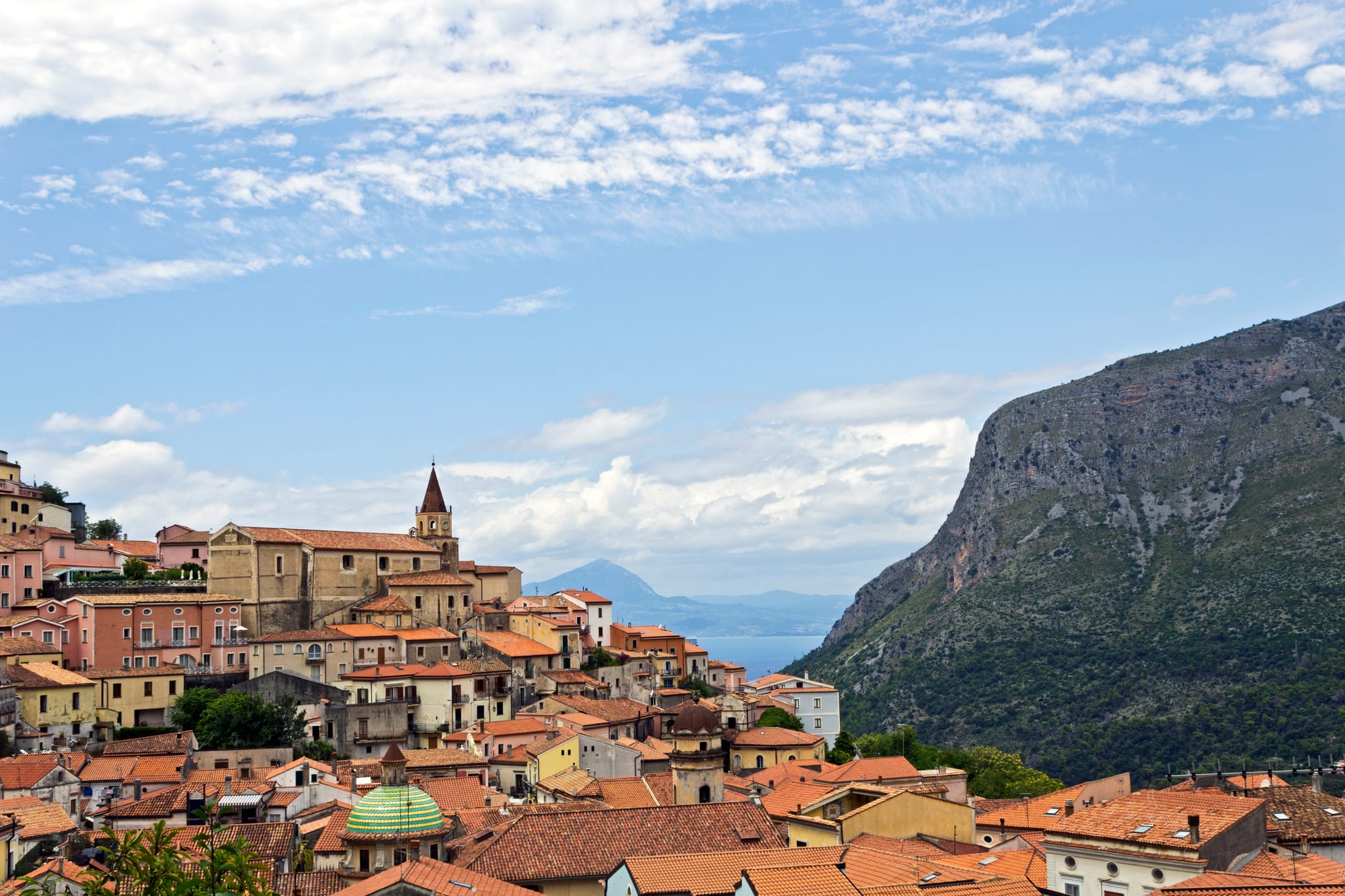
Pastel houses and tiled roofs of a hill town with a pointed bell tower and a green-tiled dome, beside a steep wooded mountain

Basilicata, Italy

Maratea

The old town of Maratea, on the slopes of Monte San Biagio. (Giuseppe Cillis / Wikimedia Commons · CC BY-SA 4.0)

The only town of Basilicata on the Tyrrhenian Sea, set on the Gulf of Policastro below Monte San Biagio, whose summit carries a basilica of Saint Blaise and a statue of Christ the Redeemer. Its hillside old town, known for its many churches, looks down on some 32 km of rocky coast, coves, a fishing harbour and wooded mountains.

Neighbourhoods

  • The Borgo
    • Historic district
    • Churches
    • Quiet evenings

    The old town on the northern slopes of Monte San Biagio, founded in the 11th or 12th century behind the mountain so it could not be seen from the sea. Its lanes hold the mother church of Santa Maria Maggiore and many of the town's churches.

    Open in Maps
  • Porto and Fiumicello-Santavenere
    • Harbour
    • Best for food
    • Beaches

    The harbour in the middle of the coast, home of the local fishing fleet, and the neighbouring hamlet of Fiumicello, developed in the 1950s, with the Santavenere watchtower above the sea.

    Open in Maps
  • Acquafredda and Cersuta
    • Rocky coves
    • Pine woods

    The hamlets on the northern stretch of coast: Acquafredda, 'cold water', with a rocky shore among pine woods and a 19th-century church, and the little village of Cersuta, 'the land of oaks'.

    Open in Maps
  • Marina and Castrocucco
    • Beaches
    • Caves

    The southern coast, where Marina grew up around a railway station between 1894 and 1921 and has the Grotta di Marina, and Castrocucco lies about 10 km down the coast road.

    Open in Maps

Things to do

Monte San Biagio

  • Statue of Christ the Redeemerlandmark

    The statue by the Florentine sculptor Bruno Innocenti, completed in 1965 on the summit of Monte San Biagio and about 22 metres tall, showing Christ after the Resurrection.

    Open in Maps
  • Basilica of San Biagiolandmark

    The sanctuary on the summit that keeps the relics of Saint Blaise, brought by sea in 732, and is said to stand over an ancient temple of Minerva.

    Open in Maps
  • Maratea Castellolandmark

    The ruins of the fortified first town on the mountain top, built against Saracen raids, which held out against the French in 1806 and was later abandoned.

    Open in Maps

The old town

  • Santa Maria Maggiorelandmark

    The mother church of the Borgo, built in 1505, with a tower incorporated in its structure.

    Open in Maps
  • Chiesa di San Vitolandmark

    A small medieval church dating to the 9th century, the oldest in the old town.

    Open in Maps
  • Colonna di San Biagiolandmark

    A votive column topped with a statue of the saint, raised in 1758 in the square in front of the church of the Annunziata.

    Open in Maps

The coast

  • Grotta di Marateaattraction

    The cave known as the Cave of Wonders, discovered in 1929 by men building the highway from Calabria.

    Open in Maps
  • Torre Santavenerelandmark

    One of the six 16th- and 17th-century watchtowers on Maratea's coast, at Fiumicello-Santavenere, once judged the most beautiful tower in the Kingdom of Naples.

    Open in Maps
  • Santo Janniattraction

    A small island named after an old chapel to Saint John, whose seabed has yielded dozens of ancient anchors now shown in the local museum.

    Open in Maps

Short trips from the town

  • Praia a Mareattraction

    A beach resort on the Tyrrhenian coast just over the border in Calabria.

    Open in Maps
  • Rivelloattraction

    A small town inland in the province of Potenza.

    Open in Maps
  • Pollino National Parkpark

    The mountain national park shared by Basilicata and Calabria, home to Europe's oldest known tree, a Heldreich's pine, and to golden eagles and Italian wolves.

    Open in Maps

Seasonal events

  • Festa di San Biagiofirst Saturday of May to the second Sunday of May

    A week-long feast marking the arrival of the saint's relics, with processions that carry his silver statue from the basilica down to Santa Maria Maggiore and through the Borgo; a religious feast is also held on 3 February.

  • Maratea Scenasummer

    A season of literary, music, theatre and cinema events held since 2011, including the Premio Maratea and the Marateale film festival.

Eat and drink

Long-standing places and food districts in Maratea. Hours, ratings and directions come from your maps app, always current.

Maratea food

  • Porto di Marateaneighborhood

    Seafood restaurants and bars around the harbour square, where the fishing boats come in.

    Open in Maps
  • The Borgoneighborhood

    Trattorias in the old town's lanes serving local dishes such as lagàne and anchovies.

    Open in Maps

Experience Maratea

History

People have lived around Maratea since the Palaeolithic. In the 15th and 14th centuries BC a trading village grew up on the La Timpa headland beside today's harbour, and it is documented until the Roman conquest of Lucania in the 2nd century BC. Dozens of ancient anchors found off Santo Janni show the coast's role in Roman trade. The name probably comes from the Greek word for fennel.

From the 7th century Saracen raids drove the people up Monte San Biagio, where they built a fortified town known as the Castello. In 732 a ship fleeing the religious persecution of the emperor Leo III brought the relics of Saint Blaise, who became the patron. As the population grew, a new town, the Borgo, was founded in the 11th or 12th century behind the mountain, out of sight of the sea. During the War of the Sicilian Vespers between Angevins and Aragonese, Maratea resisted many attacks; watchtowers were built along the coast in 1566–95, and the 18th century brought prosperity, the first hospital in Basilicata in 1734 and many of the town's churches.

Maratea refused to accept Joseph Bonaparte, and in 1806 its mayor Alessandro Mandarini held the castle with about 1,000 men for three days before surrendering; the French spared the defenders but had the walls torn down. After unification poverty drove many to the United States and Venezuela, and their money helped bring the railway in 1894, an aqueduct in 1902 and electricity in 1924. In the 1950s the industrialist Stefano Rivetti opened factories and hotels, and in 1965 the Redeemer statue was completed on the summit.

Culture & Customs

Maratea calls itself the town of 44 churches, for its many churches and chapels, and its religious year turns on Saint Blaise. The feast of the translation of his relics lasts a week, from the first Saturday of May to the second Sunday, under a protocol set in 1695: processions carry the saint's silver statue from the basilica on the summit down to Santa Maria Maggiore and through the Borgo. A religious feast is also held on 3 February, and a votive column to him has stood in the main square since 1758.

The Redeemer statue on Monte San Biagio, about 22 metres high and completed in 1965 by Bruno Innocenti on Rivetti's initiative, shows Christ after the Resurrection in an unusual pose and has become the town's emblem. The town is one of I Borghi più belli d'Italia and is known as the "Pearl of the Tyrrhenian".

Summer is the season of culture as well as beaches. Since 2011 the summer programme has been gathered under the name Maratea Scena, with literary, music, theatre and film events and talks on the area's natural heritage; the Premio Maratea dates from 1983 and the Marateale film festival from 2009. In 2015 the town put itself forward as a candidate for the UNESCO World Heritage list.

Daily Life

About 4,500 people live in the comune, which is spread between the Borgo, the summit and a string of hamlets: Acquafredda and Cersuta on the northern coast, Fiumicello and Porto in the middle, Marina and Castrocucco to the south, and Massa, Santa Caterina and Brefaro on the hillsides.

Tourism is the mainstay. Maratea was already a seaside resort before the world wars and became a well-known destination after 1945, and the hotels and factories opened by Stefano Rivetti in the 1950s lifted the local economy. Porto is the centre of the fishing industry, around a harbour for up to 200 boats, and Massa is known for its wine. The local produce includes the cheeses of Massa, salted capers and anchovies and a ribbed tomato.

Life follows the seasons. In summer the coastal hamlets fill with visitors and events; in winter, which is mild but very wet, the Borgo and the hill villages return to a quieter local rhythm built around the churches, the squares and family life.

Food

Maratea's cooking mixes land and sea. Unlike the traditional cooking of inland Basilicata, where fish is little used, it makes wide use of seafood. Many old recipes were tied to a particular time of year or occasion, and some have disappeared. Lagàne, strips of a dough of flour, oil, salt and eggs about 2.5 cm wide, are said to descend directly from the lagani of the ancient Romans.

Vermicelli con le patelle are dressed with a sauce of limpets. Alici alla scapece are fried anchovies marinated in oil, garlic, oregano and pepper, a dish traditionally eaten during the feasts of Saint Blaise. Spigola alla malvasia cooks sea bass with malvasia wine, grapes, orange and lemon peel, thyme, rosemary and garlic, and nocetti are sweets of eggs, sugar and walnuts with a lemon glaze.

Nine of the town's products are on Italy's list of traditional foods: the caciocavallo and treccia cheeses of Massa, salted capers, the carob of Maratea, gilò, the ribbed costoluto tomato, salted anchovies and aliciocculi, and the garum of Maratea. Seafood restaurants gather around the harbour, and trattorias serve local dishes in the Borgo.

Planning tools

Budget

Maratea is a long-established beach destination, and rooms near the sea cost most in July and August. Out of season, and inland in the Borgo, prices fall to levels typical of Basilicata, one of the cheaper regions of Italy. A car or scooter adds to the bill but makes the coves reachable.

Daily Budget Midrange
USD 120–240 (sea-view guesthouse, seafood dinners, a hire car)
Daily Budget Shoestring
USD 55–95 (B&B in the Borgo, trattoria meals, trains along the coast)

June and September give sea weather at lower prices than August.

Best Time to Visit

June to September for the sea, with August the busiest month and the summer events of Maratea Scena. May brings the week-long feast of Saint Blaise. Winters are mild but very wet, and much of the coast is quiet.

Suggested Number of Days

Two or three days cover the old town, the mountain and some of the coast. Four to six days suit a beach holiday or trips inland into the mountains, and the number rises for anyone relying on trains and buses rather than a car.

First Visit
2–3 days
With Surroundings
4–6 days

Transportation

The comune is spread out: the Borgo on the hillside, the summit above it and a string of hamlets along the coast road. Maratea railway station lies on the Salerno–Reggio Calabria line, and roads were built to link the old town with the coastal districts in 1930. A car or scooter is the easiest way to move between the coves.

Roads up Monte San Biagio and along the coast are narrow and winding; drive slowly.

Airport & Station Connections

Trains on the Salerno–Reggio Calabria line stop at Maratea station. The nearest airports are Naples, about 211 km away, and Lamezia Terme, about 217 km away. By road the town is on the coast highway between Campania and Calabria.

Walkability

The Borgo is compact and walkable, though hilly. The harbour, the beaches and the summit are spread out and steep, linked by winding roads, and walking between them takes time.

Safety

Italy is generally safe, with low levels of violent crime against visitors. Maratea's risks are natural rather than criminal: narrow, winding mountain and coast roads, steep paths and rocky shorelines.

Take care on the coast road and on rocks around the coves. Check current official travel advice before travelling.

Climate

A mild climate with hot, humid summers and mild but very rainy winters. The coastal hamlets are slightly milder than the Borgo, which is colder in winter and hotter in summer.

Summer
hot and humid — August averaged 23.4°C in 1961–1990
Winter
mild and wet — January averaged 8.7°C in 1961–1990

Local Customs

Saint Blaise is the patron, and the town's many churches are places of worship: shoulders and knees should be covered inside. Swimwear belongs on the beach, not in the Borgo. The town's own dialect, Marateota, is heard alongside Italian.

Keep voices down and avoid photography during services in the basilica and churches.

Common Payment Methods

Italy uses the euro. Cards are accepted widely in shops and restaurants; keep a little cash for small bars, beach kiosks and train tickets.