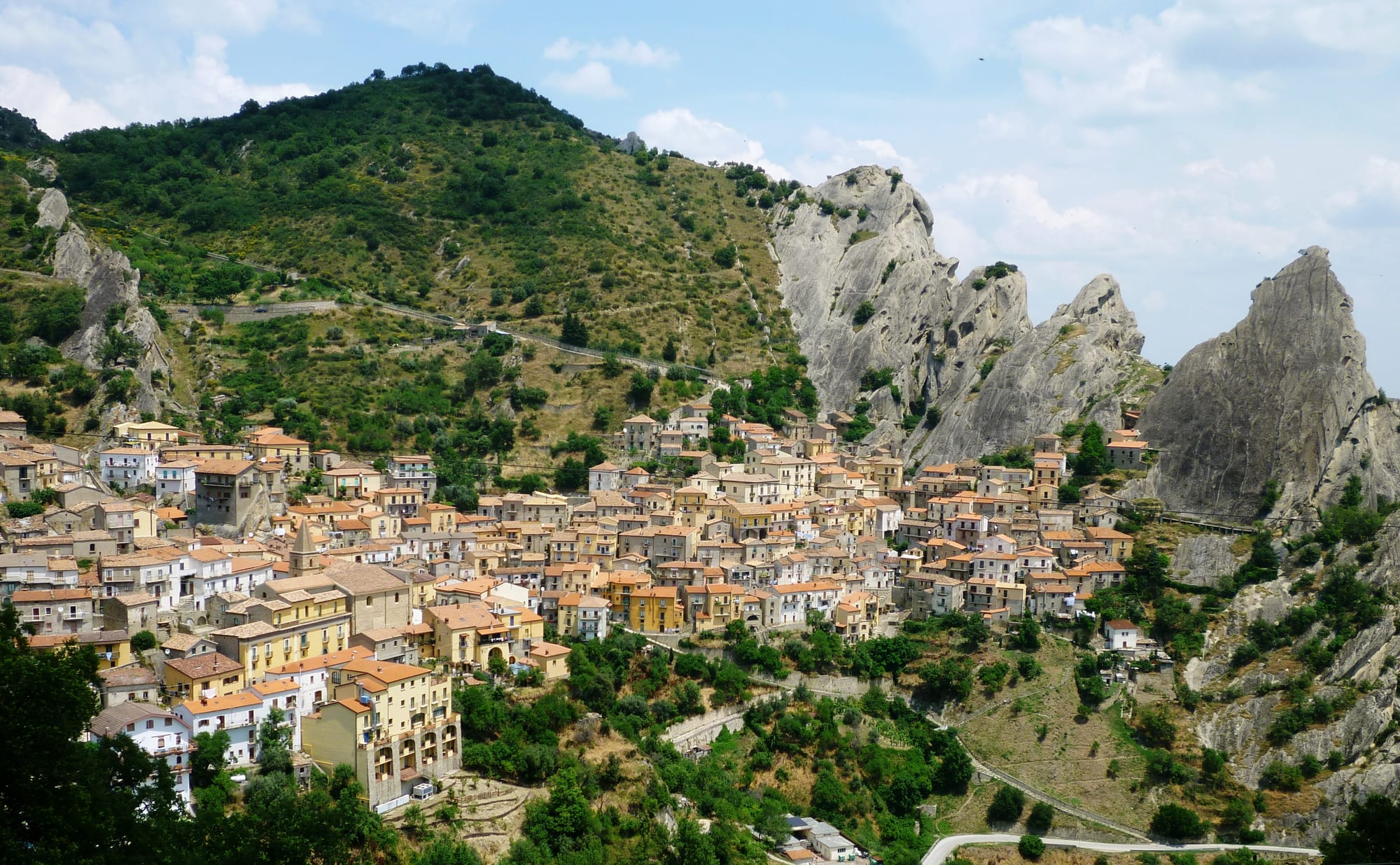
A village of ochre and cream houses spread across a green hillside beneath tall jagged grey rock pinnacles

Basilicata, Italy

Castelmezzano

Castelmezzano among the rock peaks of the Lucanian Dolomites. (Jon Shave / Wikimedia Commons · CC BY 2.0)

A small mountain village in the province of Potenza, built at about 750 metres among the sharp rock peaks of the Lucanian Dolomites above the Basento valley. Founded as a refuge from Saracen raids and named after its Norman castle, it has lost much of its population to emigration, and now draws visitors to its setting and to the zip line to Pietrapertosa.

Neighbourhoods

  • The village centre
    • First-time visitors
    • Historic district
    • Quiet and residential

    Stone houses climbing the slope below the peaks, around the mother church of Santa Maria dell'Olmo and the old chapels. Lanes and steps link the squares, and the village is small enough to cross on foot in minutes.

    Open in Maps
  • The castle rocks
    • Viewpoints
    • Walks

    Above the houses, the remains of the Norman castle walls and the steps cut into the rock that once led to its highest lookout, with views over the Basento valley and the Dolomites.

    Open in Maps

Things to do

The village

  • Chiesa madre di Santa Maria dell'Olmolandmark

    The mother church, probably begun in the early 13th century, damaged in the 1857 earthquake and rebuilt, with marble altars paid for by emigrants in the United States.

    Open in Maps
  • Cappella del Santo Sepolcrolandmark

    One of the oldest churches in the village, possibly of Byzantine origin, keeping a 14th-century wooden statue of the Madonna dell'Ascensione.

    Open in Maps
  • Norman castle remainsviewpoint

    Fragments of the walls of the castle the Normans built between the 11th and 13th centuries, with a stair cut into the rock up to the highest lookout.

    Open in Maps

Rocks, walks and the zip line

  • Volo dell'Angeloattraction

    A high-speed zip line across the valley between Castelmezzano and Pietrapertosa, opened in 2007, reaching about 120 km/h at some 400 metres above the ground.

    Open in Maps
  • Percorso delle Sette Pietretrail

    The 'Seven Stones Path', a literary walk based on Mimmo Sammartino's book Vito ballava con le streghe, with sound installations telling stories once handed down orally.

    Open in Maps
  • Lucanian Dolomitespark

    The mountain range above the Basento valley, named for its resemblance to the Dolomites, at the heart of the Gallipoli Cognato Piccole Dolomiti Lucane regional park.

    Open in Maps

Short trips from the village

  • Pietrapertosaattraction

    The neighbouring village across the valley, the far end of the zip line, with its old Arabata quarter and a Saracen fortress that gained importance under the Normans.

    Open in Maps
  • Accetturaattraction

    A village in the forests of the province of Matera, known for its Maggio, when a large oak stripped of its branches is raised in the village square with a smaller tree top attached; Castelmezzano's own tree feast resembles it.

    Open in Maps
  • Potenzaattraction

    The hilltop capital of Basilicata and the nearest city, with buses to Pietrapertosa.

    Open in Maps

Seasonal events

  • Festa della Madonna dell'AscensioneAscension Sunday, in spring

    The feast of the 14th-century statue kept in the Santo Sepolcro chapel, which legend says was found on the shore by two fishermen and asked to be carried to Castelmezzano.

  • Festa del maggioSeptember, during the feast of Saint Anthony

    The 'wedding of the trees': a turkey oak trunk felled with traditional tools is hauled to the village by pairs of oxen, joined to a holly top carried in by young men, raised and then climbed.

  • Volo dell'Angelo seasonsummer, roughly from late spring to early autumn

    The months when the zip line between Castelmezzano and Pietrapertosa operates, bringing many of the village's visitors.

Eat and drink

Long-standing places and food districts in Castelmezzano. Hours, ratings and directions come from your maps app, always current.

Village food

  • Village trattoriasneighborhood

    The few restaurants of the village serve Lucanian mountain cooking — home-made pasta, pork and lamb, peperoni cruschi.

    Open in Maps
  • Pietrapertosaneighborhood

    The neighbouring village at the other end of the zip line, with its own small restaurants serving the same cooking.

    Open in Maps

Experience Castelmezzano

History

Castelmezzano's origins are placed in the 6th or 5th century BC, when Greek settlers entered the Basento valley and founded a town called Maudoro, "world of gold". In the 10th century Saracen raids forced the people to move; legend says a shepherd named Paolino found the new site among steep rocks, from whose peaks invaders could be driven off by rolling boulders down on them.

After the Lombards, the Normans settled here between the 11th and 13th centuries and built a castle, Castrum Medianum, the "castle in the middle", from which the village takes its name; it stood between the castles of Pietrapertosa and its neighbours. The Norman period brought peace and growth, but under the Angevins the village declined, and in the 14th century it was placed first under the diocese of Potenza and then of Acerenza. Under the Aragonese it passed from lord to lord with little change, until the De Leonardis family, who held it from 1580 to 1686, brought some development; it then passed by marriage to the De Lerma, who kept it until feudalism ended in 1805.

In the 19th century the rocks and thick woods made Castelmezzano a refuge for brigands. The earthquake of 1857 damaged the mother church, and on 14 August 1860 local liberals raised the tricolour over the Annunziata chapel for Garibaldi's arrival. Late in the century mass emigration took many families overseas, and between 1961 and 2021 the population fell by more than 60 per cent.

Culture & Customs

The village's year is marked by religious feasts. On Ascension Sunday it celebrates the Madonna dell'Ascensione, a 14th-century wooden statue in the Santo Sepolcro chapel: legend says two fishermen found it on the shore and it asked to be taken to Castelmezzano. Palm Sunday begins at the chapel of San Marco, a statue of the Madonna is carried in procession on 2 July, and on the night of 15 August pilgrims set out on foot for Tolve in devotion to Saint Roch.

The most striking feast is the Festa del maggio, or "wedding of the trees", held in September during the feast of Saint Anthony and similar to the Maggio of Accettura. A long turkey oak trunk, felled with the woodcutters' traditional tools, is drawn into the village by pairs of oxen, "married" to a holly top carried in by young men, raised upright and then climbed.

Castelmezzano is one of I Borghi più belli d'Italia, received the Touring Club Italiano's orange flag in 2020, and has been praised by Budget Travel and The Telegraph. It appears in the film Un paese quasi perfetto, a television series and advertisements for the Tokyo Olympics and Ducati. The village has its own dialect.

Daily Life

About 685 people live in Castelmezzano, on a slope at about 750 metres in the central-eastern part of the province of Potenza. Its territory, with those of Pietrapertosa, Accettura, Calciano and Oliveto Lucano, makes up the Dolomiti Lucane park area, close to the Gallipoli Cognato forest; Pietrapertosa is about 10 km away by road.

Like many villages of inland Basilicata, Castelmezzano has been shaped by emigration. Families left for the Americas from the late 19th century, and emigrants in the United States paid for the marble altars of the mother church in the early 20th century. The population has fallen by more than 60 per cent since 1961.

Tourism has given the village a new role since the Volo dell'Angelo opened in 2007. In the season visitors arrive to fly across the valley, walk the Seven Stones Path and see the village among the peaks; outside it, life returns to the rhythm of a small mountain community, with its church, its squares and its feasts.

Food

Castelmezzano eats the mountain food of Basilicata, a cuisine based mainly on pork and sheep meat, legumes, cereals and vegetables, seasoned with hot peppers, powdered peppers and horseradish, which the region calls "poor man's truffle". Wild boar, mutton and lamb are popular, and lucanica and soppressata are the famous dry sausages; the Roman writer Varro traced the lucanica sausage to ancient Lucania.

Peperone crusco, a dried sweet pepper known as "the red gold of Basilicata", is eaten as a snack and in pasta con i peperoni cruschi, with dried crunchy peppers and breadcrumbs. Lagane e ceci, the "brigand's dish", is pasta with chickpeas and peeled tomatoes; rafanata is an omelette with horseradish; and ciaudedda is a stew of artichokes, potatoes, broad beans and pancetta. Acquasale is built on stale bread.

Hand-made pasta shapes of the region include strascinati, cavatelli and ferretti. Regional cheeses include canestrato di Moliterno and pecorino di Filiano, and the best-known wine is Aglianico del Vulture. The village's few restaurants serve this cooking to visitors in the zip-line season.

Planning tools

Budget

Basilicata is one of the cheapest regions of Italy, and Castelmezzano's rooms and meals are modestly priced. The main extras are a hire car, close to essential for reaching the village, and a ticket for the zip line.

Daily Budget Midrange
USD 100–200 (guesthouse or agriturismo, restaurant dinners, the zip line and a hire car)
Daily Budget Shoestring
USD 50–90 (B&B room, trattoria meals, regional buses)

Walking the village, the castle rocks and the Seven Stones Path costs nothing.

Best Time to Visit

Late spring to early autumn, when the zip line runs and the mountain paths are at their best. Summer is pleasant at this height compared with the lowlands, and September brings the tree-wedding feast. Winters are cold, with snow on the high ground.

Suggested Number of Days

The village itself can be seen in a day. Two to three days allow time for the surrounding mountains and neighbouring villages, and for the weather, which can close the zip line or the paths.

First Visit
1 day
With Surroundings
2–3 days

Transportation

The village is reached by mountain roads off the Basentana highway, which runs along the Basento valley between Potenza and Metaponto, and buses link the area with Potenza. Within the village everything is on foot, up steep lanes and steps.

Allow extra time on the winding mountain roads, and park at the edge of the village.

Airport & Station Connections

The nearest airports are Bari and Naples. By car the usual route follows the SS407 Basentana highway along the Basento valley to the Campomaggiore exit and then climbs into the mountains. Buses link the area with Potenza, the nearest city and railway hub.

Walkability

The village is small and entirely walkable, but steep: lanes and stone steps climb between the houses and up to the castle remains. Paths lead out among the rocks for those with good shoes.

Safety

Italy is generally safe, with low levels of violent crime against visitors. Castelmezzano has very little crime; the hazards are steep steps, unfenced rock edges, narrow mountain roads, and fog or snow in winter.

Wear good shoes, keep to marked paths among the rocks, and check road and weather conditions in winter. Check current official travel advice before travelling.

Climate

A mountain climate with cold winters and mild summers. In nearby Pietrapertosa, in the same range, January averages about 3.8°C and July and August about 21.5°C.

Summer
mild and pleasant — July and August average about 21.5°C in nearby Pietrapertosa
Winter
cold — January averages about 3.8°C in nearby Pietrapertosa, with snow on the high ground

Local Customs

Castelmezzano is a small, close-knit community with its own dialect, and most of its feasts are religious, with processions of statues from the chapels to the mother church. Shoulders and knees should be covered in churches.

Keep noise down in the lanes, which are lived in, and avoid photography during services and processions unless clearly welcome.

Common Payment Methods

Italy uses the euro. Cards are accepted at most accommodation and restaurants, but carry some cash for small bars and shops.