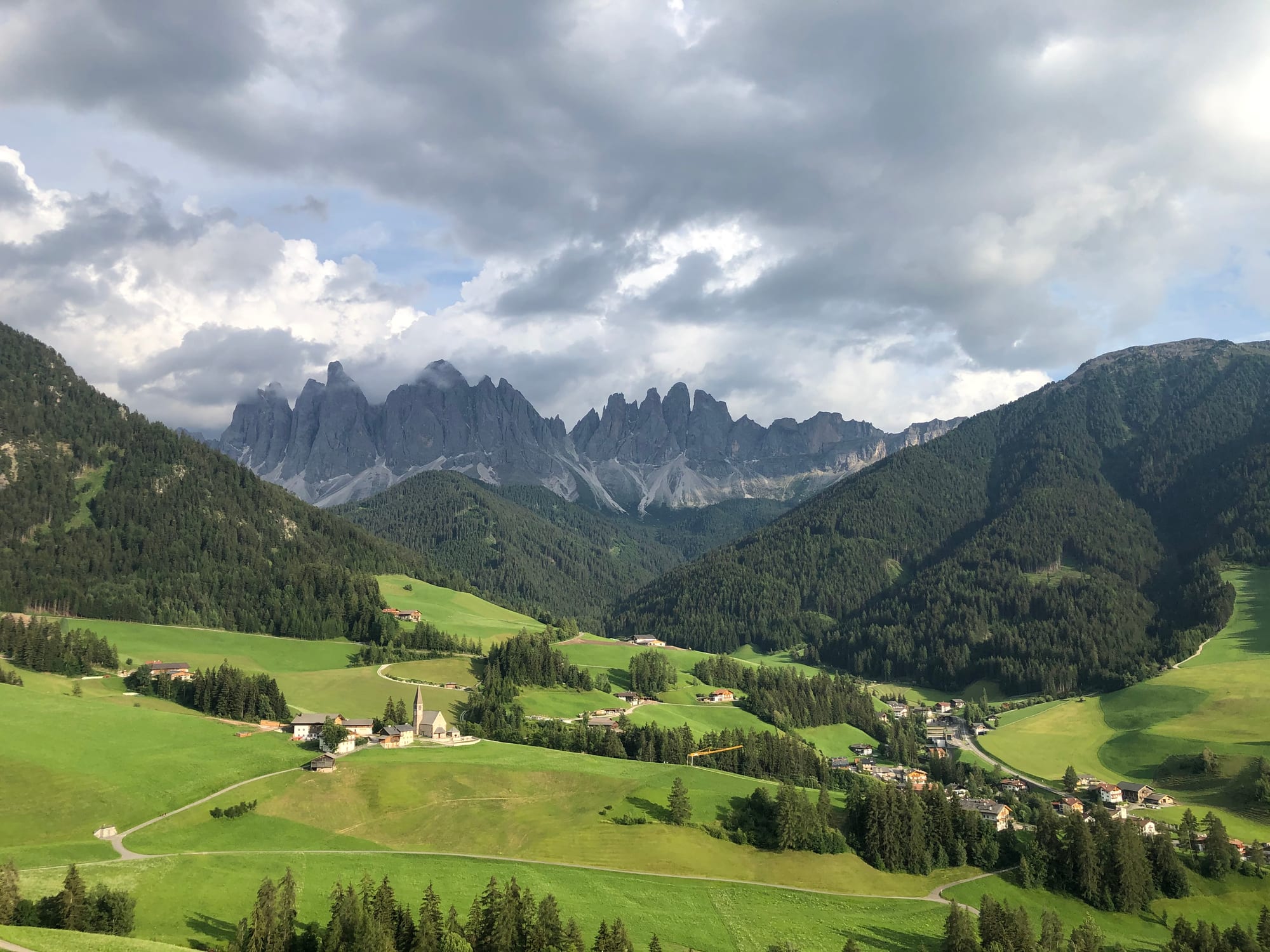
Green meadows and a village church below forested slopes and the jagged grey peaks of the Odle range under cloud

Italy

Trentino-Alto Adige / South Tyrol

Santa Maddalena in the Val di Funes, South Tyrol, beneath the Odle peaks of the Dolomites. (Einaz80 / Wikimedia Commons · CC BY-SA 4.0)

Italy's northernmost region, a mountain land of two self-governing provinces — Italian-speaking Trentino around Trento and largely German-speaking South Tyrol around Bolzano — taking in much of the Dolomites, the spa town of Merano, apple orchards and vineyards along the Adige, and the northern tip of Lake Garda.

Explore Trentino-Alto Adige / South Tyrol

History

People crossed these valleys long before history was written: Ötzi, the Iceman found in a glacier on the Austrian border in 1991, died there more than 5,000 years ago. The Raetians lived here when Rome conquered the Alps around 15 BC, and Tridentum, today's Trento, grew on the road to the Brenner Pass. After Rome came Ostrogoths, Lombards, Bavarians and Franks.

In the Middle Ages the Holy Roman Emperors gave power to the prince-bishops of Trento and Brixen, and the counts of Tyrol, named after their castle above Merano, built a state around the Brenner that passed to the Habsburgs in 1363. Trento hosted the Council of Trent from 1545 to 1563, which shaped the Catholic Counter-Reformation. In 1809 the innkeeper Andreas Hofer led a Tyrolean uprising against Bavarian and French rule and was executed in 1810.

The area was Austrian until the First World War, when the front line ran through its mountains. Italy annexed it in 1919. Fascism banned German schooling, Italianised names and brought Italian workers to Bolzano, and in 1939 German speakers were pushed to choose between emigration to the Reich and assimilation. After 1945 an Austro-Italian agreement promised autonomy; dissatisfaction led to bombings in the 1960s, and the autonomy statute of 1972 gave real self-government to the two provinces. The dispute with Austria was formally closed in 1992.

Culture & Customs

The region is two worlds. In South Tyrol most people speak German — a Bavarian-Tyrolean dialect at home — Italians are the majority in Bolzano, and Ladin, a Romance language, survives in the Val Gardena and Val Badia; road signs, schools and public jobs follow the language groups. Trentino is Italian in speech and outlook, with Ladin in the Val di Fassa and small German-derived Mòcheno and Cimbrian communities.

Tyrolean tradition is visible in costume, brass bands, the Schützen rifle companies and the churches with onion domes. The autumn custom of Törggelen, walking between farms to taste new wine, chestnuts and home-made food, is a South Tyrolean institution, and Advent brings Christmas markets and, in some villages, the Krampus runs of horned devils. The Val Gardena is known for woodcarving, and the valleys keep strong traditions of cattle drives and Alpine festivals.

Mountaineering is part of the identity: Reinhold Messner, from the Val di Funes, is a local hero, and Trento hosts a long-running mountain film festival. Catholicism is observed more strongly than in much of Italy, and South Tyroleans value tidiness, punctuality and a certain distance from Rome.

Daily Life

About 1.1 million people live in the region, split almost equally between the two provinces. Trento has around 120,000 residents and Bolzano about 107,000; Merano, Rovereto, Bressanone and Brunico are the other main towns, and many people live in villages and scattered farms.

Autonomy lets both provinces keep most of their taxes, and the region is one of Italy's wealthiest, with very low unemployment. Tourism, summer and winter, is the biggest earner; the Adige and Val di Non orchards grow a large share of Italy's apples; and vineyards cover the valley slopes. Transport, energy from hydroelectric dams, the University of Trento and research institutes add skilled jobs.

Life is orderly and outdoor: weekends are spent walking or skiing, and farm-stays and family hotels are the rural backbone. Current issues include overtourism on famous viewpoints and passes, heavy lorry traffic on the Brenner route while the Brenner Base Tunnel is built, housing costs, bears and wolves returning to the valleys, and the shrinking glaciers.

Food

The kitchen mixes Austrian and Italian traditions. South Tyrol's staples are Speck, a smoked, cured ham with protected status; Knödel, bread dumplings flavoured with speck, cheese or spinach, called canederli in Italian; Schlutzkrapfen, half-moon pasta filled with spinach and curd cheese; and goulash with polenta. Sweets are Viennese in spirit: apple strudel, Kaiserschmarrn, torn pancake with fruit compote, and Krapfen doughnuts. Trentino adds polenta with mushrooms or cheese, strangolapreti, spinach and bread gnocchi, and freshwater fish from its lakes.

Apples from the Val di Non and the Adige valley appear everywhere, in strudel, juice and schnapps. Cheeses include Puzzone di Moena, a pungent washed-rind cheese from the Val di Fassa, Trentingrana and the South Tyrolean Graukäse, a sharp sour-milk cheese.

The wines are some of Italy's most distinctive. South Tyrol makes aromatic whites such as Gewürztraminer, which takes its name from the village of Tramin, Pinot Bianco and Sauvignon, and reds from the local Lagrein and Schiava grapes. Trentino is known for Trentodoc, a bottle-fermented sparkling wine, and for the reds Teroldego Rotaliano and Marzemino, while grappa is distilled throughout the region.

Attractions & Natural Wonders

The Dolomites, a UNESCO World Heritage Site, are the region's glory. In South Tyrol the Val Gardena, with Ortisei, leads to the Seiser Alm, a vast high pasture below the Sassolungo, and to the Sella massif and its Sella Ronda ski circuit; the Val di Funes has the chapel of St Johann in Ranui and the church of Santa Maddalena beneath the Odle peaks; and the Val Badia, Lago di Braies and Lago di Carezza under the Latemar are further favourites. In Trentino the Val di Fassa sits below the Catinaccio, the Brenta Dolomites rise above Madonna di Campiglio and Lake Molveno, and San Martino di Castrozza lies below the Pale di San Martino.

Bolzano has its arcaded Laubengasse, Walther Square, the frescoed Runkelstein Castle and the South Tyrol Museum of Archaeology, home of Ötzi. Merano offers riverside promenades, thermal baths and the gardens of Trauttmansdorff Castle, with Tyrol Castle above the town; Bressanone has a cathedral and bishops' palace, and the Val Venosta leads to the Stelvio National Park.

Trento's Piazza del Duomo, the Castello del Buonconsiglio and the MUSE science museum anchor the south, with Rovereto's MART modern art museum nearby. At the northern tip of Lake Garda, Riva del Garda, Torbole and Arco sit below steep cliffs, a centre for sailing, windsurfing and climbing.

Cities in Trentino-Alto Adige / South Tyrol

Planning basics

Budget

Prices are above the Italian average, especially in the Dolomite resorts in the ski season and in August, when the Val Gardena, the Val Badia and Madonna di Campiglio are at their most expensive. Trento, Rovereto and the valley towns cost less, and farm-stays with breakfast are good value. Many hotels offer half-board, and a guest card often includes local public transport.

Daily Budget Midrange
USD 170–340 (half-board hotel, cable cars or a ski pass, restaurant dinners)
Daily Budget Shoestring
USD 80–130 (hostel or farm-stay, mountain-hut lunches, regional buses and trains)

Ask the accommodation for the local guest card, which often covers buses and regional trains; book mountain huts ahead for summer treks.

Safety

Crime is very low. The dangers are mountain ones: sudden storms and lightning, rockfall, exposed via ferrata routes, avalanches off-piste, and icy roads in winter. Brown bears have been reintroduced in western Trentino, and a runner was killed by a bear in 2023.

Check weather and avalanche bulletins, use proper gear on via ferrata routes, and follow local guidance in bear areas. Check current official travel advice before travelling.

Climate

A sheltered inner-Alpine climate. The Adige valley around Bolzano and Trento has hot summers and cold, dry winters, while Merano and the Lake Garda tip are mild enough for palms and olives. The Dolomite valleys are cool in summer and snowy from December to April.

Summer
hot in the valleys, 28–34°C in Bolzano and Trento; 15–25°C in the high valleys, with afternoon storms
Winter
cold and sunny, around -2 to 7°C in the valleys, well below freezing in the resorts, with good snow

Transportation

The Brenner railway along the Adige links Verona, Rovereto, Trento and Bolzano with Innsbruck and Munich, and branch lines run to Merano and the Val Venosta. Buses reach the Dolomite valleys, though service thins out of season. The A22 motorway follows the same corridor. The nearest large airports are Verona, Innsbruck, Venice and Munich.

Buses and lifts cover most hiking bases; drivers should expect summer queues and access restrictions on popular passes and at Lago di Braies.

Best Time to Visit

Mid-June to September for hiking, when the lifts and huts are open; mid-September to October for larch colours, the grape and apple harvest and Törggelen tastings. December to March is ski season, and Advent brings Christmas markets to Bolzano, Merano, Bressanone and Trento. Spring suits Merano and Riva del Garda.