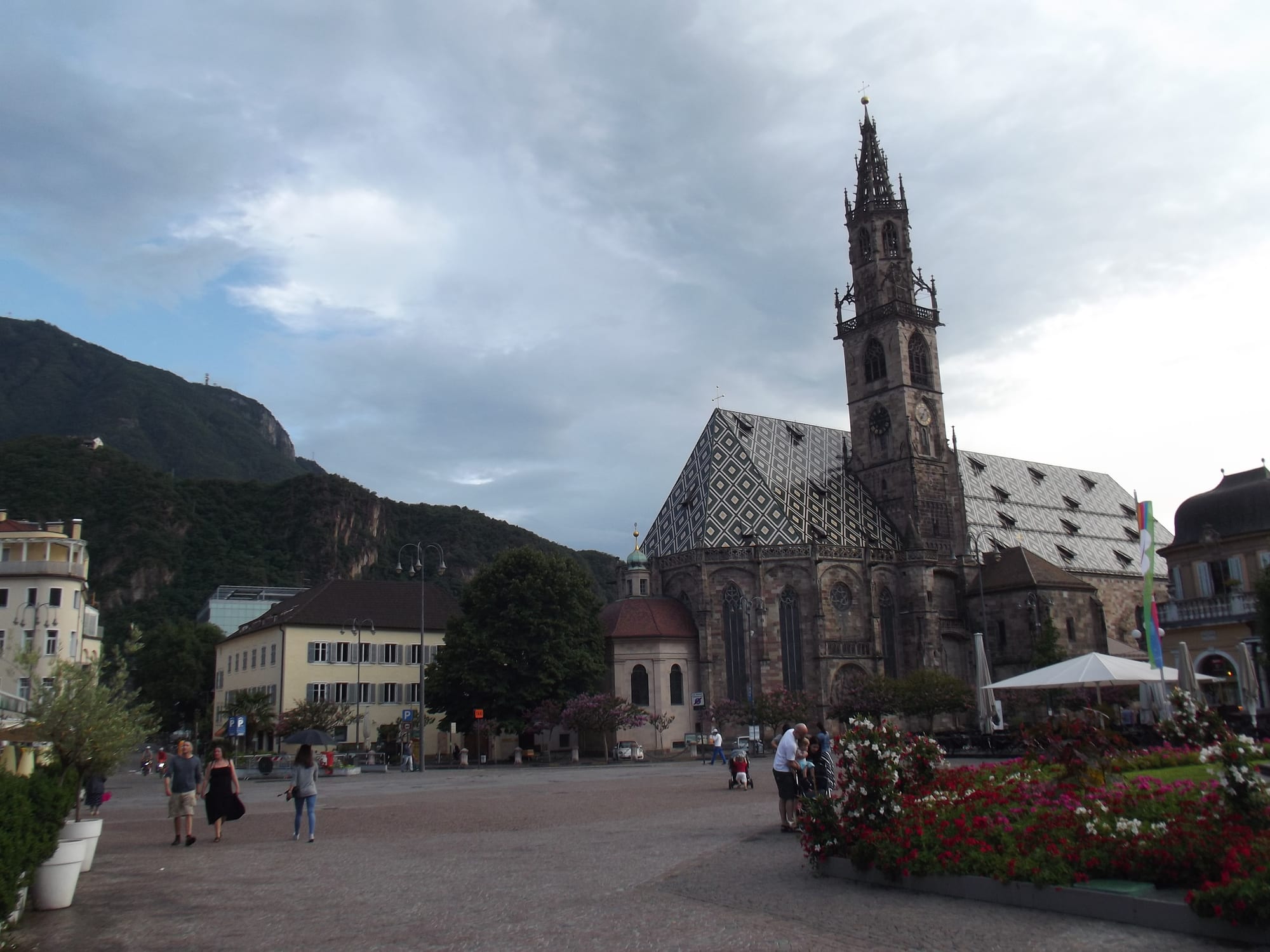
Bolzano's Gothic cathedral with its patterned tiled roof and spire beside Walther Square, below steep wooded mountains

Trentino-Alto Adige / South Tyrol, Italy

Bolzano

Bolzano Cathedral and Walther Square, with the mountains rising behind the city. (Smiley.toerist / Wikimedia Commons · CC BY-SA 4.0)

The capital of South Tyrol, in a basin where three Alpine valleys meet below vineyard slopes and the first ridges of the Dolomites. Founded as a market town on the Brenner trade route and Austrian until 1919, it is officially bilingual, three-quarters Italian-speaking, and known for its arcaded old town, its Christmas market and Ötzi the Iceman.

Neighbourhoods

  • Old town
    • First-time visitors
    • Historic district
    • Best for food

    The historic centre in the triangle between the Talfer, the Eisack and the hills, around Walther Square, the cathedral and the fruit market. The Laubengasse, a 300-metre street with medieval arcades along its whole length, is lined with shops, and most museums, theatres and restaurants are close by.

    Open in Maps
  • Gries
    • Quiet and residential
    • Parks
    • Wine

    A separate health resort under the Habsburgs, incorporated into Bolzano in 1925, west of the Talfer. The Baroque abbey church of Muri-Gries, the old parish church, the Guncina promenade and vineyards on the slopes give it a calmer, villa-town feel.

    Open in Maps
  • St Magdalena and Rentsch
    • Wine
    • Walks

    The hill vineyards east of the centre that give their name to St Magdalener red wine, above the small district centre of Rentsch, part of the old Zwölfmalgreien area absorbed into the city in 1911.

    Open in Maps
  • West Bolzano
    • Local life
    • Close to public transport

    The city beyond the Talfer built largely between the wars and after, including Europa-Neustift and Don Bosco. The Victory Monument, now home to an exhibition on Fascism and Nazism, stands at its edge, and the Saturday market fills Victory Square.

    Open in Maps

Things to do

Museums

  • South Tyrol Museum of Archaeologymuseum

    The home of Ötzi, the preserved Iceman found in the Ötztal Alps in 1991, shown with original finds, models and reconstructions of the early history of the southern Alps.

    Open in Maps
  • Museionmuseum

    The museum of modern and contemporary art, founded in 1985, in a glass-fronted building opened in 2008 on the Talfer meadows in the centre.

    Open in Maps
  • Victory Monument and BZ '18–'45museum

    A triumphal arch erected on Mussolini's orders in 1928, long a focus of tension between the language groups; since 2014 an exhibition beneath it, 'one monument, one city, two dictatorships', documents Fascism and Nazism in South Tyrol.

    Open in Maps

Churches and castles

  • Bolzano Cathedrallandmark

    The Gothic cathedral, rebuilt from around 1300 in place of a Romanesque parish church consecrated in 1180 and completed in 1519, standing on the remains of a 6th-century early Christian basilica.

    Open in Maps
  • Dominican Churchlandmark

    One of the earliest Gothic churches in Tyrol, completed in 1272, with medieval frescoes and Guercino's altarpiece The Vision of Soriano.

    Open in Maps
  • Franciscan Friarylandmark

    A friary founded in 1221, whose church and cloister hold important frescoes and other works of art.

    Open in Maps
  • Runkelstein Castlelandmark

    A castle on a rocky spur just north of the city, begun in 1237 by the lords of Wangen and known for its extensive cycle of medieval secular frescoes.

    Open in Maps
  • Sigmundskron Castlemuseum

    A castle ruin on the south-western edge of the city that houses MMM Firmian, the main museum of Reinhold Messner's project on mountains and mountaineering.

    Open in Maps

Walks, parks and lifts

  • Talfer meadowspark

    The green lung of the city, meadows and promenades along both banks of the Talfer river, busy in summer and walked even in the cold of winter.

    Open in Maps
  • Ritten cable car and plateauviewpoint

    A cable car, since 2009 Italy's first tricable gondola lift, climbs from the centre to Oberbozen on the Ritten plateau, where the narrow-gauge Ritten railway runs on to Klobenstein.

    Open in Maps

Short trips from the city

  • Meranoattraction

    A spa town since the 19th century, when it was part of the Austro-Hungarian Empire, known for its riverside promenades and reached by the branch railway from Bolzano.

    Open in Maps
  • Seiser Almpark

    A Dolomite plateau and the largest high-altitude Alpine meadow in Europe, a major destination for skiing and hiking.

    Open in Maps
  • Karerseeviewpoint

    A small Dolomite lake known for its colours and its view of the Latemar range.

    Open in Maps

Seasonal events

  • Bolzano Christmas Marketlate November to 6 January

    Founded in 1990 as Italy's first Christmas market and the most visited in the country, with a second market near Walther Square and smaller craft and Advent markets elsewhere in the old town.

  • Südtirol Jazzfestivalsummer

    A festival of up to ten days with around 90 concerts in Bolzano and across South Tyrol.

  • Bolzano Festival and Bolzano Danzasummer

    Summer seasons of classical music, with the European Union Youth Orchestra and the Gustav Mahler Jugendorchester among regular performers, and of international contemporary dance across the city.

  • BOclassicNew Year's Eve

    A road race through the city, first held in 1975, with elite men's 10 km and women's 5 km races, broadcast live on Italian television.

Eat and drink

Long-standing places and food districts in Bolzano. Hours, ratings and directions come from your maps app, always current.

Bolzano classics

  • Fruit marketmarket

    One of the oldest squares in the city, which still holds the fruit market as it did in the past, with restaurants around it.

    Open in Maps
  • Tyrolean inns of the old townneighborhood

    Restaurants and inns around the Laubengasse and the fruit market serving speck, Knödel dumplings, Schlutzkrapfen, Herrengröstl and Kaiserschmarrn alongside Italian dishes.

    Open in Maps

Markets, wine and beer

  • Saturday marketmarket

    A weekly market held every Saturday on Victory Square and the surrounding streets.

    Open in Maps
  • Wine cellars of St Magdalena and Griesneighborhood

    Bolzano is on the South Tyrolean Wine Road; its classic wines are Lagrein, St Magdalener, Pinot Bianco and Gewürztraminer, grown on the slopes around the city.

    Open in Maps

Experience Bolzano

History

In antiquity the marshy basin was home to the Raetian Isarci. Rome conquered the area in 15 BC under Drusus, whose military post, Pons Drusi, takes its name from him, and a Roman cemetery holds the tomb of Secundus Regontius, the oldest known inhabitant. Bavarians settled from the 7th century, and in 1027 the emperor Conrad II gave the area to the bishops of Trento. In the late 12th century the bishop founded a market town along the Laubengasse, and Bolzano grew as a trading post on the Augsburg–Venice route over the Brenner Pass.

Meinhard II, Count of Tyrol, took the town in 1277, and with Tyrol it passed to the Habsburgs in 1363. Citizens won a town council in 1381, and from the 14th and 15th centuries four great fairs a year drew merchants from north and south; in 1635 Claudia de' Medici founded the Mercantile Magistrate, staffed by two Italian and two German officers each season. After a brief Napoleonic interlude Bolzano returned to Austria, and it grew quickly before 1914.

Italy annexed South Tyrol after the First World War. In 1922 Fascists removed the German-speaking mayor, Julius Perathoner, and Mussolini's Italianisation brought industry and workers from other regions to new districts west of the Talfer, banned the very word Tyrol, and in 1939 pushed German speakers to choose between emigration and assimilation. During the Second World War the Nazis ran a transit camp in the city. The autonomy statute of 1972 gave the province wide self-government, Austria and Italy closed their dispute in 1992, and in 2023 Bolzano became a UNESCO City of Music.

Culture & Customs

Bolzano sits where German- and Italian-speaking cultures meet. In the 2024 census about three-quarters of residents declared Italian as their first language, a quarter German and a small number Ladin; the city is officially bilingual, and many people speak more than one language. The legacy is visible everywhere, from the statue of the medieval poet Walther von der Vogelweide in the main square to the Fascist-era Victory Monument and Casa del Fascio, both now presented in their historical context.

Music is central to city life. The Haydn Orchestra of Bolzano and Trento is based at the concert hall, which also hosts the biennial Ferruccio Busoni International Piano Competition, founded in 1949; the conservatory is housed in the Dominican monastery, and summer brings the Bolzano Festival, Bolzano Danza and the Südtirol Jazzfestival. The Christmas market, founded in 1990 as Italy's first, draws visitors from across the country, and in the German-speaking tradition children dressed as the Three Kings go from house to house singing before 6 January.

Mountaineering is part of the identity — Reinhold Messner's main museum is at Sigmundskron Castle — and sport is followed keenly: HC Bolzano play ice hockey in the international ICE Hockey League, FC Südtirol play football in Serie B, and the BOclassic road race is run on New Year's Eve. Nightlife on Friday and Saturday draws young people from neighbouring Trentino.

Daily Life

106,107 people lived in the city at the end of 2022 and around 250,000 in the greater metropolitan area, making Bolzano the largest city in South Tyrol. Foreign nationals were about 15 per cent of residents at the end of 2022, the largest groups from Albania, Morocco, Pakistan and Romania. Italian speakers live in every district, though they are a minority in the historic centre, Rentsch and Gries.

The economy combines high-quality farming — wine, fruit and dairy — with tourism, crafts in wood and ceramics, advanced services and the trade fairs of Exhibition Bolzano. The heavy industry built in the 1930s has mostly gone, and the provincial government, which keeps almost 90 per cent of the taxes raised in South Tyrol, is a major employer. The Free University teaches in Italian, German and English, and the Italian Army's Alpine command is based here.

Life is orderly and often outdoors. About 30 per cent of journeys are made by bicycle, cable cars carry commuters as well as walkers up to the Ritten, and weekends are spent in the mountains. In 2020 Bolzano was ranked jointly first among Italian cities for quality of life, though fine-particle pollution still exceeds WHO guidelines. Municipal elections were held in 2025.

Food

Bolzano's kitchen mixes Tyrolean and Italian traditions. Speck Alto Adige, a dry-cured, lightly smoked ham with protected status, is the signature product; unlike prosciutto, it is smoked. Knödel, bread dumplings with speck or other ingredients, and Schlutzkrapfen, dumplings filled with spinach or other ingredients, are classic dishes, and Herrengröstl, a pan-fry of potatoes, beef, onions and speck, and goulash are common in the inns.

Sweets are Viennese in spirit: apple strudel and Kaiserschmarrn, a sweet omelette with raisins and sugar, appear on most menus, and at Christmas bakeries sell Bozner Zelten and Christstollen. Breads, pastries and apples from the Adige valley are everywhere, and the old town's fruit market still sells fresh produce.

Wine is grown on the slopes around the city, which lies on the South Tyrolean Wine Road. Lagrein, a red grape native to South Tyrol's valleys and recorded in the 17th century at the Muri abbey in Gries, and St Magdalener from the hills east of the centre are the local reds, with Pinot Bianco and Gewürztraminer the classic whites. In autumn, Törggelen — visiting farm taverns to taste the new wine with roast chestnuts and farmhouse dishes — is a South Tyrolean custom.

Planning tools

Budget

Prices are above the Italian average, and accommodation across the region fills up during the Christmas market, when rooms should be booked well ahead. The city is cheaper than the Dolomite resorts and makes a practical base for them. Guests staying three or more nights receive a guest pass with a guided city tour and museum discounts.

Daily Budget Midrange
USD 170–330 (mid-range hotel, restaurant dinners, museum tickets, cable cars)
Daily Budget Shoestring
USD 80–130 (hostel or simple guesthouse, bakery and market lunches, buses and regional trains)

Ask the accommodation about the guest pass, and book months ahead for the Christmas market period.

Best Time to Visit

Late spring and September to October are the most comfortable, with the grape and apple harvest and Törggelen in autumn. July and August are hot in the valley but ideal for day trips to the mountains. Late November to early January brings the Christmas market, and winter days are often sunny though cold, with the ski areas within reach.

Suggested Number of Days

Two days are enough for the old town and its museums and castles. Four to six allow the mountains and the wine country around the city to be added; in summer and winter many visitors use Bolzano as a base for longer stays in the region.

First Visit
2 days
With Surroundings
4–6 days

Transportation

The centre is compact and largely pedestrian, and Bolzano is a cycling city, with a 50 km network of cycle paths and about 30 per cent of journeys made by bike. City buses cover the districts, and cable cars climb from the edge of the centre to the Ritten plateau, Jenesien and Kohlern.

The A22 motorway can be congested during the Christmas market and the ski season; trains and buses are often easier.

Airport & Station Connections

Bolzano station, on the Brenner railway between Verona and Innsbruck, has Frecciarossa, Frecciargento and Italo high-speed trains and Austrian EuroCity services towards Munich, plus branch lines to Merano and Mals. Trento is 58 km south and Innsbruck 118 km north. Bolzano's small regional airport is the base of the airline Sky Alps; the larger airports of Verona, Innsbruck, Venice and Munich are further away.

Walkability

The old town is flat, compact and easy on foot, with the Laubengasse, Walther Square and the fruit market a few minutes apart, and riverside promenades lead to Gries. Signs are in Italian and German. Getting up to the hill districts and castles means a climb, a bus or a cable car.

Safety

Italy is generally safe, with low levels of violent crime against visitors. Bolzano is a calm, orderly city; the main risks are crowds at the Christmas market and, on trips out, the mountain hazards of storms, rockfall and icy roads.

Watch bags in the Christmas market crowds, and check weather forecasts before heading into the mountains. Check current official travel advice before travelling.

Climate

A sheltered valley climate, hot in summer and cold in winter by Italian standards, with an average temperature of about 13°C. The low altitude and the mountains to the north make it much warmer than valley cities on the far side of the Alps; rainfall is moderate, and air pollution can build up in still weather.

Summer
hot — average daytime highs of 28–31°C in summer
Winter
cold — average night-time lows of −1 to −3°C in the winter months

Local Customs

Bolzano is bilingual: street names, signs and public offices use Italian and German, and greeting in either language is welcome. Coffee habits are Italian, while inns, food and festivals are often Tyrolean.

Use the bilingual place names without taking sides, cover shoulders and knees in churches, and visit the Victory Monument and its exhibition with respect for its contested history.

Common Payment Methods

The currency is the euro. Cards are accepted almost everywhere, but a little cash is useful for market stalls, mountain huts and small inns. A per-night tourist tax may be collected by accommodation.