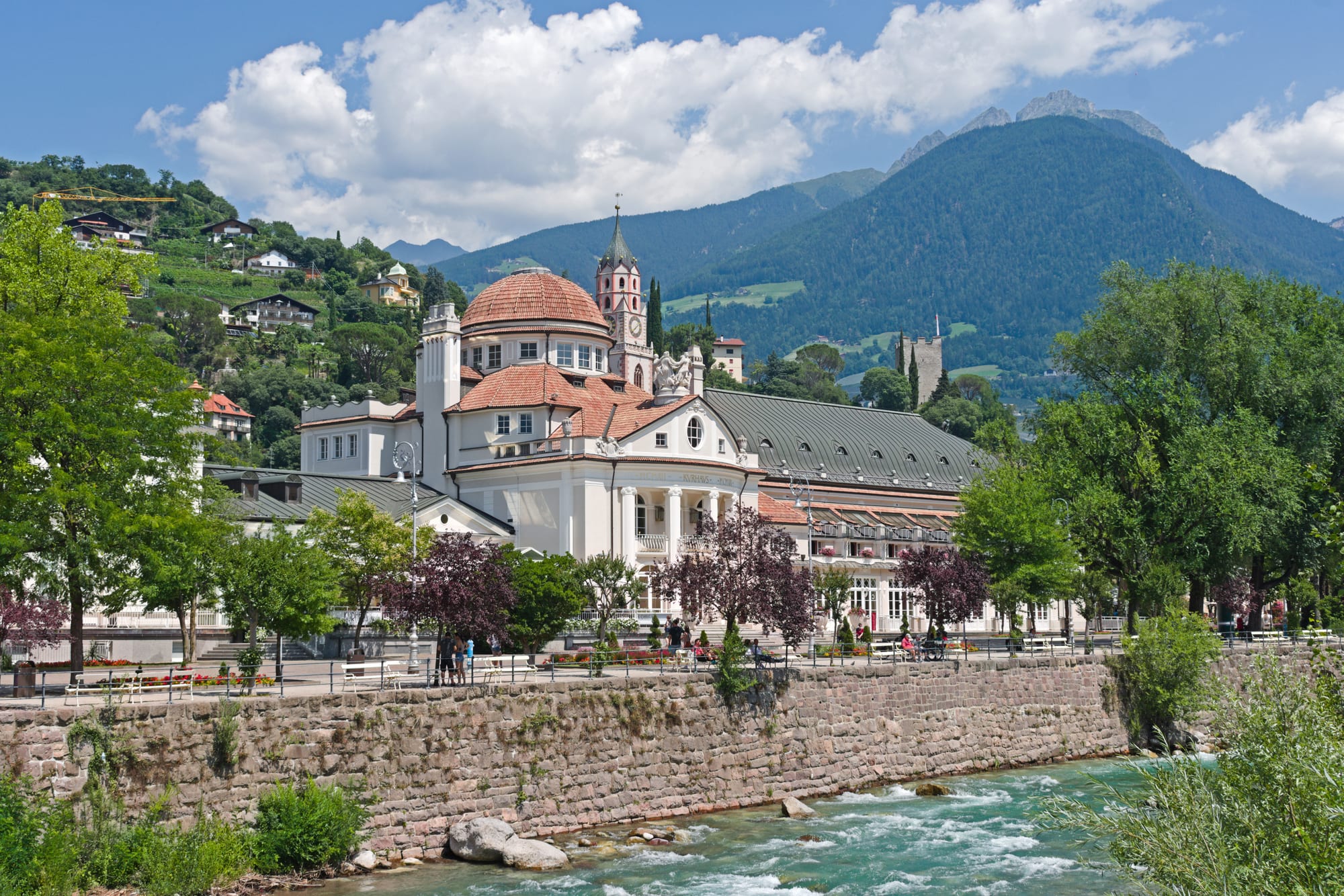
The domed white Kurhaus beside the fast green Passer river, with a church tower, vineyard slopes and mountains behind

Trentino-Alto Adige / South Tyrol, Italy

Merano

The Kurhaus on the Passer in Merano, with the tower of St Nicholas' Church and the Pulverturm behind. (Ymblanter / Wikimedia Commons · CC BY-SA 4.0)

South Tyrol's second city, in a mountain-ringed basin where the Passeier Valley and the Vinschgau meet. Once the capital of the County of Tyrol, it became a celebrated Habsburg spa in the 19th century. Today it is a bilingual town of about 41,700 people, known for river promenades, a thermal spa, vineyards and the gardens of Trauttmansdorff Castle.

Neighbourhoods

  • Old town and the Laubengasse
    • First-time visitors
    • Historic district
    • Shopping

    The medieval core inside the old gates, built around the long arcaded Laubengasse, which ends at St Nicholas' Church. The Princely Castle, the Kurhaus, the theatre and the river promenades are all a few minutes' walk away, as is the main railway station.

    Open in Maps
  • Steinach
    • Historic district
    • Quiet and residential

    A district beside the historic centre on the Passer, linked to Obermais by the 17th-century Steinerner Steg stone bridge.

    Open in Maps
  • Obermais
    • Villas and gardens
    • Quiet and residential

    The residential district across the Passer, with villas and gardens. The Villa Freischütz museum shows an upper-middle-class interior, and Trauttmansdorff Castle and its gardens lie outside the town to the south.

    Open in Maps
  • Untermais
    • Local life
    • Sport

    The flatter southern district, with the racecourse, sports grounds, everyday shops and a second railway station, home to many of the town's residents.

    Open in Maps

Things to do

Spa town landmarks

  • Kurhauslandmark

    The town's symbol, an ornate spa hall of 1874 enlarged in 1912–14 with the grand Kursaal and a rotunda, used for concerts, conferences and the annual wine festival.

    Open in Maps
  • Passer promenadestrail

    The riverside walks along the Passer through the centre, with the arched Wandelhalle and concerts on the promenade almost daily in summer.

    Open in Maps
  • Tappeiner Walktrail

    A path laid out by the spa doctor Franz Tappeiner and given to the town in 1892, winding along the slopes of the hill above the town to the Gilf ravine on the Passer.

    Open in Maps
  • Thermal spaattraction

    The spa centre on the far bank of the Passer, open all year, with an indoor pool filled with thermal water and a wide range of treatments.

    Open in Maps
  • Stadttheater Meranlandmark

    The civic theatre built in the spa years to designs by the Munich architect Martin Dülfer, renamed after Giacomo Puccini, who visited the town in 1923.

    Open in Maps

Churches, bridges and castles in town

  • St Nicholas' Churchlandmark

    The Gothic parish church at the end of the Laubengasse, with stained glass, a large rose window and a tall clock tower with a sundial.

    Open in Maps
  • St Barbara's Chapellandmark

    An octagonal chapel of 1450 behind St Nicholas', for centuries the town's burial chapel, with an ossuary below and a Gothic altar.

    Open in Maps
  • Steinerner Steglandmark

    The oldest bridge in town, a two-arched stone footbridge over the Passer built in the early 17th century to replace a wooden aqueduct.

    Open in Maps
  • Princely Castlelandmark

    A 15th-century residence of Sigismund, Archduke of Austria, in the old town.

    Open in Maps
  • Pferderennplatz Meranattraction

    One of Italy's leading racecourses, on a new site built in 1935, home to the Gran Premio Merano steeplechase each September.

    Open in Maps

Gardens and castles around the town

  • Trauttmansdorff Castle and Gardenspark

    A castle south of the town, rebuilt in 1846, now home to the Touriseum museum of tourism and surrounded since 2001 by botanical gardens.

    Open in Maps
  • Tyrol Castlemuseum

    The ancestral seat of the Counts of Tyrol, above the town in the village of Tirol, which gave its name to the whole Tyrol region.

    Open in Maps
  • Tirolattraction

    The village on the slopes above Merano below Tyrol Castle.

    Open in Maps
  • Schennaattraction

    A village in the Passeier Valley bordering Merano, with a medieval castle.

    Open in Maps

Short trips from the town

  • Vinschgau Railwaytransit hub

    The 60-kilometre railway from Merano west to Mals through the Vinschgau, the upper valley of the Adige.

    Open in Maps

Seasonal events

  • Gran Premio MeranoSeptember

    Italy's most prestigious steeplechase, first run in 1935, drawing around 13,000 people to the racecourse.

  • Merano WineFestivalfirst half of November

    A five-day international wine and food fair held every year since 1992, at the Kurhaus since 1993, and one of the main events of its kind in Italy.

  • Christmas marketChristmas season

    Merano's Christmas market, one of the Christmas markets of South Tyrol.

Eat and drink

Long-standing places and food districts in Merano. Hours, ratings and directions come from your maps app, always current.

Merano classics

  • Wine from the town's own slopesneighborhood

    Vineyards reach right into the town; the local Meraner Leiten is a light red wine, best drunk young.

    Open in Maps
  • Laubengasse cafés and restaurantsneighborhood

    The arcaded main street of the old town and its side lanes hold cafés, pastry shops and restaurants serving South Tyrolean and Italian cooking.

    Open in Maps
  • Forst beerrestaurant

    The brewery founded in 1857 on the edge of the town, in Forst near Algund, whose beers are sold throughout Italy and Europe.

    Open in Maps

Experience Merano

History

People have lived in the basin since the third millennium BC, as menhirs and other finds show. The town's story began in 15 BC, when the Romans occupied the Adige valley and set up a road station, Statio Maiensis; the settlement was first recorded as Mairania in 857. In the 13th century the counts of Tyrol, from their castle on the hill above, raised Merano to the status of a town and made it the capital of their county.

After the county passed to the Habsburgs in 1363, Duke Friedrich IV moved the court to Innsbruck in 1420, and the mint followed to Hall in 1477. Merano stayed the official capital until 1848 but lost most of its importance. During the Tyrolean Rebellion of 1809 a peasant army won a victory over French and Bavarian forces on the Küchelberg above the town before the revolt was crushed.

The 19th century remade the town. Its mild climate turned it into a renowned spa of the Austro-Hungarian Empire, especially after Empress Elisabeth began to visit, and the Kurhaus, the theatre, the promenades and the racecourse were built for the guests, who included Franz Kafka. After the First World War the town passed to Italy, and the Fascist authorities built a new town hall in the 1920s. During the Nazi occupation of 1943–45 Merano's Jewish population was almost entirely deported and murdered. Since then the town has grown into the second city of South Tyrol and a centre of tourism once more.

Culture & Customs

Merano blends Austrian and Italian heritage more evenly than almost anywhere in South Tyrol: since 2024 a slim majority of residents speak Italian as their first language, with German close behind and a tiny Ladin minority. The spa years still set the tone, with summer concerts on the promenade almost every day, the Kurhaus as the town's great hall and the Meraner Musikwochen, a music festival held since 1986.

The calendar mixes the elegant and the local. The Gran Premio Merano each September is Italy's best-known steeplechase, and the Merano WineFestival, held at the Kurhaus every November since 1993, is one of Italy's leading wine and food fairs. The Asfaltart street-art festival and the Christmas market also return every year, and every second year the town hosts the Merano Poetry Prize.

Chess has a special place: the Meran Variation of the Semi-Slav Defence is named after a game played at a tournament here in 1924, and in 1981 the town hosted the World Championship match between Anatoly Karpov and Viktor Korchnoi, later the setting for the first act of the musical Chess. The town has also hosted canoe slalom world championships on the Passer, and its handball club won the national title in 2005.

Daily Life

About 41,700 people lived in Merano at the end of 2025, roughly half German- and half Italian-speaking, making it the second-largest city in South Tyrol after Bolzano. The town spreads across the basin from the old centre to residential Obermais and Untermais, while villages such as Tirol, Schenna and Algund climb the slopes around it.

Tourism is the main business, especially with German and Italian visitors, and spa hotels and guesthouses shape the economy. Vineyards reach into the town itself, extensive apple orchards fill the valley floor, and the apples are exported throughout Europe. The Forst brewery on the edge of town is one of the best-known local firms.

The pace is unhurried. Residents walk the promenades, meet in the cafés of the Laubengasse and head for the hills above the town at weekends, to the Meran 2000 area for walking in summer and skiing in winter. Public transport links the town with Bolzano and the Vinschgau, and in 2019 Merano tested Italy's first self-driving electric bus.

Food

Merano eats as South Tyrol does, where the Tyrolean and Italian kitchens meet, and its cafés and restaurants serve both. Menus in the old town lean on Knödel dumplings, Schlutzkrapfen — half-moon pasta filled with cheese, spinach or mushrooms — and Speck Alto Adige, a dry-cured, lightly smoked ham with protected status, alongside pizza and pasta. Kaiserschmarrn, a shredded sweet pancake, is a favourite dessert.

Wine matters more here than in most towns. Vineyards come right into the town, and the local Meraner Leiten, or Meranese di collina, is a light red wine best drunk young. Every November the Merano WineFestival brings producers from across Italy and abroad to the Kurhaus for five days of tastings, and food producers join them.

Apples from the extensive orchards around the town turn up in strudel, juice and on market stalls, and beer has a strong local tradition: the Forst brewery, founded in 1857 by two entrepreneurs from Merano, produces a popular range of beers sold throughout Italy and Europe.

Planning tools

Budget

Merano is a comfortable, fairly expensive spa town, though cheaper than the big Dolomite resorts. Spa hotels with half-board and the thermal baths are the main costs; walking, the promenades and the gardens around the old town cost little. Rooms fill up during the wine festival and the Christmas market.

Daily Budget Midrange
USD 170–320 (spa or mid-range hotel, restaurant dinners, the thermal baths or a garden ticket)
Daily Budget Shoestring
USD 80–130 (hostel or guesthouse, bakery and market lunches, regional buses and trains)

A MobilCard covers all public transport in South Tyrol for three or seven days.

Best Time to Visit

Spring and autumn suit Merano best: the basin is mild, the gardens are in flower in spring, and autumn brings the grape and apple harvest, the September steeplechase and the November wine festival. Summer days are warm to hot, and the Christmas season brings the Christmas market. Winters are sunny and mild by day, with skiing above the town.

Suggested Number of Days

Two or three days are enough for the town, its gardens and a spa visit. With the valleys, castles and walking trails around the basin, four to six days make sense; many visitors come for a week of spa and walking.

First Visit
2–3 days
With Surroundings
4–6 days

Transportation

The centre is walkable, and city buses link the districts and the villages on the slopes around the basin. The Vinschgau Railway runs west from Merano to Mals, and trains run to Bolzano. Above the town, the Meran 2000 area offers walks in summer and skiing in winter.

Cycling is a pleasant way to cover the flat valley floor and the orchards around the town.

Airport & Station Connections

Merano is off the Brenner line, so most travellers come through Bolzano, about 33 km to the south-east: trains from Bolzano run roughly every 40 minutes to Merano's main station, close to the town centre. The nearest airport is at Bolzano, and the larger airports of Verona, Innsbruck and Munich are further away.

Walkability

Very good. The old town, the promenades, the Kurhaus and the spa all lie within a short level walk along the Passer, and marked paths such as the Tappeiner Walk climb gently onto the slopes around the basin. Reaching Trauttmansdorff Castle on foot takes longer; buses are an option.

Safety

Italy is generally safe, with low levels of violent crime against visitors. Merano is a quiet, orderly town; the main risks are those of the surrounding mountains — sudden storms, rockfall and icy paths in winter.

Keep to marked paths on the slopes above town and check the weather before longer walks. Check current official travel advice before travelling.

Climate

A sheltered basin climate, on the border between oceanic and humid subtropical, mild enough for palms. Summers are warm to hot with cool nights; winters are sunny by day and frosty at night. August is the wettest month and February the driest.

Summer
warm — average daily highs of 27–30°C, falling to 12–15°C at night
Winter
mild days and cold nights — highs of 6–10°C, lows usually between -4 and -2°C

Local Customs

Merano is bilingual: in 2024 just over half the residents spoke Italian as their first language and just under half German, and street names and signs appear in both. A greeting of 'Grüß Gott' or 'Buongiorno' both work. Tips are not customary in Italy; restaurants often add a cover charge, the coperto, and a euro or two is welcome for good service.

Dress modestly in churches and keep quiet during services; in the thermal baths follow the posted rules on swimwear and sauna areas.

Common Payment Methods

The currency is the euro. Cards are widely accepted in shops, hotels and restaurants, and ATMs are easy to find in the centre; small bars and market stalls may prefer cash.