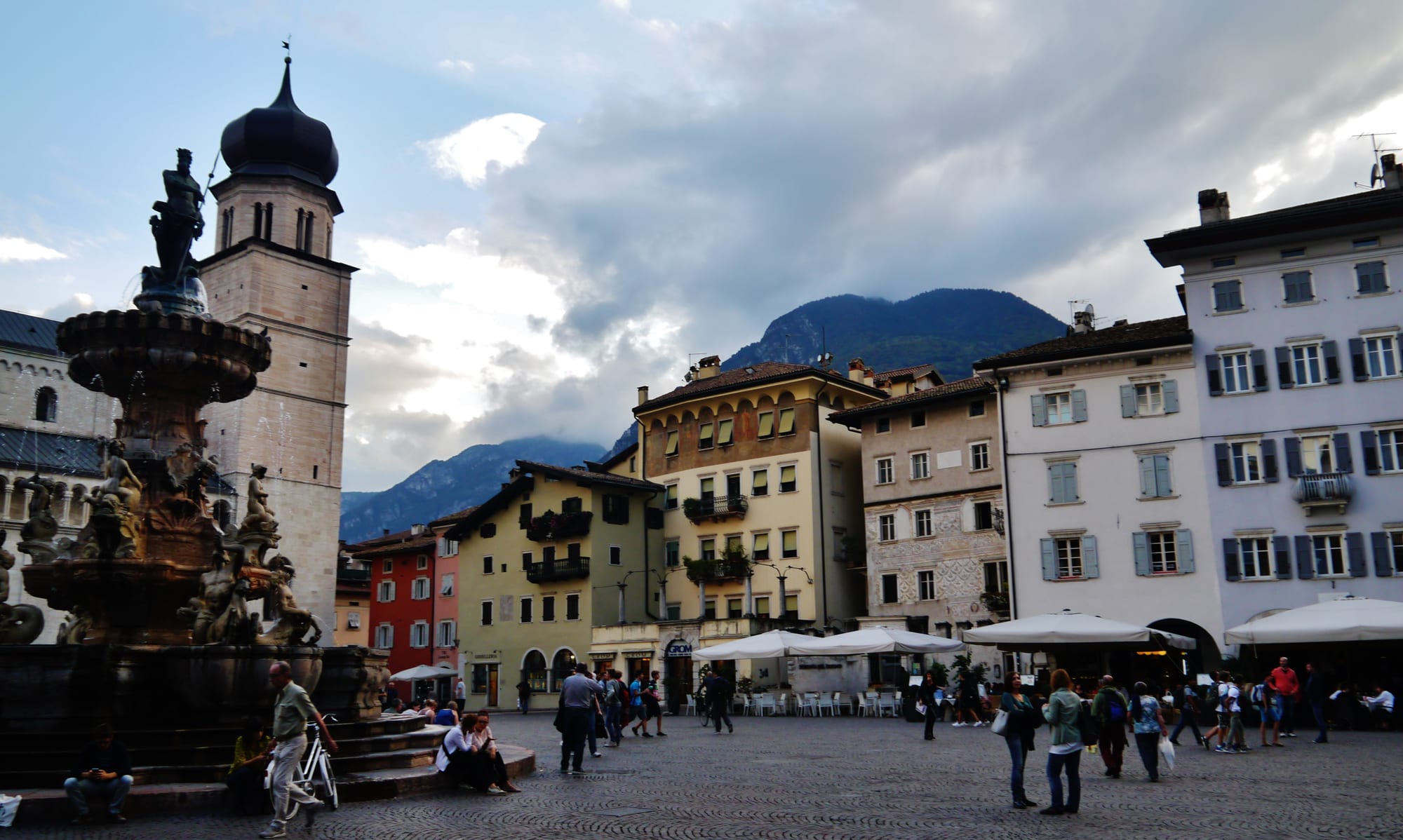
A cobbled square with a baroque Neptune fountain, a bell tower with an onion dome and pastel houses below wooded mountains

Trentino-Alto Adige / South Tyrol, Italy

Trento

Piazza Duomo in Trento, with the Fountain of Neptune and the cathedral. (Zairon / Wikimedia Commons · CC BY-SA 4.0)

The capital of Trentino, on the Adige in a wide Alpine valley ringed by mountains. Roman Tridentum, then for almost eight centuries the seat of prince-bishops, it hosted the Council of Trent in the 16th century and was Austrian until 1919. Today it is a prosperous university and research city with a frescoed old centre.

Neighbourhoods

  • Centro storico
    • First-time visitors
    • Historic district
    • Best for food

    The small, largely pedestrian old town between the cathedral and Buonconsiglio Castle, where restored late-medieval and Renaissance houses keep their pastel colours, wooden balconies and painted façades. Piazza Duomo, the palazzi of the Council of Trent and most cafés and wine bars are here, a short walk from the railway station.

    Open in Maps
  • Le Albere
    • Museums
    • Modern architecture
    • Riverside walks

    A district designed by Renzo Piano on the site of a former factory beside the Adige, south of the centre. It holds the MUSE science museum, new apartment blocks and a park, next to the moated Renaissance Palazzo delle Albere.

    Open in Maps
  • Piedicastello
    • Local life
    • Historic district

    One of the oldest quarters of the city, across the Adige at the foot of the Doss Trento hill, from which steps climb to the Cesare Battisti mausoleum.

    Open in Maps
  • Povo
    • Students
    • Quiet and residential

    A hillside suburb east of the centre, around 400 metres up, home to science faculties of the University of Trento and research institutes, with cooler summer nights than the valley floor.

    Open in Maps
  • Sardagna
    • Viewpoints
    • Quiet and residential

    A village on an old glacial terrace above the right bank of the Adige, part of the city and reached by cable car, with wide views over Trento.

    Open in Maps

Things to do

Famous landmarks

  • Trento Cathedrallandmark

    The Romanesque-Gothic cathedral of San Vigilio, rebuilt from the early 13th century over a late-Roman basilica whose remains can be seen in the crypt below.

    Open in Maps
  • Buonconsiglio Castlemuseum

    The castle and palace of the prince-bishops, from the 13th-century Castelvecchio to Bernardo Clesio's Renaissance Magno Palazzo; the Eagle Tower holds the 15th-century Cycle of the Months, a famous work of International Gothic painting.

    Open in Maps
  • Santa Maria Maggiorelandmark

    The Renaissance church built for Bernardo Clesio by Antonio Medaglia, and the site of the third session of the Council of Trent.

    Open in Maps
  • Palazzo delle Alberelandmark

    A 16th-century villa-fortress of the Madruzzo prince-bishops beside the Adige, with four corner towers, a moat and Renaissance frescoes of the twelve months.

    Open in Maps
  • Trento railway stationtransit hub

    The station of 1934–36 by the rationalist architect Angiolo Mazzoni, considered a landmark of Italian railway architecture for its mix of local stone, glass and reinforced concrete.

    Open in Maps

Museums

  • MUSEmuseum

    The museum of science and natural history designed by Renzo Piano and opened in 2013 in the Le Albere district.

    Open in Maps
  • Gianni Caproni Museum of Aeronauticsmuseum

    Italy's oldest aviation museum, founded in 1927 by the aircraft pioneer Gianni Caproni and now beside the airfield at Mattarello, south of the city.

    Open in Maps

Viewpoints and hills

  • Monte Bondoneviewpoint

    The 2,180-metre mountain west of the city, the highest of the Garda Prealps, with a ski area and the Viote Alpine Botanical Garden, founded in 1938.

    Open in Maps
  • Paganellaviewpoint

    The plateau of the Brenta Group overlooking Trento from the north-west, with ski resorts on its gentler slopes above Andalo and Fai della Paganella.

    Open in Maps

Short trips from the city

  • Lake Caldonazzobeach

    The largest lake within Trentino and the source of the Brenta, known for canoeing, sailing, windsurfing and water-skiing, with beaches awarded blue flags in 2024.

    Open in Maps
  • Lake Levicobeach

    A small natural lake in the Valsugana known for its clean water, with swimming and a spa offering mineral water.

    Open in Maps
  • Lago di Toblinoviewpoint

    A protected lake in the Valle dei Laghi, with the medieval Castel Toblino on a promontory on its northern shore.

    Open in Maps
  • Roveretoattraction

    The main city of the Vallagarina, down the Adige, where the Museum of Modern and Contemporary Art of Trento and Rovereto is based.

    Open in Maps

Seasonal events

  • Trento Film Festivalspring

    One of the oldest film festivals in Italy, founded in 1952 by the Italian Alpine Club and the city, showing films about mountains, exploration and mountaineering.

  • Festival dell'Economialate May

    A festival begun in 2006 in which economists and business leaders explain current economic questions to the public in the palazzi of the old town.

  • DiVin OttobreOctober

    One of the city's autumn food and wine events, at the time of the grape harvest.

  • Christmas Marketmid-November to 6 January

    Around 60 wooden huts set up within the old crenellated walls of Piazza Fiera, with a second market in Piazza Cesare Battisti since 2014.

Eat and drink

Long-standing places and food districts in Trento. Hours, ratings and directions come from your maps app, always current.

Trento classics

  • Wine bars of the old townneighborhood

    Numerous wine bars pour the local Teroldego reds and Nosiola whites with small plates of cheese and ham, and Trento DOC sparkling wine, made from Chardonnay and Pinot grapes.

    Open in Maps
  • Cafés on Piazza Duomocafe

    The cathedral square is the place for a coffee and a slice of apple strudel, made locally with Melinda apples from the Val di Non.

    Open in Maps
  • Trentino restaurantsrestaurant

    Where Italian and Austrian influences meet, menus run from pizza to pork with sauerkraut and canederli dumplings.

    Open in Maps

Markets

  • Christmas Market in Piazza Fieramarket

    In the weeks around Christmas, wooden huts beside the city walls sell local crafts, food and mulled drinks.

    Open in Maps

Experience Trento

History

The origins of Trento are uncertain: some scholars see a Rhaetian settlement, others a Gaulish foundation of the 4th century BC. The Romans conquered it in the 1st century BC and named it Tridentum, "three-tooth place" — possibly for the three hills around the city — and it became a stop on the road from Verona to Innsbruck. In 1027 Emperor Conrad II made its bishops prince-bishops, with both religious and temporal power, and around 1200 silver from Monte Calisio made it a mining centre with the first mining code of the Alps.

In 1475 the city's small Jewish community was falsely accused of murdering a child, Simon of Trent; eight Jews were tortured and burned. Trento formally apologised in the 1990s. In the 16th century the prince-bishops Bernardo Clesio and Cristoforo Madruzzo brought the Council of Trent here (1545–1563), the Catholic Church's answer to the Protestant Reformation, and gave the word "Tridentine" to the world.

The prince-bishopric was secularised in 1802; Trento passed to Bavaria and Napoleon's Kingdom of Italy, then to the Habsburgs in 1814, and the railway arrived in 1859. Under Austria it became, with Trieste, a symbol of Italian irredentism; the local irredentists Cesare Battisti and Damiano Chiesa were executed in the castle courtyard during the First World War, and Italy annexed the city in 1919. Allied bombing in 1944–45 hit churches and bridges but spared most of the old centre. Prosperity followed from the 1950s, helped by the province's autonomy.

Culture & Customs

The city wears its history on its walls. Restored late-medieval and Renaissance houses keep their pastel colours, wooden balconies and painted façades, and the old Latin motto on the town hall — "Mountains give me silver and the name of Trento" — recalls its mining past. The Council of Trent remains the city's great cultural reference, and the Diocesan Museum beside the cathedral tells its story.

Mountains shape the cultural calendar as much as history. The Trento Film Festival, founded in 1952 by the Italian Alpine Club and the city, is one of the oldest film festivals in Italy still running and is devoted to mountains, exploration and mountaineering. Each May the Festival dell'Economia fills the palazzi with economists explaining their subject to the public, and food and wine events run through the year. The Teatro Sociale dates from 1819.

Sport has a loyal following: Trentino Volley has won the Italian championship four times and the CEV Champions League three times, and Aquila Basket Trento plays in the top basketball league; the Giro al Sas road race, first run in 1907, still goes through the streets. Alcide De Gasperi, a founder of the European Union, and Chiara Lubich, founder of the Focolare Movement, are among the figures associated with the city.

Daily Life

About 119,000 people lived in the municipality at the end of 2023, making it the third largest municipality in the Alps. The municipality is far larger than the city itself, taking in suburbs as different as industrial Gardolo to the north and small mountain hamlets on Monte Bondone.

As late as the Second World War the city depended on wine-making and silk. Post-war industry has largely gone; today Trento lives on commerce, services, tourism, high-quality farming and food, and research. The University of Trento, founded in 1962, has over 16,000 students in the city, and research centres such as the Fondazione Bruno Kessler and the Edmund Mach Foundation have earned the city and its university the nickname of a "Silicon Valley" of the Alps. The province is one of the richest in Italy, and the city often ranks near the top of national quality-of-life tables — third in 2023.

Daily life is unhurried and orderly. Students fill the old town and the hill suburb of Povo, families head to the mountains and lakes at weekends, and pink and white porphyry quarried nearby appears in many of its buildings, old and new.

Food

Trento sits where Italian and Austrian kitchens meet, and its menus run from pizza to pork with sauerkraut. Canederli, the Knödel of the Alps, are boiled dumplings. Apples from the Val di Non, sold under the Melinda name, go into the local strudel, a staple of coffee-and-cake breaks in the cafés around Piazza Duomo.

Wine is the city's great product. Trento DOC is an appellation for sparkling white and rosé wine made in Trentino from Chardonnay, Pinot noir, Pinot Meunier and Pinot blanc; the Teroldego grape makes the local red, and Nosiola, a white grape grown north of Lake Garda in the Valle dei Laghi, is used in still wines and in the sweet Vino Santo. Numerous wine bars in the old town serve these with small plates of cheese and ham, and grappa and other spirits are local products too.

The calendar adds its own flavours: food and wine events through the year, including A Tutto Nosiola and DiVin Ottobre, and the Christmas market, where wooden huts in Piazza Fiera sell local specialities from mid-November.

Planning tools

Budget

Trento costs less than the Dolomite resorts and less than Venice or Milan, though it is among the more expensive cities of Italy to live in. Rooms are busiest during the festivals and at Christmas market time. The old town is small enough that transport costs little.

Daily Budget Midrange
USD 160–300 (mid-range hotel, restaurant dinners with local wine, museum tickets)
Daily Budget Shoestring
USD 80–130 (hostel or simple guesthouse, bakery lunches and pizza, city buses)

Lunch menus are far cheaper than dinner, and a standing coffee at the bar costs much less than one taken at a table.

Best Time to Visit

May, June, September and October are the most comfortable months, with the film festival and the economics festival in spring and the grape harvest in autumn. July and August can be hot and sweltering in the valley. November to early January brings the Christmas markets, and the ski areas of Monte Bondone and the Paganella open in winter.

Suggested Number of Days

One or two days cover the compact old town and its museums. With the lakes, the mountains and the neighbouring valleys, four or five days make sense; skiers and walkers often use the city as a base for longer.

First Visit
1–2 days
With Surroundings
4–5 days

Transportation

The old town is walkable and largely closed to traffic. Trentino Trasporti runs around 20 city bus lines and a cable car up to Sardagna, and the railway stations within the city are part of the same network. Buses and trains reach the surrounding valleys, including the Valsugana line to the lakes and the narrow-gauge line to Malè.

Validate paper regional train tickets on the platform before boarding to avoid a fine.

Airport & Station Connections

Trento station is on the Brenner railway between Verona and Innsbruck, the main rail link between Italy and Germany; regional trains from Verona take roughly an hour, Bolzano is under an hour north, and direct trains run to Munich. The A22 motorway follows the same route. The nearest passenger airports are Bolzano, about 90 km north, Verona Villafranca, about 95 km south, and Venice Marco Polo, about 154 km south-east.

Walkability

Excellent in the centre: the station, Piazza Duomo, Buonconsiglio Castle and the MUSE are all within a short walk of one another on level ground, and much of the historic centre is pedestrian. The hill suburbs such as Povo and Sardagna need a bus or the cable car.

Safety

Italy is generally safe, with low levels of violent crime against visitors. Trento is a calm, orderly city where serious crime touching visitors is rare; the usual care with bags around the station is enough. The real hazards are in the surrounding mountains: storms, rockfall and icy roads.

Keep an eye on belongings around the station, check the weather before heading into the mountains, and follow local guidance in the bear country of the Brenta Dolomites. Check current official travel advice before travelling.

Climate

A humid subtropical to continental climate on the valley floor, at just under 200 metres. Winters are cold with frequent frost and infrequent snow; spring is changeable; summers are hot; autumn is pleasant early and grey later, with the leaves turning in November in the centre.

Summer
hot, sometimes sweltering — July averages about 23°C, highs reach 35°C for at least a week a year, and nights hover around 22–24°C
Winter
cold — January averages about 1.6°C, highs usually around 8°C and lows between -3 and 0°C, with frost from mid-November to mid-March

Local Customs

Trento is Italian in speech and outlook, with a strong attachment to its autonomy and its Tyrolean past. Tips are not customary in Italy; restaurants often add a cover charge, the coperto, and a euro or two is welcome for good service. Coffee is usually drunk standing at the bar.

Dress modestly in churches, with shoulders and knees covered, and avoid sightseeing during services.

Common Payment Methods

The currency is the euro. Cards are accepted almost everywhere, though a little cash is useful for small bars and market stalls, and ATMs are easy to find in the centre.