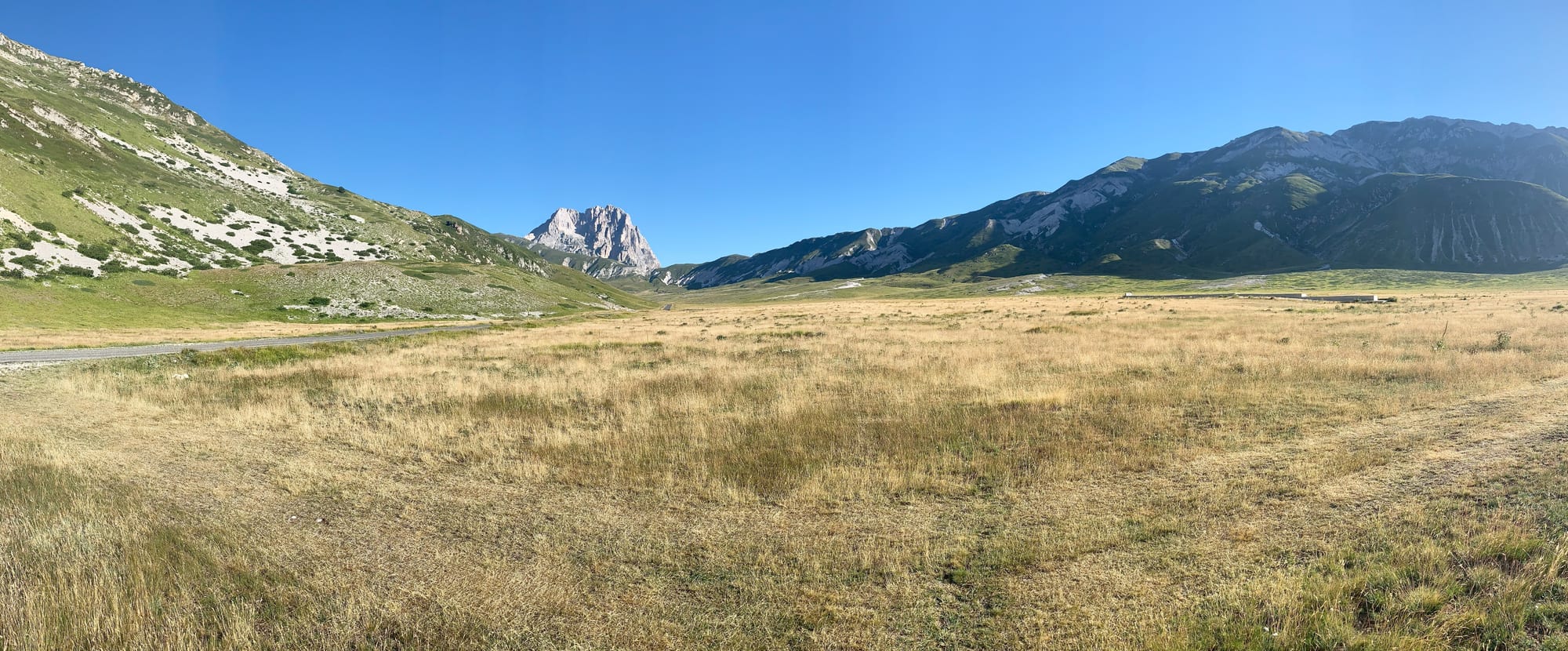
A wide golden grassland plateau under a clear blue sky, with the rocky peak of Corno Grande and green ridges beyond

Italy

Abruzzo & Molise

The high plateau of Campo Imperatore in the Gran Sasso, with the Corno Grande on the skyline. (Bouke ten Cate / Wikimedia Commons · CC BY 4.0)

Two neighbouring regions on Italy's central Adriatic side, joined as one until 1963 — Abruzzo, where the highest peaks of the Apennines and three national parks drop to a coast of fishing platforms, and small, rural Molise to the south, a land of Samnite and Roman ruins, sheep tracks and hill villages.

Explore Abruzzo & Molise

History

Before Rome, the mountains were home to Italic peoples: the Vestini, Marsi, Paeligni and Marrucini in Abruzzo, and the Samnites in Molise, who fought three wars against Rome in the 4th and 3rd centuries BC. In the Social War of 91 BC the allies made Corfinium, near Sulmona, their capital and renamed it Italia. Rome built towns such as Saepinum and Alba Fucens, and the poet Ovid was born in Sulmona in 43 BC.

After the empire the area passed to Lombards and then Normans, who joined it to the Kingdom of Sicily; from then until 1860 it belonged to the southern kingdom ruled from Naples. L'Aquila was founded in the mid-13th century when dozens of castles and villages banded together, and in 1294 the hermit Pietro da Morrone was crowned there as Pope Celestine V. Wool made the region's wealth: every autumn shepherds drove flocks down the broad tratturi, drove roads, to winter pastures in Apulia.

After Italian unification the regions became among Italy's poorest, and large numbers emigrated to the Americas. Abruzzo and Molise formed one region until 1963. In 1943 Mussolini was held at the hotel on Campo Imperatore before German commandos freed him, and that winter the battle of Ortona was fought street by street. The post-war motorways and factories lifted the economy, but on 6 April 2009 an earthquake killed 308 people in and around L'Aquila, and its centre is still being rebuilt.

Culture & Customs

Both regions have a strong pastoral identity rooted in shepherding and transhumance. Abruzzese is proud of its mountains and its reputation for hospitality and stubbornness — the phrase "forte e gentile", strong and kind, is used of its people. Molise, with about 290,000 inhabitants, is often the butt of Italians' jokes that it "does not exist", which locals have turned into a slogan. Small communities in Molise still speak Arbëreshë, an old form of Albanian, and a Croatian dialect.

The festivals are distinctive. At Cocullo, on the first of May, the statue of St Dominic is carried through the streets covered in live snakes. L'Aquila's Perdonanza Celestiniana, held each August since Celestine V's pardon of 1294, is on UNESCO's intangible heritage list. Scanno is known for its women's traditional costume and filigree jewellery, and Sulmona holds a jousting tournament in the summer.

Crafts include the church bells of Agnone, whose Marinelli foundry is one of the oldest family firms in Italy, the ceramics of Castelli, lace from Pescocostanzo, and the confetti of Sulmona, sugared almonds. Pescara produced the poet Gabriele D'Annunzio, born there in 1863.

Daily Life

Abruzzo has about 1.27 million people. Pescara, with about 120,000, is the largest city and the economic centre of the coast; L'Aquila, the capital, has about 70,000, and Chieti and Teramo are the other provincial capitals. Molise's capital, Campobasso, has about 48,000, followed by Termoli and Isernia; many villages have lost most of their population through emigration.

Abruzzo's economy is more industrial than the rest of the south: vans, motorcycles in the Sangro valley, pasta makers such as De Cecco, and food processing, along with tourism on the coast and in the ski resorts. Molise depends on farming, public employment and a large Fiat plant at Termoli. Olive oil, wine and saffron are important crops.

Life inland follows the seasons: quiet winters, summer festivals when emigrants' families return, and August feasts in every village. Current issues include depopulation of the mountain villages, the slow reconstruction after 2009 and 2016, and debates over wolves, bears and grazing.

Food

The dish of Abruzzo is arrosticini, small skewers of mutton grilled over a long narrow brazier and eaten by the dozen. Maccheroni alla chitarra, long pasta pressed through a frame of wires, is served with lamb or tomato sauce, and scrippelle 'mbusse, thin crepes in broth, come from Teramo. Brodetto alla vastese is a fish stew with tomato and chilli, and ventricina is a pork salami seasoned with peppers and fennel from the Vasto area.

Saffron from the Navelli plain near L'Aquila is highly valued, pecorino from Farindola is made with pig's rennet, and caciocavallo is made in both regions. Molise has pampanella, pork seasoned with plenty of sweet and hot pepper, and cavatelli pasta. Sweets include Sulmona's confetti, Pescara's parrozzo, an almond cake glazed with chocolate, and ferratelle, thin waffles.

The main wine is Montepulciano d'Abruzzo, a sturdy red, with Cerasuolo d'Abruzzo its cherry-coloured rosé, and white Trebbiano d'Abruzzo and Pecorino. Molise's own grape is Tintilia, a red. Centerbe is a strong herb liqueur and genziana a bitter drink made from gentian root.

Attractions & Natural Wonders

The Gran Sasso and Monti della Laga National Park is dominated by the Corno Grande, the highest peak of the Apennines, and Campo Imperatore, a high plateau reached by cable car from Fonte Cerreto. Nearby are Rocca Calascio's ruined fortress and Santo Stefano di Sessanio's stone village. L'Aquila has the basilica of Santa Maria di Collemaggio, the Fountain of the 99 Spouts and its Spanish fort.

To the south, Sulmona has its aqueduct and churches, and above it the Majella National Park, with its hermitages and the ski town of Roccaraso nearby. The Abruzzo, Lazio and Molise National Park, around Pescasseroli, shelters Marsican bears and chamois, and Scanno sits above its lake. The Trabocchi coast runs from Ortona to San Salvo, with the abbey of San Giovanni in Venere, the Punta Aderci reserve and the Via Verde cycle path.

Molise has Termoli, with its Swabian castle and walled old quarter, and the Roman town of Saepinum, with its gates, forum and theatre in open countryside. Nearby are the Samnite theatre and temple of Pietrabbondante, the prehistoric site at Isernia and the bell town of Agnone.

Cities in Abruzzo & Molise

Planning basics

Budget

Abruzzo and Molise are among the cheapest parts of central Italy. Rooms in mountain villages, agriturismi and B&Bs are inexpensive, and meals of arrosticini and local wine cost little. Prices rise along the coast in August and in the ski resorts at weekends, and a hire car is the main expense, as public transport to the parks is limited.

Daily Budget Midrange
USD 110–230 (agriturismo or boutique village hotel, restaurant dinners, a hire car, guided walks)
Daily Budget Shoestring
USD 55–100 (B&B or mountain refuge, trattoria meals, regional buses and trains)

Hire a car for the parks and hill villages, and try the fixed-price meals in the mountain trattorias.

Safety

Crime is low across both regions. The real hazards are natural: the area is seismically active, as the 2009 L'Aquila earthquake showed; mountain weather changes quickly on the Gran Sasso and Majella; and winter roads can be icy or closed. Brown bears and wolves live in the parks and should be watched from a distance.

Check mountain forecasts before hiking, keep food away from bears, and never feed wildlife. Check current official travel advice before travelling.

Climate

The climate is sharply divided. The Adriatic coast has warm summers and mild winters, while the mountain interior, with peaks close to 3,000 metres, has cold, snowy winters and cool summer nights; L'Aquila and Campobasso are among the colder regional capitals of the south-centre. Snow can close mountain passes from December to March.

Summer
warm on the coast, 27–32°C; pleasant in the mountains, 18–25°C by day
Winter
mild on the coast, 5–12°C; cold and snowy inland, often below freezing

Transportation

Motorways link Rome with L'Aquila and Pescara in under two hours, and the Adriatic railway runs along the coast through Pescara, Ortona, Vasto and Termoli. Inland rail and bus links are slow and infrequent, so a car is needed for the national parks, Sulmona's hinterland and most of Molise. Pescara has a small airport, and ferries sail from Termoli to the Tremiti Islands in summer.

Carry snow chains or winter tyres from November to April inland, and fill up before crossing the mountains.

Best Time to Visit

June to September for hiking in the Gran Sasso and Majella, with the Campo Imperatore plateau green and flowering in early summer and the coast at its best in June and September. Autumn brings the grape harvest and saffron harvest, and late August the Perdonanza in L'Aquila. From December to March the ski resorts of Roccaraso, Campo Felice and Campitello Matese open, and many mountain villages are quiet.