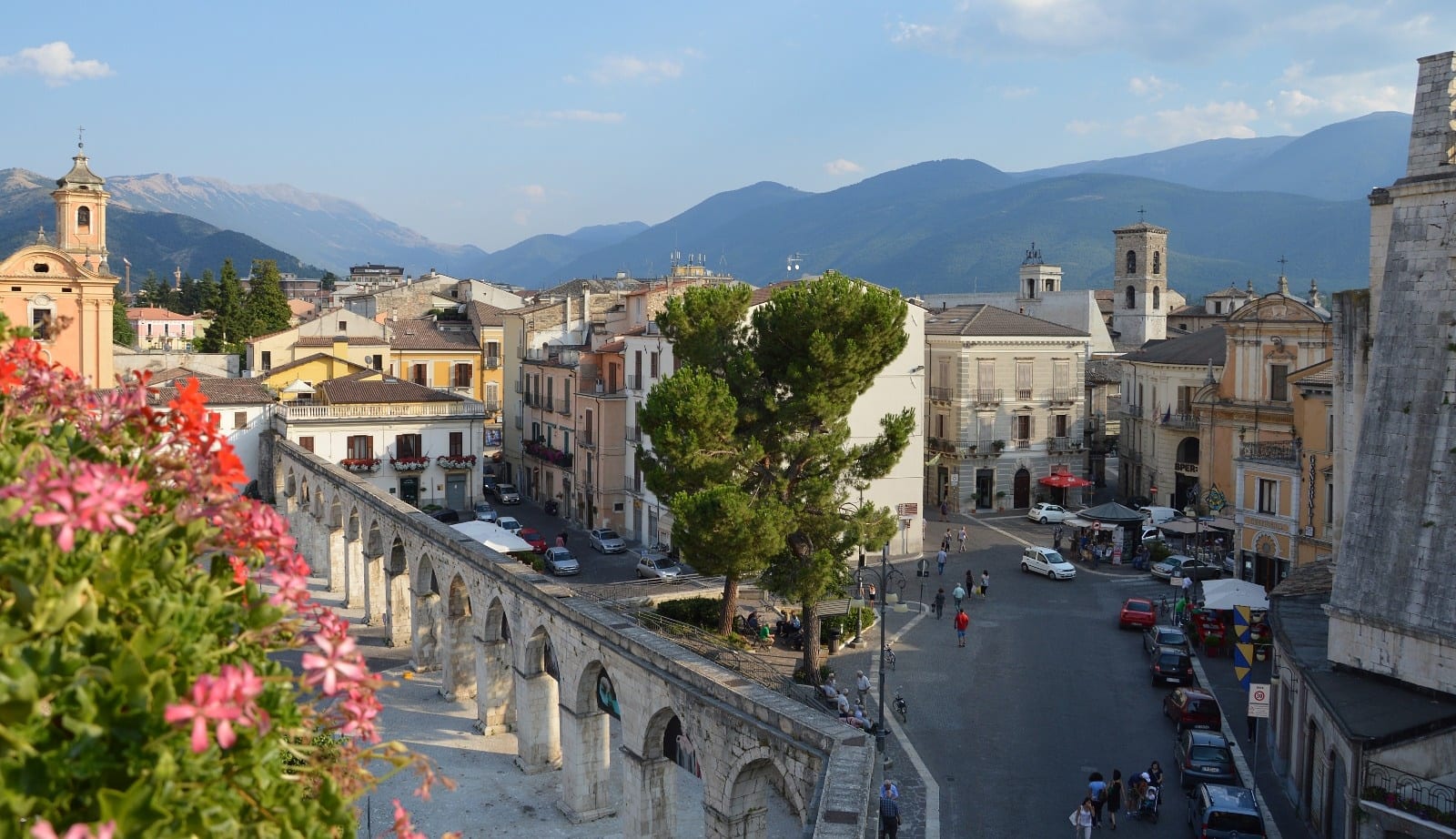
Arches of a medieval stone aqueduct running beside a square of pale houses and bell towers, with green mountains behind

Abruzzo & Molise, Italy

Sulmona

The medieval aqueduct and the historic centre of Sulmona, below the mountains of the Valle Peligna. (Lorenzo Testa / Wikimedia Commons · CC BY-SA 3.0)

A market town of the Valle Peligna in inland Abruzzo, beneath the Morrone and Majella mountains. Birthplace of the Roman poet Ovid, it grew under the Normans and Frederick II, was largely rebuilt in Baroque style after the earthquake of 1706, and is known across Italy for its sugared-almond confetti and the medieval aqueduct that runs along its largest square.

Neighbourhoods

  • Historic centre and Corso Ovidio
    • First-time visitors
    • Historic district
    • Cafés and shops

    One of the largest and best-preserved old centres in Abruzzo, a mix of medieval, Renaissance and Baroque buildings crossed end to end by Corso Ovidio. The street links the cathedral with Piazza XX Settembre, where Ovid's bronze statue stands, and opens onto the broad Piazza Garibaldi beside the aqueduct. Arcades, confetti shops, cafés and churches line the way.

    Open in Maps
  • The station quarter and the villa comunale
    • Close to public transport
    • Quiet and residential

    Beyond the public gardens of the villa comunale, laid out from 1867 beside the cathedral, the newer town spreads across the valley floor towards the railway station. It is a calmer, more modern part of town, about a quarter of an hour's walk from the centre.

    Open in Maps
  • The Morrone foothills
    • Walking
    • Monasteries and ruins

    The slopes of the Montagne del Morrone north-east of town hold the great Celestine abbey known as the Badia Morronese, the terraced ruins of the sanctuary of Hercules Curinus and, higher up the rock face, the hermitage where Pietro da Morrone lived before he became pope.

    Open in Maps

Things to do

Churches and landmarks

  • Sulmona Cathedrallandmark

    The cathedral of San Panfilo on the north-west side of the old town, built on the site of a Roman temple; its crypt keeps its Romanesque form beneath an 18th-century remodelled church.

    Open in Maps
  • The medieval aqueductlandmark

    The Gothic arches of the town's medieval aqueduct, raised in the Swabian period, run along the south side of Piazza Garibaldi, the largest square in town, with its Baroque fountain.

    Open in Maps
  • Palazzo and church of the Santissima Annunziatamuseum

    A rare late medieval and early Renaissance palace that survived the 1706 earthquake, with carved sculpture and tracery on its façade and a museum of the town's Roman past, beside a Baroque church.

    Open in Maps
  • Confetti museum at the Pelino factorymuseum

    The museum of the art and technology of confetti making, opened in 1988 in the old Pelino factory, with antique machines and a reconstruction of an 18th-century confetti workshop.

    Open in Maps

The Morrone foothills

  • Badia Morroneselandmark

    The vast former Celestine abbey of Santo Spirito, founded by Pietro da Morrone in the late 13th century at the foot of the mountain, largely remodelled in Baroque style and now home to a small archaeological museum.

    Open in Maps
  • Sanctuary of Hercules Curinuslandmark

    The terraced ruins of an Italic and Roman sanctuary at the foot of Monte Morrone, enlarged at the end of the Social War; finds here include a small column with verses attributed to Ovid.

    Open in Maps
  • Hermitage of Sant'Onofrio al Morronetrail

    A 13th-century hermitage set into the rock face of the Morrone above the valley, where the monk who became Pope Celestine V lived before his election.

    Open in Maps

Short trips from the town

  • Pacentroneighborhood

    A well-preserved medieval village on the slopes above the Valle Peligna, a few kilometres from Sulmona, listed among the most beautiful villages of Italy.

    Open in Maps
  • Corfiniumlandmark

    The remains of the ancient city near modern Corfinio that served as the headquarters of the Italian allies fighting Rome in the Social War of 91–87 BC.

    Open in Maps
  • Scannoneighborhood

    A mountain town in the Sagittario Valley reached by bus from Sulmona, among the most beautiful villages of Italy and known for its women's traditional costume.

    Open in Maps
  • Maiella National Parkpark

    The national park of the Maiella massif, established in 1991, whose highest peak, Monte Amaro, reaches 2,793 metres; the park has an operational office in Sulmona.

    Open in Maps

Seasonal events

  • Madonna che ScappaEaster Sunday

    A statue of the Madonna is carried across Piazza Garibaldi, its bearers breaking into a run to meet a statue of the risen Christ on the far side, before large crowds.

  • Giostra Cavallerescalast weekend of July

    A Renaissance-style jousting tournament on horseback in Piazza Garibaldi, revived in 1995, in which the town's sestieri and borghi compete in period costume.

  • Sulmona Film FestivalNovember

    A yearly festival of local, Italian and international films held in the town's cinema and other venues.

Eat and drink

Long-standing places and food districts in Sulmona. Hours, ratings and directions come from your maps app, always current.

Sulmona classics

  • Confetti shops of Corso Ovidioneighborhood

    The historic confetti shops along Corso Ovidio and Piazza XX Settembre sell the town's sugar-coated almonds, often wired into flowers and other shapes for weddings.

    Open in Maps
  • Pelino confetti factorymarket

    The best known of the town's confetti makers, founded by Mario Pelino; its factory and confetti museum can be visited.

    Open in Maps

Markets and cafés

  • Piazza Garibaldi marketmarket

    The twice-weekly market, on Wednesdays and Saturdays, fills the great square with vegetables, meat and local produce, with farmers selling honey or garlic from a crate.

    Open in Maps
  • Cafés of Piazza XX Settembrecafe

    The cafés and bars around Ovid's statue and along the Corso are busiest during the evening passeggiata.

    Open in Maps

Experience Sulmona

History

Sulmo was one of the principal towns of the Paeligni, an Italic people of the central Apennines, but it appears in history only with the Roman conquest. Hannibal ravaged its territory in 211 BC without attacking the town; after the civil war between Sulla and Marius it seems to have been confiscated and its land given to Sulla's soldiers. In 49 BC, garrisoned against Julius Caesar, its citizens opened the gates to his lieutenant Mark Antony. The poet Ovid was born here in 43 BC and celebrated its clear streams and its cold winters, and the initials of his line "Sulmo mihi patria est" — Sulmo is my homeland — appear on the town's coat of arms.

Christianity is traditionally dated here to the 3rd century, and Pamphilus, bishop of Valva from 682, is the patron saint, buried in the cathedral that bears his name. Under the Normans Sulmona became a free commune, and Frederick II built its aqueduct, made it the capital of a large province and gave it a court and a fair, which it lost to the Angevins. It still grew: new walls went up in the 14th century, when the town struck its own coins, and a paper industry began in the 16th.

In 1706 an earthquake nearly destroyed the town, which was rebuilt in Baroque style around the surviving medieval buildings. From the late 19th century it became a railway junction between Rome and the Adriatic, which made it a target of Allied bombing in 1943. Its Campo 78 held up to 3,000 British and Commonwealth prisoners; when the guards left in September 1943, hundreds escaped into the hills, many helped by the local resistance network of Mario Scocco.

Culture & Customs

Ovid is everywhere in Sulmona: his bronze statue stands in Piazza XX Settembre, the main street is named after him, and his motto appeared on the coins the town minted in the Middle Ages. The other figure who looms over the town is Pietro da Morrone, the hermit who lived in a cell on the mountain above, founded the great abbey at its foot and in 1294 became Pope Celestine V; his hermitage is still visited.

The old town is divided into sestieri, districts that once corresponded to the gates and had to guard and maintain the walls, and each still has its own coat of arms. Together with the outer borghi they compete each summer in the Giostra Cavalleresca, a jousting tournament held twice a year in the Renaissance, abandoned in 1656 after a plague and revived in 1995. At Easter the Madonna che Scappa, the running Madonna, draws crowds to Piazza Garibaldi, and the Camerata Musicale Sulmonese organises concerts from classical music and opera to jazz.

Local crafts go beyond confetti. Weavers make rugs, tapestries and blankets with geometric and plant patterns, and goldsmiths keep up an old tradition. Daily life is sociable and unhurried: the passeggiata along Corso Ovidio in the early evening, and again after dinner, is one of the strongest in the region, and much of the town turns out for it at weekends and on holidays.

Daily Life

About 21,500 people live in the municipality. The town sits in the middle of the Valle Peligna between the Vella stream and the Gizio river, with the Morrone and Majella mountains rising directly to the east, and most residents live either in the historic centre or in the newer streets that spread across the valley floor towards the station and the industrial areas.

The best-known local product is confetti, made by the long-established Pelino family firm and other makers. The railway remains important: the station is the junction of lines to Rome, Pescara, Terni and Isernia, and has its own locomotive depot. The Maiella National Park has an operational office in the town, and walkers come for the trails on the Morrone as well as for the historic centre.

Twice a week, on Wednesdays and Saturdays, the market fills Piazza Garibaldi with produce, meat and household goods. Evenings belong to the cafés and the Corso. Football has a long local history, but the old town club, Pro Sulmona, has been disbanded since its last season in 2015–16.

Food

Sulmona is the home of confetti, sugar-coated almonds given to friends and relatives at weddings and other celebrations. Their manufacture here is documented with certainty from 1783, and the craft was later dominated by the Pelino family factory, whose old works now hold a museum of confetti making. The shops of Corso Ovidio pile the sweets in every colour, and local artisans wire them into flowers and other decorations; some are made with chocolate or other nuts instead of almonds.

Other sweets mark the calendar. Handmade nougat, scarponi and stuffed ceci are Christmas treats, fiadoni, sweet pastries made with pecorino cheese, are eaten at Easter, and the cassata sulmonese — layers of sponge cake, creams and croccante, a crunchy nut brittle — is considered the queen of the town's desserts.

Savoury food is that of inland Abruzzo. Arrosticini, chunks of mutton or lamb on skewers grilled over a long, narrow brazier called a furnacella, come from the shepherding tradition of the mountains, and maccheroni alla chitarra, an egg pasta with a square cross-section, is a regional speciality. The red wine on most tables is Montepulciano d'Abruzzo, a dry wine with soft tannins usually drunk young; the land around Sulmo was already known in Roman times for grain and vines. The Wednesday and Saturday markets bring vegetables, meat, honey and garlic from the farms of the valley.

Planning tools

Budget

Sulmona is an inexpensive base by Italian standards. Rooms in the old town and its bed and breakfasts cost little, trattoria meals and local wine are good value, and the confetti make cheap presents. Prices rise for the joust in late July, and a hire car for the mountains is the largest extra cost.

Daily Budget Midrange
USD 110–210 (boutique hotel in the old town, restaurant dinners, a hire car for the mountains)
Daily Budget Shoestring
USD 55–95 (bed and breakfast or rented room, trattoria and pizzeria meals, regional trains and buses)

Walking the Corso, the squares and the aqueduct costs nothing; park outside the old town and walk in.

Best Time to Visit

Late spring to early autumn, when walks on the Morrone and in the Maiella park are open and the town is lively in the evenings. Late July brings the Giostra Cavalleresca, and Easter the Madonna che Scappa. High summer can be very hot in the enclosed valley, and winters are colder than the town's modest height suggests.

Suggested Number of Days

The town itself suits a day or two. Allow three to five days to add the mountain villages, the hermitages and walks in the national park. A car shortens the time needed; relying on buses, which are infrequent, adds to it.

First Visit
1–2 days
With Surroundings
3–5 days

Transportation

The old town is compact and best seen on foot. Local buses link the railway station with the centre and with nearby villages, including Pacentro, Introdacqua and Scanno, and taxis wait at the station. A car is the practical way to reach the hermitages, the national park and the ski areas around Roccaraso.

Leave the car outside the historic centre and walk in; buy bus tickets at a tobacconist before boarding.

Airport & Station Connections

Sulmona station, opened in 1888, is a junction of three lines, including the railway from Rome through Tivoli and Avezzano to Pescara. The slow, scenic train from Rome Tiburtina takes about two and three quarter hours, buses from Rome take about two, and trains from Pescara about an hour. By car the A25 motorway from Rome takes about an hour and a half. The nearest airport is Abruzzo Airport at Pescara.

Walkability

Very walkable. Corso Ovidio runs the length of the historic centre, linking the cathedral, the main squares and the aqueduct, and the walk from the station to the centre takes about a quarter of an hour. The abbey and the hermitages on the Morrone are outside town; the hermitage path climbs steeply.

Safety

Italy is generally safe, with low levels of violent crime against visitors. The persistent problem is pickpocketing and bag-snatching in the big tourist cities — Rome (around Termini and the metro), Florence, Milan, Naples, and Venice — along with taxi overcharging, ticket and "gladiator photo" scams, and distraction teams on public transport. Sulmona itself is a quiet provincial town; the main natural hazards are earthquakes, to which the valley is prone, and fast-changing weather in the mountains.

Check the mountain forecast before walking on the Morrone or in the Maiella, keep away from bears and wolves in the park, and keep bags close in the joust and Easter crowds. Check current official travel advice before travelling.

Climate

A continental climate for an inland valley at about 400 metres, with hot summers, cold winters and a wide swing between day and night — as much as 25°C. The Roman poet Ovid already called his home town "gelidus Sulmo", cold Sulmo.

Summer
hot — July averages about 25°C, and peaks above 40°C have been recorded in several heat waves
Winter
cold for its height — January averages about 4°C, and frosts and snowfalls are frequent

Local Customs

The evening passeggiata along Corso Ovidio is a lively local custom, busiest at weekends and on holidays. Bags of confetti are the traditional gift at weddings, baptisms and other celebrations. Tipping is modest; rounding up the bill is a common courtesy. Shoulders and knees should be covered in churches.

Greet shopkeepers with 'buongiorno' or 'buonasera', and avoid sightseeing in churches during Mass.

Common Payment Methods

The currency is the euro. Cards are widely accepted in shops, restaurants and hotels, and there are cash machines in the centre, but cash is useful at the market, in small bars and for local bus tickets.