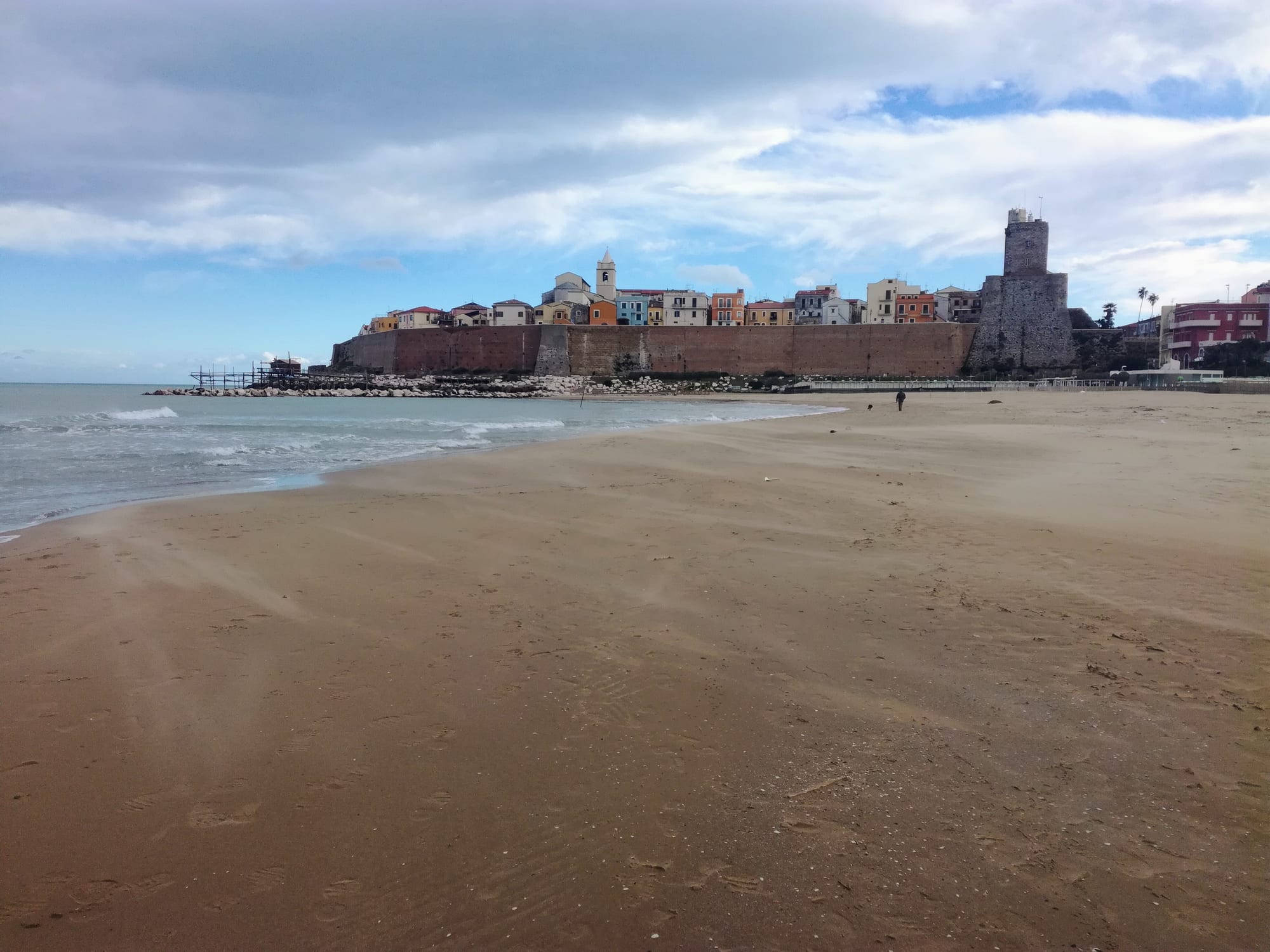
A wide sandy beach leading to the walled old town of Termoli, with pastel houses, a bell tower and a square stone castle

Abruzzo & Molise, Italy

Termoli

The walled old town of Termoli and its Swabian castle, seen from the beach of the north seafront. (Paolo Rucci / Wikimedia Commons · CC BY-SA 4.0)

Molise's only port, on the Adriatic between the Biferno and Sinarca rivers. A walled old town on a promontory, with a Swabian castle, a Romanesque cathedral and wooden trabucchi fishing platforms, has grown since the Second World War into a busy resort and industrial town, popular with Italian families and the year-round ferry port for the Tremiti Islands.

Neighbourhoods

  • The borgo antico
    • First-time visitors
    • Historic district
    • Sea views

    The walled old village on the promontory, entered past the Swabian castle and the Torretta Belvedere. White and pastel fishermen's houses line narrow lanes around the cathedral square, the walls drop straight to the sea, and trabucchi stand on the rocks below.

    Open in Maps
  • The town centre and Corso Nazionale
    • Shops and cafés
    • Evening passeggiata
    • Close to public transport

    The newer centre just inland of the old town, laid out along the pedestrian Corso Nazionale and its side streets and squares, including Piazza Sant'Antonio with the town hall. Shops, cafés and bars fill the streets, which are crowded on summer evenings and at weekends.

    Open in Maps
  • Lungomare nord and Sant'Antonio beach
    • Beaches
    • Families

    The most popular stretch of coast, a promenade lined with palms, restaurants and beach establishments looking back east to the old town, with a cycle path along the seafront.

    Open in Maps
  • Rio Vivo and the south shore
    • Beaches
    • Quieter stays

    The beaches south-east of the old town towards the mouth of the Biferno, by the round Torre del Meridiano, an old coastal watchtower, and the Marina di San Pietro tourist harbour.

    Open in Maps

Things to do

The old town

  • Castello Svevolandmark

    The plain limestone and sandstone castle at the entrance to the old town, raised by the Normans and largely rebuilt under Frederick II in 1240 after a Venetian attack; exhibitions and concerts are held in its halls.

    Open in Maps
  • Termoli Cathedrallandmark

    A 12th–13th-century cathedral in the Apulian Romanesque style, dedicated to Mary of the Purification and holding the relics of the patron saints Bassus and Timothy; restorations removed its Baroque additions.

    Open in Maps
  • A Rejecelleattraction

    A pedestrian lane in the old town, by Vico II Castello, only about 40 centimetres wide and counted, with a lane in Ripatransone, as the narrowest street in Italy.

    Open in Maps
  • The trabucchiattraction

    Wooden fishing platforms on stilts below the old town walls, built to fish without boats; from the mid-19th century they mattered to the town's food supply, and today they are kept as a heritage feature.

    Open in Maps

Museums and the waterfront

  • MACTEmuseum

    A contemporary art museum opened in 2019 in the redesigned building of the old neighbourhood market, keeping its circular central court.

    Open in Maps
  • Sant'Antonio beachbeach

    The town's busiest sandy beach on the north shore, with views of the old town walls and a mix of free stretches and beach establishments renting umbrellas and loungers.

    Open in Maps
  • Rio Vivo beachbeach

    The southern beach beyond the harbour, lined with beach establishments and the scene of bonfires on the night of the San Basso festival.

    Open in Maps

Short trips from the town

  • Tremiti Islandsattraction

    A small archipelago of clear waters off the Gargano, reached from Termoli's port by ferry in about an hour to an hour and a half all year; San Nicola has a historic monastery.

    Open in Maps
  • Larinoneighborhood

    A hill town in the fertile Biferno valley, the Roman Larinum, one of the inland towns within about 25 kilometres of Termoli that keep a rural way of life.

    Open in Maps
  • Campomarinoneighborhood

    An Arbëreshë town about five kilometres south-east, with the seaside resort of Campomarino Lido below the old village on its hill.

    Open in Maps

Seasonal events

  • Feast of San Basso3–4 August

    The patron saint's statue is carried from the cathedral to the port and taken to sea on a fishing boat chosen by lot, followed by the fleet; the bishop throws a wreath into the sea for those lost at sea, and the festival ends with fireworks at the port and bonfires on the beach.

  • Incendio del Castellonight of 15 August

    A show at the castle recalling the attacks the old town suffered in the past, with stalls and events all along the seafront.

  • Kimera International Film Festivalyearly

    An international film festival founded in Campobasso in 2002 and held at Termoli's Cinema Sant'Antonio since 2013.

Eat and drink

Long-standing places and food districts in Termoli. Hours, ratings and directions come from your maps app, always current.

Termoli classics

  • Brodetto alla termoleserestaurant

    U' bredette, the town's fish stew and the old evening meal of fishermen back from the trawlers, served by seafood restaurants around the port and the old town.

    Open in Maps
  • Restaurants of the borgo antico and the portneighborhood

    Seafood restaurants fill the old town lanes and the streets above the fishing harbour, with fish from the local trawler fleet.

    Open in Maps

Cafés and bars

  • Corso Nazionaleneighborhood

    The pedestrian main street and its side streets hold many of the town's cafés, gelato shops and bars, with aperitivo snacks such as olives and taralli.

    Open in Maps
  • Lungomare Cristoforo Colomboneighborhood

    The palm-lined north seafront, where the beach bars and restaurants are crowded with visitors from the surrounding towns in summer.

    Open in Maps

Experience Termoli

History

People lived around Termoli in prehistoric times, as necropolises outside town show, and wealthy Romans had villas along this coast. The ancient name is thought to have been Interamna Frentanorum, "the land between two rivers" of the Frentani, after the Biferno and the Sinarca. When barbarian raids and crisis struck the late empire, around the early 5th century, people from nearby took refuge on the promontory, high, open to the sea and joined to the land by a single approach. The Lombards made it the seat of a county and gave it walls, a keep and eight crenellated towers.

The town flourished under the Normans. Count Robert I of Loritello built the castle in the 11th century, and it was largely rebuilt under Frederick II in 1240 after an attack by the Venetian fleet; the cathedral rose in the 12th and 13th centuries. An earthquake in 1456 wrecked the upper part of its façade, and in 1566 the Turks sacked the town. A long decline followed until around 1770, when the Kings of Naples let local nobles build outside the walls along the coast and inland.

In October 1943 Termoli was the scene of one of the biggest tank battles of the Italian campaign. British commandos landed from the sea on the night of 2–3 October and cleared the town, then held it against counter-attacks by the 16th Panzer Division until reinforcements, with Canadian tanks, drove the Germans back on 6 October. After the war, people from the depopulating hill towns moved to the coast, and a Fiat factory opened in 1972.

Culture & Customs

Life in Termoli has always been bound to the sea, and so are its festivals. On 3 August the statue of San Basso, the patron saint, is carried from the cathedral to the port and loaded onto a fishing boat chosen by lot; the fleet follows it out to sea, where the bishop throws a wreath of flowers into the water in memory of those lost at sea, and the statue spends the night in the fish market. The next night brings fireworks over the harbour and bonfires along the beach of Rio Vivo. On the night of 15 August the Incendio del Castello recalls the attacks the old town suffered in centuries past.

The trabucchi on the rocks are the town's emblem as much as the castle. These wooden fishing machines, which during the Second World War alone fed much of the then smaller population, are now kept for their heritage value. Contemporary art has a home in MACTE, opened in the converted neighbourhood market in 2019, and since 2013 the Cinema Sant'Antonio has hosted the Kimera International Film Festival.

Termoli also has an Arbëreshë (Italo-Albanian) population, like neighbouring towns such as Campomarino. Local pride shows in a long-running rivalry, especially in sport, with the provincial capital, Campobasso: some termolesi like to say their town is "senza provincia". The semi-professional football club, Termoli Calcio, was founded in 1920.

Daily Life

About 31,700 people live in Termoli, the second most populous town in Molise after Campobasso, and the population grew quickly after the Second World War as families left the inland hill towns. Most live in the residential districts spreading inland and along the coast north towards Sant'Antonio and south towards Rio Vivo, while the old town on the promontory is small, restored and partly given over to visitors.

The economy rests on three things. The port, the only one in Molise, keeps a trawler fleet working and runs ferries to the Tremiti Islands all year. The industrial zone is anchored by the Stellantis car plant, built by Fiat in 1972, the most important plant there. And tourism, once modest, has made the town a favourite resort for Italian families, many of them from Campania and Puglia, though few foreigners come.

The rhythm changes with the seasons. In summer the beaches fill by day, the seafront restaurants are crowded and Corso Nazionale is packed in the evening, especially at weekends, with young and old walking or meeting friends. Outside summer the town is quieter and more workaday, with olive groves and vineyards in the countryside just beyond the suburbs. The public park, the Girolamo La Penna municipal park, was laid out in the 1960s as the town's main green space.

Food

Termoli's cooking is the food of a fishing port, made with olive oil from the surrounding countryside; the town belongs to Italy's national associations of olive-oil towns and sea-fish towns. Its signature dish is u' bredette alla termolese, the local brodetto, one of the fish stews that are the signature dishes of almost every Italian town along the Adriatic. In Termoli it was the evening meal of fishermen coming home from the trawlers, made with many kinds of fish — cuttlefish, red mullet, mussels and others — according to the season and the catch.

Seafood pasta is the other mainstay, and menus around the port and in the old town offer dishes such as tagliatelle with cuttlefish ink, clams and cherry tomatoes. Inland Molise contributes cavatelli, small pasta shells of semolina dough, for which Molise has its own local names such as cavatielle, and caciocavallo, a cheese made in several southern regions including Molise.

Evenings start with an aperitivo, often a drink with olives, taralli — ring-shaped wheat crackers common across southern Italy — crisps and small sandwiches, and end with gelato on the Corso. The wine of the region to look for is Tintilia, a red grape grown in Molise whose wine became a DOC in 2011, and the countryside around town produces its own olive oil and wine.

Planning tools

Budget

Termoli is good value by Italian seaside standards. Rooms and meals cost less than on the better-known coasts, and seafood is plentiful. Prices rise in July and August, above all around the San Basso festival and the August holiday, when beach umbrellas and loungers add to the bill.

Daily Budget Midrange
USD 110–220 (seafront hotel, seafood dinners, a beach establishment, a ferry to the Tremiti Islands)
Daily Budget Shoestring
USD 55–95 (bed and breakfast or simple apartment, pizza and market food, free beaches, trains and buses)

The free stretches of beach (spiaggia libera) cost nothing; rooms are cheaper in June and September than in August.

Best Time to Visit

June to September for the beaches and the ferries, with the San Basso festival in early August and the castle show in mid-August, when the town is at its fullest. June and September are calmer and still warm. Out of season the old town is quiet and the winters are mild, though cold winds can blow.

Suggested Number of Days

The old town and the seafront take a day or two. Allow three or four days to include the islands offshore and the inland hill towns, or longer for a beach holiday. Ferry and weather conditions can change the number.

First Visit
1–2 days
With Surroundings
3–4 days

Transportation

The centre is compact and walkable, and many beaches are within a short walk. A central bus terminal serves towns around Termoli, and trains run along the coast, but a hire car is the easiest way to explore inland Molise. Ferries leave from the port for the Tremiti Islands.

In town, white parking spaces are free and blue ones are paid; watch for signs giving street-cleaning hours.

Airport & Station Connections

Termoli station, opened in 1864, is on the Adriatic railway between Ancona and Lecce and is the terminus of a line inland towards Venafro, with trains from Bologna, Rome and Bari. The A14 coastal motorway has a Termoli exit, buses link the town with Naples, and the drive from Rome takes about three to four hours. The nearest airports are at Pescara, Naples and Rome.

Walkability

Easy on foot. The old town, the pedestrian Corso Nazionale, the port and the north beach are all close together, and the old town's lanes are car-free in practice. The southern beaches at Rio Vivo are a longer walk along the shore, and the north seafront has a cycle path.

Safety

Italy is generally safe, with low levels of violent crime against visitors. The persistent problem is pickpocketing and bag-snatching in the big tourist cities — Rome (around Termini and the metro), Florence, Milan, Naples, and Venice — along with taxi overcharging, ticket and "gladiator photo" scams, and distraction teams on public transport. Termoli is a calm family resort; the main things to watch are crowded beaches and festival nights in August, and the strong summer sun.

Keep an eye on bags on crowded beaches and at the August festivals, and check sea conditions before a Tremiti crossing. Check current official travel advice before travelling.

Climate

Mediterranean, tending to semi-arid, with little rain, most of it in autumn, and the sea keeping the daily range small. Summers are long, hot and breezy; winters are mild but can be windy when the cold Maestrale blows, which only rarely brings snow.

Summer
long and hot, with average highs around 29–30°C tempered by winds; heat waves have brought 35–40°C in recent years
Winter
mild, with highs of about 12–15°C and lows of about 7°C

Local Customs

Termoli's traditions are tied to the sea, above all the San Basso festival, when the fishing fleet escorts the saint's statue. People call themselves termolesi and like to say that Termoli is "senza provincia", without a province, a jab at a rivalry with Campobasso. The evening walk along Corso Nazionale draws all ages. Tipping is modest; rounding up is a common courtesy.

Cover shoulders and knees in the cathedral, keep swimwear for the beach, and greet shopkeepers with 'buongiorno' or 'buonasera'.

Common Payment Methods

The currency is the euro. Cards are widely accepted in shops, restaurants and beach establishments, and there are cash machines in the centre, but cash is useful in small bars, at markets and on free beaches.