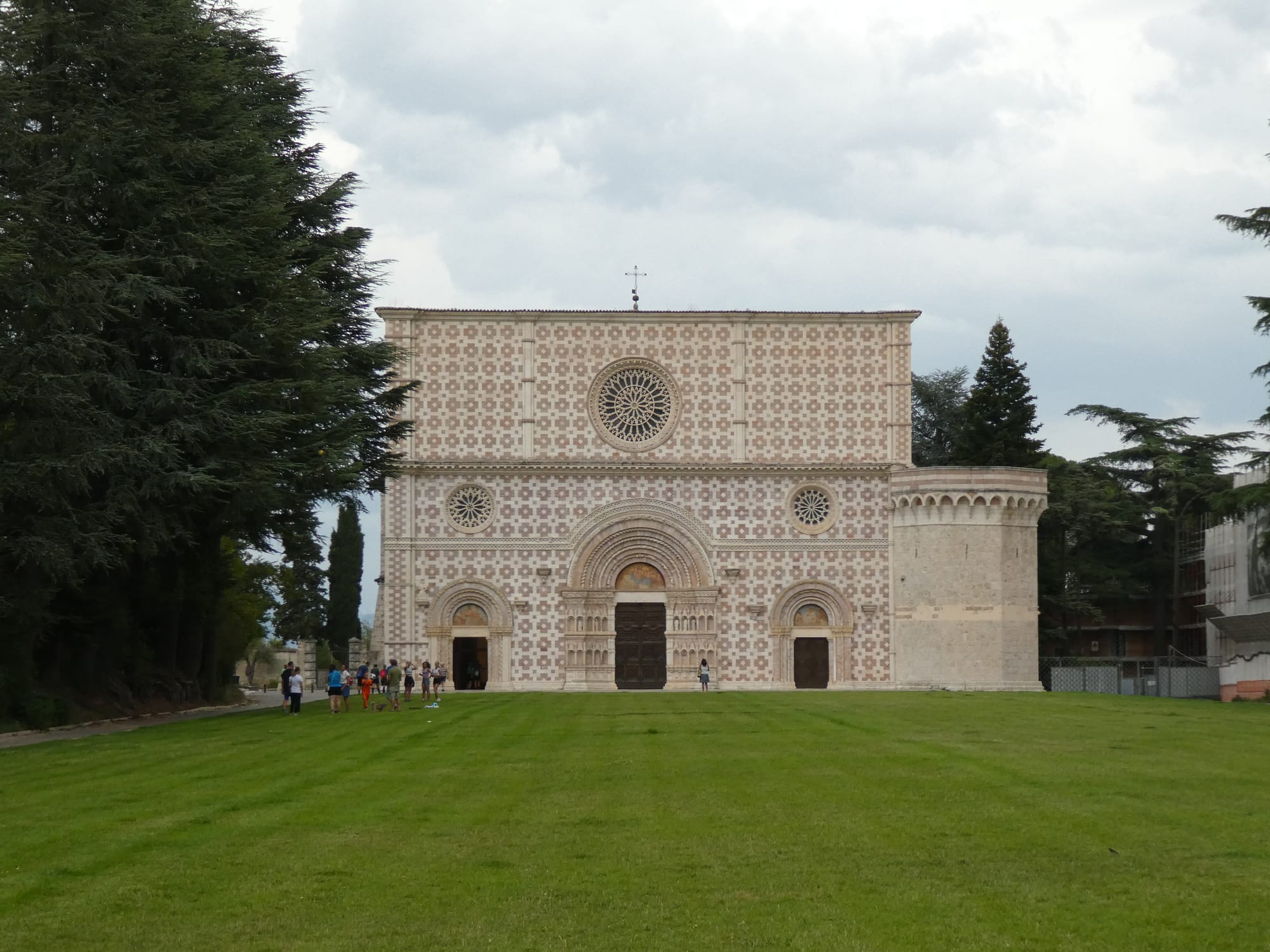
The square facade of a church patterned in pink and white stone, with three rose windows, beyond a wide green lawn

Abruzzo & Molise, Italy

L'Aquila

The pink and white facade of the basilica of Santa Maria di Collemaggio in L'Aquila. (Syrio / Wikimedia Commons · CC BY-SA 4.0)

The capital of Abruzzo, built in the 13th century from dozens of mountain villages on a hill in the Aterno valley, with the Gran Sasso to the north-east. Repeatedly shaken by earthquakes, most recently in 2009, its walled centre of Renaissance and Baroque churches is still being rebuilt; it is a university city and Italy's Capital of Culture for 2026.

Neighbourhoods

  • Centro storico
    • First-time visitors
    • Historic district
    • Restaurants

    The walled hilltop centre, a grid of narrow streets lined with Renaissance and Baroque palaces and churches opening onto piazzas, around Piazza del Duomo and its morning market. Cranes and scaffolding remain part of the scene as buildings damaged in 2009 are restored and reopened.

    Open in Maps
  • Castello and Collemaggio
    • Sightseeing
    • Parks
    • Concerts

    The edges of the centre: the Spanish fortress and its park at the highest point of the town, with Renzo Piano's wooden Auditorium del Parco, and the basilica of Collemaggio standing alone outside the walls at the end of its long lawn.

    Open in Maps
  • The lower town by the 99 Spouts
    • Close to the railway
    • Historic fountain

    The lower western side of the city, down a steep hill from the centre, where the medieval Fountain of the 99 Spouts stands near the railway station.

    Open in Maps

Things to do

Churches

  • Santa Maria di Collemaggiolandmark

    The Romanesque and Gothic basilica of pink and white stone where Celestine V was crowned pope in 1294 and is buried; damaged in 2009, it reopened in 2017.

    Open in Maps
  • Basilica of San Bernardinolandmark

    Built between 1454 and 1472 for Saint Bernardino of Siena, who died in the city, with a Renaissance facade finished by Cola dell'Amatrice and the saint's monumental tomb; it reopened in 2015 after earthquake repairs.

    Open in Maps
  • L'Aquila Cathedrallandmark

    The cathedral of Saints Maximus and George on Piazza del Duomo, founded in the 13th century, rebuilt after the 1703 earthquake and badly damaged again in 2009; reconstruction work began in February 2023.

    Open in Maps

Landmarks and museums

  • Forte Spagnololandmark

    The massive Renaissance fortress at the top of the town, begun in 1534 under the Spanish viceroy Pedro de Toledo and known locally as il Castello.

    Open in Maps
  • Fountain of the 99 Spoutslandmark

    The Fontana delle 99 Cannelle, probably of 1272, outside the western walls, where water pours from 93 stone masks and six single spouts in memory of the villages said to have founded the city.

    Open in Maps
  • MAXXI L'Aquilamuseum

    The L'Aquila branch of Italy's national museum of 21st-century art, opened in 2021 in the restored Palazzo Ardinghelli and showing mainly temporary exhibitions of contemporary art.

    Open in Maps

Short trips into the mountains

  • Campo Imperatorepark

    A vast high plateau of the Gran Sasso, 1,500 to 1,900 metres up and about 27 km long, beside Corno Grande, the highest peak of the Apennines, with one of Italy's oldest ski resorts and a film set for The Name of the Rose and Ladyhawke.

    Open in Maps
  • Castle of Rocca Calasciolandmark

    The highest fortress in the Apennines, at around 1,460 metres, a ruined stone stronghold above the Plain of Navelli.

    Open in Maps
  • Santo Stefano di Sessanioneighborhood

    A medieval stone hill town in the Gran Sasso national park beside Campo Imperatore, listed among the most beautiful villages of Italy.

    Open in Maps
  • Amiternumlandmark

    The ruins of a Sabine and then Roman city about 9 km from L'Aquila, the birthplace of the historian Sallust.

    Open in Maps
  • Bominaconeighborhood

    A village known for its two medieval churches, the oratory of San Pellegrino and Santa Maria Assunta.

    Open in Maps

Seasonal events

  • Perdonanza Celestinianalate August

    The annual jubilee of pardon decreed by Celestine V in 1294, with its central days at Collemaggio on 28–29 August; it is on UNESCO's intangible heritage list.

  • Street ScienceSeptember–October

    A week of public science events organised by the University of L'Aquila.

Eat and drink

Long-standing places and food districts in L'Aquila. Hours, ratings and directions come from your maps app, always current.

Food districts and markets

  • Piazza del Duomo marketmarket

    A morning market held every day except Sunday on the cathedral square, which has hosted the city market since 1303.

    Open in Maps
  • Restaurants of the centro storiconeighborhood

    Trattorias around Piazza del Duomo and the reopened streets of the centre serving Abruzzese mountain cooking, from pasta alla chitarra to lamb.

    Open in Maps
  • Restaurants near the 99 Spoutsneighborhood

    A few places to eat in the lower town around the medieval fountain.

    Open in Maps

Experience L'Aquila

History

The city was born of a revolt by the villages of the area against their feudal lords. In 1254 the emperor Conrad IV, son of Frederick II, allowed their people to build a new city called Aquila, "eagle", on a hill in the Aterno valley; tradition says 99 villages took part, each building its own quarter. Manfred razed it in 1259, but Charles I of Anjou had it rebuilt, and the walls were completed in 1316. On 29 August 1294 the hermit Pietro da Morrone was crowned Pope Celestine V at Collemaggio and decreed the annual pardon that became the Perdonanza.

Wool, saffron and trade made L'Aquila the second city of the Kingdom of Naples, linked by the "via degli Abruzzi" to Florence and Naples. It resisted a 13-month siege by the condottiero Braccio da Montone, who died of wounds after the battle below its walls in 1424; a printing press followed in 1481. In the 16th century the Spanish crushed the city's autonomy and built the fortress, and its prosperity never fully returned.

Earthquakes punctuate its story. The quake of 1349 killed about 800 people, and that of 1703 more than 3,000, when almost all the churches collapsed. Named Aquila degli Abruzzi in 1861, it became L'Aquila in 1939. On 6 April 2009 a magnitude 6.3 earthquake killed 308 people and left about 65,000 homeless, and that July the G8 summit was moved here in solidarity. Reconstruction has reopened San Bernardino in 2015 and Collemaggio in 2017, and in 2026 L'Aquila is Italian Capital of Culture.

Culture & Customs

The Perdonanza Celestiniana is the heart of the city's calendar: every year at the end of August, pilgrims come to Collemaggio to receive the pardon decreed by Celestine V, and the rite has been on UNESCO's intangible heritage list since 2019. The legend of the 99 founding villages runs through local identity, from the Fountain of the 99 Spouts to the tale of 99 churches and squares.

As a university city, L'Aquila has more cultural institutions than its size suggests: a repertory theatre, the Teatro Stabile d'Abruzzo, a symphony orchestra, a fine art academy, a state conservatory and a film institute founded in 1981. After 2009 Renzo Piano designed the wooden Auditorium del Parco as a symbol of rebirth, and the MAXXI opened a branch in Palazzo Ardinghelli. Films from The Name of the Rose to Ladyhawke were shot in and around the city.

Rugby has a long history here — L'Aquila Rugby won five Italian titles before the club disbanded in 2018 — and the surrounding mountains make skiing and hiking part of everyday life. The cemetery holds the grave of Karl Heinrich Ulrichs, the 19th-century German pioneer of gay rights, who lived here, and people gather there each year to honour him.

Daily Life

L'Aquila had 70,421 inhabitants in 2025, spread across a large municipality of many outlying villages, and at the end of 2023 about 9 per cent of residents were foreign nationals. It is the seat of the Abruzzo regional government and council, though Pescara, on the coast, is larger.

The university has more than 16,000 students, and the Gran Sasso Science Institute, founded in 2012, trains doctoral researchers. Beneath the mountain, the Laboratori Nazionali del Gran Sasso — the largest underground research centre in the world — host particle physics experiments.

Seventeen years after the earthquake, reconstruction still shapes the daily routine. The town hall worked from temporary premises until 2023, and the return of shops, offices and residents to the centre has been gradual. Students fill the bars of the reopened streets in the evening, while the old difficulties of a mountain city — long winters, a slow railway and weak public transport links — remain.

Food

The city's cooking is mountain food rooted in Abruzzese tradition. Its own antipasto is intingolo all'aquilana, a mixture of ox marrow with Abruzzo saffron, eggs, cream and butter. Pasta comes in Abruzzese shapes — spaghetti alla chitarra, ravioli and fregnacce, irregularly cut sheets of pasta — served with tomato sauce and lamb or in vegetable or chicken broth. Anellini alla pecorara, small pasta rings with tomato, vegetables and sheep's-milk ricotta, is the classic first course of the area, and dishes of the poor kitchen include sagne with chickpeas or beans, and lentils with potatoes.

Saffron from the Navelli plain, on the edge of the L'Aquila basin, has been prized since the Middle Ages and carries a protected designation of origin. Across Abruzzo, arrosticini, small mutton skewers grilled over a long narrow brazier, are a shepherds' tradition.

The city is known for its torrone, above all torrone Nurzia, and for ferratelle, thin waffles pressed in metal moulds with a raised diamond pattern; both are recognised traditional products. Genziana, a bitter drink made from gentian root, and nocino, a walnut liqueur, are made locally.

Planning tools

Budget

L'Aquila is inexpensive by Italian standards, with modest prices for rooms and meals. Costs rise on winter weekends, when skiers fill the rooms, and during the Perdonanza in late August. A hire car is the main extra cost for anyone heading into the Gran Sasso.

Daily Budget Midrange
USD 120–230 (central hotel, restaurant dinners, museum tickets, a hire car for the mountains)
Daily Budget Shoestring
USD 60–100 (B&B or guest room, trattoria meals and market food, city buses)

Book ahead for winter weekends and the Perdonanza; city buses run to Fonte Cerreto for the cable car up to Campo Imperatore.

Best Time to Visit

June to September for walking in the Gran Sasso, with the Perdonanza in late August; spring and early autumn are pleasant for the city itself. Winters are cold and snowy, but the ski resorts around the city open.

Suggested Number of Days

One or two days cover the city's churches, fountain and fortress. Allow three to five days to add the high plateau and the stone villages of the Gran Sasso; a car makes the surroundings much easier.

First Visit
1–2 days
With Surroundings
3–5 days

Transportation

The centre is easy to walk, and city buses link it with the outer districts, the railway station and the Gran Sasso cable car at Fonte Cerreto. Intercity buses leave from the main bus terminal at the northern end of the city for Rome, Pescara, Sulmona and Teramo. Ride-hailing apps do not operate.

Carry winter tyres or chains on mountain roads from November to April, and check whether roads to the plateau are open before setting out.

Airport & Station Connections

The city is about 100 km east-north-east of Rome, linked by a motorway through the mountains; the drive takes under an hour and a half. Direct intercity buses run from Roma Tiburtina station, and Flixbus runs from Fiumicino Airport, 148 km away; Abruzzo Airport near Pescara is 103 km east. The railway station, on the slow Terni–Sulmona line, lies well below the centre, down a considerable hill, with no clear bus link.

Walkability

The walled centre is compact enough to cross on foot, though it sits on a slope and the walk down to the fountain and the station is steep. Some streets are still affected by building sites, and pavements can be icy in winter.

Safety

Italy is generally safe, with low levels of violent crime against visitors. L'Aquila is a quiet university city with low crime. It lies in one of Italy's most earthquake-prone areas, and the mountains around it have fast-changing weather and harsh winters.

Respect fenced-off building sites in the centre, know the basic earthquake safety steps, and check mountain forecasts before going up to the Gran Sasso. Check current official travel advice before travelling.

Climate

At 721 metres and ringed by peaks above 2,000 metres, the city is cut off from warm, humid Mediterranean air, so its climate is drier and cooler than most of central Italy. The annual average is about 9°C; locals joke that it has eleven cold months and one cool one.

Summer
warm days and cool nights in the mountains around the city; the record high in the centre is 40°C, in August 1960
Winter
cold and often snowy — the annual average minimum is only 4.9°C, and the centre has recorded −17.8°C

Local Customs

Aquilani are proud of their city and of its survival through disaster; the 2009 earthquake is a painful subject, best approached with tact. The Perdonanza is both a religious rite and a civic festival. Dress modestly in churches, and expect the slower rhythm of a mountain town, with shops closing in the early afternoon.

Tipping is not expected, though rounding up is welcome; ask before photographing residents or their damaged homes.

Common Payment Methods

The currency is the euro. Cards are widely accepted, but cash is useful at the market, in small bars and in mountain villages, where cash machines are few.