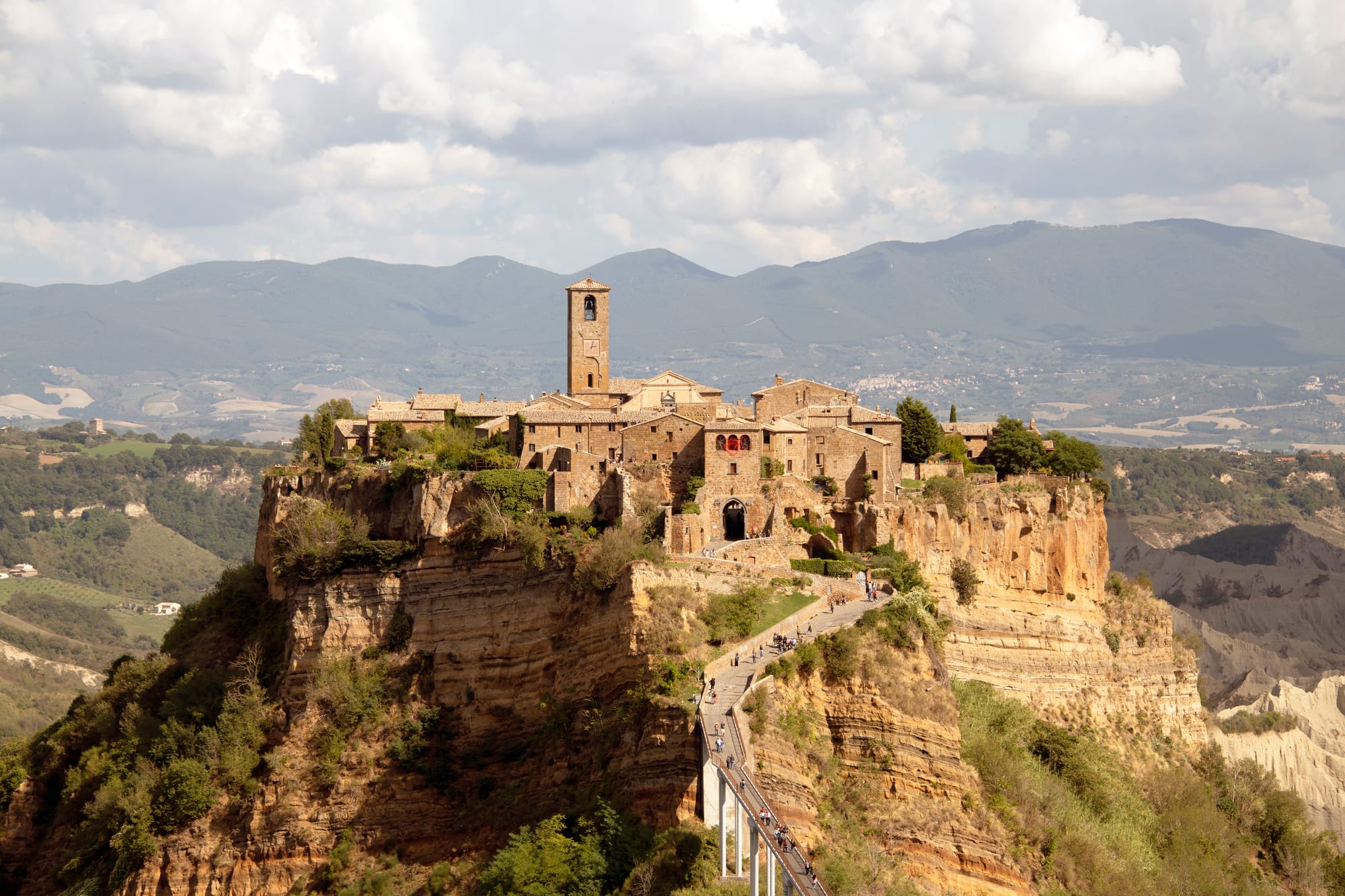
The stone village of Civita di Bagnoregio on an eroded cliff-top, reached by a long footbridge, with hills behind

Italy

Lazio

Civita di Bagnoregio in northern Lazio, perched on a crumbling spur of volcanic tuff above the Valle dei Calanchi. (Orlando Paride / Wikimedia Commons · CC BY-SA 4.0)

The region around Rome in central Italy, stretching from the Tyrrhenian coast inland to the Apennines — the ancient Latium of the Latins and Etruscans, for centuries the heart of the Papal States, and beyond the capital a land of volcanic lakes, hill towns, Roman villas and Etruscan tombs, from Tivoli and Ostia Antica to the Castelli Romani and Viterbo.

Explore Lazio

History

Latium, the plain south of the Tiber, was the land of the Latins, whose towns on the Alban Hills formed a league long before Rome dominated them. North of the river the Etruscans built cities such as Tarquinia, Cerveteri, Veio and Vulci, while Sabines, Volsci and Hernici held the hills to the east and south. Rome, founded by tradition in 753 BC, absorbed them all by the 4th and 3rd centuries BC, and the countryside filled with villas, from Hadrian's at Tivoli to Tiberius's at Sperlonga, while Ostia served as the capital's port.

After the empire, the papacy became the real power in the region. The Patrimony of St Peter grew into the Papal States, and Lazio's towns were ruled from Rome, contested by baronial families such as the Colonna, Orsini and Caetani. In the 13th century the popes lived for decades at Viterbo, where the marathon election of 1268–71 led to cardinals being locked in — the origin of the conclave. St Benedict founded his first monasteries at Subiaco and then Montecassino.

Rome fell to Italian troops in September 1870 and became the capital of the kingdom in 1871, and the rest of Lazio was joined to it. Under Fascism the Pontine Marshes south of Rome were drained and new towns founded, including Latina and Sabaudia. The Allied landings at Anzio and the battle of Monte Cassino, which destroyed the abbey, brought the Second World War to the region in 1944. Post-war Rome grew rapidly with migrants from the south, and in 2016 an earthquake destroyed the town of Amatrice in the northern Apennines.

Culture & Customs

Lazio is dominated by Rome, and the Roman temperament — ironic, unhurried, quick to mock pretension — is the best known of the region. Romanesco, the Roman dialect, has a long literary tradition, from the sonnets of Giuseppe Gioachino Belli to the films of Alberto Sordi, and Rome's cinema industry at Cinecittà, founded in 1937, has made the city part of the world's film imagination. Outside the capital, the provinces of Viterbo, Rieti, Frosinone and Latina have strong local identities of their own; the Tuscia of the north feels close to Tuscany and Umbria, the Ciociaria of the south to Campania.

Religious life is shaped by the presence of the papacy and by great pilgrimage years such as the Jubilee. Viterbo's Macchina di Santa Rosa, a lit tower about 30 metres high carried through the streets on 3 September by a team of porters, is recognised by UNESCO as intangible heritage along with similar processions elsewhere in Italy. Genzano lays a carpet of flowers along its main street for Corpus Domini, and Marino's grape festival in October has fountains running with wine.

Football divides Rome between Roma and Lazio, and their derby is one of the most intense in the country. Crafts include ceramics at Civita Castellana and Vasanello, and the Castelli Romani keep the tradition of the fraschette, simple taverns serving the local wine.

Daily Life

About 5.7 million people live in Lazio, and roughly half of them in the city of Rome, which has about 2.75 million residents and a wider metropolitan area of around four million. The other provincial capitals — Latina, Viterbo, Frosinone and Rieti — are small in comparison, and many people commute into Rome from the Castelli Romani, the coast and the Sabine hills.

The economy rests on public administration and the national government, tourism and pilgrimage, services, film and television production, and pharmaceuticals and chemicals in the Latina and Frosinone areas. Fiumicino is Italy's busiest airport, and Civitavecchia is one of the Mediterranean's main cruise ports. The Pontine plain grows vegetables and kiwifruit, and water buffalo are raised for mozzarella on the southern plains.

Daily life in Rome means long commutes, traffic and a late rhythm: lunch around 1.30, dinner rarely before nine. The region's current issues include Rome's problems with rubbish collection and public transport, pressure from mass tourism and short-term lets on the historic centre, and the depopulation of the inland mountain villages.

Food

Roman cooking is working-class and bold. The four classic pastas are carbonara, made with eggs, guanciale and pecorino; cacio e pepe, just cheese and pepper; gricia, guanciale and pecorino; and amatriciana, which adds tomato and takes its name from Amatrice. The quinto quarto, the offal once paid to slaughterhouse workers in Testaccio, gives coda alla vaccinara, braised oxtail, and pajata. Supplì are fried rice balls with a mozzarella centre, carciofi alla romana and carciofi alla giudia are braised and deep-fried artichokes, the latter from the Jewish Ghetto, and abbacchio is roast milk-fed lamb.

Beyond Rome, porchetta from Ariccia is whole roast pork with herbs, sold in thick slices, Nemi is known for its wild strawberries, and the lakes and coast supply eel, lake fish and seafood. Pecorino Romano is the classic sheep's cheese, and buffalo mozzarella is made on the southern plains. Maritozzi, soft buns split and filled with whipped cream, are the Roman breakfast treat.

Frascati is the famous white wine of the Castelli Romani, and the hills around Montefiascone produce Est! Est!! Est!!!, a white with a legend about a thirsty bishop's servant. Cesanese del Piglio, from the province of Frosinone, is a leading red.

Attractions & Natural Wonders

Rome's ancient sites include the Palatine and Forum, the Capitoline Museums, the Baths of Caracalla and the Appian Way with its catacombs; later layers bring the Borghese Gallery, Baroque piazzas such as Navona, and the neighbourhoods of Trastevere and Testaccio. Vatican City sits inside Rome but is a separate state. Ostia Antica, near the coast, preserves streets, apartment blocks, baths and a theatre of Rome's port town.

East of Rome, Tivoli has Hadrian's Villa, with its pools and colonnades, and the Villa d'Este, whose gardens of fountains and water organs descend a hillside, both UNESCO World Heritage Sites; further on are the monasteries of Subiaco. To the south-east, the Castelli Romani include Frascati and its villas, Castel Gandolfo above Lake Albano, Nemi above its crater lake, and Ariccia. Further south lie Montecassino's rebuilt abbey, the Circeo National Park, the coastal towns of Sperlonga and Gaeta, and the Pontine Islands of Ponza and Ventotene.

North of Rome, the Etruscan necropolises of Cerveteri and Tarquinia, a UNESCO World Heritage Site, have painted and carved tombs. Viterbo's Palazzo dei Papi and medieval quarter lead on to Villa Lante at Bagnaia, the Farnese palace at Caprarola, the Monster Park at Bomarzo, the volcanic lakes of Bolsena, Vico and Bracciano, and Civita di Bagnoregio on its eroding tuff spur.

Cities in Lazio

Planning basics

Budget

Rome is one of Italy's most expensive cities for accommodation, and it adds a city tourist tax per night. The rest of Lazio is much cheaper: rooms and meals in Viterbo, the Castelli Romani and the southern coast cost far less, and the Castelli's fraschette serve wine and porchetta at modest prices. Many of the region's sites, such as Ostia Antica, are cheaper and quieter than their Roman counterparts.

Daily Budget Midrange
USD 180–370 (central Rome hotel, restaurant dinners, museum and site tickets, day trips by train)
Daily Budget Shoestring
USD 80–140 (hostel or simple B&B, pizza al taglio and trattoria meals, public transport)

Stay outside the historic centre of Rome on a metro line to save money, and use regional trains for day trips to Tivoli, Frascati and Ostia.

Safety

Outside Rome, Lazio is quiet and safe. In Rome the main problems are pickpockets on buses, the metro and around Termini station and major monuments, scams near the Colosseum and the Vatican, and heavy traffic for pedestrians. Summer heat is a real risk at open archaeological sites such as Ostia and Hadrian's Villa.

Carry water and a hat at the ancient sites in summer, and keep bags closed and in front on Roman public transport. Check current official travel advice before travelling.

Climate

The coast and Rome have a Mediterranean climate with long hot summers and mild, rainy winters. The Alban Hills and the Viterbo area are a few degrees cooler, and the Apennines along the border with Abruzzo, around Rieti and the Monti Simbruini, have cold winters and regular snow.

Summer
hot and dry, 30–35°C in Rome, cooler on the coast and in the hills
Winter
mild and wet, 4–14°C in Rome; cold with snow in the Apennines

Transportation

Rome is the hub, with Fiumicino airport, high-speed trains to Florence, Naples and Milan, and a regional network in all directions. Ostia Antica is about half an hour from the city on the Roma–Lido railway, Frascati is a short regional train ride, Tivoli is reachable by train or Cotral bus in about an hour, and Viterbo takes around two hours by regional train. A car helps for the Tuscia lakes, the Etruscan sites and the southern coast, but driving inside Rome is best avoided.

Buy and validate tickets before boarding Roman buses and regional trains; do not drive into Rome's ZTL zone.

Best Time to Visit

April to June and September to October are best, with warm days suited to both Rome and the countryside, and the grape harvest and wine festivals in the Castelli Romani in early autumn. July and August are hot and very crowded in Rome, when Romans head to the coast at Sperlonga, Gaeta and the Pontine Islands. Winter is mild enough for sightseeing and the quietest time for museums.