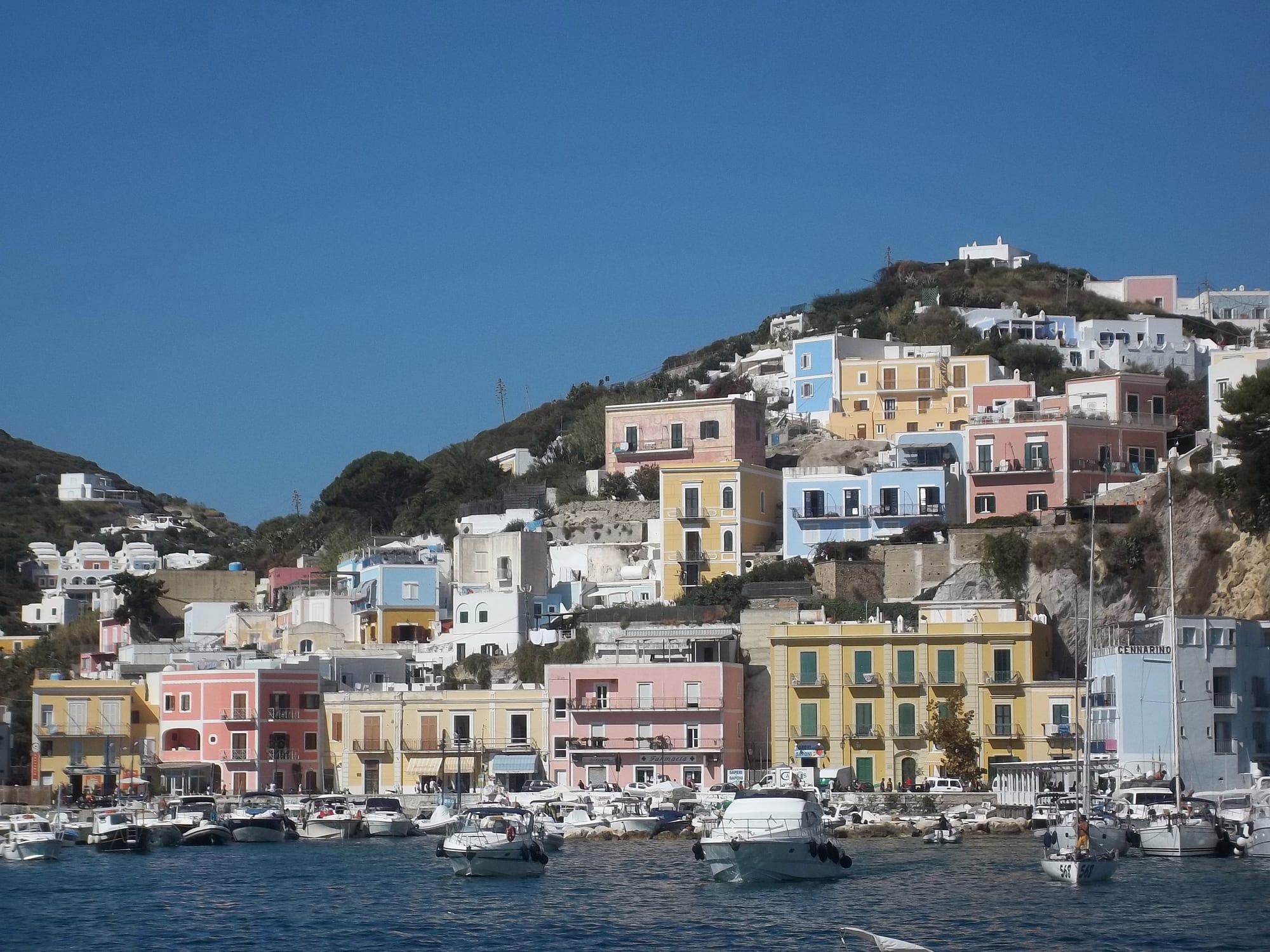
Pink, yellow and blue houses stacked on a hillside above a harbour full of white motorboats under a clear sky

Lazio, Italy

Ponza

The pastel houses of Ponza town rising above the harbour. (sandrino100 / Wikimedia Commons · CC BY 3.0)

The largest of the Pontine Islands, a crescent of volcanic rock in the Tyrrhenian Sea south of Cape Circeo. A Roman place of exile and later a Fascist prison island, it was resettled by the Bourbons with families from Ischia in the 18th century; today its pastel harbour town fills with Italian holidaymakers every summer.

Neighbourhoods

  • Ponza Porto
    • First-time visitors
    • Restaurants
    • Close to ferries

    The main town around the harbour, laid out under the Bourbons in the late 18th century with a curving front of houses on two street levels, the town hall and the parish church. Ferries, the bus, boat hire and most restaurants and shops are here.

    Open in Maps
  • Santa Maria and Giancos
    • Quiet and residential
    • Beaches

    The low, fertile stretch of coast beside the harbour, where the Roman port once stood. Santa Maria has a small beach, and Roman tunnels link it with the newer harbour.

    Open in Maps
  • Le Forna
    • Swimming
    • Local life

    The village in the north of the island, beyond Campo Inglese, with its own coves, a natural seawater pool and the island's Assumption feast in August. Bentonite mines here employed islanders until 1975.

    Open in Maps

Things to do

Town and history

  • Santi Silverio e Domitillalandmark

    The neoclassical parish church above the harbour, dedicated to the island's patron Saint Silverius and to Saint Domitilla.

    Open in Maps
  • Grotte di Pilatolandmark

    Rock-cut Roman chambers at the water's edge below Punta Madonna, used for fishing and, despite the name, unconnected with Pontius Pilate.

    Open in Maps

Beaches and coast

  • Chiaia di Lunaviewpoint

    The crescent bay on the south-western shore beneath high tuff cliffs — the island's largest bay, its beach closed to access after a fatal rockfall in 2001 but still a famous view from above.

    Open in Maps
  • Cala Feolabeach

    One of the island's coves, a popular place to swim in summer.

    Open in Maps
  • Cala Fontebeach

    A small natural fishermen's harbour on the north side of the island, with clear water for swimming.

    Open in Maps
  • Faraglioni di Lucia Rosaviewpoint

    Sea stacks off the cliffs, named after a young woman who threw herself from the cliff rather than give up the poor farmer she loved.

    Open in Maps

Boat trips

  • Palmarolapark

    The craggy, mostly uninhabited island about 10 km west, mainly a nature reserve, with grottoes, cliffs and a few small beaches, where Pope Silverius died in exile.

    Open in Maps
  • Zannonepark

    An uninhabited island of about one square kilometre, with the Punta Varo lighthouse and a small forestry station and exhibit on its highest point.

    Open in Maps

Seasonal events

  • Feast of San Silverio20 June

    The feast of the island's patron, the pope who died on Palmarola, and the most important celebration of the year for the deeply devoted islanders.

  • Madonna della Civita21 July

    A feast at Scotti di Sopra with a procession and traditional games.

  • Assumption at Le Forna15 August

    The feast of the Madonna Assunta in the northern village, at the height of the summer season.

Eat and drink

Long-standing places and food districts in Ponza. Hours, ratings and directions come from your maps app, always current.

Food districts

  • Harbour restaurantsneighborhood

    Restaurants and bars along the curving harbour front and the street above it, where most visitors eat fish and seafood landed by the island's boats.

    Open in Maps
  • Le Fornaneighborhood

    Smaller places to eat in the northern village, near the coves and the natural pool.

    Open in Maps

Experience Ponza

History

The island was inhabited from Neolithic times, and its main settlements arose under the Volsci. Under Rome, Ponza grew into a busy port, with aqueducts, villas and long tunnels linking the old harbour at Santa Maria with the villas on the hills. It was also a place of exile: Caligula's eldest brother Nero Caesar was deported here in AD 29 and put to death the following year, and his sisters Agrippina the Younger and Julia Livilla were exiled here in AD 39. The origin of the name is uncertain; a local tradition links it to Pontius Pilate, but the name Pontia appears earlier in Strabo.

In the Middle Ages Benedictine monks kept a religious and trading centre going for a time, and Pope Silverius died in exile on nearby Palmarola. Raids by Saracens and pirates eventually emptied the island, and the Ottoman fleet defeated Andrea Doria's Spanish fleet off Ponza in 1552.

In 1734 the archipelago passed to Charles of Bourbon, king of Naples, who settled it with colonists mainly from Ischia; today's islanders descend from them. Under Ferdinand IV the harbour town, the fortress and the public buildings were built. After a brief Napoleonic interlude and capture by a British captain in 1813, Ponza joined Italy in 1861. The Fascist regime made it a place of internal exile for political opponents from 1928, and Mussolini himself was held here from 27 July to 7 August 1943, after his arrest. Bentonite mining at Le Forna ran from 1935 to 1975, when the mines were closed.

Culture & Customs

Ponza's identity is that of a close island community with Neapolitan roots, shaped by fishing, the sea and the Church. The feast of San Silverio on 20 June is the high point of the year; the Assumption is celebrated at Le Forna on 15 August, and smaller feasts include the Madonna della Civita in July, with a procession and traditional games.

Myth runs through the island's landscape. Ponza has been suggested as Homer's Aeaea, the island of the sorceress Circe, and grottoes on the west coast carry the names of Circe and Ulysses. The cliff of Lucia Rosa recalls a 19-year-old woman who, forbidden by her family to marry the poor farmer she loved, threw herself into the sea; the sea stacks below now bear her name.

The island has long attracted film-makers and celebrities. Federico Fellini shot scenes of Satyricon (1969) here, some of Wes Anderson's The Life Aquatic was filmed on the island, and the Rai series Un'altra vita (2014) was largely shot on Ponza. Jacques Cousteau and his son Philippe filmed documentaries in the surrounding waters.

Daily Life

The municipality of Ponza has about 3,100 residents and takes in the uninhabited Zannone, Palmarola, which is lived on only in summer, and Gavi. Most people live in the harbour town and the nearby districts of Guarini, Giancos, I Conti and Santa Maria, and in the north around Campo Inglese and Le Forna.

Tourism is the biggest industry, followed by boatbuilding, boat repair and fishing. Part of the population still fishes and a few grow vines, but farming has shrunk since tourism took hold, and many of the terraces that once covered the hillsides are no longer worked. Restrictions on commercial fishing have weakened the local economy, and many young islanders leave for the mainland and do not return, while other Italians move in.

The year has two rhythms. In summer the harbour fills with yachts, ferries and holidaymakers, the population swells and the narrow road is busy. In winter the ferries are fewer, many businesses close, and the island depends on its boat links to the mainland, which rough seas can interrupt. There is no airstrip; plans for one in the north were cancelled on environmental grounds.

Food

Ponza eats from the sea. The harbour is a working fishing port, and the restaurants along the waterfront and in the streets above serve the fish and seafood landed by local boats. Smaller places to eat are found at Le Forna and around the coves in the north.

Farm production on the island is small but of good quality. Ponza is known for its lentils and for a fragrant white wine sold as Fieno di Ponza IGT. The same terraces have traditionally grown grapes, prickly pears and figs, though many have fallen out of use as islanders turned to tourism.

Most islanders descend from the families who settled here from Ischia in the 18th century, and fishing remains part of island life. Summer evenings centre on the harbour front, where bars and cafés stay open late as the evening stroll goes on.

Planning tools

Budget

Ponza is expensive in July and August, when rooms are scarce and boat hire is in high demand; June and September cost noticeably less. The ferry or hydrofoil crossing is an extra cost on top of travel to the port, and hiring a boat or joining a boat tour is the main expense for most visitors.

Daily Budget Midrange
USD 180–350 (guesthouse or apartment, seafood dinners, a shared boat tour)
Daily Budget Shoestring
USD 90–150 (simple guest room, pizza and bar meals, the island bus)

Book rooms and crossings early for summer weekends and August, and allow a spare day in case rough seas cancel the boats.

Best Time to Visit

June and September offer warm sea weather with fewer crowds. July and August are the hottest, driest and busiest months, when visitors arrive mainly from Campania and Lazio. Many businesses close outside the season, and November is the wettest month.

Suggested Number of Days

Two or three days give time for the harbour town and a boat trip around the coast. Allow longer to visit the neighbouring islands as well, and add a margin for bad weather, which can stop ferries and boat trips.

First Visit
2–3 days
With Surroundings
4–6 days

Transportation

A narrow two-lane road runs the length of the island, suitable only for small cars, and a bus runs along it every 10–30 minutes from the harbour. The sea is the best way to see the island: many coves and grottoes can be reached only by boat.

Small cars only suit the island's road; for a short stay the bus and the boats cover most needs.

Airport & Station Connections

Ferries and hydrofoils connect the harbour with Formia, Terracina and Naples all year, and seasonally with Anzio and Ischia; boats also link it with San Felice Circeo. Hydrofoils from Anzio and Formia take about 75 minutes and the Formia ferry about two hours. Formia is reached by frequent trains from Rome Termini. Crossings may be cancelled in severe weather.

Walkability

Ponza town is compact and walkable, though steep away from the harbour front. The rest of the island is spread along one hilly road with little room for pedestrians, so walkers use the bus between villages.

Safety

Italy is generally safe, with low levels of violent crime against visitors. On Ponza the real danger is natural: rockfalls from the crumbling cliffs have killed sunbathers, and several beaches, including Chiaia di Luna, are permanently closed.

Respect closed beaches and warning signs, keep away from cliff edges and the foot of cliffs, and check the sea forecast before boat trips. Check current official travel advice before travelling.

Climate

A Mediterranean climate with hot, dry summers and mild, rainy winters, moderated by the sea. The annual average temperature is about 17°C.

Summer
hot and very dry — August averages about 25.5°C, and July is the driest month
Winter
mild — February, the coldest month, averages about 10.4°C, and November is the wettest month

Local Customs

Islanders descend largely from 18th-century settlers from Ischia and are deeply attached to their patron, San Silverio. Swimwear stays on the beach and the boats; cover up in town and in church. Life runs late in summer, with dinner and the evening stroll along the harbour.

Tipping is not expected, though rounding up is welcome; dress modestly in churches and keep clear of fishermen's work on the quays.

Common Payment Methods

The currency is the euro. Cards are accepted in most restaurants, shops and hotels, but carry cash for small bars, buses and some boat operators. Cash machines are in the harbour town.