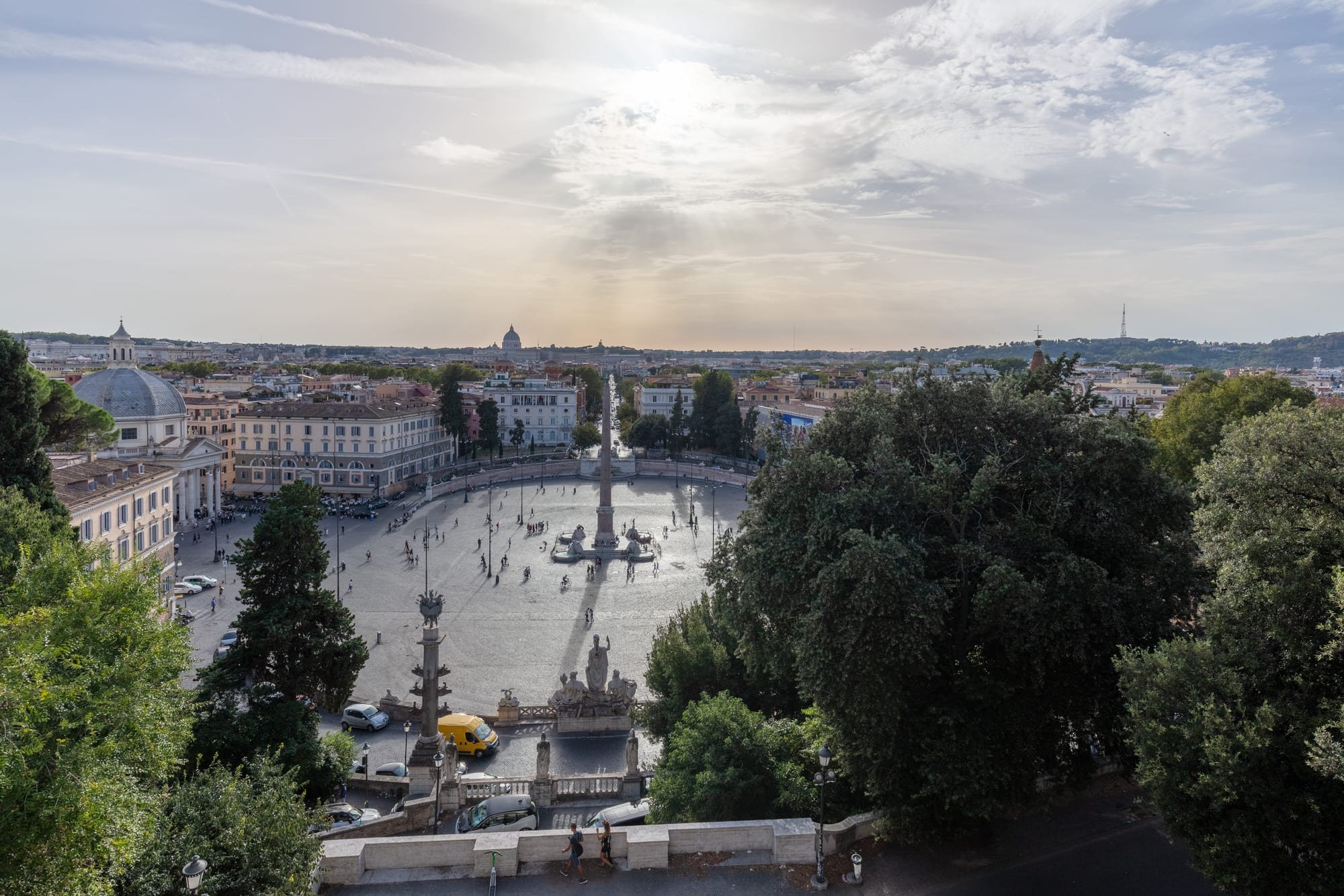
Piazza del Popolo with its central obelisk seen from the Pincio terrace, with Rome's rooftops and a distant dome beyond

Lazio, Italy

Rome

Piazza del Popolo and the rooftops of Rome, seen from the Pincio terrace above the square. (Diego Delso / Wikimedia Commons · CC BY-SA 4.0)

Italy's capital and largest city, on the Tiber in Lazio — by legend founded in 753 BC, then the centre of an empire, for centuries the seat of the popes and since 1871 the capital of united Italy. Its UNESCO-listed historic centre layers ancient ruins, churches and Baroque squares, around which spreads a sprawling modern city of about 2.7 million people.

Neighbourhoods

  • Centro Storico
    • First-time visitors
    • Historic district
    • Close to the sights

    The historic centre in the bend of the Tiber, a dense grid of lanes and piazzas around the Pantheon, Piazza Navona and Campo de' Fiori. Most of the famous squares and fountains are within walking distance, and it is the busiest and most expensive place to stay.

    Open in Maps
  • Monti
    • Bars and cafés
    • Close to public transport
    • Near the Colosseum

    A central rione on the slopes between the Forum and Santa Maria Maggiore, with narrow streets of small shops, wine bars and restaurants a short walk from the Colosseum and the metro.

    Open in Maps
  • Trastevere
    • Nightlife
    • Best for food
    • Historic district

    The district across the Tiber below the Janiculum, a maze of cobbled lanes, churches and trattorias where the city's Jewish community once lived. It is crowded at night, so much so that a night-time traffic limit now applies.

    Open in Maps
  • Testaccio
    • Best for food
    • Local life
    • Nightlife

    A working-class rione built around Monte Testaccio, a hill of broken ancient amphorae, and the former slaughterhouse that gave Roman cooking its offal dishes. Its covered market and bars make it a local favourite for eating and going out.

    Open in Maps
  • Prati
    • Quiet and residential
    • Close to the Vatican
    • Shopping

    A late 19th-century district of broad, straight streets and apartment blocks beside Vatican City and Castel Sant'Angelo, with shopping streets and a calmer feel than the centre.

    Open in Maps
  • Esquilino
    • Close to public transport
    • International food
    • Budget stays

    The area around Termini station and Santa Maria Maggiore, now largely an immigrant neighbourhood with restaurants serving many cuisines and many budget hotels; it is convenient but busy and scruffy around the station.

    Open in Maps
  • San Lorenzo
    • Students and nightlife
    • Street life

    A student district beside the Sapienza university, heavily bombed in July 1943 and now full of bars, cafés, restaurants and nightclubs, so busy at night that a night-time traffic limit applies.

    Open in Maps
  • EUR
    • Architecture
    • Business district

    A planned district south of the centre, begun for a world's fair that never took place and completed after the war as a business quarter of wide avenues and monumental white buildings.

    Open in Maps

Things to do

Ancient Rome

  • Colosseumlandmark

    The great oval amphitheatre completed in AD 80, the largest of the ancient world and still the largest standing, where gladiators fought before tens of thousands of spectators.

    Open in Maps
  • Roman Forumlandmark

    The ruins of the ancient city's centre of public life, a valley of temples, basilicas and triumphal arches between the Palatine and Capitoline hills.

    Open in Maps
  • Palatine Hilllandmark

    The hill above the Forum where, by tradition, Rome was founded, later covered by the palaces of the emperors.

    Open in Maps
  • Pantheonlandmark

    An ancient Roman temple, later a church, whose great concrete dome with its open oculus has stood for nearly two thousand years.

    Open in Maps
  • Baths of Caracallalandmark

    The towering brick ruins of one of the largest public bath complexes of imperial Rome, south of the centre.

    Open in Maps

Squares and fountains

  • Trevi Fountainlandmark

    The largest Baroque fountain in the city, its sculpted figures set against the facade of Palazzo Poli; since February 2026 non-residents need a ticket to approach the basin and throw coins.

    Open in Maps
  • Piazza Navonalandmark

    A long Baroque square that follows the shape of an ancient stadium, with Bernini's Fountain of the Four Rivers at its centre.

    Open in Maps
  • Spanish Stepslandmark

    The 18th-century stairway climbing from Piazza di Spagna to the church of Trinità dei Monti.

    Open in Maps

Churches and the Vatican

  • St Peter's Basilicalandmark

    The vast Renaissance basilica in Vatican City, a separate state inside Rome, crowned by Michelangelo's dome.

    Open in Maps
  • Vatican Museumsmuseum

    The papal collections in Vatican City, whose route ends in the Sistine Chapel.

    Open in Maps
  • Castel Sant'Angelolandmark

    Hadrian's mausoleum on the Tiber, turned into a papal fortress and now a museum, where Clement VII sheltered during the sack of 1527.

    Open in Maps
  • Santa Maria Maggiorelandmark

    One of Rome's four major papal basilicas, on the Esquiline near Termini, with early Christian mosaics.

    Open in Maps
  • Archbasilica of St John Lateranlandmark

    The cathedral of Rome and seat of its bishop, the pope, and the oldest of the four major papal basilicas.

    Open in Maps

Museums

  • Capitoline Museumsmuseum

    Ancient sculpture and Renaissance painting in the palaces on Michelangelo's Piazza del Campidoglio, among the oldest public museums in the world.

    Open in Maps
  • Galleria Borghesemuseum

    A villa in the Borghese gardens holding Bernini's sculptures and paintings by Caravaggio, Raphael and Titian.

    Open in Maps
  • Museo Nazionale Romanomuseum

    The national museum of ancient Rome, spread over several sites including Palazzo Massimo near Termini and the Baths of Diocletian.

    Open in Maps
  • MAXXImuseum

    The national museum of 21st-century art and architecture in the Flaminio district, in a building designed by Zaha Hadid.

    Open in Maps

Parks, viewpoints and the Appian Way

  • Villa Borghese gardenspark

    Rome's third-largest public park, laid out for the Borghese family, with the Pincio terrace overlooking Piazza del Popolo.

    Open in Maps
  • Janiculumviewpoint

    The ridge above Trastevere, with one of the widest views across the city's domes and rooftops.

    Open in Maps
  • Aventine Hillviewpoint

    A quiet residential hill of churches and gardens above the Circus Maximus and the Tiber.

    Open in Maps
  • Appian Waytrail

    The ancient road leading south-east from the city, lined with tombs and ruins and with early Christian catacombs beneath the fields beside it.

    Open in Maps

Short trips from the city

  • Ostia Anticaattraction

    The excavated harbour town of ancient Rome near the coast, with streets of apartment blocks, warehouses, baths and a theatre, reached on the Roma–Lido railway.

    Open in Maps

Seasonal events

  • Natale di Roma21 April

    The city's birthday, marking the legendary founding of Rome, celebrated with historical parades and events.

  • Italian OpenMay

    A major international clay-court tennis tournament played at the Foro Italico.

  • Rome Film FestOctober

    An international film festival held each October, centred on the Auditorium Parco della Musica.

  • Rome Marathonspring

    An annual marathon through the streets of the historic centre.

Eat and drink

Long-standing places and food districts in Rome. Hours, ratings and directions come from your maps app, always current.

Food districts and markets

  • Campo de' Fiorimarket

    A square in the historic centre that has held a daily vegetable and fish market since 1869, surrounded by bars and restaurants.

    Open in Maps
  • Testaccio Marketmarket

    The covered market of the old slaughterhouse district, moved from Piazza Testaccio to Via Luigi Galvani in 2012, with food stalls among the produce.

    Open in Maps
  • The Roman Ghettoneighborhood

    The old Jewish quarter near the Great Synagogue, where restaurants serve carciofi alla giudia and other dishes of the city's ancient Jewish community.

    Open in Maps
  • Trastevereneighborhood

    Lanes full of trattorias, pizzerias and bars across the river, busiest in the evening.

    Open in Maps
  • Esquilinoneighborhood

    The district near Termini where restaurants serve many international cuisines, reflecting the immigrant communities who live there.

    Open in Maps

Experience Rome

History

Roman legend dates the founding of the city to 21 April 753 BC, when Romulus killed his twin Remus and gave the city his name, but the hills by the Tiber had been settled long before, by a mix of Latins, Etruscans and Sabines. Rome was ruled by kings until 509 BC, when the last was expelled and a republic led by two consuls took over. The republic conquered first central Italy and then the Mediterranean, and in 27 BC Octavian became Augustus, the first emperor. At its height the city may have held a million people; it lost its political role as the empire divided, was sacked by the Visigoths in 410 and the Vandals in 455, and shrank to tens of thousands among the ruins.

From the 8th century Rome was the capital of the Papal States. Boniface VIII called the first Jubilee in 1300, the papacy moved to Avignon from 1309 to 1377, and on its return the popes rebuilt the city as a Renaissance capital until imperial troops sacked it in 1527. Baroque popes then gave it its fountains, squares and domes.

After brief republics in 1798–1800 and 1849, French troops guarding the pope withdrew in 1870, Italian forces took the city, and in 1871 it became the capital of the Kingdom of Italy. It grew from about 225,000 people in 1870 to over a million soon after 1930. Mussolini's regime cut wide avenues through the centre; Allied bombing hit San Lorenzo in July 1943, killing about 3,000 people. The post-war boom filled new suburbs, the city hosted the 1960 Olympics, and the Treaty of Rome founding the European Economic Community was signed here in 1957. The population peaked at over 2.8 million in the mid-1980s.

Culture & Customs

Rome is the seat of the Catholic Church and has been for most of two thousand years; Vatican City, with St Peter's, is a separate state within it, and pilgrims arrive in great numbers in Jubilee years. The city is also called the Eternal City and Caput Mundi, the capital of the world, and its historic centre is a UNESCO World Heritage Site. A Jewish community has lived here since the end of the Roman Republic; confined to a ghetto until 1870, it still worships at the Great Synagogue in the old quarter.

Cinema is central to the city's image. Cinecittà, founded in 1937, is the largest film studio in Europe, and the Rome Film Fest is held each October. Romanesco, the Roman dialect, has a long literary tradition, and the city's "talking statues", such as Pasquino, have long served as places to voice opinions, often satirically.

Football divides the city between Lazio, founded in 1900, and Roma, founded in 1927, who share the Stadio Olimpico, and their Derby della Capitale is a staple of Roman sporting life. The Foro Italico hosts the Italian Open tennis tournament each May, and every 21 April the Natale di Roma marks the city's legendary birthday.

Daily Life

About 2.75 million people lived in the comune of Rome in 2026, making it Italy's largest city and the third most populous within city limits in the European Union; the wider urban area holds about 3.9 million. Immigrants make up about 15 per cent of residents, many of them from Romania, Poland, Ukraine and Albania, the Philippines, Bangladesh and China, and the Esquilino district near Termini has become largely an immigrant neighbourhood.

The economy is mostly services: national government and public administration, tourism, commerce, finance, telecommunications, aerospace and defence, media and the creative industries. Eni, Enel, Leonardo, Poste Italiane and the state railways have their headquarters here, and EUR, Ostiense and the Tiburtina valley are the main office districts. La Sapienza, founded in 1303, is one of the largest universities in the world.

Daily life means long commutes on a stretched transport network, heavy traffic caused by the radial street plan and a late daily rhythm. The population has slowly declined since the 1980s as people moved to nearby suburbs, while the city receives an average of 7–10 million tourists a year, sometimes double that in holy years.

Food

Roman cooking is working-class and bold. The famous pastas are cacio e pepe, simply cheese and black pepper; gricia, with guanciale (cured pig's jowl) and hard cheese, typically pecorino romano; carbonara, which adds egg; and amatriciana, which adds tomato. Testaccio, the old slaughterhouse district, gave the city its offal cooking: coda alla vaccinara, oxtail cooked the butchers' way, still one of the city's most popular dishes, and rigatoni with pajata. Abbacchio is a lamb dish, and artichokes, peas and fava beans fill the spring menus.

The city's Jewish community has shaped Roman food for centuries: carciofi alla giudia, Jewish-style artichokes, deep-fried until crisp, come from the Ghetto, along with pizza dolce di Beridde. Pizza al taglio, sold by the slice, and supplì, balls of rice with tomato sauce, are the street food, and porchetta, a savoury boneless pork roast, is iconic of Lazio. Maritozzi are buns filled with whipped cream.

Campo de' Fiori has held a daily market since 1869, and Testaccio's covered market moved to Via Luigi Galvani in 2012. Grattachecca, a shaved ice, is typical of Rome. Frascati, a white wine of the Castelli Romani, is iconic of Lazio.

Planning tools

Budget

Rome is one of Italy's most expensive cities for accommodation, and a city tourist tax is added per night. Food need not be costly: pizza al taglio, supplì and market stalls are cheap, and many churches, squares, fountains and viewpoints are free. The big costs are central rooms, tickets for the major sites and museums, and dinners in the most visited areas.

Daily Budget Midrange
USD 190–370 (central hotel, restaurant dinners, site and museum tickets, taxis now and then)
Daily Budget Shoestring
USD 80–140 (hostel bed or simple B&B, pizza al taglio and trattoria meals, metro and buses)

Staying outside the historic centre on a metro line saves money; book timed tickets for the most popular sites well ahead in high season.

Best Time to Visit

April to June and September to October are the best months, warm enough for long days outdoors without the worst of the heat. July and August are hot, humid and very crowded, and many Romans leave the city in August. Winter is mild and the quietest time for museums, though it can be wet.

Suggested Number of Days

Three or four days give a first look at the ancient city, the main churches and museums and the historic centre at a sensible pace. Five to seven allow time for the outer districts and day trips by train into Lazio. Queues and summer heat both stretch the number.

First Visit
3–4 days
With Surroundings
5–7 days

Transportation

Rome has three metro lines: A and B cross at Termini, and line C, which runs in from the eastern suburbs, reached the Colosseum in December 2025. More than 350 bus lines, a small tram network and urban trains cover the rest. Traffic is heavy because of the city's radial street plan, taxis are relatively scarce, and much of the centre is a limited traffic zone closed to unauthorised cars.

Buy and validate tickets before boarding buses and trams, and do not drive into the ZTL, where cameras fine unauthorised cars.

Airport & Station Connections

Leonardo da Vinci–Fiumicino, Italy's busiest airport, is about 35 km by road from the historic centre, with trains into the city. Ciampino, the older airport, is about 12 km south-south-east of the centre. Termini, one of Europe's largest stations, and Tiburtina have high-speed trains to all major Italian cities and overnight trains to Sicily, Munich and Vienna.

Walkability

The historic centre is best seen on foot: the Pantheon, Piazza Navona, the Trevi Fountain and the Spanish Steps lie within a short walk of one another, and the Forum and Colosseum are a little further. Distances add up quickly, cobbles are hard on the feet, and pavements are often narrow or crowded. Crossing busy roads needs care, as drivers rarely wait.

Safety

Italy is generally safe, with low levels of violent crime against visitors. In Rome the main problems are pickpockets on buses, the metro and around Termini and the big monuments, and scams near the Colosseum and the Vatican. Heavy traffic is a real hazard for pedestrians, and summer heat is draining at open archaeological sites.

Keep bags closed and in front on public transport, carry water and a hat at the ancient sites in summer, and use official taxis or apps. Check current official travel advice before travelling.

Climate

A Mediterranean climate with hot, dry summers and mild, humid winters. The city's record temperature of 42.9°C was set in July 2023.

Summer
hot and dry — August days average about 32°C, nights about 17°C
Winter
mild — January days average about 13°C, nights about 2°C

Local Customs

Coffee is drunk standing at the bar, and cappuccino is a morning drink. Football loyalties divide the city between Roma and Lazio, and aperitivi with small snacks before dinner are popular. St Peter's and the major basilicas enforce dress codes.

Cover shoulders and knees to enter St Peter's and other churches, and keep voices low during services.

Common Payment Methods

The currency is the euro, also used in Vatican City. Cards and contactless payment are accepted almost everywhere, but a little cash is useful for small bars and market stalls. Cash machines are everywhere, and the city tourist tax is collected by the accommodation.