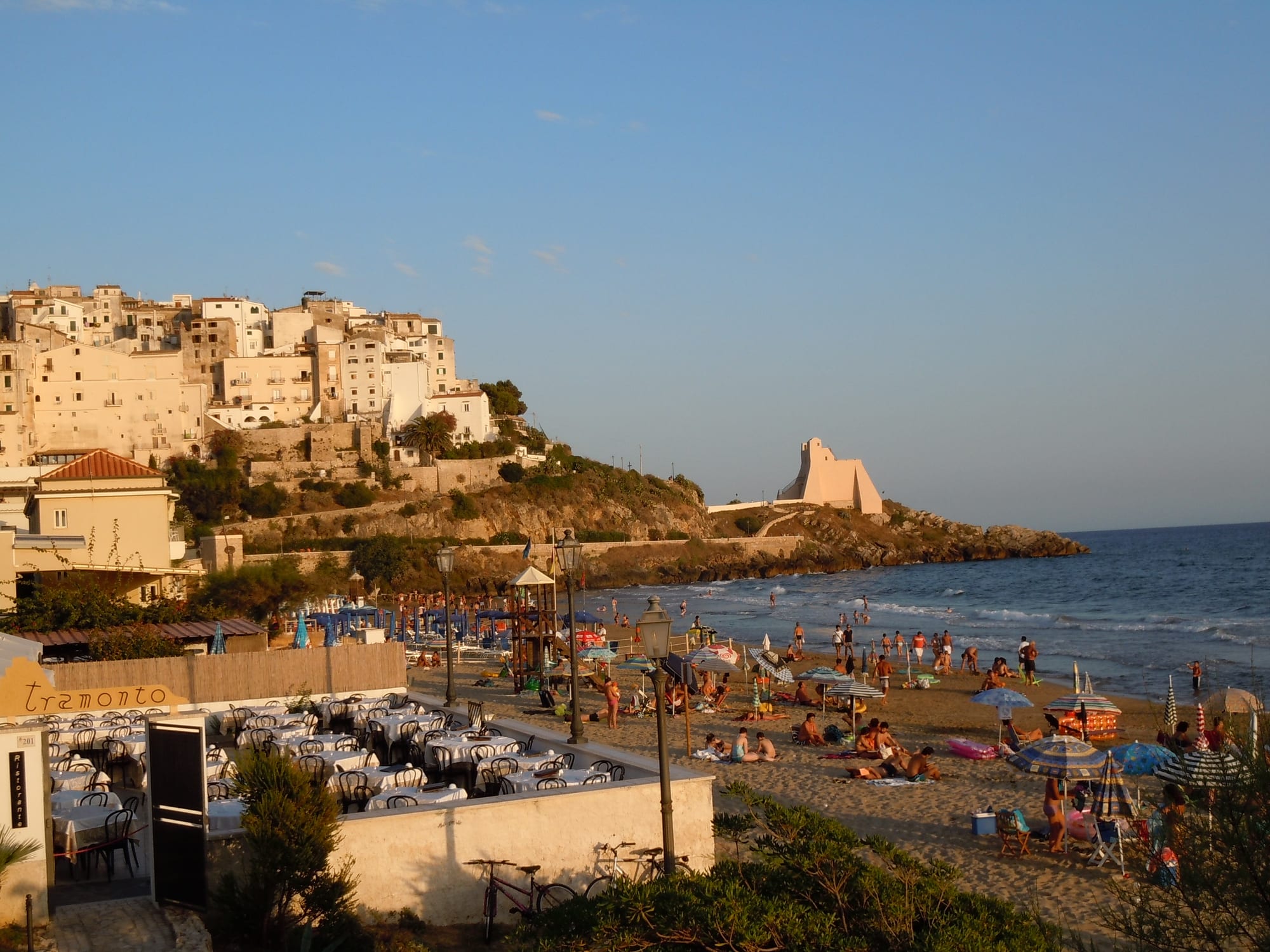
Pale houses of Sperlonga on a rocky headland above a sandy beach with umbrellas, and a white watchtower at the point

Lazio, Italy

Sperlonga

The old town of Sperlonga above its beach, with the Truglia Tower on the tip of the headland. (Ursula_Iris / Wikimedia Commons · CC BY 3.0)

A small seaside town in southern Lazio, about halfway between Rome and Naples, whose white houses climb a rocky spur above long sandy beaches. Named after the sea grotto where the emperor Tiberius dined, it stayed a small fishing village until a coast road opened in the late 1950s; today it lives from summer beach tourism.

Neighbourhoods

  • The old town
    • Historic district
    • Views
    • Evenings out

    The whitewashed village on the promontory of San Magno, a maze of stepped lanes and alleys, closed to traffic. Two old gates survive from the medieval walls, and the little central square is where the town gathers on summer evenings.

    Open in Maps
  • The beach strip
    • Beaches
    • Families
    • Restaurants

    The newer lower town along the shore on either side of the headland, with most of the hotels, beach clubs, apartments and restaurants. The western beach runs for many kilometres towards Terracina; to the south-east, towards Gaeta, short sandy beaches alternate with rocky points.

    Open in Maps
  • Villa of Tiberius and the grotto
    • Archaeology
    • Quiet beaches

    The southern end of the town's beach, where the ruins of the emperor's villa, the sea grotto and the archaeological museum stand beside the Via Flacca, with small coves and cliffs beyond.

    Open in Maps

Things to do

History and archaeology

  • Villa of Tiberius and the Sperlonga sculpturesmuseum

    The natural sea cave that Tiberius used as a dining room, and the museum opened in 1963 beside it to show the marble groups found there in 1957, which tell episodes of the Odyssey, including the blinding of Polyphemus.

    Open in Maps
  • Truglia Towerlandmark

    A 16th-century coastal watchtower on the tip of the headland, one of the line of towers built against pirate raids along this shore.

    Open in Maps
  • Church of Santa Marialandmark

    A church of the old town, first recorded in 1135.

    Open in Maps

Beaches

  • The western beachbeach

    A long strip of fine sand running north-west from the headland towards Terracina, lined with beach clubs near the town and quieter further out.

    Open in Maps
  • Beaches and coves towards Gaetabeach

    South-east of the town, short sandy beaches between rocky spurs, some reached only from the sea, along the protected coast of the Riviera di Ulisse park.

    Open in Maps

Short trips from the town

  • Gaetaneighborhood

    A fishing port and seaside resort on its own promontory to the south-east, with walls dating back to Roman times, reached along the cliff road of the Via Flacca.

    Open in Maps
  • Temple of Jupiter Anxurlandmark

    The terraced Roman sanctuary on Mount Sant'Angelo above Terracina, built between the mid-second and mid-first centuries BC beside the Via Appia.

    Open in Maps
  • Fondineighborhood

    The farming town inland on the old Via Appia, with the railway station that serves Sperlonga and a market-garden plain around it.

    Open in Maps
  • Circeo National Parkpark

    A coastal national park founded in 1934 to protect the last remnants of the Pontine Marshes, with dunes, lagoons and forest along the coast to the north-west.

    Open in Maps

Seasonal events

  • Feast of San Leone and San Roccoaround the first Sunday of September

    The patronal festival, with processions through both the old town and the beach town; San Rocco's statue is carried down to the sea at night for fireworks before returning through the lanes.

Eat and drink

Long-standing places and food districts in Sperlonga. Hours, ratings and directions come from your maps app, always current.

Food districts

  • Old town restaurantsneighborhood

    Restaurants around the main square and the road leading up to it, mostly serving seafood and pizza, and busy late on summer nights.

    Open in Maps
  • Beachfront restaurantsneighborhood

    Seafood restaurants and beach bars along the street behind the sands below the old town.

    Open in Maps

Markets and local produce

  • Buffalo mozzarella stands on the Via Flaccamarket

    Roadside shops selling buffalo mozzarella from the plains around Fondi and the former Pontine Marshes.

    Open in Maps

Experience Sperlonga

History

People lived around Sperlonga from the Middle Palaeolithic, and in Roman times the coast, under the jurisdiction of Fundi, was lined with villas. The most famous was a late-republican villa enlarged for the emperor Tiberius, built around a natural sea cave that served as a summer dining room. According to Tacitus and Suetonius, the roof of the grotto fell while the emperor was dining in 26 AD, and Sejanus' rescue of Tiberius helped launch his rise. The town's name probably comes from that cave, the Latin spelunca.

After the fall of the empire the ruins sheltered local people, but the settlement moved up to the promontory of San Magno to escape raids from the sea. A castle is recorded in the 10th century, and walls were built in the 11th; two gates bearing the arms of the Caetani family survive. In the summer of 1534 the Ottoman admiral Barbarossa sacked the village and carried many of its people, above all women, into slavery, and Barbary corsairs raided again in 1623.

Rebuilt between the 17th and 19th centuries, Sperlonga belonged for centuries to the Kingdom of Naples and the province of Terra di Lavoro. In 1927 it was moved into Lazio, and from 1934 it belonged to the new province of Littoria, now Latina. Its isolation ended only when the Via Flacca coast road from Terracina to Gaeta opened in the late 1950s; road builders found the fragments of the Tiberius sculptures in 1957, and tourism followed.

Culture & Customs

Sperlonga is a member of the association of the most beautiful villages of Italy, and its identity rests on its old town: white houses packed tightly on the rock, stepped alleys and lanes, and a skyline of watchtowers. Murals in the lanes recall the pirate raids that once carried off its people.

The local dialect is the last on the Lazio coast, going south, to be classed as a central Italian dialect, but it carries strong southern features from the centuries when the town was part of the Kingdom of Naples. Its vowels, altered inside words as well as at the end, make it sound in places closer to the dialects of Apulia and Molise — perhaps because fishermen came from Apulia, or because of the Di Sangro princes who once governed the town.

The main festival honours the patron, Pope Leo the Great, known locally as San Leone, and San Rocco, the co-patron, in the days around the first Sunday of September. The town has a single parish, so the processions cover both the old town and the beach town, and San Rocco's statue is carried down to the sea at night for fireworks before being taken back through the lanes.

Daily Life

About 3,000 people live in Sperlonga, a figure that multiplies in summer, when Romans and Neapolitans fill the hotels, apartments and campsites. Tourism is the economy, much of it in small businesses: in 2015 the town's 314 firms employed fewer than 900 people. Agriculture has never driven the economy, though the town is known for its own pear-shaped tomato, recognised as a traditional product of Lazio.

The town has two centres. The old town on the hill has the main square and much of the evening life, and its lanes are closed to traffic; the lower town along the beaches holds most of the hotels, beach clubs and restaurants. Children attend a nursery, a primary and a lower secondary school in the town, and the parish belongs to the Archdiocese of Gaeta.

Life swings with the seasons. From June to September the beaches are packed, nights run late in the square, and parking is the town's daily problem. In winter many places close and the residents have the town to themselves.

Food

The kitchen of Sperlonga is that of the sea. Most restaurants serve seafood, and pizza is close to the Neapolitan style, a reminder of how near the town is to Naples. The restaurants are clustered in two places: around the main square of the old town and the road that leads up to it, and along the street behind the beach.

The farming plain around Fondi supplies fresh fruit and vegetables, and there is usually a farmers' market in the main square of the old town. Sperlonga's own pomodoro perino, a pear-shaped tomato, is listed among Lazio's traditional food products, and the area also grows white celery.

Buffalo mozzarella, mozzarella di bufala, is the local cheese to buy. Water buffalo have long been raised on the plains north of Terracina, in the former Pontine Marshes, and around Fondi, once also marshland, and shops along the Via Flacca sell the cheese fresh.

Planning tools

Budget

Sperlonga is a package and weekend beach resort for Romans and Neapolitans, so prices follow the season: rooms are much dearer in July and August, when many places ask for a minimum stay, and cheap in spring and autumn. Beach-club loungers and parasols are an extra cost; the free stretches of sand are further from the town.

Daily Budget Midrange
USD 150–300 (beach hotel or apartment, seafood dinners, a beach-club lounger, museum ticket)
Daily Budget Shoestring
USD 70–120 (hostel bed or campsite, pizza and market food, buses from Fondi)

Book summer rooms well ahead, and visit in June or September for lower prices and calmer beaches.

Best Time to Visit

June and September are the best beach months, warm and less crowded than the peak. July and August are the hottest and driest, when the town is full and parking is hard to find. From October to May it is quiet, with some places closed, and November is the wettest month.

Suggested Number of Days

A day or two is enough to see the town itself; most visitors who come for the beach stay several days or a week. Add time to explore the neighbouring coast and hill towns, which is easiest with a car.

First Visit
1–2 days
With Surroundings
3–5 days

Transportation

The town is small and walkable, though the old town is all steps. A local bus runs within Sperlonga, and buses link it with Fondi, Terracina and Formia. The Via Flacca coast road is the only main road, and in summer traffic and parking are the main problems.

Park in the car parks below the old town, which is closed to traffic, and arrive early on summer weekends.

Airport & Station Connections

The nearest station is Fondi-Sperlonga in Fondi, on the Rome–Naples line via Formia, about 12 km away by road; buses meet many trains. Drivers come from Rome by the Via Appia or the Via Pontina to Terracina and then along the Via Flacca, or from Naples via Formia and Gaeta. The Rome and Naples airports are each within about two hours' drive.

Walkability

Easy on foot within each part of town, but the old town is built of steep lanes and stairways that rule out pushchairs and wheels. A path and steps connect the village with the beaches below, and the walk along the shore to the Villa of Tiberius follows the sand.

Safety

Italy is generally safe, with low levels of violent crime against visitors. Sperlonga is a quiet resort town; the usual care with bags on crowded beaches and with valuables in parked cars is enough, and summer heat and sun are the main concerns.

Swim at beaches with lifeguards, take care on the steep stone steps of the old town, and keep valuables out of sight in parked cars. Check current official travel advice before travelling.

Climate

A Mediterranean climate with short, hot, dry summers and longer, cool, rainy winters. Temperatures over the year usually range from about 5°C to 30°C, rarely dropping below 2°C or rising above 33°C.

Summer
hot and sunny — in July and August average highs reach about 30°C and lows about 20°C, and July is the driest month
Winter
cool and rainy — in January and February average highs are 12–13°C and lows about 6°C; November is the wettest month

Local Customs

Swimwear belongs on the beach; cover up in the old town's streets, shops and churches. The evening stroll and late dinners set the pace in summer, and Italian families make up most of the visitors. Many businesses close or shorten their hours outside the season.

Tipping is not expected, though rounding up is welcome; dress modestly in churches and keep noise down in the residential lanes of the old town at night.

Common Payment Methods

The currency is the euro. Cards are accepted in most hotels, restaurants and beach clubs, but carry cash for small bars, market stalls and buses. There are cash machines in the town, though queues can form in August.