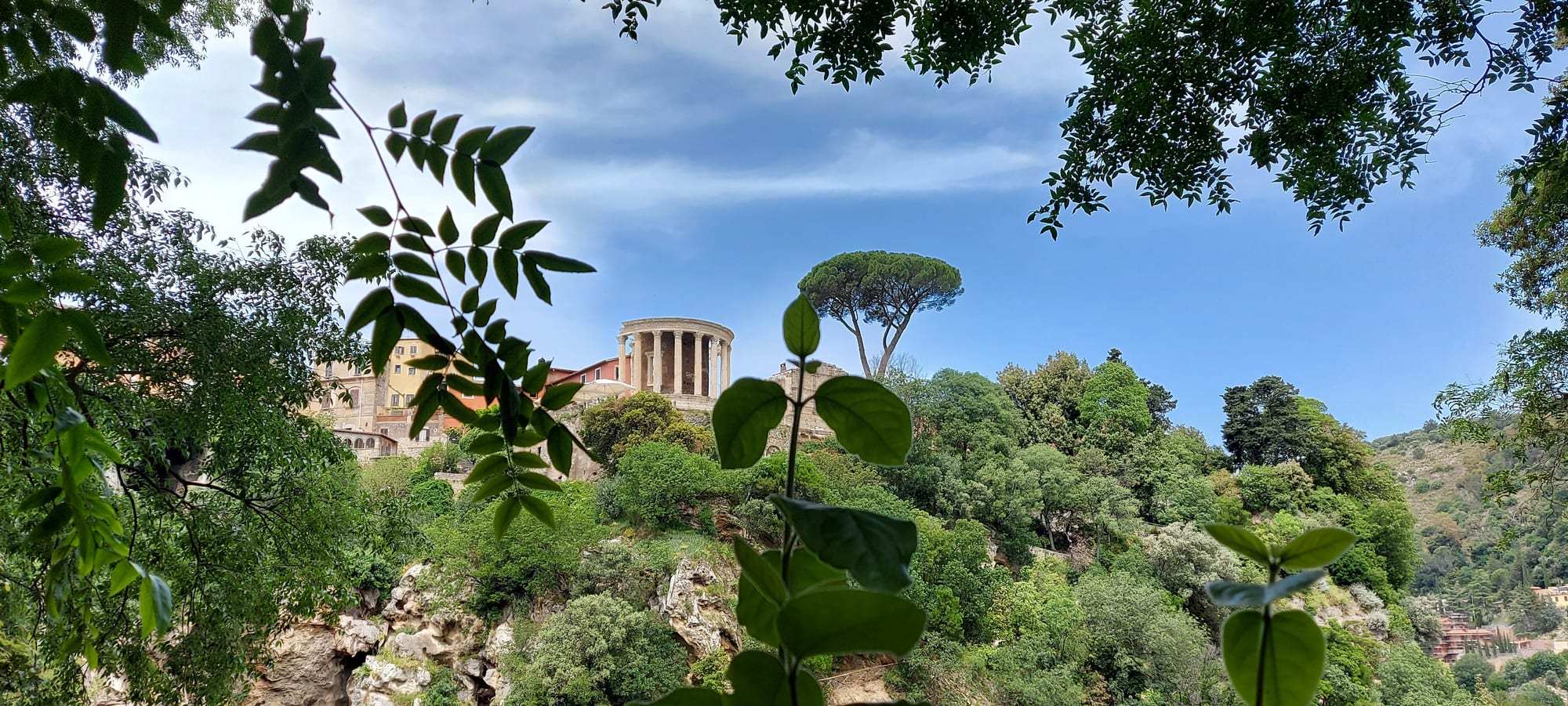
The round columned Temple of Vesta on a wooded clifftop in Tivoli, framed by leaves under a blue sky

Lazio, Italy

Tivoli

The Temple of Vesta on Tivoli's ancient acropolis, seen from the park of Villa Gregoriana below. (Anna Eden 86 / Wikimedia Commons · CC BY-SA 4.0)

A hill town about 30 km north-east of Rome at the falls of the Aniene, where the river leaves the Sabine Hills. Ancient Tibur, a retreat of Roman emperors and poets and later of cardinals and popes, it holds two UNESCO World Heritage Sites — Hadrian's Villa on the plain below and the terraced fountain gardens of the Villa d'Este.

Neighbourhoods

  • The historic centre and the acropolis
    • First-time visitors
    • Historic district
    • Views

    The old town on its hill above the Aniene gorge, with the cathedral on the site of the Roman forum, medieval lanes and the temples of the ancient acropolis looking down over the falls and the park of Villa Gregoriana.

    Open in Maps
  • Around the Villa d'Este
    • Gardens
    • Close to the sights
    • Best for food

    The upper town around the Villa d'Este, where the villa's gardens drop down the hillside and cafés and restaurants serve the day visitors.

    Open in Maps
  • Villa Adriana
    • Archaeology
    • Quiet and residential

    A populous district at the foot of the town's hill, on the left bank of the Aniene, named after Hadrian's Villa, whose vast ruins lie nearby.

    Open in Maps
  • Tivoli Terme
    • Thermal springs
    • Close to public transport

    Formerly Bagni di Tivoli, the oldest of the outlying districts, on the plain towards Rome, known since antiquity for its sulphurous mineral springs, among them the Aquae Albulae.

    Open in Maps

Things to do

The great villas

  • Villa d'Estelandmark

    A 16th-century villa famous for its terraced Renaissance garden of fountains, basins and water features, which shaped garden design across Europe; a UNESCO World Heritage Site since 2001.

    Open in Maps
  • Hadrian's Villalandmark

    The emperor Hadrian's palace complex of around AD 120, more than 30 buildings, pools and gardens over at least a square kilometre, larger than Pompeii; a UNESCO World Heritage Site.

    Open in Maps
  • Villa Gregorianapark

    A wooded park in the Aniene gorge created by Pope Gregory XVI in 1835 after a flood, with paths to caves, cascades and the Great Waterfall.

    Open in Maps

Ancient and historic Tivoli

  • Temple of Vestalandmark

    A small circular temple of the early 1st century BC on the edge of the acropolis above the falls, whose capitals were widely imitated.

    Open in Maps
  • Sanctuary of Hercules Victorattraction

    The ruins of a huge 2nd-century BC sanctuary outside the ancient city, once one of the largest structures in central Italy, where Augustus is said to have administered justice under its porticoes.

    Open in Maps
  • Tivoli Cathedrallandmark

    The cathedral of San Lorenzo, rebuilt in 1635–1641 on the site of the Roman forum's basilica.

    Open in Maps
  • Rocca Pialandmark

    A massive fortress built by Pope Pius II in 1461 to subdue the town's feuding factions, the Colonna and the Orsini.

    Open in Maps
  • Ponte Lucanolandmark

    A seven-arched Roman stone bridge of the 1st century BC over the Aniene on the Via Tiburtina, beside the round mausoleum of the Plautii.

    Open in Maps

Short trips from the town

  • Subiacoattraction

    A town up the Aniene valley where St Benedict founded his first monasteries.

    Open in Maps

Seasonal events

  • Along Came JazzJuly

    An annual festival exploring the links between jazz, classical music and Mediterranean and northern European folk music.

  • Feast of San Lorenzo10 August

    The procession of Tivoli's patron saint, accompanied by historical scenes from his life.

  • L'Inchinata14–15 August

    A religious festival dating from the Middle Ages and still very popular, in which two ancient images, of the Virgin and of the Saviour, are carried in procession to meet each other.

Eat and drink

Long-standing places and food districts in Tivoli. Hours, ratings and directions come from your maps app, always current.

Tivoli classics

  • Restaurants of the historic centreneighborhood

    Trattorias in the old town serve the cooking of Lazio, from the Roman pastas to porchetta, and the local pizzutello grapes in season.

    Open in Maps
  • Cafés near the Villa d'Estecafe

    Bars and cafés on the streets and squares around the villa's entrance, busy with visitors.

    Open in Maps

Experience Tivoli

History

Tibur, as the Romans called it, was a Sabine town on the route from Rome over the Apennines, and legend credited its founding to Catillus, a Greek who had escaped the slaughter at Thebes, and his sons; another account made it a colony of Alba Longa. Its oldest settlement stood on the hill now called San Paolo, before the inhabitants moved closer to the river and the acropolis above the falls. The town was the seat of the Tiburtine Sibyl, honoured as a tenth Sibyl, and two small temples above the falls are traditionally linked with her and with Vesta. At first an independent ally of Rome, Tibur sided with the Gauls in 361 BC and was defeated and absorbed in 338 BC.

Under Rome it became a fashionable retreat. Maecenas and Augustus had villas here, the poet Horace a modest one, and Catullus and Statius mentioned the town in their poems; around AD 120 the emperor Hadrian built his vast villa on the plain below. The great sanctuary of Hercules Victor, a centre of commerce and religion, stood outside the walls.

In the Middle Ages the town backed the emperor Frederick Barbarossa, who strengthened its walls, and its feuding factions, led by the Colonna and Orsini, were finally subdued when Pope Pius II built the Rocca Pia in 1461. Cardinals and popes made it a resort again: Cardinal Ippolito d'Este laid out the Villa d'Este in the 16th century, and after a devastating flood in 1826 Pope Gregory XVI diverted the Aniene through a tunnel in Monte Catillo, creating the Great Waterfall, and opened the Villa Gregoriana in 1835. In the 20th century industry — rubber, travertine quarrying and paper mills — drew new residents and the town spread over the plain.

Culture & Customs

Tivoli's identity rests on its villas and its water. The Villa d'Este's fountains and the Aniene falls lent the town's name to pleasure gardens abroad, among them the Jardin de Tivoli in Paris and the Tivoli Gardens in Copenhagen. The Temple of Vesta's capitals were so admired that a variant of the Corinthian order is sometimes called the Tivoli order, and the temple inspired copies in English and French gardens and buildings.

The religious calendar is strong. On 10 August the town processes for its patron, San Lorenzo, with historical scenes from his life, and on 14 and 15 August comes the Inchinata, a festival dating from the Middle Ages in which two ancient images, of the Virgin and of the Saviour, are carried to meet each other. The Sagra del Pizzutello celebrates the local grape, with residents in traditional dress offering it through the streets, and each July the Along Came Jazz festival brings together jazz, classical and folk music.

The old dialect of Tivoli survives mainly in the historic centre; younger people, especially in the districts nearest Rome, now speak a form of Roman.

Daily Life

About 55,000 people live in the comune of Tivoli, which is becoming an extension of the Rome conurbation along the Via Tiburtina. Many live not in the hilltop old town but in the districts that spread below it, such as Tivoli Terme and Villa Adriana.

Tivoli's quarries produce travertine, the white stone used in most of Rome's monuments, and in the 20th century rubber factories and paper mills brought workers and rapid urban growth to the districts below the town. The sulphurous springs of the Aquae Albulae at Tivoli Terme have been used since antiquity. Tourism centres on the two UNESCO villas and the gorge park, and the town is busy with day visitors from Rome, especially at weekends.

The old town keeps the rhythm of a provincial Italian centre, with shops closing in the early afternoon, an evening stroll and Sunday lunches, while the plain below lives at the pace of the capital's commuter belt.

Food

Tivoli's food is that of Lazio. Roman pastas — cacio e pepe, and gricia, carbonara and amatriciana, built on guanciale and pecorino romano — are the classics of the region, along with porchetta, a savoury boneless pork roast, and abbacchio, a lamb dish. The offal tradition of Roman cooking gives coda alla vaccinara, oxtail cooked the butchers' way, and spring brings globe artichokes, peas and fava beans to the table, with pecorino romano and ricotta the cheeses of the region. Pizza al taglio, sold by the slice, is the everyday snack.

The town's own speciality is the pizzutello, a variety of table grape grown on the fertile soils below the waterfall, which the town celebrates at its Sagra del Pizzutello, when residents in traditional costume offer and sell the grapes through the streets. Frascati, the white wine of the Castelli Romani, is iconic of Lazio, and trattorias in the historic centre and near the Villa d'Este serve day visitors and locals alike.

Planning tools

Budget

Tivoli is much cheaper than Rome for rooms and meals, and most visitors come on a day trip from the capital by train or bus. The main costs are entry tickets to Hadrian's Villa and the Villa d'Este, which are separate sites some way apart, and transport between them.

Daily Budget Midrange
USD 150–280 (hotel or B&B in town, restaurant dinners, tickets to both villas and Villa Gregoriana, taxis)
Daily Budget Shoestring
USD 70–110 (simple room or day trip from Rome, trattoria meals, regional trains and buses)

Hadrian's Villa is on the plain below the town, so plan the transfer between it and the Villa d'Este; an urban bus links them.

Best Time to Visit

April to June and September to October are best for the gardens and the open ruins. Midsummer is hot at Hadrian's Villa, which has little shade, though the town's August festivals of San Lorenzo and the Inchinata draw crowds. Winter is quiet and cool.

Suggested Number of Days

Most visitors come for a long day from Rome, but the two villas and the gorge park are a lot for one day, and a night in town makes for an easier pace. A further day suits those heading on into the Aniene valley.

First Visit
1–2 days
With Surroundings
2–3 days

Transportation

The historic centre and the Villa d'Este are close together on the hill and walkable. Hadrian's Villa lies on the plain below, reached by urban bus, taxi or car. Driving from Rome follows the Via Tiburtina or the motorway, and parking near the centre is limited.

Avoid driving back to Rome on the motorway on weekend evenings, when the toll station can be very congested.

Airport & Station Connections

Tivoli is about 30 km north-east of central Rome. Regional trains from Roma Tiburtina take just over an hour to Tivoli station, and buses run from Ponte Mammolo on metro line B, also stopping near Hadrian's Villa. The nearest airports are those of Rome.

Walkability

The old town is small but steep, with stairs and sloping streets between the acropolis, the cathedral and the Villa d'Este. The paths of Villa Gregoriana descend deep into the gorge and climb back out, and the Villa d'Este gardens are terraced, so both involve many steps. Hadrian's Villa is flat but very large.

Safety

Italy is generally safe, with low levels of violent crime against visitors. Tivoli is quiet and crime rarely affects visitors. Summer heat is a real risk at Hadrian's Villa, and the steep paths of the gorge and the gardens call for care.

Carry water and a hat at Hadrian's Villa in summer, and wear sturdy shoes for the steps of the gardens and the gorge. Check current official travel advice before travelling.

Climate

A Mediterranean climate, as in nearby Rome, with hot, dry summers and mild, damp winters.

Summer
hot and dry — in nearby Rome August days average about 32°C
Winter
mild — in nearby Rome January days average about 13°C and nights about 2°C

Local Customs

The people of Tivoli still call themselves tiburtini, after the ancient name of the town. Life follows the Italian rhythm of a long lunch and an evening stroll, and religious feasts such as the Inchinata in August remain central to local identity. Coffee is drunk standing at the bar, and cappuccino is a morning drink.

Cover shoulders and knees in the cathedral and churches, and keep voices low during services.

Common Payment Methods

The currency is the euro. Cards are widely accepted at the villas, hotels and most restaurants, but a little cash is useful for small bars and buses. There are cash machines in the town centre.