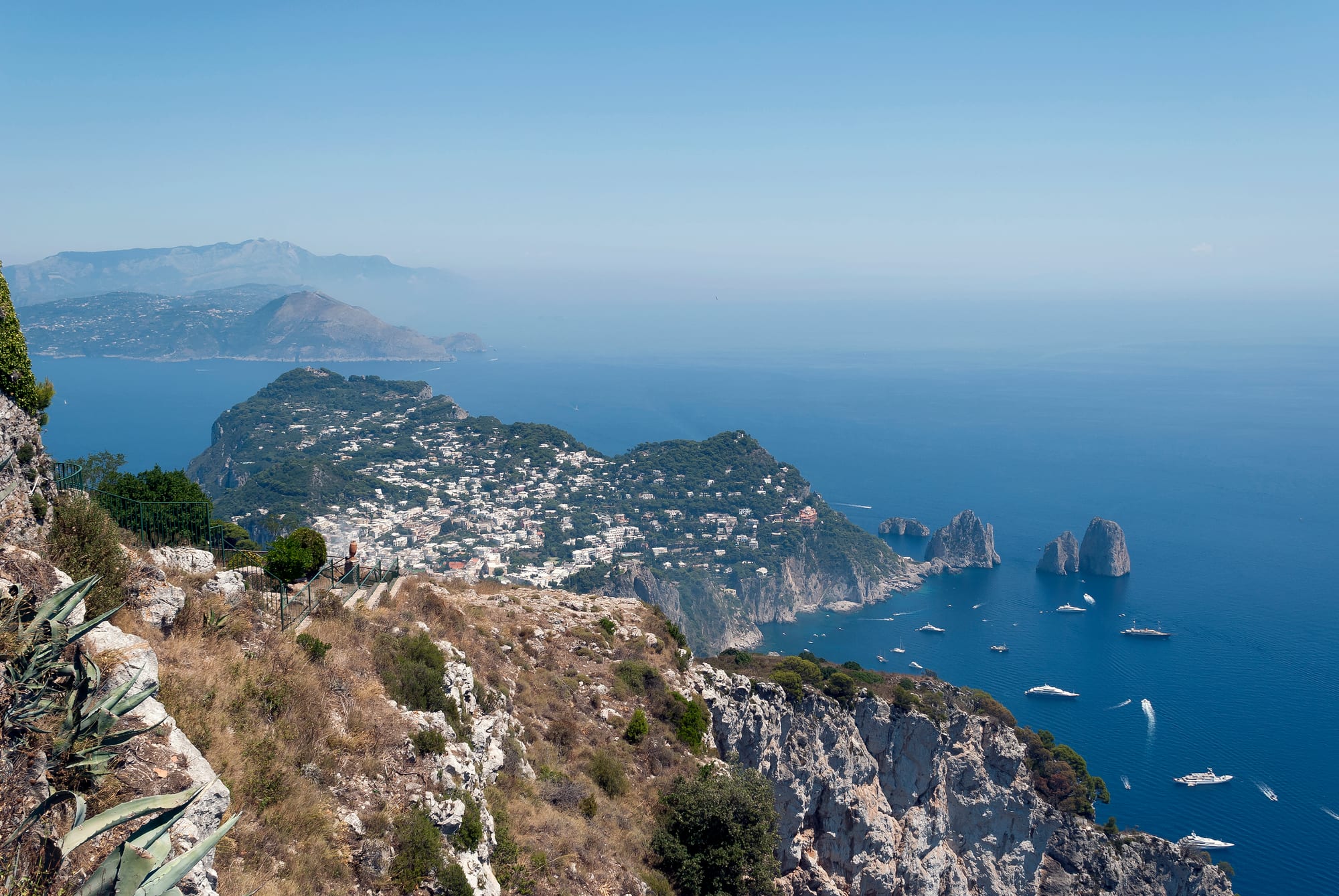
View from a rocky summit over the white houses of Capri, the Faraglioni rocks and the Sorrento peninsula beyond

Italy

Campania

Capri and its Faraglioni seen from Monte Solaro, with the Sorrento peninsula across the strait. (Mайкл Гиммельфарб / Wikimedia Commons · CC BY-SA 4.0)

Southern Italy's most populous region, curving around the Bay of Naples and the Gulf of Salerno beneath Vesuvius — the land of Naples, the buried Roman towns of Pompeii and Herculaneum, the cliff villages of the Amalfi Coast, the islands of Capri and Ischia, and the Greek temples of Paestum.

Explore Campania

History

Greeks from Euboea founded Cumae on the coast west of Naples in the 8th century BC, one of their earliest colonies in Italy, and later Neapolis, the "new city" whose street grid still shapes central Naples, while settlers from Sybaris founded Poseidonia, which the Romans called Paestum. Oscans and Samnites held the interior until Rome absorbed the whole area, which became the playground of the Roman elite: villas lined the bay, Tiberius ruled the empire from Capri, and the eruption of Vesuvius in AD 79 buried Pompeii, Herculaneum and Stabiae.

After Rome, the Lombards ruled from Benevento while Naples survived as a duchy under nominal Byzantine rule, and Amalfi grew rich as a maritime republic trading with Constantinople and the Islamic world. The Normans united the south in the 12th century, and under the Angevins from the 1260s Naples became the capital of a kingdom covering most of southern Italy. Aragonese kings, then two centuries of Spanish viceroys, made it one of Europe's largest cities, crowded, devout and periodically rebellious, as in Masaniello's revolt of 1647.

The Bourbons arrived in 1734 and built on a royal scale: the palace at Caserta, the San Carlo opera house, the excavations of Herculaneum and Pompeii. Garibaldi entered Naples in 1860, and the former capital declined into a provincial city, the starting point for millions of emigrants. In September 1943 Neapolitans rose against the German occupiers in the Four Days of Naples. The Irpinia earthquake of 1980 killed more than 2,400 people inland, and the decades since have been shaped by the struggle against the Camorra and by a tourism boom.

Culture & Customs

Campania's identity is Neapolitan above all. Neapolitan is spoken as a language of its own in the streets and in song, and the city has exported a whole repertoire, from "Funiculì, funiculà" and "'O sole mio" to the singer-songwriters and rappers of today. The masked figure of Pulcinella, from the commedia dell'arte, stands for the city's cunning, comic, put-upon everyman, and the playwright Eduardo De Filippo and the actor Totò are local heroes.

Religion is intense and theatrical. Three times a year crowds gather in the cathedral to watch whether the dried blood of San Gennaro, the patron saint, liquefies, which is taken as a good omen for the city. Street shrines, votive lamps and the cult of the souls in purgatory in the Fontanelle cemetery reflect a popular faith mixed with superstition, and good-luck horns, the cornicelli, hang from rear-view mirrors. Via San Gregorio Armeno is lined with workshops carving figures for the presepe, the Christmas crib, a craft Naples has practised since the 18th century.

Other crafts belong to particular towns: coral and cameo carving at Torre del Greco, ceramics at Vietri sul Mare, hand-made paper at Amalfi and inlaid wood at Sorrento. Football is a civic religion — Napoli's titles with Maradona in 1987 and 1990 are still celebrated in murals, and new ones in 2023 and 2025 set off city-wide parties.

Daily Life

About 5.6 million people live in Campania, making it Italy's third most populous region and its second most densely populated. Naples has over 900,000 residents and its metropolitan city about three million, spreading around the foot of Vesuvius. Salerno, with about 125,000, is the second city; Caserta, Benevento and Avellino are the provincial capitals inland, where towns are smaller and the population is ageing and shrinking.

The economy combines one of Italy's busiest ports, aerospace and car plants, tourism and a rich farm belt: San Marzano tomatoes grow on the volcanic plain south of Vesuvius, buffalo are raised on the plains around Caserta and the Sele valley, and Gragnano has made dried pasta for centuries. Unemployment, especially among the young, is far above the national average, and many graduates leave for the north or abroad.

Life in Naples is loud and public: the espresso drunk standing at the bar, often with a "suspended coffee" paid forward for a stranger, lunch as the main meal, evenings on the seafront. Current issues include illegal waste dumping in the so-called Land of Fires north of Naples, the pressure of short-term lets on the historic centre, and renewed ground uplift and earthquakes at the Campi Flegrei.

Food

Campania gave the world pizza. The Neapolitan pizza — soft, blistered, thin in the middle, with a puffed rim — comes as the marinara with tomato, garlic and oregano or the margherita with tomato, mozzarella and basil, and the art of the Neapolitan pizzaiuolo is on UNESCO's intangible heritage list. Street food includes pizza fritta, deep-fried pizza, and the cuoppo, a paper cone of fried seafood. Pasta is dried and often short: spaghetti alle vongole with clams, the long-simmered Sunday ragù, and pasta e patate with provola cheese.

Mozzarella di bufala campana, made from the milk of water buffalo, is the region's famous cheese, alongside smoked provola and the pear-shaped caciocavallo. Lemons from Sorrento and Amalfi flavour limoncello, the sweet lemon liqueur, and delizia al limone, a lemon-cream sponge. Neapolitan pastry is a genre of its own: the shell-shaped sfogliatella with its sweet filling, the rum-soaked babà, and pastiera, a wheat-and-ricotta Easter tart scented with orange-flower water.

The inland hills of Irpinia produce the region's serious wines — the red Taurasi from the Aglianico grape and the whites Fiano di Avellino and Greco di Tufo — while Falanghina and the Lacryma Christi of Vesuvius's slopes are lighter everyday wines. Coffee, dense and sweet, is a point of local pride.

Attractions & Natural Wonders

Naples rewards several days: the UNESCO-listed historic centre along Spaccanapoli, the National Archaeological Museum with the finds and mosaics of Pompeii, Giuseppe Sanmartino's Veiled Christ in the Sansevero Chapel, the tunnels of Napoli Sotterranea, the Capodimonte museum, the Royal Palace, Castel Nuovo and Castel dell'Ovo on the seafront. West of the city, the Campi Flegrei hold the Roman amphitheatre of Pozzuoli, the submerged ruins of Baia and the Sibyl's cave at Cumae.

Vesuvius stands at the centre of a national park. At its foot lie Pompeii, with its forum, houses, frescoes and amphitheatre, Herculaneum, where wooden beams and upper floors survived, and the great villa at Oplontis. Beyond, the Sorrento peninsula leads to the Amalfi Coast, a UNESCO World Heritage Site: Positano's stacked houses, Amalfi's cathedral, the villa gardens of Ravello, and the Path of the Gods walking trail high above the sea.

In the bay, Capri offers the Blue Grotto, the Faraglioni, the chairlift up Monte Solaro from Anacapri and Tiberius's Villa Jovis; Ischia is a volcanic island of thermal springs and the Aragonese Castle on its causeway; and Procida is a small fishing island of pastel houses. South of Salerno, Paestum's temples of Hera and Athena and the painted Tomb of the Diver open onto the Cilento national park, with the Greek town of Velia and the Certosa di Padula. Inland, the Royal Palace of Caserta, a UNESCO World Heritage Site with its long park and cascades, is joined by medieval Caserta Vecchia and Benevento's Arch of Trajan.

Cities in Campania

Planning basics

Budget

Campania has two price levels. Naples is one of Italy's best-value big cities, where a pizza margherita still costs little and hostels and B&Bs are plentiful, while Capri, Positano, Ravello and Amalfi in summer are among the most expensive places in the country. Staying in Naples, Sorrento or Salerno and making day trips keeps costs down.

Daily Budget Midrange
USD 170–370 (hotel in Sorrento or on the coast, restaurant dinners, ferries and site tickets)
Daily Budget Shoestring
USD 65–110 (hostel or B&B in Naples, pizza and street food, local trains and buses)

Base in Naples or Salerno and visit Capri and the Amalfi Coast as day trips; buy the Pompeii ticket online in high season.

Safety

Visitors rarely meet serious crime, but Naples has more petty crime than most Italian cities: pickpockets on the Circumvesuviana and around the central station, bag and phone snatching, and theft from cars. Traffic is chaotic, the Amalfi road demands care, and the Campi Flegrei area around Pozzuoli has been experiencing volcanic ground uplift and small earthquakes that are closely monitored.

Carry a phone and bag on the side away from the road, leave nothing in parked cars, and follow local civil-protection notices around Pozzuoli. Check current official travel advice before travelling.

Climate

Mediterranean along the coast and on the islands, with long hot summers and mild, rainy winters; the Bay of Naples and the Amalfi Coast rarely see frost. Inland, the Apennine valleys of Irpinia and the Sannio are cooler and noticeably colder in winter, with snow on the higher ground.

Summer
hot and humid, 28–34°C in Naples; sea breezes on the coast and islands, much heat inland
Winter
mild and wet on the coast, 8–15°C; cold inland, with snow in the Apennines

Transportation

Naples is about an hour from Rome by high-speed train and has the region's main airport at Capodichino. The Circumvesuviana railway runs from Naples to Herculaneum, Pompeii and Sorrento; ferries and hydrofoils link Naples, Sorrento and Salerno with Capri, Ischia, Procida and the Amalfi towns. Buses serve the Amalfi Coast road, which is narrow and congested in summer, and Paestum and Caserta are easy train trips from Salerno and Naples.

Use boats rather than the road along the Amalfi Coast in high summer; the Circumvesuviana is slow and crowded, so keep bags close.

Best Time to Visit

April to June and September to October are best: warm sea, open ferries and fewer people on the Amalfi road. July and August are hot, crowded and expensive on the coast and islands, and Pompeii is punishing at midday. Winter suits Naples itself, with its museums, Christmas cribs on Via San Gregorio Armeno and cheaper rooms, but many coastal hotels close.