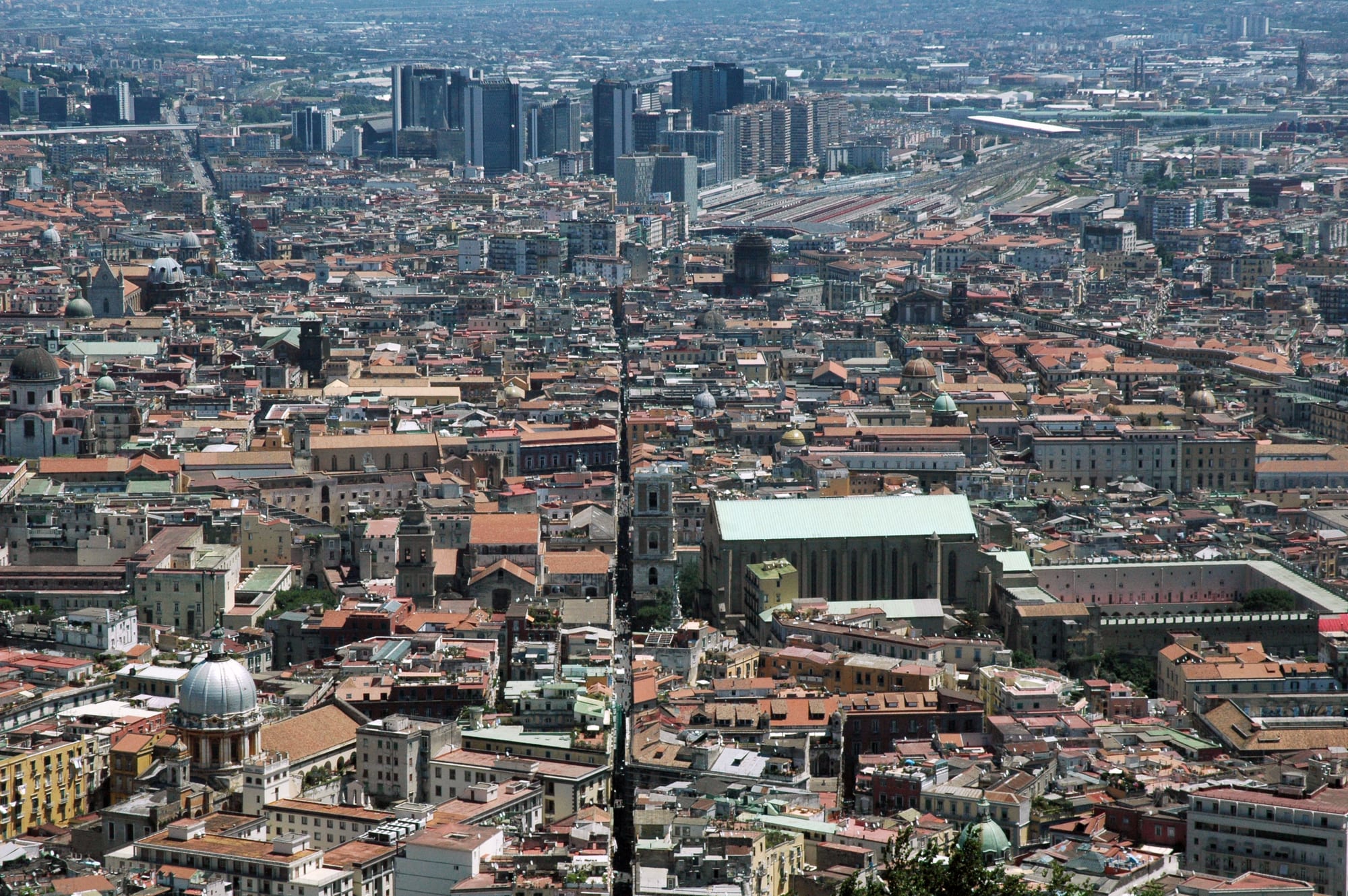
Dense red-roofed old city cut by one long straight street, with church domes and modern office towers in the distance

Campania, Italy

Naples

The straight line of Spaccanapoli through the historic centre of Naples, seen from Castel Sant'Elmo. (DimiTalen / Wikimedia Commons · CC0)

Southern Italy's largest city, on the Bay of Naples beneath Vesuvius. Founded by Greeks and for centuries the capital of a kingdom covering most of the south, it keeps a UNESCO-listed centre on its ancient street grid, great museums, castles and an opera house, and has seen tourism boom in recent years; it is loud, crowded and proud of its pizza.

Neighbourhoods

  • Centro Storico
    • First-time visitors
    • Historic district
    • Best for food

    The UNESCO-listed old centre, where the grid of Greek Neapolis still shapes the streets. Spaccanapoli and Via dei Tribunali run east to west past churches, palaces, street vendors and pizzerias, and Via San Gregorio Armeno is lined with nativity-figure workshops. It is crowded, noisy and central.

    Open in Maps
  • Quartieri Spagnoli
    • Street life
    • Close to public transport

    A tight grid of narrow streets climbing west of Via Toledo, laid out in the 16th century to house Spanish garrisons. Shops, restaurants and small fruit, vegetable and fish vendors fill the lanes of a working neighbourhood long marked by social difficulty that now also draws many visitors.

    Open in Maps
  • Chiaia
    • Shopping
    • Seafront
    • Nightlife

    An affluent seafront quarter between Piazza Vittoria and Mergellina, one of the wealthiest in the city, with luxury shops on its main street and the large Villa Comunale park.

    Open in Maps
  • Vomero
    • Views
    • Quiet and residential
    • Close to public transport

    A hilltop residential quarter above the centre, linked to it by three funiculars. Piazza Vanvitelli, a pedestrian zone of shops and cafés, the Floridiana park and Castel Sant'Elmo give it a calmer feel and wide views over the city, the bay and Vesuvius.

    Open in Maps
  • Rione Sanità
    • Local life
    • Catacombs

    A popular neighbourhood north of the historic centre, beneath the Capodimonte hill, built over the Catacombs of San Gennaro and close to the Fontanelle cemetery.

    Open in Maps
  • Posillipo
    • Quiet and residential
    • Sea views

    An affluent residential quarter on the hill and coast west of Mergellina, where elite Romans built villas from the 1st century BC; the remains survive in the Pausilypon archaeological park, and villas and small coves line the shore.

    Open in Maps

Things to do

Famous landmarks

  • Spaccanapolilandmark

    The long, straight and narrow street through the old centre, the lowest of the three decumani of the Greco-Roman city, lined with churches and palaces from the Gesù Nuovo eastwards.

    Open in Maps
  • Naples Cathedrallandmark

    The cathedral that keeps the vial of San Gennaro's blood, brought out three times a year in the hope that the dried blood will liquefy as a good omen for the city.

    Open in Maps
  • Piazza del Plebiscitolandmark

    The city's great square near the gulf, bounded by the Royal Palace on one side and the church of San Francesco di Paola, with its twin colonnades, on the other.

    Open in Maps
  • Royal Palace of Napleslandmark

    The palace built from 1600 for the Spanish viceroys, later home of the Bourbon kings, whose western half is a museum of the Royal Apartment and eastern half the National Library.

    Open in Maps
  • Teatro di San Carlolandmark

    The opera house beside the Royal Palace, opened in 1737 and the oldest continuously active opera venue in the world, decades older than La Scala.

    Open in Maps
  • Galleria Umberto Ilandmark

    A cross-shaped shopping arcade of 1887–90 under a glass and iron dome, opposite the San Carlo, the cornerstone of the decades-long rebuilding of the city known as the risanamento.

    Open in Maps
  • Castel Nuovolandmark

    The Maschio Angioino, the massive castle first built in 1279 facing Piazza Municipio, now holding the civic museum and the Palatine Chapel.

    Open in Maps
  • Castel dell'Ovolandmark

    The city's oldest castle, on the tiny islet of Megaride where the first Greek settlers founded the city, joined to the seafront by a causeway.

    Open in Maps

Museums and galleries

  • National Archaeological Museummuseum

    One of the great archaeological museums, with Greek and Roman works and above all the finds, frescoes and mosaics from Pompeii, Herculaneum and Stabiae.

    Open in Maps
  • Cappella Sanseveromuseum

    A small chapel near San Domenico Maggiore filled with 18th-century sculpture, including Giuseppe Sanmartino's marble Veiled Christ.

    Open in Maps
  • Museo di Capodimontemuseum

    One of Italy's largest museums, in an 18th-century Bourbon palace on the Capodimonte hill, the main collection of Neapolitan painting and decorative art.

    Open in Maps
  • Certosa di San Martinomuseum

    A Carthusian monastery completed in 1368 and remodelled in Baroque style on the Vomero hill, now a museum of Spanish and Bourbon-era Naples with views over the gulf.

    Open in Maps
  • Castel Sant'Elmoviewpoint

    The medieval fortress on the Vomero hill beside San Martino, enlarged by King Robert in 1329 and now a museum and exhibition space overlooking the city.

    Open in Maps

Streets and underground Naples

  • Via San Gregorio Armenoattraction

    A narrow street in the historic centre lined with craft workshops making figures for the presepe, the Neapolitan nativity scene, busiest before Christmas.

    Open in Maps
  • Via Toledoattraction

    One of the city's main shopping streets, almost 1.2 kilometres long from Piazza Dante to Piazza Trieste e Trento near the Plebiscito.

    Open in Maps
  • Toledo metro stationtransit hub

    One of the city's art stations, with blue and ochre tiled skylights and mosaics, ranked by The Daily Telegraph and CNN among the most beautiful metro stations in the world.

    Open in Maps
  • Catacombs of San Gennaroattraction

    Early Christian burial and worship sites carved out of tuff on two levels beneath the Rione Sanità, on the slope up to Capodimonte.

    Open in Maps
  • Fontanelle cemeteryattraction

    An ossuary in a tuff cave in the Materdei area, where the bones of the city's poor were stacked and became the focus of a popular cult of the anonymous dead.

    Open in Maps

Short trips from the city

  • Pompeiiattraction

    The Roman town buried by Vesuvius in AD 79, with its forum, houses, frescoes and amphitheatre, reached by the Circumvesuviana railway.

    Open in Maps
  • Herculaneumattraction

    The smaller Roman town buried in the same eruption, where roofs, beds, doors and other wooden objects were preserved.

    Open in Maps
  • Mount Vesuviustrail

    The active volcano at the centre of a national park, whose crater now gives off little more than sulphur-rich steam.

    Open in Maps
  • Capriattraction

    The limestone island of the Blue Grotto and the Faraglioni stacks, reached by ferry and hydrofoil from the city's port.

    Open in Maps
  • Pozzuoliattraction

    The port town of the Campi Flegrei west of the city, with a Roman amphitheatre, where ground uplift and small earthquakes are closely monitored.

    Open in Maps
  • Royal Palace of Casertaattraction

    The Bourbon kings' vast 18th-century palace inland, a UNESCO World Heritage Site with a long park of fountains and cascades.

    Open in Maps

Seasonal events

  • Miracle of San Gennarofirst Saturday in May, 19 September and 16 December

    Crowds gather in the cathedral to see whether the dried blood of the patron saint liquefies, which is taken as a good omen for the city.

  • Maggio dei MonumentiMay

    A month of cultural events, art and 18th-century music, when many buildings normally closed to the public open their doors.

  • Festa di PiedigrottaSeptember

    A music festival held in memory of the Madonna of Piedigrotta, long associated with Neapolitan song.

  • Christmas cribs of San Gregorio ArmenoDecember

    The nativity-figure workshops of the old centre are at their busiest, and the street is packed with visitors shopping for presepe figures.

Eat and drink

Long-standing places and food districts in Naples. Hours, ratings and directions come from your maps app, always current.

Naples classics

  • Pizzerias of Via dei Tribunalineighborhood

    The old main street of the Greek city is lined with pizzerias serving soft Neapolitan pizza, marinara and margherita.

    Open in Maps
  • L'Antica Pizzeria da Michelerestaurant

    A pizzeria on Via Cesare Sersale in the historic centre.

    Open in Maps
  • Gran Caffè Gambrinuscafe

    The historic café on Via Chiaia, founded in 1860, by Piazza Trieste e Trento close to Piazza del Plebiscito.

    Open in Maps
  • Pasticceria Scaturchiocafe

    A traditional pastry shop on Piazza San Domenico Maggiore in the historic centre, for sfogliatelle, babà and other Neapolitan sweets.

    Open in Maps

Markets

  • Pignasecca marketmarket

    A busy street market that gives a strong sense of everyday Neapolitan life.

    Open in Maps
  • Porta Nolana marketmarket

    A street market around the old city gate beside the Circumvesuviana terminus, another window on popular Neapolitan life.

    Open in Maps

Experience Naples

History

Greek sailors founded Parthenope, named after a siren of Greek myth, early in the first millennium BC, on the islet of Megaride and the Pizzofalcone hill above it; in the 6th century BC the city was refounded as Neápolis, the "new city", and became one of the leading cities of Magna Graecia. Its rectangular street grid can still be traced in the old centre. Under Rome it kept its Greek culture, and in the 5th century AD the last western emperor, Romulus Augustulus, was exiled here.

After Rome, Naples survived as a duchy, first under Byzantine and then papal protection, until the Normans absorbed it into the Kingdom of Sicily. Frederick II founded its university in 1224, and under the Angevins it became the capital of a kingdom covering most of southern Italy. Aragonese kings and Spanish viceroys followed; by the 17th century it was Europe's second-largest city after Paris, though plague killed about half its 300,000 people in 1656. The Bourbons, from 1734, built palaces, the San Carlo opera house and the Capodimonte porcelain factory.

After unification in 1860 the former capital grew slowly; in 1884, still Italy's largest city, it suffered a cholera epidemic that led to the risanamento, a rebuilding of the centre. In September 1943 Neapolitans rose against the German occupiers in the Four Days of Naples. The population peaked at about 1.23 million in 1971 and has fallen since, while the waste crisis, the Camorra and unemployment shaped the city's image. In recent years tourism has boomed, with about 20 million visitors in 2025.

Culture & Customs

Naples has given Italy and the world a whole culture of its own. The historic centre was listed by UNESCO in 1995, and the art of the Neapolitan pizzaiuolo is on UNESCO's intangible heritage list. Neapolitan song, from "'O sole mio" onwards, the comic masked figure of Pulcinella, the sceneggiata — a popular musical melodrama of thwarted love and honest men driven to crime — and the San Carlo opera house, the oldest continuously active in the world, all belong to the city. The San Pietro a Majella conservatory, founded in 1826, continues a musical tradition that goes back to conservatories of the 16th century.

Faith is intense and public. Three times a year the cathedral fills to watch whether the dried blood of San Gennaro, the patron saint, liquefies; street shrines and votive lamps stand on corners, and the Fontanelle cemetery keeps alive an old cult of the anonymous dead. Via San Gregorio Armeno's workshops carve figures for the presepe, the Christmas crib, and Capodimonte porcelain descends from the Bourbon royal factory founded in 1743.

Football is close to a religion. SSC Napoli play at the Stadio Diego Armando Maradona in Fuorigrotta, renamed after the Argentine who led the club to its first titles, and the club has since won four league championships. Neapolitan, regarded as a distinct language and protected by a regional law of 2008, is spoken across the city alongside Italian.

Daily Life

About 905,000 people live within the city limits, and nearly three million in the metropolitan city, which spreads around the foot of Vesuvius; the wider urban area holds about 4.4 million. Naples is Italy's most densely populated major city, although its population has fallen by about a quarter since 1971 as people moved to the suburbs. Immigrants make up a smaller share than in northern cities, under 7 per cent of residents.

Within its own limits Naples has Italy's fourth-largest city economy, after Milan, Rome and Turin. The port, the universities — Federico II, founded in 1224, and L'Orientale, specialising in Eastern studies — public services and NATO's Allied Joint Force Command all employ many people, and tourism carries ever more weight. Unemployment, especially among the young, stays high, and the growth of short-term lets in the historic centre has raised fears of gentrification of the kind seen in Venice and Florence.

Daily life is loud and lived in public: espresso at the bar, washing strung across narrow streets, scooters in every alley, evenings on the seafront between Castel dell'Ovo and Mergellina. Weekday commutes by public transport average well over an hour. West of the city, renewed ground uplift and small earthquakes at the Campi Flegrei around Pozzuoli are closely monitored, and plans have been prepared to evacuate up to 360,000 people from the area if needed.

Food

Naples is traditionally credited as the home of pizza. The Neapolitan pizza is soft, thin in the middle with a puffed rim, and comes as the marinara, with tomato, garlic and oregano, or the margherita, with tomato, mozzarella and basil, named after Queen Margherita of Savoy following her visit. Street food includes pizza fritta, deep-fried pizza, and the cuoppo, a paper cone of mixed fried food. In May 2024 Time Out named Naples the best city in the world for food.

Spaghetti is the city's other emblem, eaten with clams (alle vongole) or other shellfish. Parmigiana di melanzane, layered aubergine, and casatiello, an Easter bread, are home classics, and as a port Naples cooks seafood dishes such as impepata di cozze, peppered mussels; alici marinate, marinated anchovies; and baccalà, salt cod, stewed or fried.

The pastry shops are a genre of their own: shell-shaped sfogliatelle, rum-soaked babà, zeppole, pastiera for Easter and struffoli, little balls of dough in honey, at Christmas. Coffee is dense and sweet, and the old Neapolitan flip coffee pot, the cuccumella, inspired both the espresso machine and the moka pot. Limoncello, the lemon liqueur, is claimed as a Naples speciality. The street markets of the Pignasecca and Porta Nolana show the everyday side of the city's food.

Planning tools

Budget

Naples is one of the best-value big cities in Italy. Pizza, street food and coffee cost little, and hostels and bed and breakfasts are plentiful in the centre. Hotel prices rise in spring, summer and around Christmas, and tickets for the big museums, ferries to the islands and the archaeological sites are the main extra costs.

Daily Budget Midrange
USD 150–300 (central hotel, restaurant dinners, museum tickets, a ferry or site trip)
Daily Budget Shoestring
USD 65–110 (hostel or B&B in the centre, pizza and street food, metro and Circumvesuviana)

Pizza at the counter and a standing espresso are among the cheapest good meals in Italy; walking the old centre, the seafront and the Galleria costs nothing.

Best Time to Visit

April to June and September to October bring warm weather and easier sightseeing, with the Maggio dei Monumenti in May and the San Gennaro feast in September. July and August are hot and humid, and the archaeological sites are punishing at midday. Winter is mild and wet but good for the museums, with the Christmas cribs in December and cheaper rooms.

Suggested Number of Days

Three or four days cover the city itself. Allow six to eight to add the buried Roman towns, the volcano and the islands. Ferry timetables in the off season and the summer heat can stretch the time needed.

First Visit
3–4 days
With Surroundings
6–8 days

Transportation

The Naples Metro has three lines, and its art stations, such as Toledo, are sights in themselves. Four funiculars climb from the centre and Chiaia to the Vomero and Posillipo, buses and trams fill the gaps, and an integrated regional fare system, UnicoCampania, covers most transport. The Circumvesuviana railway runs from Porta Nolana and Garibaldi to Herculaneum, Pompeii and Sorrento, and ferries and hydrofoils leave for the islands and the coast.

Traffic is heavy and chaotic, so walk or use the metro rather than drive; contactless bank cards can be used on the Circumvesuviana.

Airport & Station Connections

Naples International Airport at Capodichino is about 6 kilometres north-north-east of the centre; the Alibus shuttle runs to Napoli Centrale and Piazza Municipio, near the ferry port. Napoli Centrale, on Piazza Garibaldi, is the main station of southern Italy, about an hour from Rome by high-speed train, and ferries link the port with the islands, Sorrento and the Amalfi Coast.

Walkability

The historic centre, the Spanish Quarter, Via Toledo, the Plebiscito and the seafront are all walkable, though pavements are narrow, the streets are crowded and scooters weave through pedestrian lanes. Hills separate the centre from the Vomero and Posillipo, which are best reached by funicular.

Safety

Italy is generally safe, with low levels of violent crime against visitors. The persistent problem is pickpocketing and bag-snatching in the big tourist cities — Rome (around Termini and the metro), Florence, Milan, Naples, and Venice — along with taxi overcharging, ticket and "gladiator photo" scams, and distraction teams on public transport. In Naples the hot spots are the central station area, the Circumvesuviana and crowded streets, where phones and bags are snatched; theft from cars is common, and the traffic needs care.

Carry a phone and bag on the side away from the road, use official taxis or apps, leave nothing in parked cars, and follow civil-protection notices around the Campi Flegrei. Check current official travel advice before travelling.

Climate

A hot-summer Mediterranean climate bordering on humid subtropical. Summers are hot and humid; the sea softens the winters, which are mild but can bring heavy rain, above all in autumn and winter. Snow is rare in the city, though frequent on Vesuvius.

Summer
hot and humid; the highest temperature recorded since 1946 is 40.0°C
Winter
mild and often wet, with snow rare; the lowest temperature recorded since 1946 is −5.7°C

Local Customs

Coffee is drunk standing at the bar, and some customers pay for a caffè sospeso, a suspended coffee, for a stranger who cannot afford one. Religion is public and theatrical, with street shrines and votive lamps, and football is a civic passion. Neapolitan is spoken in the streets alongside Italian.

Cover shoulders and knees in churches, avoid sightseeing during Mass, and ask before photographing people in the narrow residential streets.

Common Payment Methods

The currency is the euro. Cards and contactless payment are widely accepted, including on parts of the transport network, but cash is useful for street food, markets, small bars and some pizzerias. Cash machines are plentiful.