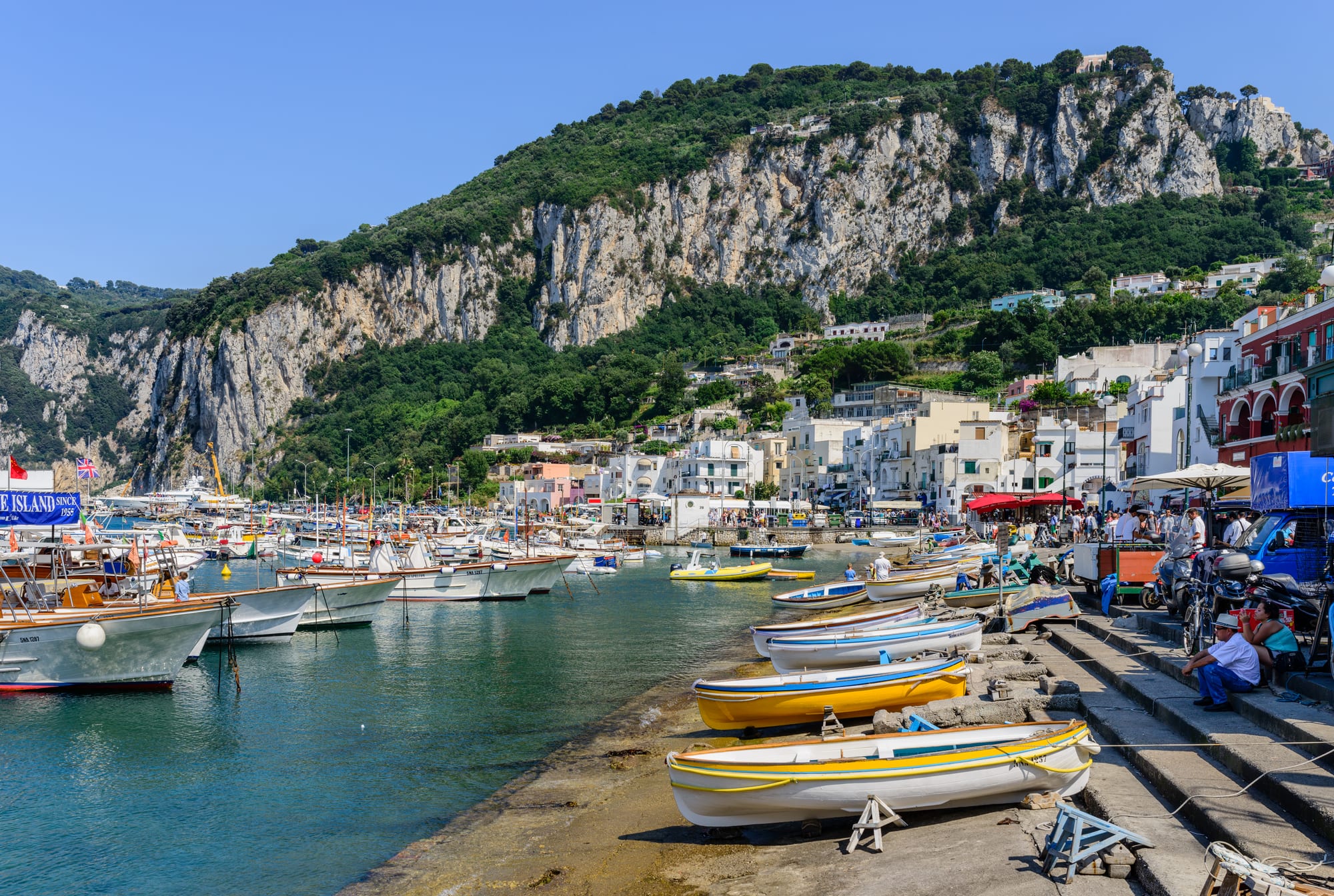
Small wooden boats drawn up on the quay of Marina Grande, with white houses and steep green limestone cliffs behind

Campania, Italy

Capri

Boats in the harbour of Marina Grande, the main port of Capri. (Norbert Nagel / Wikimedia Commons · CC BY-SA 3.0)

A limestone island at the western entrance to the Gulf of Naples, a few kilometres off the tip of the Sorrento Peninsula. Augustus made it a private resort and Tiberius ruled the Roman Empire from it; artists and writers rediscovered it in the 19th century. Today its two towns, Capri and Anacapri, live almost entirely from tourism, with heavy day-tripper crowds in summer.

Neighbourhoods

  • Capri town
    • First-time visitors
    • Historic district
    • Shopping

    The island's main town, covering the centre and east, built around the Piazzetta at the top of the funicular. Narrow lanes of white houses lead out to the Certosa, the Gardens of Augustus and the long footpath to Villa Jovis, and the streets are lined with expensive boutiques.

    Open in Maps
  • Anacapri
    • Quieter evenings
    • Walks and viewpoints

    The upper town on the western slopes of Monte Solaro, on average about 150 metres higher than Capri town and a separate municipality. It holds Villa San Michele, the church of San Michele Arcangelo and the chairlift to the summit, and the road down to the Blue Grotto starts here.

    Open in Maps
  • Marina Grande
    • Close to public transport
    • Boat trips

    The main port on the north coast, at the foot of Monte Solaro, where the ferries and hydrofoils dock. The funicular climbs from here to the Piazzetta, and boats leave the quay for the Blue Grotto and trips round the island.

    Open in Maps
  • Marina Piccola
    • Beaches
    • Swimming

    The small harbour on the south side, near the Faraglioni, used by Augustus and Tiberius before Marina Grande. It has two small pebble beach areas, crowded in July and August, and is reached by bus or on foot from Capri town.

    Open in Maps

Things to do

Roman villas and historic buildings

  • Villa Jovislandmark

    The largest of Tiberius's twelve villas on the island, completed in AD 27, from which he ruled the empire until his death in AD 37; its terraces of walls and staircases cover some 7,000 square metres.

    Open in Maps
  • Villa San Michelemuseum

    The villa that the Swedish physician and writer Axel Munthe built in Anacapri around the end of the 19th century, at the top of the Phoenician Steps, with gardens looking over the bay to Vesuvius.

    Open in Maps
  • Certosa di San Giacomomuseum

    A Carthusian charterhouse founded in 1363, now a museum and venue for cultural events, with a late Renaissance great cloister and a small cloister of Roman marble columns.

    Open in Maps
  • Piazzettalandmark

    Piazza Umberto I, the small square nicknamed 'the drawing room of the world', which has been the centre of Capri town and the island's meeting point since Roman times.

    Open in Maps

Grottoes, rocks and the coast

  • Blue Grottoattraction

    A sea cave on the island's coast entered by small rowing boat through a tiny opening, where sunlight passing through an underwater cavity lights the water an intense blue; boats can get in only at low tide in a calm sea.

    Open in Maps
  • Faraglioniviewpoint

    Three rock stacks rising out of the sea off the south-east coast, the tallest over 100 metres high, best seen from the clifftop paths or from a boat.

    Open in Maps
  • Arco Naturalelandmark

    A limestone arch on the east coast, the remains of a collapsed grotto, spanning 12 metres at a height of 18 metres.

    Open in Maps

Gardens, walks and viewpoints

  • Gardens of Augustuspark

    Terraced gardens laid out by the industrialist Friedrich Alfred Krupp in the early 20th century, with views of Monte Solaro, Marina Piccola and the Faraglioni and a marble monument to Lenin by Giacomo Manzù.

    Open in Maps
  • Monte Solaroviewpoint

    The island's highest point at 589 metres, reached by chairlift from Anacapri or on foot, with views over the whole Bay of Naples and an old British–French blockhouse on its slopes.

    Open in Maps
  • Phoenician Stepstrail

    A long, steep stone stairway, probably built by Greek colonists, that was the only way up to Anacapri before the road was built; its upper end is near Villa San Michele.

    Open in Maps

Seasonal events

  • Festival of San Costanzo14 May

    The feast of the patron saint of Capri town.

  • Festival of Sant'Antonio13 June

    Anacapri's patron saint's day, celebrated with a large rustic festival.

  • International Folklore FestivalAugust

    Bands and folk dance companies perform in the squares of Anacapri.

  • Settembrata AnacapreseSeptember

    Anacapri's grape-harvest festival, with shows, competitions and games built around the island's produce.

  • Capri Hollywood International Film Festivallate December to early January

    A winter film festival bringing Italian and international filmmakers to the island.

Eat and drink

Long-standing places and food districts in Capri. Hours, ratings and directions come from your maps app, always current.

Capri classics

  • Cafés of the Piazzettacafe

    The tables of the cafés filling the small square, the island's place to sit and watch the evening once the day-trippers have left.

    Open in Maps
  • Restaurants of Capri townneighborhood

    Trattorias and restaurants in the lanes around the Piazzetta serving ravioli capresi, pasta e piselli and insalata caprese, with torta caprese and limoncello to finish.

    Open in Maps

Anacapri and the harbour

  • Restaurants of Anacaprineighborhood

    Bars and trattorias around Piazza Vittoria and the lanes of the upper town, generally calmer than those below.

    Open in Maps
  • Marina Grande waterfrontneighborhood

    Cafés and seafood restaurants along the quay where the boats come in.

    Open in Maps

Experience Capri

History

People lived on Capri in the Neolithic and Bronze Age, and Greek colonists were its first recorded inhabitants, calling it Kapreai; the name may come from the Greek for wild boar, whose fossils have been found on the island, or from the Latin for goats. Augustus turned it into a private resort of villas, temples, aqueducts and gardens. His successor Tiberius built twelve villas here, moved to the island for good in AD 27 and governed the empire from Villa Jovis until his death ten years later.

After Rome fell, Capri passed to the Duchy of Naples and suffered raids by pirates and Saracens; in 866 it was granted to the Duchy of Amalfi, and from 987 it had its own bishop until 1818. Ottoman admirals seized it in 1535 and again in 1553. In the Napoleonic Wars the French took it in 1806, the British held it as a naval base, and the French recaptured it in 1808 before it returned to the Bourbon kingdom of Naples in 1815.

August Kopisch's account of his rediscovery of the Blue Grotto in 1826 brought the island new fame. Through the later 19th and early 20th centuries Capri drew painters, writers and expatriates, and it gained a reputation as a tolerant haven for gay men and lesbians. Axel Munthe built Villa San Michele, Friedrich Alfred Krupp laid out gardens before leaving after a scandal in 1902, and Maxim Gorky hosted Lenin in 1908. Today tourism is the island's business, and overtourism is a live concern.

Culture & Customs

Capri's cultural reputation was made by the people who came to stay. Norman Douglas set South Wind here, Compton Mackenzie wrote Vestal Fire and Extraordinary Women about island society, Somerset Maugham set his story The Lotus Eater on Capri, and Munthe's The Story of San Michele made his villa famous. John Singer Sargent painted on the island, and Debussy named one of his piano préludes after the hills of Anacapri.

The island is split between two towns with separate identities and separate municipalities: Capri in the centre and east, and Anacapri higher up to the west. Each has its own patron saint — San Costanzo for Capri in May, Sant'Antonio for Anacapri in June — and Anacapri holds a folklore festival in August and the Settembrata, a grape-harvest festival, in September. In season, concerts, exhibitions and plays are staged in squares and villas, and a film festival takes place around the turn of the year.

The Piazzetta, Piazza Umberto I, is the social heart of the island, nicknamed the drawing room of the world. Residents and visitors meet at its café tables, and the evening there, once the day-trippers have left, is a ritual. Luxury shops, handmade leather sandals and limoncello are part of the island's image.

Daily Life

About 13,500 people live on the island, split almost evenly between the municipality of Capri, with about 6,700, and Anacapri, with about 6,750; roughly a quarter are over 65, and immigrants make up about one in eight. Most homes are white houses on the slopes around the two towns and above the two harbours.

The economy rests on tourism, as it has since the 19th century: hotels, restaurants, shops, boats, taxis and the funicular. Agriculture is limited, though some wine and olive oil are made, and handicrafts add a little more. In July and August large numbers of day-trippers arrive by ferry from Naples and the Sorrento Peninsula, and the lanes, quays and buses fill up; there has been discussion of measures to limit their numbers.

The rhythm of the year follows the season. From spring to autumn life is busy from the first boats in the morning until late evening in the Piazzetta; in winter many businesses close and the island returns to its residents. Cars of non-residents are restricted for much of the year, so islanders travel by bus, taxi and on foot along the network of stairways.

Food

Capri is known in Campania for its marjoram, which dominates the island's signature dish, ravioli capresi, filled with caciotta cheese. Pasta e piselli, pasta with peas, is held locally to be a speciality and is cooked in many versions, with prosciutto or pancetta and with oil, butter or prosciutto fat, almost always using short tube pasta.

Two dishes known around the world carry the island's name. Insalata caprese, sliced fresh mozzarella with tomatoes and basil, seasoned with salt and olive oil, is believed to have originated here and became known internationally in the 1950s; in Italy it is usually eaten as an antipasto, without vinegar. Torta caprese is a dense, flourless chocolate cake made with almonds, popular both home-made and from the pastry shop, and often dusted with powdered sugar in the shape of the Faraglioni; torta anacaprese uses white chocolate and Capri lemon instead.

Lemons appear again in limoncello, the lemon-zest liqueur of the Gulf of Naples, served chilled after dinner and sold in shops all over the island. A little wine and olive oil are produced locally.

Planning tools

Budget

Capri is one of the most expensive places in Italy, especially in July and August. Rooms on the island cost far more than in Naples or Sorrento, and cafés at the harbour and around the Piazzetta charge high prices. Boat trips, the Blue Grotto and the chairlift add up quickly. Many visitors come for the day by ferry and sleep on the mainland.

Daily Budget Midrange
USD 250–450 (room on the island, restaurant dinners, a boat trip and the chairlift)
Daily Budget Shoestring
USD 100–170 (day trip from Naples or Sorrento, ferry, island buses, picnic food from a grocery store)

Staying overnight means seeing the island after the day boats leave; outside July and August prices and crowds both fall.

Best Time to Visit

April to June and September to October bring warm weather and calmer lanes. July and August are hot and very crowded, with long queues at the Blue Grotto and the funicular. In winter many hotels and restaurants close and boat services are fewer, but the island is quiet.

Suggested Number of Days

Many people see Capri on a day trip, but a night or two on the island allows a slower pace once the crowds thin. Add a day or two if combining it with Naples, Sorrento or the Amalfi Coast. Rough seas can delay or cancel boats, so spare time helps.

First Visit
1–2 days
With Surroundings
3–4 days

Transportation

Vehicle access for non-residents is heavily restricted for much of the year, so visitors rely on buses, taxis and their feet. The funicular climbs from Marina Grande to the Piazzetta, a public bus network links Marina Grande, Capri town, Marina Piccola, Anacapri and the Blue Grotto, and open-top taxis wait at the main stops. A chairlift runs from Anacapri to the top of Monte Solaro.

Buses between Capri and Anacapri are small and fill up quickly in summer, so allow extra time.

Airport & Station Connections

The island has no airport; the nearest are at Naples and Salerno. Ferries and hydrofoils run to Marina Grande from Naples (Molo Beverello and Calata di Massa), Sorrento, Positano and Amalfi, with summer services from Ischia; the crossing from Naples or Sorrento takes well under an hour.

Walkability

The island is small and criss-crossed by signposted stairways and footpaths, but it is steep everywhere. Capri town is compact and largely pedestrian, while reaching Villa Jovis, the Arco Naturale or Anacapri on foot means long climbs and many steps. Comfortable shoes and water are needed.

Safety

Italy is generally safe, with low levels of violent crime against visitors. Crime on Capri is rarely an issue; the main risks are crowding on the quays and buses, steep paths and steps, and the sea itself.

Swimming in the Blue Grotto is forbidden, and boats enter it only when the sea is calm. Check current official travel advice before travelling.

Climate

A Mediterranean climate, with warm to hot, generally dry summers and mild, wet winters; rain falls mostly in autumn and least in late spring and summer.

Summer
warm to hot and dry — August, the warmest month, averaged about 25°C in 1961–90
Winter
mild and wet — January and February averaged about 10°C in 1961–90

Local Customs

Capri is a resort where dressing up for the evening around the Piazzetta is part of the scene, but churches expect covered shoulders and knees. Meals follow the Italian sequence of antipasto, primo and secondo, and lunch and dinner come late by northern European standards.

Swimwear belongs on the beach, not in the lanes or churches; ask before photographing residents.

Common Payment Methods

Italy uses the euro. Cards are accepted almost everywhere, including most shops and restaurants on the island; keep a little cash for small bars, bus tickets and kiosks.