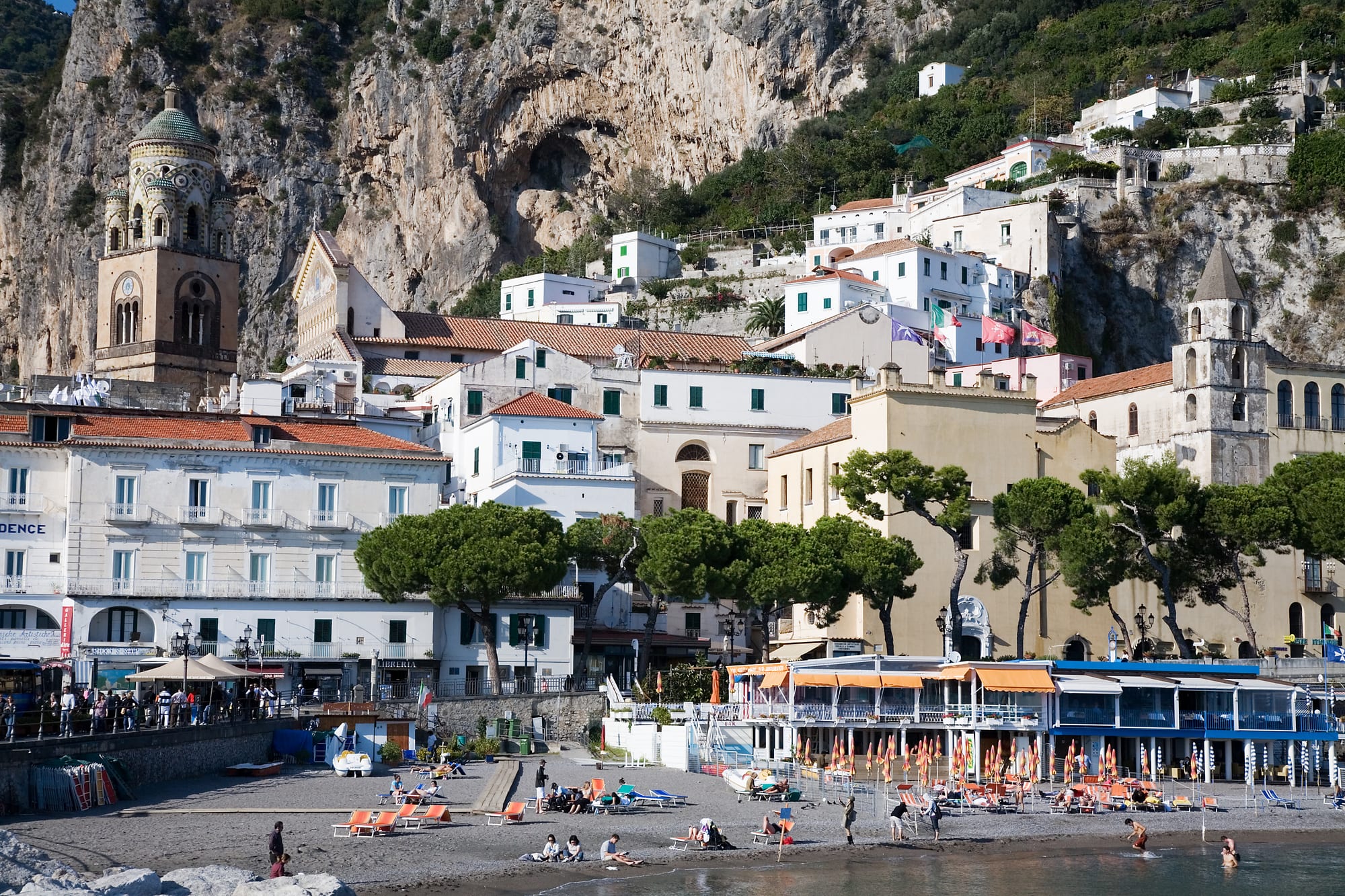
Amalfi's seafront seen from the water, with the beach and pale houses climbing the hillside behind

Campania, Italy

Amalfi

Amalfi seen from the sea, with its beach and the town rising behind it. (Jorge Royan / Wikimedia Commons · CC BY-SA 3.0)

A small town on the Gulf of Salerno at the mouth of a deep ravine below Monte Cerreto, once capital of a maritime republic that traded across the Mediterranean and gave its name to the Amalfi Coast. Its cathedral holds the relics of Saint Andrew, its mills made paper, and today it lives from lemons and tourism.

Neighbourhoods

  • Piazza Duomo and the old town
    • First-time visitors
    • Historic district
    • Best for food

    The heart of Amalfi, where a flight of steps climbs to the cathedral above the square. Pedestrian streets lined with restaurants, pastry shops and souvenir stores run inland from here up the narrow valley, and covered alleys and stairways thread between the houses.

    Open in Maps
  • The seafront and harbour
    • Beaches
    • Close to public transport
    • Boat trips

    The strip of pebbled beach and the Molo Pennello pier where ferries and excursion boats dock, with restaurants and beach bars along the front.

    Open in Maps
  • Valle dei Mulini
    • Walks
    • Paper-making history

    The Mill Valley in the northern part of town, named after the mills that once stood there. The Museum of Handmade Paper is here, and paths continue upstream into the Valle delle Ferriere, along the Canneto stream.

    Open in Maps
  • Pogerola and the hill villages
    • Quiet and residential
    • Views

    The outlying villages of the municipality — Pogerola, Vettica, Pastena, Lone and Tovere — scattered on the slopes above town and reached by road and long stairways, most with their own patron saints' feasts.

    Open in Maps

Things to do

Landmarks and museums

  • Amalfi Cathedrallandmark

    The cathedral of Saint Andrew, begun in the 9th and 10th centuries and layered with Arab-Norman, Gothic, Renaissance and Baroque work behind a 19th-century facade; the apostle's relics lie in the crypt, brought from Constantinople in the early 13th century.

    Open in Maps
  • Cloister of Paradiselandmark

    The 13th-century cloister beside the cathedral, built in the Arab-Norman style.

    Open in Maps
  • Arsenal of the Maritime Republicmuseum

    Two vaulted stone halls where the republic built and repaired its warships, now holding a row-barge from the Historical Regatta, ship models and the Compass Museum.

    Open in Maps
  • Museum of Handmade Papermuseum

    An old paper mill of the Milano family in the Valle dei Mulini, turned into a museum in 1969, with restored working machinery once used to make paper by hand.

    Open in Maps

Neighbouring towns

  • Atranineighborhood

    Italy's smallest municipality by area, a village of houses packed around a tiny square just east of Amalfi.

    Open in Maps
  • Ravelloneighborhood

    A hilltop town high above the coast, reached by road or a long stairway from Atrani, known for its gardens and views.

    Open in Maps
  • Villa Rufololandmark

    In the centre of Ravello facing the cathedral square, a villa laid out in the 13th century and extensively remodelled in the 19th.

    Open in Maps
  • Villa Cimbronepark

    A Ravello villa much altered and extended in the early 20th century by Ernest Beckett, with gardens open to the public and the Terrace of Infinity belvedere.

    Open in Maps

Short trips along the coast

  • Grotta dello Smeraldoattraction

    The Emerald Grotto, a cave partly flooded by the sea at Conca dei Marini, a short way west along the coast.

    Open in Maps
  • Positanoneighborhood

    The steep town of houses stacked down a hillside to the sea, further west along the coast and linked to Amalfi by boat and bus.

    Open in Maps

Seasonal events

  • Feast of Saint Andrew25–27 June and 30 November

    The town's patron saint is honoured twice a year, with processions from the cathedral.

  • Regatta of the Historical Maritime Republicsearly summer, in Amalfi once every four years

    A rowing race between crews from Amalfi, Genoa, Pisa and Venice, recalling the old rivalry of the maritime republics; the host city rotates each year.

  • Byzantine New Year31 August

    A celebration of the start of the year in the old civil calendar of the Byzantine Empire, recalling Amalfi's ties to Constantinople.

Eat and drink

Long-standing places and food districts in Amalfi. Hours, ratings and directions come from your maps app, always current.

Amalfi classics

  • Pasticceria Pansacafe

    A pastry shop on Piazza Duomo known for traditional Amalfi cakes.

    Open in Maps
  • Restaurants of the old townneighborhood

    Trattorias in the streets and squares around the cathedral serving scialatielli with seafood, local fish and lemon desserts, with limoncello to finish.

    Open in Maps

Along the coast

  • Seafront restaurantsneighborhood

    Seafood restaurants and beach bars along the main beachfront.

    Open in Maps
  • Cetaraneighborhood

    The fishing village further east along the coast that makes colatura di alici, an amber anchovy sauce aged in small chestnut barrels.

    Open in Maps

Experience Amalfi

History

Amalfi grew rich on trade. Its merchants carried grain from neighbouring lands, salt from Sardinia, slaves from the interior and timber, exchanging them for gold dinars minted in Egypt and Syria that bought Byzantine silks for resale in the West. In the 9th century they were already buying land with gold coins while most of Italy bartered. The town broke from Byzantine vassalage in 839, elected its first duke in 958 and rivalled Pisa and Genoa before Venice rose; around the year 1000, under Duke Manso, the state may have had 70,000 to 80,000 people. Its maritime code, the Tavole amalfitane, was used by Christian ports across the Mediterranean.

The Normans took the republic in 1073, Roger II of Sicily subdued it in 1131, and the Pisans took it in 1135 and 1137; a copy of Justinian's Pandects found there was claimed as booty. In 1206 Cardinal Pietro Capuano brought the relics of Saint Andrew from Constantinople after the Fourth Crusade. A tsunami in 1343 destroyed the port and the lower town, and Amalfi never again had more than local importance.

The town also kept schools of law and mathematics, and one of Europe's first paper industries, learned from the Arabs. Visitors arrived early: two former monasteries became hotels in the 19th century, Richard Wagner and Henrik Ibsen completed works here, and in the Edwardian era members of the British upper class wintered in the town. The coast was listed as a UNESCO World Heritage Site in 1997.

Culture & Customs

The memory of the republic shapes local identity. Every year the four old maritime republics — Amalfi, Genoa, Pisa and Venice — meet for the Historical Regatta, a rowing race first held in 1955 that comes to Amalfi once every four years, and the arsenal keeps one of the boats. On 31 August the town marks Byzantine New Year, the start of the year in the old civil calendar of Constantinople, and tradition holds that Flavio Gioia, credited with bringing the mariner's compass to Europe, came from Amalfi.

The religious year centres on Saint Andrew, the patron saint, whose feast days fall on 25–27 June and 30 November. A liquid said to seep from the tomb in the crypt, called manna, is collected twice a year at celebrations. The outlying villages keep their own patron saints' feasts.

Craft traditions survive. Amalfi still makes bambagina, a thick handmade paper used across Italy for wedding invitations, visiting cards and fine stationery, and exported to Europe and America; two mills remain. Lemons are everywhere, grown on terraces along the whole coast and turned into limoncello.

Daily Life

About 4,600 people live in the municipality, in the old town at the mouth of the valley and in the villages of Pogerola, Vettica, Pastena, Lone and Tovere on the slopes above. Space is tight: houses climb the cliffs, streets are stairways and alleys, and the one coast road carries all the traffic.

Tourism dominates the economy, with hotels, restaurants, shops and boat services along the seafront and the main street. Most of the farmland is given over to the Costa d'Amalfi lemon, which has protected status; the large, thick-skinned lemons called sfusato amalfitano grow on terraced gardens, where fruit can be seen from February to October. Paper-making continues on a small scale.

Life follows the season. In July and August the beach is full of Italian families on holiday, buses and boats are crowded, and the town is busy late into the evening. When the ferries stop in late autumn, the pace slows and the town returns to its residents. The local football club, Costa d'Amalfi, won its first promotion to Serie D in 2024.

Food

Lemons are the flavour of Amalfi. The sfusato amalfitano is long and at least twice the size of other lemons, with a thick, wrinkled skin and sweet, juicy flesh with few pips. Its zest goes into limoncello, the lemon liqueur of the Gulf of Naples and the Gulf of Salerno, served chilled after dinner and sold in shops all over town.

The town's own pasta is scialatielli, a short, thick, slightly curved strip made from a dough with milk and eggs and flavoured with parmesan, with parsley added for seafood or courgettes and basil for aubergine. It is one of the most recently invented pasta shapes: the chef Enrico Cosentino devised it in Amalfi in the late 1960s, and it is now typical of modern Campanian cooking.

Along the coast, the fishing village of Cetara makes colatura di alici, a clear amber fish sauce produced by fermenting salted anchovies in small chestnut barrels. The sfogliatella, the shell-shaped Campanian pastry, descends from a version created in the 17th century in a convent at Conca dei Marini, just west of Amalfi.

Planning tools

Budget

Amalfi in summer is among the most expensive places in Italy. Rooms are few for the demand and fill up early, and seafront cafés and restaurants charge resort prices. Staying in Salerno and arriving by boat or bus keeps costs down; prices fall sharply outside the main season.

Daily Budget Midrange
USD 220–420 (room in town, restaurant dinners, ferries and museum tickets)
Daily Budget Shoestring
USD 80–140 (day trip from Salerno, ferry or bus, pizza and a pastry)

Buy bus tickets before boarding from bars and tobacconists, and validate them on the bus.

Best Time to Visit

Late spring and early autumn are warm, with ferries running and fewer people than in July and August, when the beach, the buses and the coast road are packed. Boat services run from around Easter to October; in winter the town is quiet and many businesses close.

Suggested Number of Days

A day or two is enough for the town itself. Allow three to five days to use Amalfi as a base for the rest of the coast and the hill towns, with time for boat trips and walks; summer traffic makes every journey slower.

First Visit
1–2 days
With Surroundings
3–5 days

Transportation

Amalfi sits on the SS163 Amalfitana, a narrow cliff road that is congested in summer. SITA buses run along the coast to Sorrento and Salerno and up to Ravello and Agerola, and from roughly Easter to October ferries link the port with Positano, Salerno, Capri, Naples and Sorrento. Parking is scarce and expensive.

Boats avoid the traffic in high summer; buses fill quickly, and the hairpin bends bother anyone prone to motion sickness.

Airport & Station Connections

The nearest airport is Salerno Costa d'Amalfi, about 45 km away, and Naples Capodichino is about 74 km. Most visitors come by ferry from Salerno, Sorrento, Positano or Capri, by bus from Sorrento or Salerno, whose station has high-speed trains to Naples and Rome, or by car along the coast road.

Walkability

The town centre is compact and largely pedestrian, from the seafront through Piazza Duomo and up the valley. Everything off the main street means steps, and the hill villages are reached by long stairways; walkers can continue up the Valle delle Ferriere.

Safety

Italy is generally safe, with low levels of violent crime against visitors. In Amalfi the practical risks are traffic on the narrow coast road, which has no pavement for long stretches, crowds at the bus stops and on the boats, and steep, slippery paths in the hills.

Walk on the coast road only where there is room, carry water on hill paths, and keep bags closed in crowds. Check current official travel advice before travelling.

Climate

Mediterranean, with mild, rainy winters and hot, sunny summers that are rarely muggy.

Summer
hot and sunny — August, the warmest month, averaged about 27°C in 1961–90
Winter
mild and rainy — January averaged about 11°C in 1961–90

Local Customs

The cathedral is an active church; shoulders and knees should be covered inside. Swimwear belongs on the beach rather than in the streets. Amalfi is proud of its history as a republic, and the feasts of Saint Andrew are the high points of the local year.

Keep voices down and avoid photography during services in the cathedral and crypt.

Common Payment Methods

Italy uses the euro. Cards are accepted widely in shops, hotels and restaurants; keep a little cash for small bars, bus tickets and kiosks.