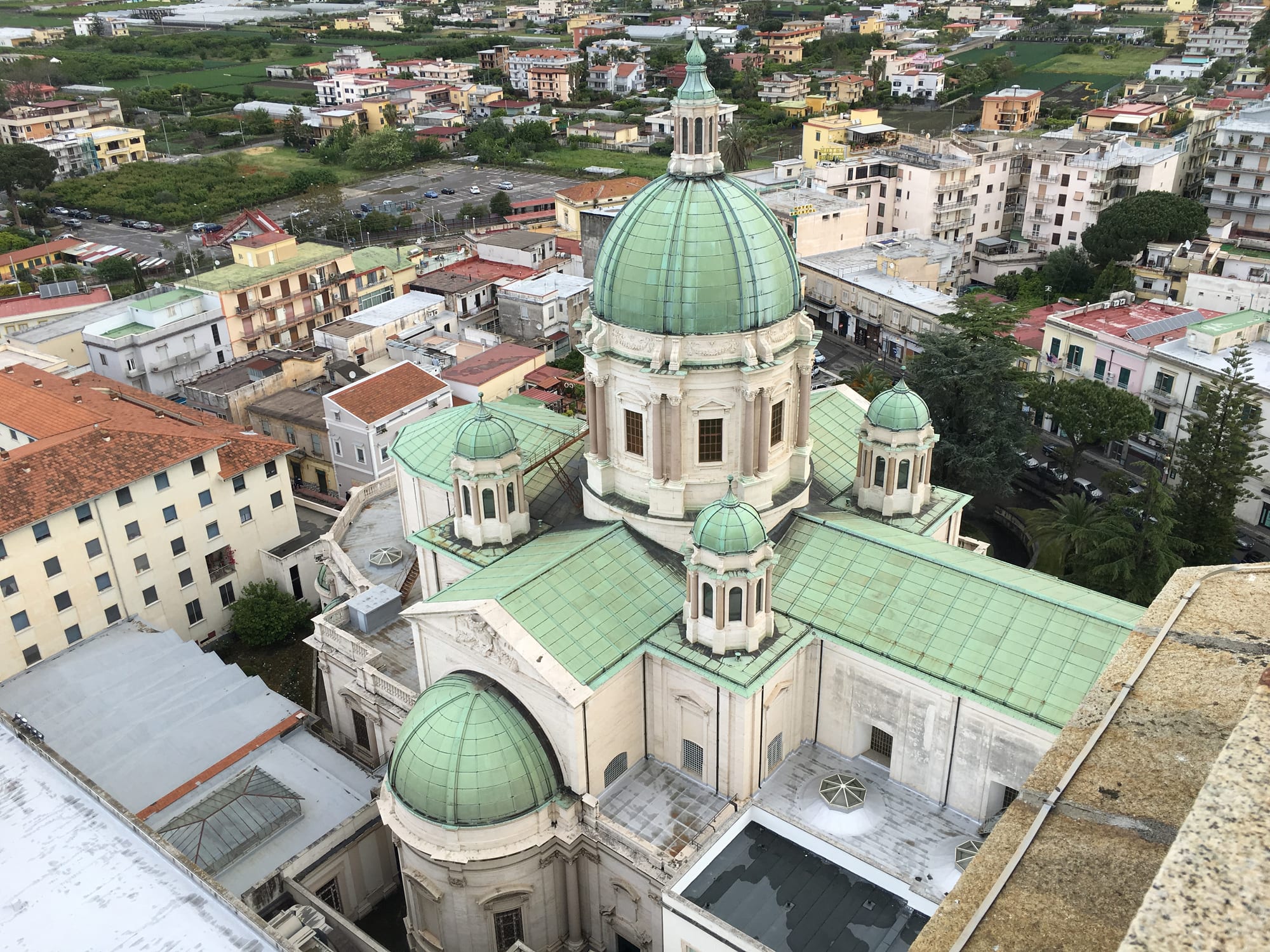
The green copper domes of the Pompei basilica seen from above, with the flat roofs and apartment blocks of the modern town around it

Campania, Italy

Pompei

The Shrine of the Virgin of the Rosary of Pompei seen from above. (Achille Battimelli / Wikimedia Commons · Public domain)

A modern town at the foot of Vesuvius, south-east of Naples, beside the excavated Roman city of Pompeii. It grew up only after 1876 around Bartolo Longo's Marian shrine, became a separate municipality in 1928, and today lives from two kinds of visitor: tourists bound for the ruins and pilgrims bound for the basilica.

Neighbourhoods

  • Town centre and the sanctuary
    • Pilgrims
    • Close to public transport
    • Local life

    The modern town grew up around the basilica and Piazza Bartolo Longo, with the 80-metre bell tower standing over the square. Via Sacra runs from here towards the Trenitalia station, and the Pompei Santuario stop of the Circumvesuviana is close by; shops, cafés and restaurants serve both pilgrims and residents.

    Open in Maps
  • Pompei Scavi
    • First-time visitors
    • Archaeology

    The area around the main entrance to the excavations. The Pompei Scavi–Villa dei Misteri station of the Circumvesuviana stands just outside the gate, and the streets nearby are lined with cafés, souvenir stalls and restaurants aimed at day visitors.

    Open in Maps

Things to do

The Roman city

  • Pompeii archaeological sitelandmark

    The Roman city buried under 4 to 6 metres of ash and pumice in AD 79 and excavated since the mid-18th century, a UNESCO World Heritage Site that draws about 2.5 million visitors a year; daily ticket sales are capped at 20,000.

    Open in Maps
  • Amphitheatre of Pompeiilandmark

    One of the oldest surviving Roman amphitheatres, at the eastern end of the excavations, close to the entrance nearest the modern town.

    Open in Maps
  • House of the Vettiilandmark

    The house of two wealthy freedmen, whose almost complete wall frescoes, painted after the earthquake of AD 62, are a leading example of Pompeii's Fourth Style.

    Open in Maps
  • Villa of the Mysterieslandmark

    A suburban villa on the outskirts of the ancient city, famous for a cycle of 1st-century BC frescoes usually read as the initiation of a bride into a mystery cult.

    Open in Maps

The modern town

  • Shrine of the Virgin of the Rosary of Pompeilandmark

    The basilica begun in 1876 and consecrated in 1891, built to house a painting of Our Lady of the Rosary obtained by Bartolo Longo; its walls are covered with ex-votos, and a lift climbs its bell tower for views over the town, Vesuvius and the ruins.

    Open in Maps

Short trips from the town

  • Herculaneumlandmark

    In Ercolano, the smaller and wealthier Roman town buried by the same eruption, where carbonised wooden roofs, beds and doors survive.

    Open in Maps
  • Villa Poppaealandmark

    In Torre Annunziata, a luxurious Roman seaside villa of ancient Oplontis buried about 10 metres below today's ground level, with fine marble columns and wall paintings.

    Open in Maps
  • Stabiaelandmark

    Near Castellammare di Stabia, about 4.5 km south-west of Pompeii, a group of enormous elite Roman villas on a headland overlooking the Gulf of Naples.

    Open in Maps
  • Vesuvius National Parkpark

    The national park founded in 1995 around the active volcano and the older crater of Monte Somma, covering about 135 square kilometres.

    Open in Maps

Seasonal events

  • Supplica alla Madonna di Pompei8 May and the first Sunday of October

    Tens of thousands of pilgrims come to the shrine for Bartolo Longo's prayer of supplication to the Virgin, recited at midday on 8 May.

Eat and drink

Long-standing places and food districts in Pompei. Hours, ratings and directions come from your maps app, always current.

Food districts

  • Around Piazza Bartolo Longoneighborhood

    Pizzerias, cafés and pastry shops around the basilica square and along Via Sacra, used by pilgrims and residents alike.

    Open in Maps
  • By the Pompei Scavi entranceneighborhood

    Cafés and restaurants clustered by the main gate of the excavations and the Circumvesuviana station, convenient before or after a visit.

    Open in Maps

Experience Pompei

History

The land below Vesuvius was settled long before Rome, and the Roman city of Pompeii, a wealthy town of 10,000 to 20,000 people, was buried under ash and pumice in the eruption of AD 79. Its ruins were found in 1599, but real excavation began only in 1748, and for nearly two centuries the excavations and the surrounding countryside belonged to the municipality of Torre Annunziata.

The modern town owes its existence to Bartolo Longo, a lawyer who returned to the Catholic faith and dedicated his life to the rosary. In October 1873 he began restoring a dilapidated church in the valley and promoted a festival to Our Lady of the Rosary; in 1875 he obtained a painting of the Virgin from a convent in Naples, reports of miracles followed and pilgrims began to arrive. The cornerstone of a larger church, which he co-founded with Countess Mariana di Fusco, later his wife, was laid on 8 May 1876, and it was consecrated in 1891. The modern town grew up around it and counts 1881 as its founding year.

Land from Torre Annunziata and Scafati was combined to create the municipality of Pompei in 1928, and it was granted the rank of city in 2004. Longo was beatified in 1980 and canonised by Pope Leo XIV in October 2025, and the pope visited the shrine on 8 May 2026. Excavation in the ancient city continues, with new frescoed rooms uncovered in 2024.

Culture & Customs

Pompei's identity is divided between two worlds a short walk apart. One is the archaeological site, which draws visitors from all over the world; the other is the shrine, a Marian pontifical shrine and the seat of a territorial prelature. Churches, chapels and shrines across the world are dedicated to Our Lady of Pompei, and the painting at the high altar, showing the Virgin and Child giving rosaries to Saint Dominic and Saint Catherine of Siena, was crowned by Pope Paul VI in 1965.

The great days of the year are 8 May and the first Sunday of October, when tens of thousands of the faithful come for the Supplica, the prayer of supplication that Longo wrote, recited by devotees everywhere at the same hour, at midday on 8 May. The walls of the basilica are covered with ex-votos left in thanks for favours received. Popes have come repeatedly: John Paul II twice, Benedict XVI in 2008, Francis in 2015 and Leo XIV in 2026.

Everyday culture is that of the towns around Naples: football — the local club is Pompei FC — Sunday family lunches, and the habits of a place that sees visitors every day of the year.

Daily Life

About 23,600 people live in the municipality, whose built-up area runs without a break into Scafati on the far side of the provincial border with Salerno. The population is slightly younger than the Italian average, with more children and fewer over-65s. Pompei borders Torre Annunziata, Castellammare di Stabia and Boscoreale in a densely populated stretch of the Vesuvian plain.

Tourism and pilgrimage drive the economy: guides, shops, restaurants, hotels and transport serve the visitors heading for the excavations and the shrine. Around 2.5 million people a year visit the ruins, and since 2024 their managers have capped daily ticket sales at 20,000 and introduced timed entry in the peak summer season.

Commuters use the Circumvesuviana and the Naples–Salerno railway, and the A3 motorway passes the town. Like everyone who lives near Vesuvius, residents share the region's awareness of living close to one of the world's most dangerous volcanoes, in an area of some three million people.

Food

Pompei eats as the Bay of Naples does. Neapolitan pizza, with its soft, thin dough and high edges, is made with San Marzano tomatoes or the pomodorini del Piennolo del Vesuvio, small tomatoes grown on the volcanic plain south of the volcano, and with buffalo mozzarella or fior di latte.

Campanian pastries fill the shop windows: the sfogliatella, a shell-shaped pastry with a sweet filling, in its layered riccia and shortcrust frolla forms, and at Easter the pastiera, a tart of cooked wheat, eggs and ricotta flavoured with orange flower water. The sfogliatella descends from the Santa Rosa pastry created in a convent at Conca dei Marini on the Amalfi Coast in the 17th century, and is usually bought from a pasticceria rather than made at home.

The slopes of Vesuvius produce Lacryma Christi, Christ's tear, a wine made in white from Verdeca and Coda di Volpe grapes and in red from Piedirosso and Sciascinoso. Limoncello, the lemon-zest liqueur of the Gulf of Naples and the Gulf of Salerno, is served chilled after dinner.

Planning tools

Budget

Pompei is cheaper than Capri or the Amalfi Coast, and many visitors come for the day from Naples or Sorrento by train. The main cost is the ticket to the excavations; food near the gates costs more than in the town centre around the basilica.

Daily Budget Midrange
USD 150–300 (room in town, restaurant dinner, tickets for Pompeii and a second site)
Daily Budget Shoestring
USD 70–120 (day trip by Circumvesuviana, site ticket, pizza and a pastry)

In the peak summer season entry to the ruins is timed and daily sales are capped, so buy tickets in advance.

Best Time to Visit

Spring and autumn are best for walking the ruins, which have little shade and grow very hot at midday in July and August. The town is busiest with pilgrims around 8 May and the first Sunday of October.

Suggested Number of Days

A single long day covers the excavations, which are large. Allow two or three days to add the other buried towns and villas nearby and the volcano itself, or base here between Naples and Sorrento.

First Visit
1 day
With Surroundings
2–3 days

Transportation

Pompei has four stations on two Circumvesuviana lines: Pompei Scavi–Villa dei Misteri, beside the main entrance, on the Naples–Sorrento line, and Pompei Santuario in the town centre on the line to Poggiomarino. Trenitalia regional trains on the Naples–Salerno line stop at Pompei station. The A3 motorway has exits at Pompei.

Circumvesuviana trains are crowded, especially at closing time from the ruins; keep bags close.

Airport & Station Connections

Naples Capodichino airport is about 28 km away; Salerno's airport is about 49 km. Most visitors arrive by Circumvesuviana train from Naples or Sorrento, by Trenitalia regional train from Naples or Salerno, or on coach tours.

Walkability

The modern town is small and flat, and the basilica, the stations and the gates of the excavations are within walking distance of one another. Inside the ruins, the old stone streets are uneven and rutted by cart wheels, and a full visit means many kilometres on foot.

Safety

Italy is generally safe, with low levels of violent crime against visitors. In Pompei the main concerns are pickpockets on crowded Circumvesuviana trains, unofficial guides and touts near the gates, and heat in the shadeless ruins in summer.

Carry water and a hat in the excavations, take care on the uneven ancient paving, and keep bags closed on the train. Check current official travel advice before travelling.

Climate

A hot-summer Mediterranean climate, with long, hot summers and mild, rainy winters; around the Bay of Naples November is usually the wettest month and July the driest.

Summer
hot and humid — August, the warmest month, averaged about 25°C at Naples Capodichino in 1971–2000
Winter
mild and wet — January averaged about 9°C at Naples Capodichino in 1971–2000

Local Customs

The basilica is an active place of worship and pilgrimage; dress modestly, with shoulders and knees covered, and keep quiet during services. Meals follow the Italian sequence of antipasto, primo and secondo.

Avoid photography during Mass, and expect large, devout crowds on the two days of the Supplica.

Common Payment Methods

Italy uses the euro. Cards work widely, including for site tickets; keep a little cash for small bars, train tickets and stalls.