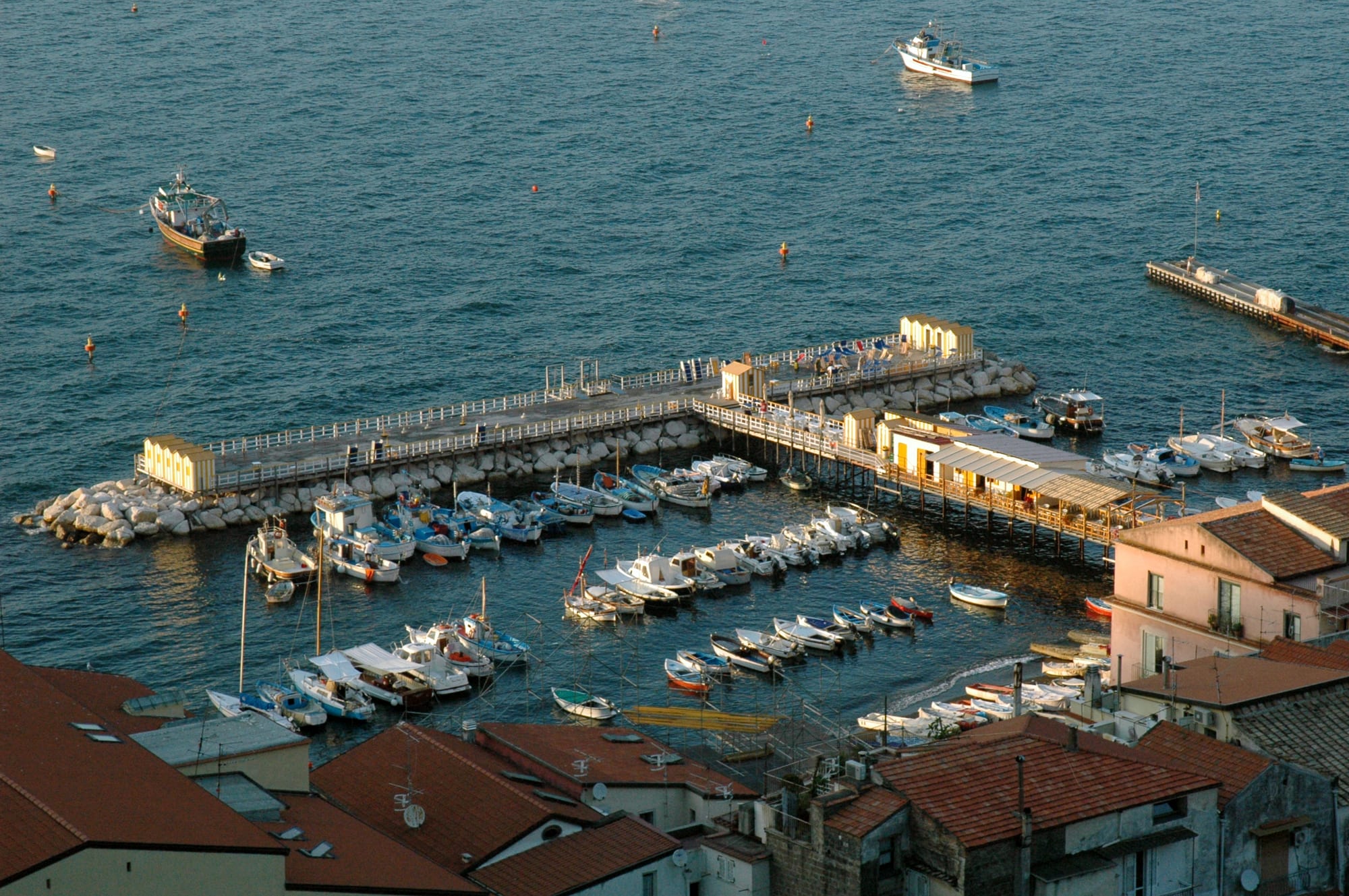
Small fishing boats moored inside a stone breakwater with wooden piers, seen from above over red-tiled roofs

Campania, Italy

Sorrento

The fishing harbour of Marina Grande in Sorrento in the evening light. (DimiTalen / Wikimedia Commons · CC0)

A cliff-top town on the Sorrentine Peninsula facing Naples and Vesuvius across the bay. An ancient Oscan and Roman town, then a small medieval duchy, it became a Grand Tour favourite and is now a popular resort, a base for Capri, Pompeii and the Amalfi Coast known for lemons, limoncello and inlaid woodwork.

Neighbourhoods

  • Centro storico and Piazza Tasso
    • First-time visitors
    • Shopping
    • Close to public transport

    The old town on its cliff-top plain, whose streets still follow the plan of Roman Surrentum. Piazza Tasso, with its cafés, is the hub; Via San Cesareo is lined with shops, and the cathedral, the basilica of Sant'Antonino and the Villa Comunale terrace are a few minutes apart. The railway station is a short walk away.

    Open in Maps
  • Marina Grande
    • Seafood
    • Local life

    The small fishermen's harbour below the cliffs, with restaurants by the water.

    Open in Maps
  • Marina Piccola
    • Ferries
    • Beaches

    The town's small port, below the cliffs of the centre, where hydrofoils leave for Capri, Ischia, Positano and Naples and swimmers use the nearby shore.

    Open in Maps
  • Capo di Sorrento
    • Walks
    • Roman ruins
    • Swimming

    The headland west of town, where the remains of a Roman villa known as the Bagni della Regina Giovanna surround a sheltered natural pool in the rock, a quieter spot for a swim.

    Open in Maps

Things to do

The old town

  • Sorrento Cathedrallandmark

    The cathedral of Saints Philip and James, first built around the 11th century and rebuilt in the 15th, with 11th-century doors from Constantinople, a bell tower on Roman foundations and the font where Torquato Tasso was baptised.

    Open in Maps
  • Basilica of Sant'Antoninolandmark

    An 11th-century basilica that keeps the remains of Sant'Antonino, the abbot and hermit who is the town's patron saint, in its crypt.

    Open in Maps
  • Church and cloister of San Francescolandmark

    A church first built in the 14th century and rebuilt in 1850, with the cloister of its adjoining convent.

    Open in Maps
  • Vallone dei Muliniviewpoint

    A deep, damp gorge just behind Piazza Tasso, holding the overgrown ruins of stone flour mills built as early as the 13th century and abandoned in the 1940s.

    Open in Maps
  • Villa Comunalepark

    The public park of the town, with a view across the Gulf of Naples to Vesuvius.

    Open in Maps

Museums

  • Museum Correalemuseum

    A patrician villa set in a citrus grove, with a belvedere over the gulf, holding Neapolitan paintings of the 17th and 18th centuries, Capodimonte and Sèvres ceramics, clocks and an archaeological collection.

    Open in Maps
  • Museo della tarsia ligneamuseum

    A museum of the inlaid woodwork, or marquetry, for which Sorrento's craftsmen are known.

    Open in Maps

Short trips from the town

  • Capriattraction

    The island of the Blue Grotto and the Faraglioni, reached by hydrofoil and ferry from Marina Piccola.

    Open in Maps
  • Positanoattraction

    The Amalfi Coast village of houses stacked down a steep slope, reached by SITA bus along the Amalfi Drive or by boat.

    Open in Maps
  • Pompeiiattraction

    The Roman town buried by Vesuvius in AD 79, on the Circumvesuviana line between Sorrento and Naples.

    Open in Maps
  • Punta Campanellaviewpoint

    The tip of the Sorrentine Peninsula facing Capri, with an active lighthouse, near where the ancient temple of Athena stood.

    Open in Maps

Seasonal events

  • Good Friday procession of Our Lady of SorrowsHoly Week, Good Friday

    One of the two great Holy Week processions, the 'Visit to the Sepulchres', organised by the confraternity of Saint Monica.

  • Good Friday procession of the Crucified ChristHoly Week, Good Friday

    The second Good Friday procession, organised by the confraternity of the Death.

Eat and drink

Long-standing places and food districts in Sorrento. Hours, ratings and directions come from your maps app, always current.

Sorrento classics

  • Limoncello shops of Via San Cesareoneighborhood

    The shopping street off Piazza Tasso has shops selling limoncello, the lemon liqueur made from Sorrento lemon peel, alcohol, water and sugar.

    Open in Maps
  • Restaurants of Marina Grandeneighborhood

    Restaurants at the old fishing harbour below the town.

    Open in Maps

Cafés

  • Cafés of Piazza Tassocafe

    The central square has many cafés with outdoor tables for coffee, a drink and watching the town go by.

    Open in Maps

Experience Sorrento

History

Indigenous villages stood here from the 8th century BC on a route used by Etruscan traders, and the oldest remains of the town are Oscan, from about 600 BC. Legend credited its founding to a descendant of Ulysses, and a great sanctuary on the tip of the peninsula, the Athenaion, was said to have been founded by him for the cult of the Sirens, from whom Sorrento may take its name. As Surrentum it was subject to Nuceria, joined the revolt of the Italian allies in 90 BC and received a Roman colony. It was famous for its wine, its fish and its red pottery, wealthy Romans built villas along the coast, and the modern streets still follow the ancient plan.

Sorrento became an archbishopric around 420. After Rome it passed to the Ostrogoths and Byzantium, resisted Lombard sieges, and in the 9th century became an autonomous duchy, fighting Amalfi, the Saracens and the Lombards of Benevento. The Normans ended its independence when Roger II took it in 1137. On 13 June 1558 an Ottoman fleet under Dragut and Piali sacked the town and reportedly carried off 2,000 captives, which led to new walls; a revolt against Spanish rule followed in 1648, and plague in 1656.

In the 19th century farming, trade and tourism flourished, a road to Castellammare di Stabia was opened under Ferdinand II, and in 1861 the town joined the Kingdom of Italy. It developed into a resort, visited by Byron, Keats, Goethe, Dickens, Wagner and Ibsen; Nietzsche spent six months here in 1876, and Maxim Gorky lived here in exile from 1922 to 1932.

Culture & Customs

The poet Torquato Tasso, author of Jerusalem Delivered, was born in Sorrento in 1544 and baptised in its cathedral, and the main square bears his name. The town's name went round the world with "Torna a Surriento", Come Back to Sorrento, composed in 1894 by Ernesto De Curtis to words by his brother Giambattista and now one of the best-known Neapolitan songs. In the summer of 1985 Lucio Dalla composed his song "Caruso" in Sorrento.

Holy Week is the great religious moment of the year. On Good Friday two processions pass through the streets: the procession of Our Lady of Sorrows, known as the Visit to the Sepulchres, organised by the confraternity of Saint Monica, and the procession of the Crucified Christ, organised by the confraternity of the Death. The patron saint, Sant'Antonino, an abbot and hermit of the 7th century, rests in the basilica that the townspeople built in his honour.

Myth runs deep here. The Sirens who tried to lure Ulysses were said to live on the Li Galli islands off Punta Campanella, and local tradition holds that Queen Giovanna of Anjou spent her summers in Sorrento; the natural pool at the Capo di Sorrento bears her name. Craft traditions — inlaid woodwork, or tarsia lignea, cabinet-making, linen and lace — have a museum of their own and fill the town's shops.

Daily Life

About 14,800 people live in Sorrento, on the northern coast of the peninsula. The town has been the seat of the archbishops of Sorrento-Castellammare di Stabia since 1986, and its football club, FC Sorrento, plays at the Stadio Italia.

The economy once rested on farming, crafts and shipbuilding. Today it depends overwhelmingly on tourism, which has brought a proliferation of hotels, holiday lets and restaurants, drawn by the town's culture and its sea. The crafts of cabinet-making, inlaid wood, linen and lace survive, but mainly for foreign customers, and the shipyards that once built merchant ships and fishing boats for the whole peninsula now produce little. Lemons, oranges, wine, nuts and olives are still grown on the terraces around town, and Sorrento lemons carry a protected geographical indication.

The season shapes the year. From spring to autumn the streets around Piazza Tasso are packed with visitors arriving by train, bus and boat, and the Circumvesuviana fills with day-trippers and commuters. In winter the pace slows and residents have the town largely to themselves. As on the rest of the coast, traffic on the narrow peninsula roads is a constant topic.

Food

Lemons define Sorrento's kitchen. The Sorrento lemons grown on the terraces of the peninsula carry a protected geographical indication, and their peel is steeped in alcohol with water and sugar to make limoncello, the lemon liqueur produced especially around the Gulf of Naples and sold in many shops in town. The delizia al limone, a lemon-cream sponge cake, was created by the Sorrento pastry cook Carmine Marzuillo in 1978.

The town's best-known dish is gnocchi alla sorrentina, potato gnocchi dressed with Neapolitan ragù and fior di latte cheese and baked in a small single-portion clay pot. The peninsula also has its own cheeses in Neapolitan cuisine, among them the delicate fresh caciottella of the Sorrento peninsula and the burrino di Sorrento, a small provolone with a heart of butter.

In antiquity Surrentum was famous for its wine and fish, and both still matter: restaurants gather at the fishing harbour of Marina Grande, and the terraces above town produce wine, olives and nuts alongside the citrus. Evenings often begin with a drink at a café on Piazza Tasso, and meals end with a small glass of limoncello, served chilled.

Planning tools

Budget

Sorrento is cheaper than Capri or Positano but not cheap in summer, when rooms in town and on the cliffs are in demand. Ferries, site tickets and restaurant dinners add up. The Circumvesuviana is a low-cost way to reach Pompeii and Naples, and spring and autumn bring lower prices than July and August.

Daily Budget Midrange
USD 170–350 (hotel in town, restaurant dinners, ferries and site tickets)
Daily Budget Shoestring
USD 75–130 (hostel or guesthouse, pizzeria and bakery meals, local trains and buses)

The old town, the Villa Comunale view and the Vallone dei Mulini from above cost nothing; taking the train to Pompeii is far cheaper than a tour.

Best Time to Visit

April to June and September to October bring warm weather and easier travel on the ferries and the coast road. July and August are hot, crowded and expensive. Holy Week, with its Good Friday processions, is a striking time to visit; in winter the town is quiet and some services to the islands and the coast are reduced.

Suggested Number of Days

Two or three days suit the town itself. Allow five to seven to use it as a base for the islands, the buried Roman towns and the coast. Ferry schedules, traffic on the coast road and the weather can change the number.

First Visit
2–3 days
With Surroundings
5–7 days

Transportation

The centre is compact and walkable. Local buses serve the surrounding area, SITA buses run along the coast road to Positano and Amalfi from the square by the station, and ferries and hydrofoils leave Marina Piccola for the islands, the coast and Naples. Scooters can be hired, but traffic on the peninsula is heavy in summer.

In high summer the boats are usually the least stressful way to reach Positano and Capri; on the Circumvesuviana, keep bags close.

Airport & Station Connections

Sorrento is the southern terminus of a Circumvesuviana line from Naples, about an hour and twenty minutes from Porta Nolana and Garibaldi, with faster seasonal Campania Express trains. Buses run from Naples airport at Capodichino, and hydrofoils link the town with Naples. By car, the drive from Naples can take an hour and a half in traffic.

Walkability

The old town, Piazza Tasso and the station are close together on a level plain. Reaching the harbours means steep streets or stairways down the cliff; the walk to the Capo di Sorrento follows the road out of town. Pavements are narrow on the main roads.

Safety

Italy is generally safe, with low levels of violent crime against visitors. The persistent problem is pickpocketing and bag-snatching in the big tourist cities — Rome (around Termini and the metro), Florence, Milan, Naples, and Venice — along with taxi overcharging, ticket and "gladiator photo" scams, and distraction teams on public transport. Sorrento is a calm resort; the main risks are pickpockets on the crowded Circumvesuviana and the narrow, busy roads of the peninsula.

Keep bags closed on the train and buses, take care walking on roads without pavements, and swim only where it is permitted. Check current official travel advice before travelling.

Climate

A Mediterranean climate, with mild, wet winters and warm, dry summers; spring can be warm early, and the temperature reached 29°C in April 2013. The mild climate of the Gulf of Naples drew Roman emperors to holiday nearby.

Summer
warm and dry, long and sunny along this coast; across the bay, Naples recorded its highest temperature since 1946, 40.0°C, in August 1981
Winter
mild and wet; in nearby Positano winter minimums almost never fall below 6°C

Local Customs

Religious traditions are strong, above all in Holy Week, when the town's confraternities lead the Good Friday processions. Sorrento's craftsmen are known for inlaid woodwork, lace and ceramics.

Cover shoulders and knees in churches, keep swimwear for the beach, and greet shopkeepers with 'buongiorno' or 'buonasera'.

Common Payment Methods

The currency is the euro. Cards are widely accepted in hotels, shops and restaurants, and there are cash machines in the centre, but cash is useful for buses, small bars and beach piers.