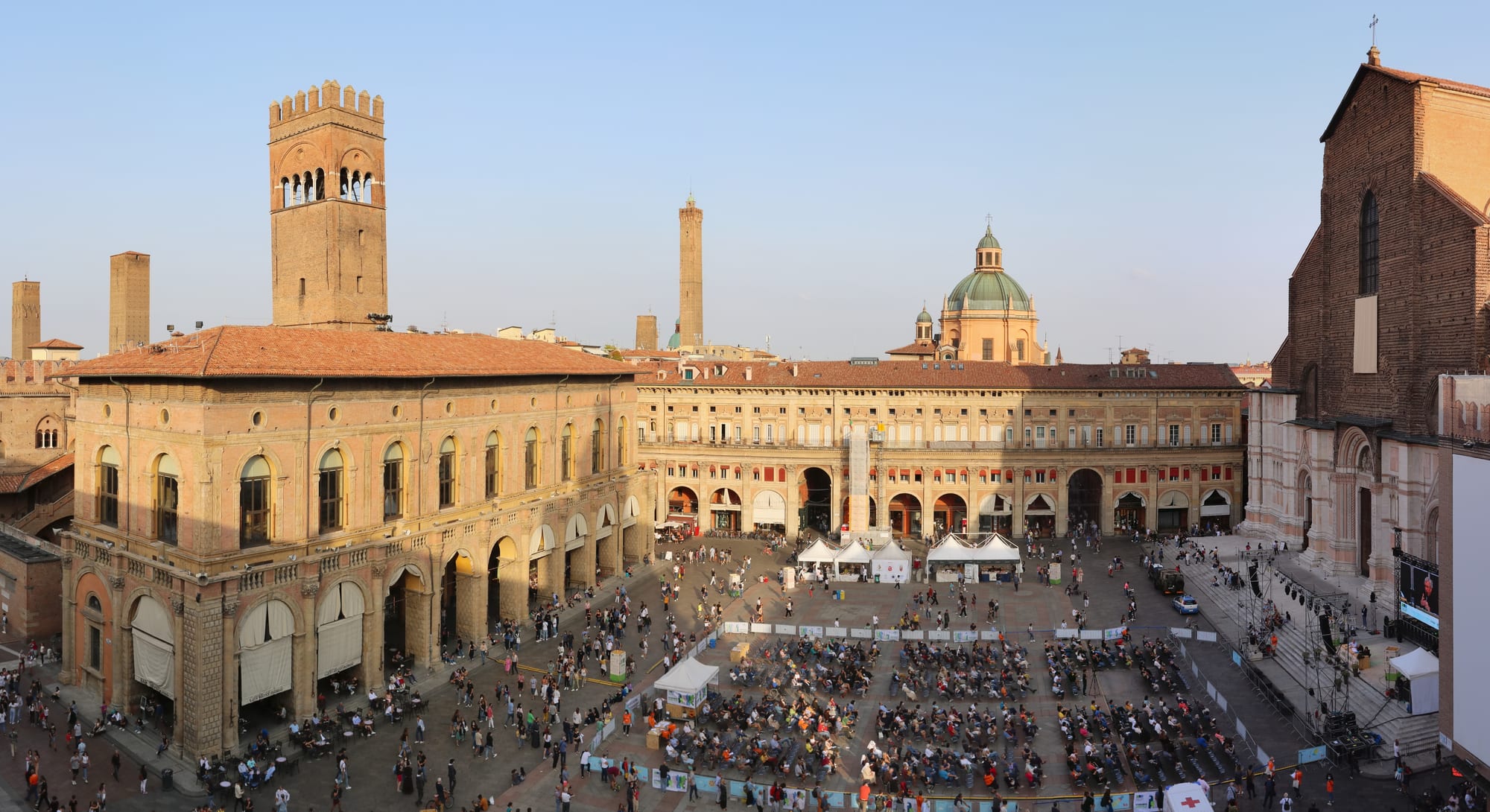
Bologna's Piazza Maggiore in late-afternoon light, with a battlemented tower, arcaded palaces, a green dome and the brick basilica

Italy

Emilia-Romagna

Piazza Maggiore in Bologna, the regional capital, seen from the Palazzo Comunale. (Ingo Mehling / Wikimedia Commons · CC BY-SA 4.0)

The wide plain between the River Po and the northern Apennines, strung along the Roman Via Emilia from Piacenza to Rimini — a wealthy region of arcaded cities, ducal courts and Byzantine Ravenna, the home of Parmigiano, prosciutto and balsamic vinegar, and of Italy's fast-car industry and its busiest beach coast.

Explore Emilia-Romagna

History

The Via Aemilia, built by the consul Marcus Aemilius Lepidus in 187 BC from Rimini to Piacenza, gave Emilia its name and its shape: nearly every major city still sits on the road. Before Rome, Etruscans had founded Felsina, the future Bologna, and Gauls held much of the plain. In 402 the western emperor moved his court to Ravenna, protected by marshes; the city became the capital of Theodoric's Ostrogothic kingdom and then the seat of Byzantine rule in Italy, leaving the mosaics that still fill its churches. "Romagna" comes from Romania, the land of the Romans, as the Byzantine-held area was called.

In the Middle Ages the cities became communes, and Bologna's university, dated by tradition to 1088, drew students from across Europe. Matilda of Canossa, whose castle saw Emperor Henry IV wait in the snow for the pope in 1077, ruled much of the Apennine foothills. Later came signorie and courts: the Este in Ferrara and then Modena, the Farnese in Parma and Piacenza from 1545, the Malatesta in Rimini and the Bentivoglio in Bologna, while the Romagna and Bologna itself fell under the Papal States.

Napoleon's Cispadane Republic adopted the Italian tricolour at Reggio Emilia in 1797. The region joined unified Italy in 1860, and the Gothic Line cut across it in 1944, when the SS massacre at Marzabotto killed hundreds of civilians. After the war Emilia-Romagna became the model of "Red Emilia", governed by the left, built on cooperatives and small manufacturers. Earthquakes struck the plain around Modena and Ferrara in 2012, and floods devastated Romagna in 2023.

Culture & Customs

The region has two identities joined by a hyphen. Emilians, from Piacenza to Bologna, are known for business sense and civic organisation; Romagnoli, east of the Sillaro river toward the Adriatic, for warmth, holiday hospitality and a fierce local pride. Dialects differ strongly from town to town, and Romagnol has its own poetry and songs, including the liscio ballroom dance music of the Casadei family.

Civic life is dense with associations and cooperatives, from supermarkets to wineries and building firms, and the case del popolo and summer Feste dell'Unità of the old Communist Party left a tradition of communal outdoor feasting. Music runs deep: Verdi was born near Busseto, Toscanini in Parma and Pavarotti in Modena, and Parma's opera audiences are notoriously severe. Cinema claims Fellini from Rimini and Bertolucci from Parma.

The Motor Valley around Modena and Bologna — Ferrari at Maranello, Maserati in Modena, Lamborghini at Sant'Agata Bolognese, Ducati in Bologna — is a source of local pride, as is the Imola racetrack. Crafts include the maiolica of Faenza, which gave its name to faience, and hand-rolled fresh pasta, which many home cooks still make with a rolling pin on a wooden board. Festivals include Ferrara's Palio, raced in costume each May, and its summer street-music Buskers Festival.

Daily Life

About 4.4 million people live in Emilia-Romagna, among the most prosperous in Italy. Bologna has about 390,000 residents and a large student population; Parma, Modena, Reggio Emilia, Ravenna, Ferrara, Rimini, Piacenza and Forlì are all mid-sized cities of 100,000 to 200,000. The region has high employment, good public services and a steady flow of migrants from the South and abroad.

The economy combines food processing — cheese, ham, pasta, Barilla in Parma — with machinery, packaging, ceramic tiles around Sassuolo, cars and motorbikes, and biomedical firms near Mirandola. The port of Ravenna handles bulk cargo, and tourism concentrates on the Adriatic resorts, which run a long summer season.

Daily life in the cities is lived under the porticoes, by bicycle and around the markets and aperitivo bars; Bologna's student bars keep late hours. Summer shifts life to the Riviera. Current debates concern flood defence after 2023, housing costs and short-term lets in Bologna, and the future of the many small farms that supply the protected cheeses and hams.

Food

This is often called Italy's food capital. Emilia is the land of fresh egg pasta: tortellini, small filled rings served in capon broth; tagliatelle al ragù, the dish that the world knows loosely as spaghetti bolognese; green lasagne; and tortelli filled with chard and ricotta or, in Ferrara, cappellacci with pumpkin. Romagna eats cappelletti and strozzapreti and wraps everything in piadina, a thin flatbread filled with squacquerone, a soft fresh cheese, and rocket.

Protected products fill the delicatessens: Parmigiano Reggiano, aged from 12 to over 36 months; Prosciutto di Parma; culatello from the Po lowlands near Zibello; mortadella from Bologna; zampone and cotechino, spiced pork sausages, from Modena; and aceto balsamico tradizionale, a syrupy vinegar aged for at least twelve years in wooden barrels in Modena and Reggio Emilia. Gnocco fritto, puffs of fried dough, and tigelle, small flat breads, are eaten with cured meats.

The wines are Lambrusco, a sparkling red from around Modena and Reggio, Sangiovese di Romagna, the white Albana and Bologna's Pignoletto. Nocino is a walnut liqueur, and zuppa inglese a layered custard and liqueur-soaked sponge dessert.

Attractions & Natural Wonders

Bologna centres on Piazza Maggiore, the unfinished basilica of San Petronio and the Neptune fountain, with the Two Towers, the Asinelli and the leaning Garisenda, nearby. Its porticoes, a UNESCO World Heritage Site, include the arcade of nearly 4 km that climbs to the sanctuary of San Luca. Modena's cathedral, Ghirlandina tower and Piazza Grande form another UNESCO site, and the Enzo Ferrari museum is in the city, with the Ferrari museum at Maranello to the south. Parma has Correggio's cathedral dome, Antelami's baptistery and the wooden Teatro Farnese in the Pilotta palace, and Reggio Emilia and Piacenza have fine centres of their own.

To the north-east, Ferrara's Castello Estense, Palazzo dei Diamanti and cycle-path walls stand at the heart of a UNESCO-listed Renaissance city, and the Po Delta's lagoons, with the canal town of Comacchio and the abbey of Pomposa, lie near the coast. Ravenna holds the mosaics of San Vitale, Galla Placidia's mausoleum, Sant'Apollinare Nuovo and Sant'Apollinare in Classe, plus Dante's tomb.

The Rimini coast runs through Cervia's salt pans, Cesenatico, Rimini and Riccione; Rimini itself has the Arch of Augustus, the Tiberius bridge and Alberti's Tempio Malatestiano. Inland are Faenza's ceramics museum, the gypsum hills and castle of Brisighella, the painted walls of Dozza, and in the Apennines the ski slopes of Monte Cimone and Corno alle Scale.

Cities in Emilia-Romagna

Planning basics

Budget

Emilia-Romagna costs less than Tuscany or Lombardy for similar standards. Bologna's hotels fill and rise in price during its big trade fairs, but Ferrara, Modena, Parma and Ravenna are good value, and the Rimini coast has hundreds of family hotels with full-board deals outside August. Food is the bargain: trattorias and market lunches are excellent for the price.

Daily Budget Midrange
USD 150–290 (mid-range hotel, sit-down dinners, museum tickets, a food tour or cheese-dairy visit)
Daily Budget Shoestring
USD 70–110 (hostel or simple hotel, piadina and trattoria lunches, regional trains)

Check Bologna's trade-fair calendar before booking, and book dairy and balsamic-vinegar visits a few days ahead.

Safety

Emilia-Romagna is one of Italy's safest regions. The usual precautions apply around Bologna's central station and on crowded summer beaches. The bigger natural risks are summer heat on the plain, winter fog on the roads, and floods: much of Romagna was flooded in 2023.

Drive carefully in winter fog on the plain, and keep an eye on bicycles in the city centres. Check current official travel advice before travelling.

Climate

The plain has a continental climate: hot, humid, still summers that regularly reach the mid-30s°C, and cold winters with dense fog in the lowlands. The Apennines along the southern edge are cooler and snowy in winter, and the Adriatic coast is milder, with sea breezes in summer.

Summer
hot and humid, 28–35°C on the plain; slightly cooler with a breeze on the coast
Winter
cold and often foggy, 0–8°C on the plain; snow in the Apennines

Transportation

Emilia-Romagna is the easiest Italian region to tour by train. The main line follows the Via Emilia through Piacenza, Parma, Reggio Emilia, Modena, Bologna and on to Rimini, and Bologna is a high-speed hub about an hour from Milan and under 40 minutes from Florence. Branch lines reach Ferrara and Ravenna. A car helps for the Apennine villages, the Po Delta and the dairy farms; many people in the cities get around by bicycle.

Use regional trains between the cities and hire a car only for the countryside; watch for ZTL zones in every historic centre.

Best Time to Visit

April to June and September to October suit the cities, with mild days and the autumn season of truffles, mushrooms and new wine. July and August are hot and muggy inland but are the high season on the Rimini coast, which is packed in August. Winter is foggy and quiet, but the cities are uncrowded and it is the season for the richest food.