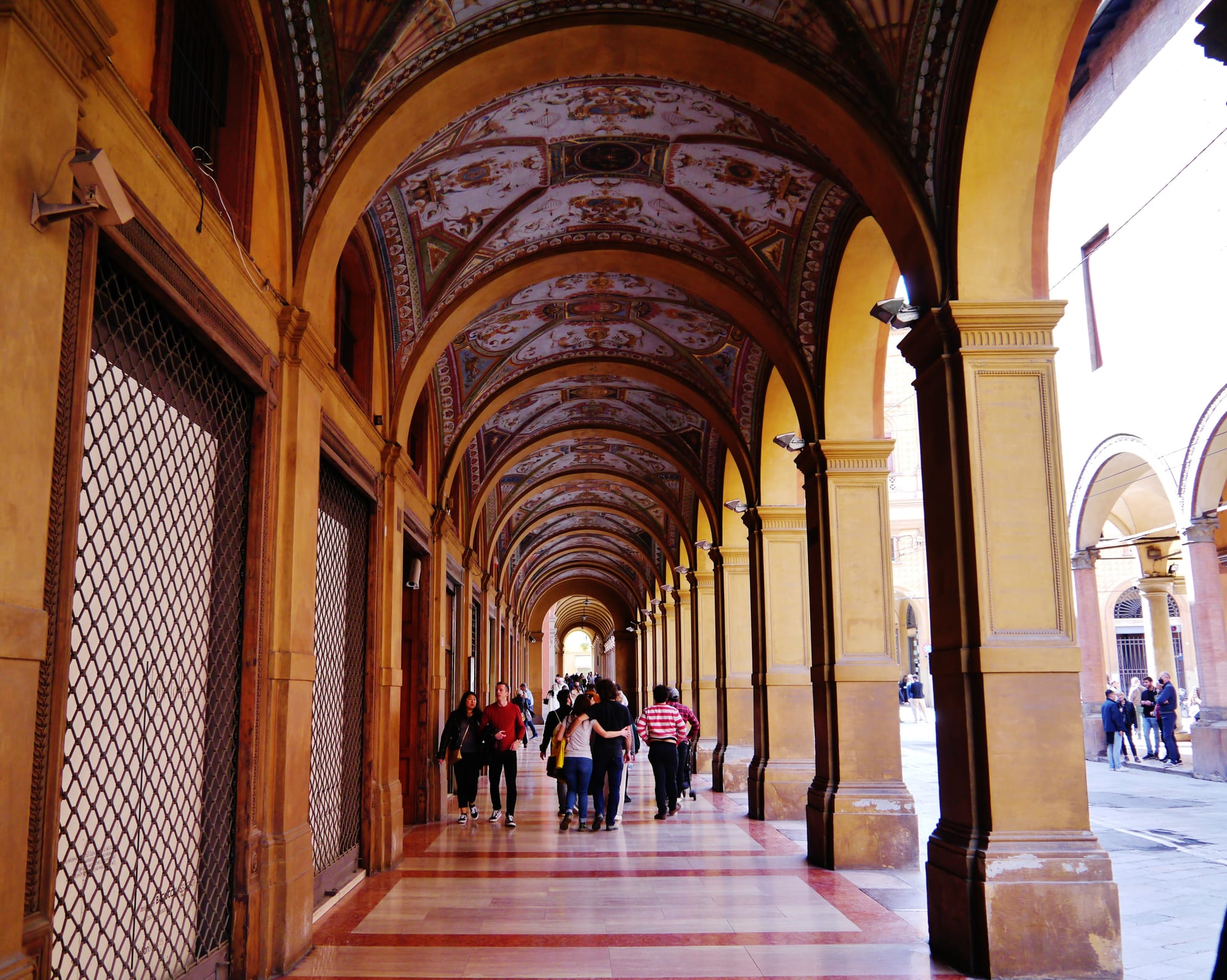
People walking under a long arcade of painted vaults and stone columns on a marble-paved Bologna street

Emilia-Romagna, Italy

Bologna

The painted portico of Via Farini in central Bologna, part of the city's UNESCO-listed porticoes. (Zairon / Wikimedia Commons · CC BY-SA 4.0)

The capital of Emilia-Romagna, on the edge of the Po plain at the foot of the Apennines, and home to the oldest university in continuous operation, founded in 1088. Etruscan Felsina and Roman Bononia grew into a medieval city of towers and porticoes; today it is a wealthy, left-leaning university and trade-fair city of about 390,000, known across Italy for its food.

Neighbourhoods

  • Piazza Maggiore and the centre
    • First-time visitors
    • Historic district
    • Close to public transport

    The heart of the city, where Piazza Maggiore and Piazza del Nettuno meet beneath San Petronio, the town hall and the Neptune fountain. The old Via Emilia still crosses the centre, and Piazza Maggiore itself is a large pedestrian square.

    Open in Maps
  • The Quadrilatero
    • Best for food
    • Markets

    The old market district just east of Piazza Maggiore, on the site of the medieval Mercato di Mezzo. Its lanes still carry the names of the trades once practised there — goldsmiths, drapers, fishmongers, blacksmiths — and are lined with delicatessens, small shops and places to eat.

    Open in Maps
  • The university quarter
    • Students and nightlife
    • Museums

    North-east of the Two Towers, around Via Zamboni, where the university has had its headquarters since the Napoleonic era. Palazzo Poggi's museums, the national art gallery and the opera house are here, and the bars of Piazza Verdi keep student hours.

    Open in Maps
  • Santo Stefano
    • Historic district
    • Quiet and residential

    The streets between Via San Vitale and Via Santo Stefano, east of the towers, centred on Piazza Santo Stefano and its cluster of seven churches. Porticoed palaces, Corte Isolani's courtyard passage of cafés and small shops, and calmer evenings than the university area.

    Open in Maps
  • Via del Pratello
    • Bars
    • Best for food

    A street of osterie and bars on the west side of the centre that is the hub of the city's alternative scene, busy with young people in the evenings.

    Open in Maps
  • The hills south of the walls
    • Parks
    • Walks and viewpoints

    Beyond the ring road the city meets its hills. The Giardini Margherita, the main park, lies just outside Porta Santo Stefano beneath the hills, and from Porta Saragozza the portico of San Luca climbs to the sanctuary on its hilltop.

    Open in Maps

Things to do

Squares, towers and churches

  • Piazza Maggiorelandmark

    The main square, framed by the basilica of San Petronio, Palazzo d'Accursio and Palazzo del Podestà, and the stage for summer film screenings.

    Open in Maps
  • San Petronio Basilicalandmark

    Begun in 1390 and never finished, its façade half-clad; at 132 metres long, the most imposing church in Bologna.

    Open in Maps
  • Fountain of Neptunelandmark

    A mid-16th-century Mannerist fountain with an over-life-size bronze Neptune designed by Giambologna, on the square beside Piazza Maggiore.

    Open in Maps
  • Two Towerslandmark

    The Asinelli, 97 metres tall, and the shorter, more steeply leaning Garisenda, the city's symbols; the Garisenda has been fenced off since late 2023 while work to prevent its collapse goes on.

    Open in Maps
  • Santo Stefanolandmark

    The 'Seven Churches', a complex of linked religious buildings that, by tradition, Saint Petronius began in the 5th century over a temple of Isis.

    Open in Maps
  • San Domenicolandmark

    A 13th-century basilica holding the tomb of Saint Dominic, with medieval monumental tombs in the square outside.

    Open in Maps
  • San Giacomo Maggiorelandmark

    A church begun in 1267 and finished in 1315, whose Renaissance art includes Lorenzo Costa's Bentivoglio Altarpiece.

    Open in Maps

Museums and libraries

  • Archiginnasiomuseum

    The university's main building from 1563, now the municipal library, with walls covered in students' coats of arms and a wooden anatomical theatre.

    Open in Maps
  • Pinacoteca Nazionalemuseum

    The national gallery of Emilian painting from the 13th to the 18th century, including works by Annibale Carracci and Guido Reni.

    Open in Maps
  • Archaeological Civic Museummuseum

    Collections from the Villanovan, Etruscan and Roman city, alongside an Egyptian collection that is among the most important in Europe.

    Open in Maps
  • Palazzo Poggimuseum

    The university's headquarters on Via Zamboni, whose museums show its historic scientific collections.

    Open in Maps
  • MAMbomuseum

    The city's museum of modern and contemporary art, in a former industrial bakery.

    Open in Maps
  • Biblioteca Salaborsaattraction

    The main public library, inside Palazzo d'Accursio, where a glass floor shows the archaeological remains beneath.

    Open in Maps

Porticoes, parks and viewpoints

  • Porticoes of Bolognaattraction

    More than 38 km of arcades in the historic centre alone, listed as a UNESCO World Heritage Site in 2021, which make it possible to walk long distances under cover.

    Open in Maps
  • Sanctuary of the Madonna di San Lucaviewpoint

    The hilltop basilica above the city, reached by a 3.8 km portico of 666 arches built between 1674 and 1793 to shelter the procession of its icon.

    Open in Maps
  • Giardini Margheritapark

    Bologna's main park, opened in 1879 just south of the city centre.

    Open in Maps
  • Finestrella di Via Piellaviewpoint

    A small window on Via Piella that looks out over the Moline Canal.

    Open in Maps

Music and sport

  • Teatro Comunaleattraction

    The city's opera house, in the university quarter, in a UNESCO City of Music.

    Open in Maps
  • Stadio Renato Dall'Araattraction

    Bologna FC's stadium, opened in 1927 and a venue at the 1934 and 1990 World Cups.

    Open in Maps

Short trips from the city

  • Ferraraattraction

    The Este family's Renaissance city, with broad streets and palaces, a UNESCO World Heritage Site.

    Open in Maps
  • Imola Circuitattraction

    The Autodromo Enzo e Dino Ferrari, about 34 km from Bologna, which hosted Formula One for many years and the Emilia Romagna Grand Prix from 2020 to 2025.

    Open in Maps

Seasonal events

  • Arte FieraJanuary

    Italy's oldest and largest modern and contemporary art fair, held at the city's exhibition centre since 1974.

  • Bologna Children's Book FairMarch or April

    Four days of the meeting place for professionals who create and publish children's books, held since 1963.

  • Procession of the Madonna di San LucaLate spring, around the Feast of the Ascension

    The Byzantine icon of the Madonna is carried between San Luca and the cathedral, a procession held since 1433.

  • Il Cinema RitrovatoLate June

    Nine days of restored film classics in the centre's cinemas, with free evening screenings on a big screen in Piazza Maggiore.

  • 2 August commemoration2 August

    The anniversary of the 1980 station bombing, marked each year and ending with a concert in Piazza Maggiore.

Eat and drink

Long-standing places and food districts in Bologna. Hours, ratings and directions come from your maps app, always current.

Bologna classics

  • Tagliatelle al ragù and tortellini in brodorestaurant

    The city's two signature pastas: egg tagliatelle with the slow-cooked meat ragù, and small stuffed tortellini served in capon broth, found in trattorias across the centre.

    Open in Maps
  • Mortadellarestaurant

    Bologna's great cured meat, finely ground pork studded with cubes of fat, sold by the slice in delicatessens and in sandwiches.

    Open in Maps

Markets and food streets

  • The Quadrilateromarket

    The old market streets east of Piazza Maggiore, full of food shops and places to sit down and eat and drink.

    Open in Maps
  • Mercato di Mezzomarket

    A food hall on Via Clavature in the heart of the Quadrilatero.

    Open in Maps
  • Mercato delle Erbemarket

    The city's other historic market.

    Open in Maps
  • Via del Pratelloneighborhood

    A street of osterie, trattorias and bars popular with students and the young.

    Open in Maps

Experience Bologna

History

People lived here from the 3rd millennium BC, and by the end of the 6th century BC the Etruscans had founded the city of Felsina. Gaulish Boii followed, and in 196 BC the Romans made it the colony of Bononia on the Via Emilia, which still runs straight through the centre. Lombards and then Franks held it after Rome's fall. Around 1088 its teaching of Roman law grew into the university, the first degree-awarding institution of its kind, whose students would include Dante, Petrarch and Copernicus.

As a free commune Bologna joined the Lombard League against Frederick Barbarossa, grew rich on canals that brought barges into the city, and raised up to 180 family towers. In 1249 it captured King Enzo, son of Emperor Frederick II, and held him prisoner in Palazzo Re Enzo until his death. The Black Death halved its population in 1348; the Pepoli, the Visconti and the Bentivoglio ruled in turn until Pope Julius II took the city in 1506, beginning almost three centuries of papal rule. Charles V was crowned emperor here in 1530, and the painters of the Bolognese School made its name in art.

Napoleon arrived in 1796, and in 1860 Bologna voted to join the Kingdom of Italy. An air raid in July 1943 destroyed a significant part of the centre, and partisans fought at Porta Lame in 1944 before resistance forces entered on 21 April 1945. After the war the Communist Party and its successors governed without a break until 1999. On 2 August 1980 a bomb at the central station killed 85 people. The porticoes were listed by UNESCO in 2021, and in October 2023 the leaning Garisenda tower was sealed off amid fears for its stability.

Culture & Customs

Bologna has four nicknames, and each describes it. La dotta, the learned, refers to the university, whose tens of thousands of students from across Italy and abroad keep the centre young and its nightlife busy. La grassa, the fat, refers to its rich cooking. La rossa, the red, began with the colour of its brick and terracotta buildings and came to mean its left-wing politics and dense network of cooperatives. La turrita, the towered, recalls the medieval towers, of which only a couple of dozen survive out of up to 180.

UNESCO named Bologna a City of Music in 2006. The Teatro Comunale stages opera, the Orchestra Mozart, created in 2004, had Claudio Abbado as music director until his death in 2014, and the city's festivals range from electronic music and film to the Zecchino d'Oro children's song contest. The Cineteca's Il Cinema Ritrovato fills Piazza Maggiore with film-goers in late June. Bolognese dialect still has a stage of its own, in theatres that play in it.

Unusually for Italy, basketball is the most followed sport, and the city calls itself Basket City for its two rival clubs, Virtus, one of Europe's most successful, and Fortitudo. Bologna FC, seven times Italian champions, won the Coppa Italia in 2025. Every year since 1433 the icon of the Madonna di San Luca has been carried down from its hilltop sanctuary to the cathedral, and the anniversary of the 1980 station bombing is marked each 2 August with a concert in the main square.

Daily Life

About 390,000 people live in the city, and more than a million in its metropolitan area; about 18 per cent of residents were born abroad, most often in Moldova, Bangladesh, Romania, Pakistan or the Philippines. The population is older than the student crowds suggest: a quarter are over 65. Over 80,000 students were enrolled at the university in 2015, and the Johns Hopkins SAIS centre and other foreign universities have campuses here.

The economy is among the strongest in Italy. Food processing, packaging machinery — the area is called the "packaging valley" — and engines and vehicles, including Ducati and Lamborghini, sit alongside publishing, energy and one of Europe's largest permanent trade-fair grounds. Cooperatives, rooted in 19th-century farmers' and workers' struggles, remain a major employer. The regional government occupies the Fiera district towers designed by Kenzo Tange.

Life is lived under the porticoes, on bicycles and in the aperitivo bars. Students keep the centre lively, and the local authorities often have to deal with the noise and litter of the university quarter's nightlife. Works for the new tramway, under construction since 2023, have disrupted many streets. Matteo Lepore, of the centre-left Democratic Party, has been mayor since 2021.

Food

The city's cooking rests on pork, egg pasta and dairy. Ragù — the original of the sauce known abroad as bolognese — is a slowly cooked sauce of a soffritto of onion, celery and carrot with minced beef and some fatty pork, simmered with white wine, milk and a little tomato. In Bologna it dresses tagliatelle and lasagne, and serving it with spaghetti is considered odd. Tortellini, small rings of egg pasta stuffed with pork loin, prosciutto, mortadella, Parmesan, egg and nutmeg, are served in capon broth.

Mortadella Bologna, which holds protected status, is a large cooked sausage of finely ground cured pork with at least 15 per cent small cubes of hard fat, flavoured with peppercorns and sometimes pistachios. The Quadrilatero, the old market streets east of Piazza Maggiore, is the place to buy it, along with cheese, cured meats and fresh pasta, and the Mercato di Mezzo and Mercato delle Erbe are its historic markets.

Sweets follow the calendar: fave dei morti, coloured almond-paste biscuits for All Saints, jam-filled raviole for Saint Joseph's Day, sfrappole, light fried pastries dusted with sugar, at Carnival, and certosino, a spiced Christmas cake. Torta di riso, made with almonds, rice and amaretto, is eaten all year. The wines poured here include Pignoletto from the hills just outside the city, Lambrusco from around Modena and Sangiovese from Romagna.

Planning tools

Budget

Bologna costs less than Milan, Venice or Florence for similar standards. Hotel prices rise sharply during the big trade fairs, so dates matter more than the season. Food is the city's bargain: trattoria lunches, market stalls and delicatessen sandwiches cost little for the quality.

Daily Budget Midrange
USD 160–300 (mid-range hotel, sit-down dinners, museum tickets, a food tour)
Daily Budget Shoestring
USD 75–120 (hostel or simple hotel, market lunches and sandwiches, buses)

Check the trade-fair calendar before booking a room, and remember that the porticoes, the squares and most churches cost nothing.

Best Time to Visit

March or April to October is the best stretch, when people eat and drink outdoors in the squares; late June brings the free film screenings in Piazza Maggiore. July and August are very hot and humid, and winter is cold, damp and often foggy, though the porticoes make rain and snow easy to live with.

Suggested Number of Days

Two or three days suit a first visit to the city itself. Allow four to six to add the other cities of the Via Emilia, the hills and the food producers nearby. Trade-fair dates and the length of meals, which are rarely hurried, both change the count.

First Visit
2–3 days
With Surroundings
4–6 days

Transportation

The compact centre is best on foot. TPER runs a large network of buses and trolleybuses, and a commuter rail service links the suburbs and nearby towns. A new tramway is under construction, so some streets have building works. Bicycles are popular with residents, and bike hire is available.

Leave a hire car outside the historic centre, and watch for cyclists under the arcades and on the streets.

Airport & Station Connections

Bologna Guglielmo Marconi Airport is about 6 km north-west of the centre; the Marconi Express monorail links it to Bologna Centrale in about seven minutes. Centrale is one of Italy's most important rail hubs, on the high-speed lines to Milan, Florence and Rome, with regional trains across Emilia-Romagna.

Walkability

Excellent. The historic centre is compact, follows the Roman street grid and is sheltered by some 38 km of porticoes, so walking is easy in sun and rain. Piazza Maggiore to the Two Towers, the Quadrilatero or Santo Stefano takes minutes. The walk up to San Luca under its portico is long and steep.

Safety

Italy is generally safe, with low levels of violent crime against visitors. In Bologna the usual precautions apply around the central station and in crowds, and the late-night student bars around Piazza Verdi can be rowdy.

Keep bags closed on buses and around the station, and take care with bicycles on narrow streets. Check current official travel advice before travelling.

Climate

A humid subtropical climate with very hot, muggy summers and fairly cold, damp winters. Light winds let fog and haze settle over the city, and rain falls mainly in spring and autumn.

Summer
very hot and humid; the record is 40.1°C, set in August 2017
Winter
cold and damp, with fog and night frosts — the record low is −18.8°C, set at the airport in 1966; snow is not uncommon from late November to early March, and 119 cm fell in February 2012

Local Customs

Tipping is not customary in Italy: restaurants usually add a small coperto, a cover charge, and leaving a euro or two for good service is plenty. Coffee is drunk standing at the bar, and the aperitivo before dinner is a city ritual. Bolognesi are proud of their cooking and particular about it: ragù goes with tagliatelle, not spaghetti.

Dress respectfully and keep voices low in churches, and keep noise down late at night in residential streets of the university quarter.

Common Payment Methods

The currency is the euro. Cards are accepted almost everywhere, but a little cash is useful for market stalls, small bars and tips, which cannot be added to a card payment. A per-night tourist tax may be collected by accommodation.