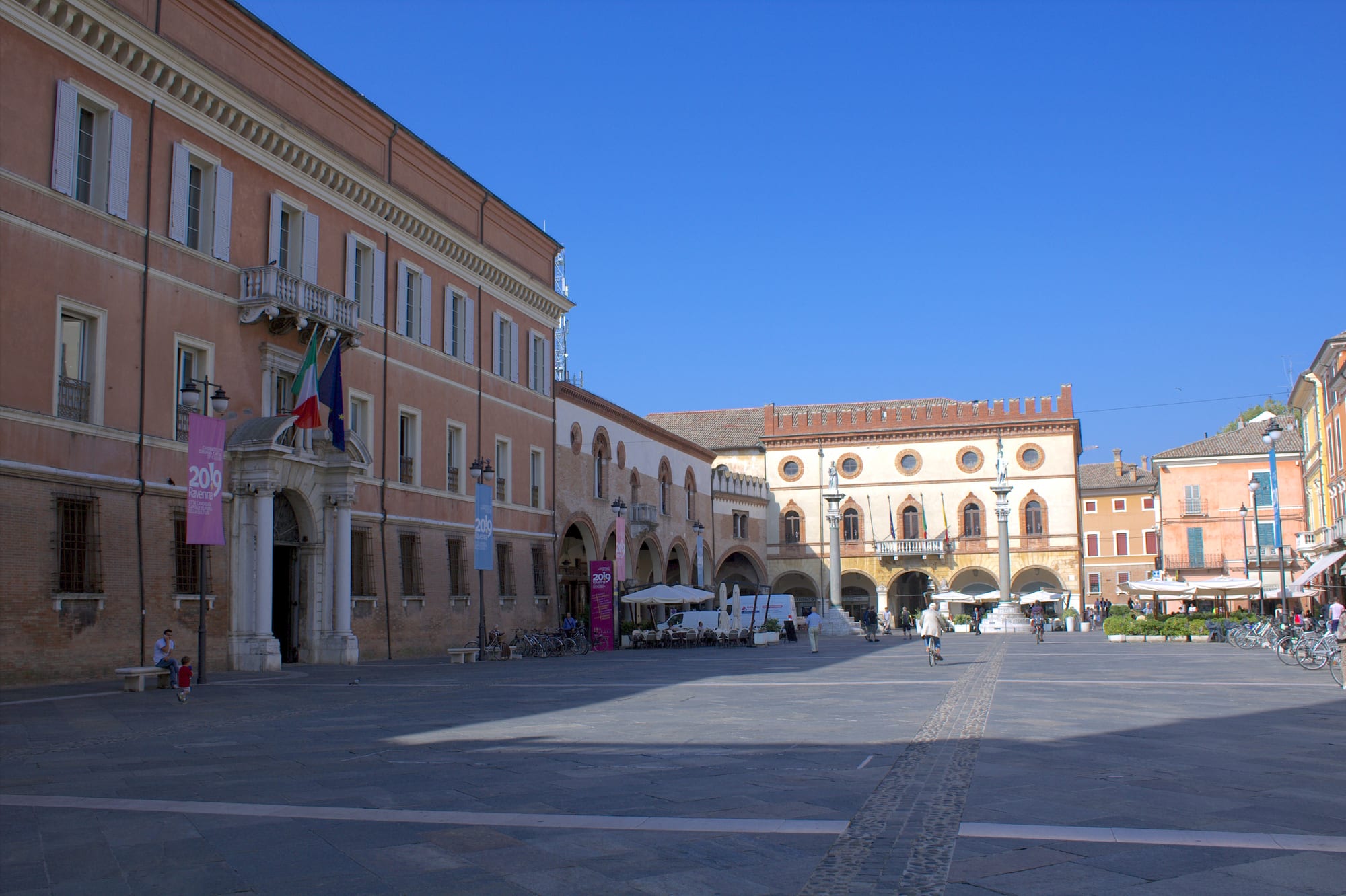
Sunny Piazza del Popolo in Ravenna, with a battlemented arcaded palace, two columns and a cyclist crossing the paving

Emilia-Romagna, Italy

Ravenna

Piazza del Popolo, the main square of Ravenna, with the arcaded town hall and its two columns. (Incola / Wikimedia Commons · CC BY-SA 3.0)

A city of about 156,000 in Romagna, a few kilometres inland from the Adriatic, to which it is joined by the Candiano Canal. Capital of the Western Roman Empire in the 5th century, then of Theodoric's Ostrogoths and of Byzantine Italy, it keeps eight early Christian monuments with gold-ground mosaics listed by UNESCO, as well as Dante's tomb and a long line of beaches.

Neighbourhoods

  • Piazza del Popolo and the centre
    • First-time visitors
    • Close to public transport

    The main square, with the town hall's arcade and two columns, sits at the centre of a flat old town of brick churches and palaces. The covered market of 1922 is just north of the square, and most of the mosaics are within a short walk or cycle ride.

    Open in Maps
  • The San Vitale quarter
    • Historic district
    • Mosaics

    The quarter around San Vitale holds the city's most famous group of monuments: the basilica of San Vitale, the Mausoleum of Galla Placidia in its grounds, and the National Museum in the former monastery next door.

    Open in Maps
  • The Dante zone
    • Historic district
    • Quiet streets

    Around the basilica of San Francesco, where Dante's funeral was held in 1321, the small neoclassical tomb of the poet stands in a 'zona dantesca' where visitors are asked to keep silent.

    Open in Maps
  • Classe
    • History
    • Nature

    South of the city, the site of Augustus's naval harbour of Classis, where the great basilica of Sant'Apollinare in Classe still stands among the fields, with the pine woods of the Pineta di Classe towards the coast.

    Open in Maps
  • The lidi
    • Beaches
    • Summer

    Ravenna's municipality reaches the sea in a string of resorts — Marina di Ravenna, the first of them, Punta Marina, Lido Adriano, Lido di Dante, Lido di Classe and others — with beach clubs, pine woods and a cycle path from the city.

    Open in Maps

Things to do

The UNESCO mosaics

  • Basilica of San Vitalelandmark

    An octagonal church completed in 547, whose mosaic panels beside the apse show the emperor Justinian and the empress Theodora with their courts; its mosaics are the largest and best-preserved Byzantine examples outside Istanbul.

    Open in Maps
  • Mausoleum of Galla Placidialandmark

    A small cross-shaped building of 425–450 whose dome glows with a starry blue mosaic sky — misnamed, as Galla Placidia was not buried there.

    Open in Maps
  • Basilica of Sant'Apollinare Nuovolandmark

    Theodoric's palace church, dedicated in 504, its nave lined with long mosaic processions of martyrs and virgins.

    Open in Maps
  • Baptistery of Neonlandmark

    The Orthodox baptistery, begun around 400 and finished with its mosaics by Bishop Neon later in the 5th century, with a dome mosaic of the baptism of Christ ringed by the apostles.

    Open in Maps
  • Arian Baptisterylandmark

    Built for Theodoric's Arian Christians around 500, with its own dome mosaic of the baptism.

    Open in Maps
  • Archbishop's Chapellandmark

    The private oratory of the Nicene bishops, built around 495 in Theodoric's time; the smallest of the mosaic sites and the only early Christian private oratory to survive.

    Open in Maps
  • Mausoleum of Theodoriclandmark

    The Ostrogothic king's tomb of 520, just outside the old walls.

    Open in Maps
  • Basilica of Sant'Apollinare in Classelandmark

    Consecrated in 549 in the old port town of Classe and praised by UNESCO for the purity of its design and the richness of its decoration.

    Open in Maps

Dante, churches and museums

  • Tomb of Dantelandmark

    The neoclassical monument of 1781 over the poet's grave; Florence has sought the return of his remains since at least 1519, without success.

    Open in Maps
  • Basilica of San Francescolandmark

    The church of Dante's funeral, with a crypt and fragments of early mosaic floor that are usually under water after heavy rain.

    Open in Maps
  • San Giovanni Evangelistalandmark

    A 5th-century church raised by Galla Placidia after she survived a storm at sea, wrecked by bombing in 1944 and restored.

    Open in Maps
  • Domus dei Tappeti di Pietramuseum

    The 'House of the Stone Carpets', mosaic floors of a Byzantine-era palace reached through the 18th-century church of Sant'Eufemia.

    Open in Maps
  • National Museum of Ravennamuseum

    The city's national museum, in the former monastery beside San Vitale.

    Open in Maps
  • Rocca Brancaleonepark

    A castle built by the Venetians in 1457 as part of the walls, now a public park.

    Open in Maps

Beaches and short trips

  • Lido di Classebeach

    One of Ravenna's seaside resorts, between the mouth of the Savio and the pine woods and nature reserve of the Bevano.

    Open in Maps
  • Mirabilandiaattraction

    Italy's largest theme park, at Savio within the municipality, with roller coasters, a waterpark and a 92-metre Ferris wheel.

    Open in Maps
  • Cerviaattraction

    The neighbouring seaside town to the south, known for its salt pans.

    Open in Maps
  • Comacchioattraction

    A lagoon town of canals and bridges in the Po Delta.

    Open in Maps
  • Faenzaattraction

    The Romagna town whose maiolica gave its name to faience, with an international ceramics museum.

    Open in Maps

Seasonal events

  • Ravenna FestivalJune and July

    A summer festival of opera and classical music, dance and jazz, founded in 1990 by Maria Cristina Mazzavillani Muti, with concerts in San Vitale and Sant'Apollinare in Classe.

  • Opera season at the Teatro AlighieriNovember to April

    Up to six operas a season in the city's opera house, inaugurated in 1852.

Eat and drink

Long-standing places and food districts in Ravenna. Hours, ratings and directions come from your maps app, always current.

Romagna classics

  • Piadina with squacqueronerestaurant

    Romagna's thin flatbread of flour, lard or olive oil, salt and water, cooked on a griddle and typically filled with squacquerone, a soft, spreadable fresh cheese from Romagna.

    Open in Maps
  • Cappelletti and strozzapretirestaurant

    The pastas of Romagna: hat-shaped filled cappelletti and hand-made strozzapreti, served in the city's trattorias.

    Open in Maps

Markets

  • Mercato Copertomarket

    The covered market of 1922 on Piazza Andrea Costa, just north of the main square, with a place to eat lunch.

    Open in Maps

Experience Ravenna

History

Ravenna began as a settlement of the Umbri, houses on piles across small islands in a marshy lagoon, much as Venice would later be built. Rome accepted it as a federated town in 89 BC; Julius Caesar gathered his forces here before crossing the Rubicon in 49 BC, and Octavian founded the naval harbour of Classis, a base of the imperial fleet. In 402 the emperor Honorius moved his court here, protected by the marshes, and Ravenna was the capital of the Western Empire for most of the 5th century. Galla Placidia's rule brought the Orthodox Baptistery and San Giovanni Evangelista, and in 476 the last western emperor, Romulus Augustulus, was deposed here.

Odoacer held the city until the Ostrogoth Theodoric took it in 493 after a three-year siege. Theodoric built Sant'Apollinare Nuovo, an Arian cathedral and baptistery, and his own mausoleum; Arian Goths and Nicene Romans lived side by side under their own laws. Justinian's general Belisarius took Ravenna in 540, and it became the seat of the Byzantine exarch who governed Italy. In those decades the bishops completed San Vitale and Sant'Apollinare in Classe.

The Lombards took the city in 751; Pepin's donation of 756 handed the former exarchate to the pope. The Da Polenta family ruled from 1275 and sheltered the exiled Dante, who died here in 1321. Venice annexed Ravenna in 1441 and built the Rocca Brancaleone; Venetian rule ended in 1509, and in 1512 French troops sacked the city after the Battle of Ravenna. Drainage canals over three centuries turned the marshes into farmland. Ravenna joined unified Italy in 1861, and Allied bombing in 1944 destroyed San Giovanni Evangelista before Canadian and British troops liberated the city on 5 November.

Culture & Customs

Mosaic is Ravenna's art and identity. Eight early Christian buildings form a UNESCO World Heritage Site, and the concentration of mosaics has made the city the "capital of mosaics", with workshops and schools that still teach the craft. Several of the monuments remain places of worship, and their calm interiors set the tone for a city that is quieter than its Romagna neighbours on the coast.

Literature has long drawn on the city. Dante spent most of his exile here, mentioned Ravenna in the Inferno and lies in a tomb whose remains Florence has sought in vain since at least 1519; the area around it is a zone of silence. Lord Byron lived here from 1819 to 1821 for love of Teresa Guiccioli and continued Don Juan; Oscar Wilde and Alexander Blok wrote poems named after the city, Hermann Hesse wrote two about it, and Michelangelo Antonioni filmed Red Desert in its industrial zone in 1964.

Music fills the summer. The Ravenna Festival, founded in 1990 by Maria Cristina Mazzavillani, wife of the conductor Riccardo Muti, a longtime resident who regularly takes part, brings orchestras from around the world to the Teatro Alighieri, the Palazzo Mauro de André and the basilicas of San Vitale and Sant'Apollinare in Classe. The beaches, which hosted the 2011 Beach Soccer World Cup, are where the city spends its summer weekends.

Daily Life

About 156,000 people live in Ravenna, which is the second-largest municipality in Italy by area, stretching across farmland, pine woods and coast. More than a quarter of residents are over 65, and about 15 per cent were born abroad, most often in Albania, Romania, Senegal, Moldova or Ukraine. Lido Adriano, Mezzano and Marina di Ravenna are the largest of its many outlying villages.

The economy rests on the port, an important commercial and tourist harbour reached by the Candiano Canal, on the industry around it, on agriculture in the reclaimed land and on tourism, both cultural in the centre and seaside along the lidi. Gas pipelines come ashore along the coast, and coastal erosion is a concern: Lido di Dante lost 35 cm in the first two decades of the century.

Daily life is calm and largely lived on bicycles in the flat centre, with lunch at the covered market or a piadina kiosk and summer evenings at the beach. Ravenna FC plays in Serie C. Ravenna was among the cities hit by the Emilia-Romagna floods of May 2023.

Food

Ravenna eats the food of Romagna. The piadina, a thin flatbread of white flour, lard or olive oil, salt and water, was first recorded in 1317 and holds EU protected status; it was traditionally cooked on a terracotta dish called a teggia or testo, now usually on a flat pan or griddle. It is commonly filled with squacquerone, a very soft, spreadable fresh cow's-milk cheese with a lactic, sweet-sour taste, which has its own protected designation.

Cappelletti, ring-shaped filled pasta named for their hat shape, are larger and thicker than tortellini; the traditional filling includes meats, Parmesan, eggs and nutmeg. Strozzapreti, a long hand-made pasta whose name means 'priest chokers', are the other Romagna classic.

The Mercato Coperto, built in 1922 just north of Piazza del Popolo, is a popular place for lunch. Sangiovese di Romagna and the white Albana are the wines of the surrounding hills, and the salt pans of Cervia lie just down the coast.

Planning tools

Budget

Ravenna is good value, and the centre is small enough to need no transport. Prices rise at the beach resorts in high summer, and during the Ravenna Festival in June and July rooms in town fill faster.

Daily Budget Midrange
USD 150–270 (mid-range hotel, sit-down dinners, monument tickets, a festival concert)
Daily Budget Shoestring
USD 70–110 (hostel or simple hotel, piadina and market lunches, bike hire)

Rent a bicycle to reach Classe and the beaches, and book festival concerts in good time.

Best Time to Visit

Spring and autumn are best for the monuments, which can be seen in any weather. June and July bring the Ravenna Festival and the beach season, which peaks in August; winter is quiet and damp, the season for opera at the Alighieri.

Suggested Number of Days

One full day covers the main mosaics; two allow a slower pace and the museums. Three or four add Classe, the beaches and the towns of Romagna and the Po Delta. A summer stay at the beach changes the count entirely.

First Visit
1–2 days
With Surroundings
3–4 days

Transportation

The centre is flat, and the bicycle is the natural way around: a cycle path runs out to Marina di Ravenna and Punta Marina on the coast, and another to Lido Adriano and Lido di Dante. Classe is about 5 km south of the centre. A car is useful mainly for the Po Delta and the countryside.

Hire a bike for Classe and the coast, and watch for cyclists everywhere in the centre.

Airport & Station Connections

Ravenna station has direct trains to Bologna, Ferrara, Rimini, Faenza and further to Milan, Verona and Lecce. The nearest major airport is Bologna's, about 80 km away, with Rimini's as an alternative. By road the A14 branch from Bologna ends at the city, and the Romea road leads north towards Venice.

Walkability

Excellent. The historic centre is compact and flat, and San Vitale, Galla Placidia, the baptisteries, Sant'Apollinare Nuovo and Dante's tomb are all within walking distance of Piazza del Popolo. Sant'Apollinare in Classe and the beaches need a bike, bus or train.

Safety

Italy is generally safe, with low levels of violent crime against visitors. Ravenna is a calm city; ordinary care with belongings is enough. Much of Romagna was badly flooded in 2023, and the low-lying land around the city remains exposed to heavy rain.

Lock bicycles securely, keep an eye on bags on busy beaches, and follow weather alerts during heavy rain. Check current official travel advice before travelling.

Climate

A temperate sub-continental climate, tempered slightly by the sea: humid, muggy summers and moderately cold winters, with fog over the flat land around the city.

Summer
warm and muggy — summer averages are around 23°C
Winter
moderately cold — winter averages are around 5°C, and the record low is −14.0°C, from 1946

Local Customs

Tipping is not customary in Italy: restaurants usually add a small coperto, a cover charge, and leaving a euro or two for good service is plenty. Coffee is drunk standing at the bar. Several of the mosaic monuments are working churches as well as heritage sites, and the area around Dante's tomb is a zone of silence.

Dress respectfully and speak quietly in the basilicas and baptisteries, and keep silent at Dante's tomb.

Common Payment Methods

The currency is the euro. Cards are accepted almost everywhere, but a little cash is useful for market stalls, piadina kiosks and tips, which cannot be added to a card payment. A per-night tourist tax may be collected by accommodation.