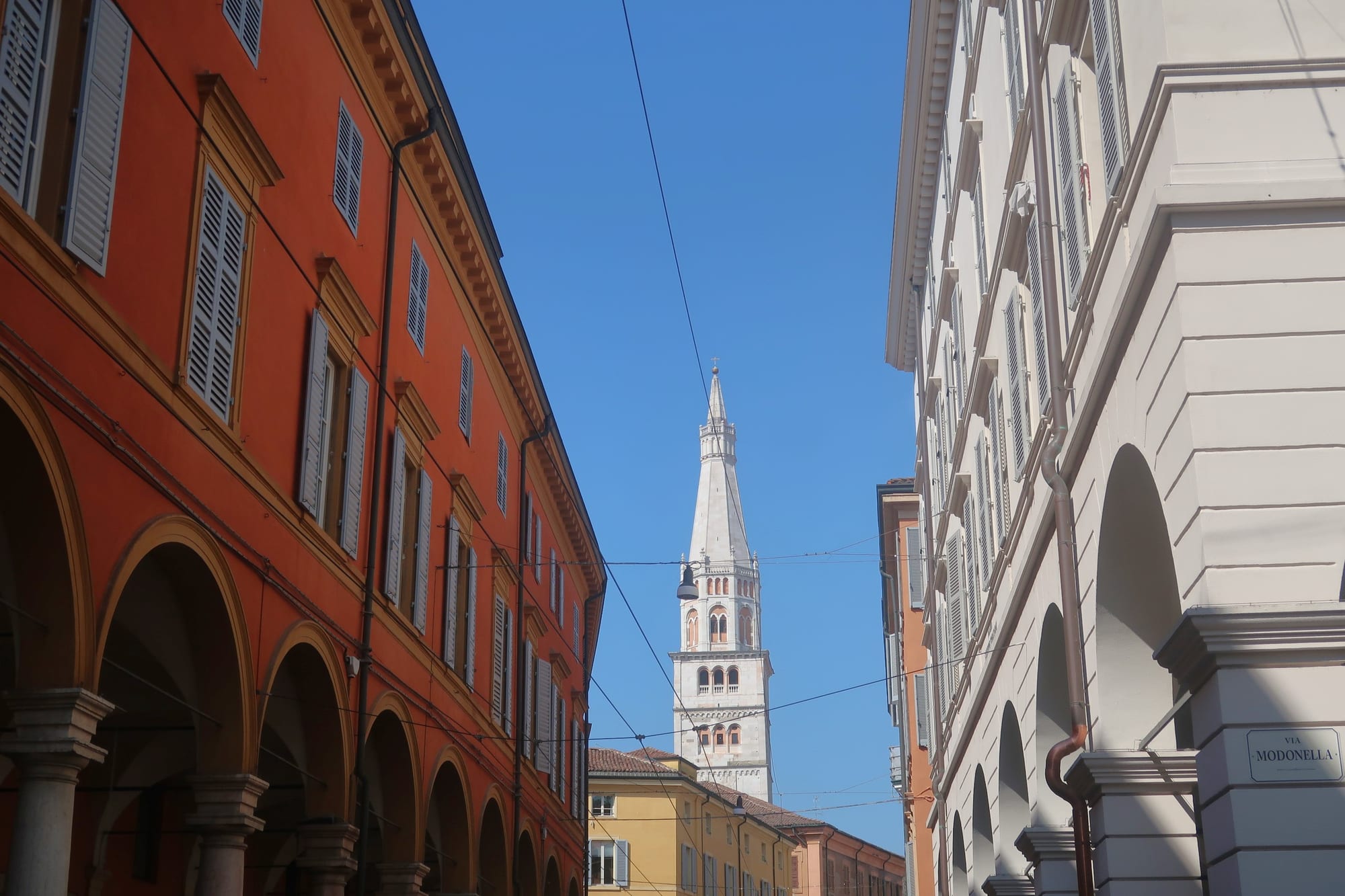
The white Ghirlandina bell tower rising between a red arcaded building and a pale palazzo under a clear blue sky

Emilia-Romagna, Italy

Modena

The Ghirlandina, Modena Cathedral's bell tower, seen between the arcaded buildings of the city centre. (Vlach Pavel / Wikimedia Commons · CC0)

A prosperous city of about 184,000 on the Via Emilia between the Secchia and Panaro rivers, at the southern edge of the Po plain. Roman Mutina became the capital of the Este dukes, who left a Baroque palace beside a Romanesque cathedral listed by UNESCO; today Modena is known for balsamic vinegar, Luciano Pavarotti and the sports-car makers around it.

Neighbourhoods

  • Piazza Grande and the cathedral
    • First-time visitors
    • Historic district

    The UNESCO-listed heart of the city: the cathedral, the Ghirlandina and the town hall around one square, with the Preda Ringadora, the old speakers' stone, by the town hall porch. The synagogue of 1873 stands nearby, opposite the Palazzo Comunale.

    Open in Maps
  • Via Emilia Centro
    • Shopping
    • Close to public transport

    The Roman road still crosses the centre as one of its main streets, lined with shops and cafés; the Palazzo dei Musei stands nearby on the square of Sant'Agostino.

    Open in Maps
  • Piazza Roma and the Ducal Palace
    • Architecture
    • Parks

    A short walk from the cathedral, the Baroque Ducal Palace of the Este, built on the site of their old castle, now houses the Military Academy, whose cadets hold ceremonies in its Honour Court.

    Open in Maps
  • The outer city
    • Quiet and residential
    • Motoring

    Beyond the old centre, residential districts reach out across the plain towards the two rivers, with the Enzo Ferrari museum, Aldo Rossi's San Cataldo cemetery and the road south towards Maranello and the Apennines, which begin about 10 km away.

    Open in Maps

Things to do

Piazza Grande and the churches

  • Modena Cathedrallandmark

    A Romanesque cathedral begun in 1099 by the master builder Lanfranco, with sculpture by Wiligelmus, finished in 1184; a model for church building across the Po valley and a UNESCO World Heritage Site.

    Open in Maps
  • Torre della Ghirlandinalandmark

    The cathedral's bell tower, 86 metres tall and the symbol of the city, finished in 1319 with Gothic upper storeys whose garland decoration gave it its name.

    Open in Maps
  • Palazzo Comunalelandmark

    The town hall on Piazza Grande, with its clock tower, the painted Sala del Fuoco and the Secchia Rapita, the bucket kept since a victory over Bologna in 1325.

    Open in Maps
  • Sant'Agostinolandmark

    A 14th-century church redecorated in 1663 for the funeral of Duke Alfonso IV d'Este, holding Antonio Begarelli's terracotta Deposition.

    Open in Maps
  • San Pietrolandmark

    A church rebuilt between 1476 and 1518 for a Benedictine abbey founded in 983, with six terracotta sculptures by Begarelli.

    Open in Maps

Museums and palaces

  • Ducal Palacelandmark

    The Este court's Baroque palace, begun in 1634, now home to the Military Academy and its museum.

    Open in Maps
  • Galleria Estensemuseum

    The Este collection in the Palazzo dei Musei, with works by Correggio, Tintoretto, Veronese, Guido Reni, a Bernini bust and a Velázquez portrait of Duke Francesco I.

    Open in Maps
  • Biblioteca Estensemuseum

    One of Italy's most important libraries, holding the dukes' books and some 3,000 manuscripts.

    Open in Maps
  • Museo Casa Enzo Ferrarimuseum

    Enzo Ferrari's father's house and workshop beside a yellow gallery designed by Future Systems, displaying rare Ferraris from the 1950s to Formula One cars.

    Open in Maps
  • San Cataldo Cemeterylandmark

    The cemetery extension designed by the architect Aldo Rossi, built between 1971 and 1997.

    Open in Maps

Markets, music and sport

  • Mercato Albinellimarket

    The historic covered food market in the centre, founded in 1931.

    Open in Maps
  • Teatro Comunale Luciano Pavarottiattraction

    The city opera house, opened in 1841 and renamed in 2007 after the tenor born in Modena.

    Open in Maps
  • Stadio Alberto Bragliaattraction

    The 21,000-seat stadium of Modena FC, which has also hosted international rugby union.

    Open in Maps

Short trips from the city

  • Museo Ferrarimuseum

    Ferrari's own museum in Maranello, 300 m from the factory, with cars, trophies and the story of the marque's racing technology.

    Open in Maps
  • Vignolaattraction

    A town in the province where the torta Barozzi chocolate cake was created in 1897, named after the Renaissance architect Giacomo Barozzi da Vignola.

    Open in Maps
  • Castelvetro di Modenaattraction

    A small town in the province of Modena, about 15 km south of the city.

    Open in Maps

Eat and drink

Long-standing places and food districts in Modena. Hours, ratings and directions come from your maps app, always current.

Modena classics

  • Traditional balsamic vinegarmarket

    Aceto balsamico tradizionale, made from cooked grape must aged at least twelve years, is produced only in the provinces of Modena and Reggio Emilia; family acetaie, the vinegar cellars where it ages, show how it is made.

    Open in Maps
  • Tortellini, zampone and cotechinorestaurant

    The city's trattorias serve tortellini and tortelloni, and the pork specialities zampone and cotechino Modena.

    Open in Maps
  • Osteria Francescanarestaurant

    Chef Massimo Bottura's restaurant in the centre, among the most acclaimed in the world.

    Open in Maps

Markets and snacks

  • Mercato Albinellimarket

    The historic covered food market of 1931, in the centre of the city.

    Open in Maps
  • Gnocco fritto and crescentinerestaurant

    Puffed diamonds of fried dough and the small round breads also called tigelle, eaten with cured meats, cheese or the lard-and-rosemary spread called pesto modenese.

    Open in Maps

Experience Modena

History

Villanovans, Etruscans and the Gaulish Boii lived around Mutina before Rome, and the Etruscan town was already standing when the Boii besieged it during Hannibal's invasion in 218 BC. Refounded as a Roman colony in 183 BC on the Via Aemilia, it became the leading city of Cisalpine Gaul; in 44–43 BC Mark Antony besieged it and Octavian relieved it, and Cicero praised Mutina splendidissima. Legend says a fog sent by Saint Geminianus, the patron saint, hid it from Attila, but floods buried the Roman town and its people moved to nearby Cittanova.

Bishop Ludovicus restored and fortified Modena around the end of the 9th century. Countess Matilda of Tuscany held it, and under her the cathedral was begun in 1099 by the master builder Lanfranco with the sculptor Wiligelmus. A free commune from the 12th century, Modena sided with the emperor against the papacy and beat Bologna at Zappolino in 1325, carrying off the bucket still kept in the town hall. The Este family ruled from 1288, permanently from 1336, and Borso d'Este made Modena a duchy.

When the pope took Ferrara in 1598, the Este made Modena their capital, building the citadel and the Ducal Palace from 1634. French invasions twice drove Duke Rinaldo away, and many of the family's pictures were sold to Dresden. After Napoleon the Austria-Este branch returned in 1814, demolished the fortifications in 1816 and ruled until Piedmontese forces annexed the duchy in 1859. Communist mayors governed from 1946 to 1992, and the earthquake of 2012 closed the Estense Gallery and Library, which reopened in 2015.

Culture & Customs

Music runs deep. Luciano Pavarotti and the soprano Mirella Freni were both born in Modena, the opera house now carries Pavarotti's name, and his home has become a museum. Francesco Guccini, born here, spent his teenage years in the city, and the Modena City Ramblers took their name from the city. The town hall keeps the Secchia Rapita, the bucket carried off from Bologna, which inspired Alessandro Tassoni's mock-heroic poem of the same name.

Cars are part of the city's identity. Enzo Ferrari was born here, his father's house is now a museum, and the Ferrari factory and racing team are at Maranello just to the south; Maserati and Pagani are based in the Modena area, and the city is known as the "Supercar Capital". The Ferrari 360 Modena carries its name. Modena Volley has won twelve national championships and four Champions League titles, and the football club, refounded in 2018, plays at the Braglia.

Food is a matter of seriousness and pride. The family acetaia, the cellar where traditional balsamic vinegar ages in barrels over many years, is a local institution, and Massimo Bottura's Osteria Francescana has brought the city international attention. The Panini publishing group is based in Modena, and Giuseppe Panini's collection of picture cards and stickers became a museum in 2006.

Daily Life

About 184,000 people live in Modena; a quarter of the city's residents are over 65, and about 18 per cent were born abroad, most often in Morocco, Albania, Moldova, the Philippines or Ghana. The university, founded in 1175 and expanded by Duke Francesco II d'Este in 1686, focuses on economics, medicine and law, and with the Military Academy in the Ducal Palace it brings students and cadets to the centre.

The province is among the most affluent in Italy, built on rich farmland and many small and medium manufacturers. The bank BPER, the Panini publishing group, food companies from cured meats to Parmigiano, the ceramic tile district around Sassuolo and the supercar makers are among the area's main employers. Elsewhere in the province, Carpi is known for textiles and Mirandola for biomedical manufacturing.

Life is lived along the Via Emilia's arcades, at the Mercato Albinelli and in the cafés of Piazza Grande. The flat plain brings thick autumn and winter fog, and humid summers that feel hotter than the thermometer says.

Food

Modena's most famous product is balsamic vinegar. The traditional kind, aceto balsamico tradizionale, is made only in the provinces of Modena and Reggio Emilia from cooked grape must aged at least twelve years in a series of barrels, and holds protected designation of origin; the cheaper, widely exported Balsamic Vinegar of Modena has the lesser PGI protection. Cooking grape must goes back to the Romans, who used it as a sweetener and medicine.

Pork rules the rest of the table. Zampone, a stuffed pig's trotter, and its leaner cousin cotechino Modena, a spiced sausage that dates back to around 1511 in Mirandola, both hold protected status. Tortellini and tortelloni are Modena's pasta, and ciccioli are pork scraps slowly cooked, pressed and aged. Pesto modenese is cured back fat pounded with garlic, rosemary and Parmesan, spread inside crescentine, small round breads from the Apennines also called tigelle, and borlenghi.

Gnocco fritto, diamonds of dough made with flour, water and lard that puff up when fried, is eaten with salumi and cheese. Torta Barozzi, a flourless chocolate cake with coffee, almonds and peanuts, was created in Vignola in 1897, and torta nera is a dark almond and cocoa tart. Lambrusco, the sparkling red of the plain, is the local wine.

Planning tools

Budget

Modena is good value compared with Bologna or the big art cities, and its centre is small enough to need no transport. Food is the reason many people come and costs relatively little in trattorias and at the market; the motoring museums and producer visits are the main extra costs.

Daily Budget Midrange
USD 150–280 (mid-range hotel, sit-down dinners, the Ferrari museums, a balsamic or cheese producer visit)
Daily Budget Shoestring
USD 70–110 (simple hotel, market food and gnocco fritto, buses and regional trains)

Arrange acetaia visits through the tourist office on Piazza Grande, and check combined tickets for the two Ferrari museums.

Best Time to Visit

Spring and early autumn are best. Summers are hot and muggy, and winters cold and damp, and fog is frequent in autumn and winter. The vineyards are most attractive at harvest time in autumn.

Suggested Number of Days

One or two days cover the centre and its museums. Three or four leave time for the motoring museums around Maranello, food producers and the hill towns of the foothills; without a car, allow a little more.

First Visit
1–2 days
With Surroundings
3–4 days

Transportation

The centre is compact and walkable, and SETA runs the city buses and trolleybuses. Suburban buses connect Modena with Carpi, Sassuolo, Vignola, Maranello and other towns of the province. A car helps for the hills and producers but is restricted in the historic centre.

Use buses or a car for Maranello and the hills, and leave a car outside the centre's restricted zone.

Airport & Station Connections

Modena station, opened in 1859, is on the Milan–Bologna line, with fast trains from Milan in about 75 minutes via Parma and Reggio Emilia and onward to Bologna and Rome; branch lines run to Verona and Sassuolo. The nearest major airport is Bologna's, about 40 km away. The city sits at the junction of the A1 and the Brenner motorway.

Walkability

Very walkable. Piazza Grande, Via Emilia, the Ducal Palace and the Palazzo dei Musei are a few minutes apart along arcaded streets, and the centre is flat. The outer sights, from the Enzo Ferrari museum to the San Cataldo cemetery, are easier by bus or bike.

Safety

Italy is generally safe, with low levels of violent crime against visitors. Modena is a calm, prosperous city where ordinary care with belongings is enough. Thick fog is frequent in autumn and winter, sometimes for days on end.

Watch for bicycles in the centre and drive carefully in fog on the plain. Check current official travel advice before travelling.

Climate

A humid subtropical climate with continental influence, typical of the Po plain: a wide gap between summer and winter, high humidity all year, and frequent autumn and winter fog.

Summer
hot and very muggy, with peaks well above 35°C, increasingly from late spring
Winter
cold and damp, with average lows below 0°C for several weeks and about 35 cm of snow in an average year

Local Customs

Tipping is not customary in Italy: restaurants usually add a small coperto, a cover charge, and leaving a euro or two for good service is plenty. Coffee is drunk standing at the bar. Modenesi are proud of their food and of the sharp line between true traditional balsamic vinegar and the cheaper commercial kind.

Dress respectfully and keep quiet in the cathedral and other churches, particularly during services.

Common Payment Methods

The currency is the euro. Cards are accepted almost everywhere, but a little cash is useful for market stalls, small bars and tips, which cannot be added to a card payment. A per-night tourist tax may be collected by accommodation.