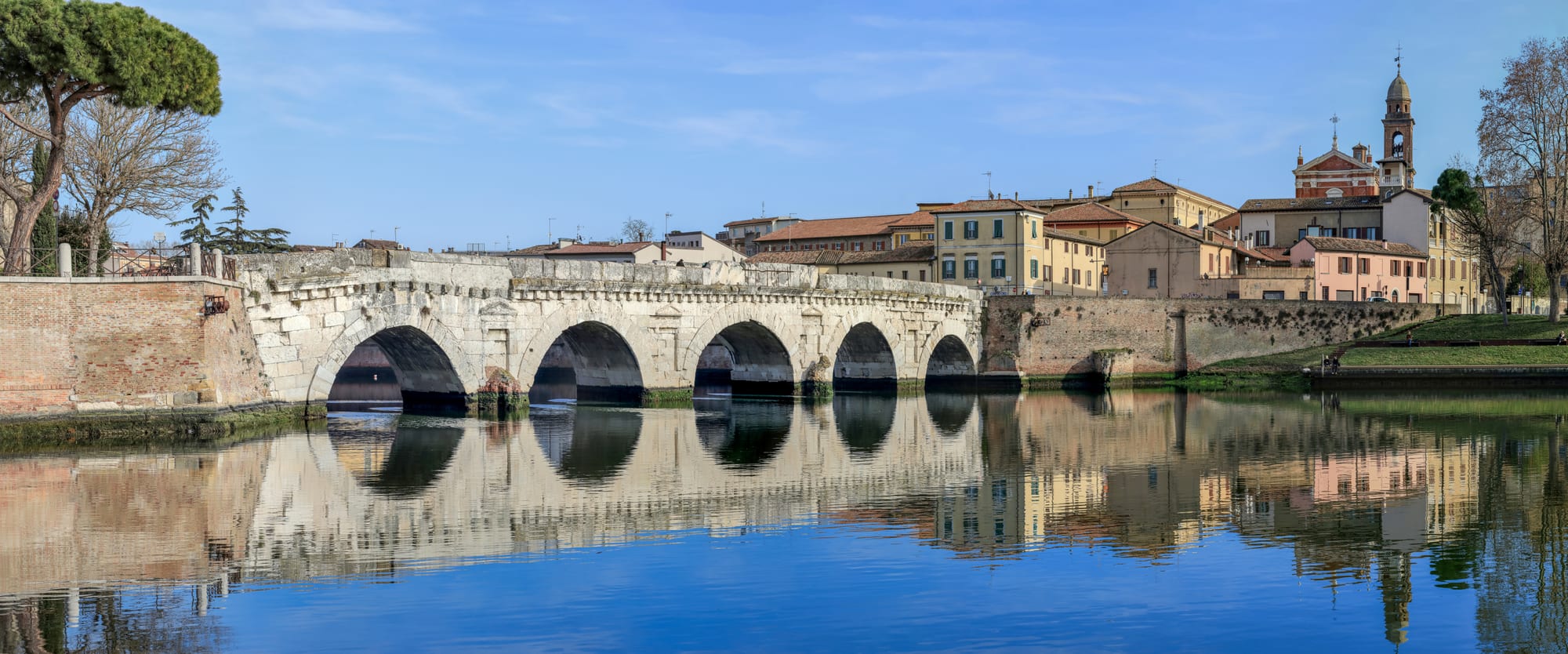
The five stone arches of the Roman Ponte di Tiberio reflected in still blue water, with ochre houses and a bell tower behind

Emilia-Romagna, Italy

Rimini

The Ponte di Tiberio over the Marecchia canal, with the historic centre of Rimini beyond, seen from Borgo San Giuliano. (Terragio67 / Wikimedia Commons · CC BY-SA 4.0)

The Adriatic city at the southern tip of the Po Valley, founded by the Romans as Ariminum in 268 BC at the start of the Via Flaminia and the Via Aemilia. Its Roman arch and bridge, the Malatesta lords' Renaissance temple and the memory of Federico Fellini sit behind a 15-kilometre sandy beach that made it one of Europe's best-known seaside resorts.

Neighbourhoods

  • Historic centre
    • First-time visitors
    • Historic district
    • Museums

    The old town inside the line of the Malatesta walls, entered through the Arch of Augustus and left over the Ponte di Tiberio. Piazza Cavour with its medieval town halls and the Galli Theatre, Piazza Tre Martiri, Castel Sismondo and the Tempio Malatestiano are all a few minutes apart on foot.

    Open in Maps
  • Borgo San Giuliano
    • Best for food
    • Historic district

    A former fishermen's quarter across the Tiberius bridge, dating to the 11th century — narrow streets and small squares of colourful low houses, many painted with murals of characters and places from Fellini's films, and a string of trattorias and bars.

    Open in Maps
  • Marina Centro
    • Beaches
    • Nightlife
    • Close to public transport

    The seaside district between the railway and the sea, a short walk from the old town and the station. Hotels, bathing establishments, Liberty-style villas and the lighthouse at the port canal give it a busy resort feel from spring to autumn.

    Open in Maps
  • Miramare and the southern beaches
    • Beaches
    • Families

    The long beach suburbs running south towards Riccione, ending in Miramare, about 5 km from the centre and home to the airport and the Fiabilandia amusement park. Rows of family hotels face the sand, and the Metromare busway runs behind them.

    Open in Maps
  • Viserba and the northern beaches
    • Beaches
    • Quiet and residential
    • Families

    Quieter seaside villages north of the Marecchia mouth — Rivabella, Viserba, Viserbella and Torre Pedrera — with their own small stations, a small fishing museum and the Italia in Miniatura park.

    Open in Maps

Things to do

Roman and medieval landmarks

  • Arch of Augustuslandmark

    Built in 27 BC in honour of Augustus at the end of the Via Flaminia from Rome, the oldest preserved triumphal arch in Italy and a symbol of the city on its coat of arms.

    Open in Maps
  • Ponte di Tiberiolandmark

    A five-arched Roman bridge of Istrian stone completed under Tiberius in 21 AD and pedestrianised in May 2020; retreating German forces in 1944 ordered its destruction without success.

    Open in Maps
  • Tempio Malatestianolandmark

    Rimini's unfinished cathedral, rebuilt for Sigismondo Pandolfo Malatesta by Leon Battista Alberti from around 1450 with a classical front wrapped around an older Franciscan church.

    Open in Maps
  • Castel Sismondolandmark

    The fortress of the Malatesta lords, of which only the central core survives; since 2021 it has been one of the three sites of the Fellini Museum.

    Open in Maps
  • Roman amphitheatrelandmark

    The remains of a 2nd-century arena built on the edge of the Roman town, east of the old centre towards the sea, and used mainly for gladiator shows.

    Open in Maps
  • Piazza Cavourlandmark

    The old municipal square, lined by the medieval Palazzo dell'Arengo and Palazzo del Podestà and the 19th-century Galli Theatre.

    Open in Maps

Museums and theatre

  • Fellini Museummuseum

    Opened in 2021 across Castel Sismondo, Piazza Malatesta and the Fulgor cinema, with documents, drawings, sets and costumes from the films of the Rimini-born director.

    Open in Maps
  • City Museum and the Domus del Chirurgomuseum

    Rimini's main and oldest museum, whose archaeological rooms hold mosaics, coins and the medical kit found in the Domus del Chirurgo, a Roman house excavated nearby.

    Open in Maps
  • Amintore Galli Theatreattraction

    The city's opera house on Piazza Cavour, wrecked by Allied bombing in the Second World War and reopened in 2018 after a full restoration, with Roman and medieval remains shown beneath it.

    Open in Maps
  • Museum of Glancesmuseum

    A museum of art from Africa, Oceania and the pre-Columbian Americas, with about 600 works on show in Villa Alvarado on the Covignano hill.

    Open in Maps

The beach and the seafront

  • Rimini beachbeach

    Fifteen kilometres of fine sand up to 200 metres wide, shelving gently into the sea and lined almost end to end with numbered bathing establishments.

    Open in Maps
  • Rimini Lighthouselandmark

    The working lighthouse on the east side of the port canal, a reminder of the centuries when fishing was the mainstay of the city's economy; it was rebuilt in 1946 after wartime damage.

    Open in Maps
  • Italia in Miniaturaattraction

    A miniature park in Viserba, opened in 1970, with 273 models of Italian and European landmarks and a 1:5 Venice that can be crossed by gondola.

    Open in Maps

Short trips from the city

  • San Marinoattraction

    The independent republic on the slopes of the Apennines inland from Rimini, reached by road to Borgo Maggiore and then by cable car to the City of San Marino.

    Open in Maps
  • Santarcangelo di Romagnaattraction

    A town on the Via Emilia inland from Rimini, crossed by the Uso and Marecchia rivers.

    Open in Maps
  • Riccioneattraction

    The neighbouring resort to the south, linked to Rimini's station by the Metromare busway.

    Open in Maps
  • Gradaraattraction

    A medieval town in the Marche about 25 km from Rimini, ringed by a double line of walls around one of Italy's best-preserved castles, the setting Dante gave to Paolo and Francesca.

    Open in Maps

Seasonal events

  • PaganelloEaster weekend

    A beach ultimate frisbee tournament held since 1991 on a 500-metre stretch of sand, from Maundy Thursday to Easter Monday, with shows along the beach.

  • Notte Rosaearly July

    The Pink Night, a weekend of exhibitions, concerts and fireworks across the whole Romagna riviera.

  • Rimini Meetinglast week of August

    A week of talks, debates, exhibitions and concerts at Rimini Fiera, organised by the lay Catholic movement Communion and Liberation.

Eat and drink

Long-standing places and food districts in Rimini. Hours, ratings and directions come from your maps app, always current.

Rimini classics

  • Piadina rimineserestaurant

    Rimini's version of the Romagna flatbread, thinner than the piadina made further north, traditionally of flour, lard, salt and water and eaten with grilled meat or fish or filled with cured meats, cheese and greens.

    Open in Maps
  • Seafood and grilled fishrestaurant

    Grilled mackerel, sardines and skewers of oily fish, cuttlefish with peas and fried squid — the catch of the Adriatic fleet based between Cattolica and Cesenatico.

    Open in Maps

Food districts

  • Borgo San Giulianoneighborhood

    The old fishermen's quarter across the Tiberius bridge, where trattorias and bars fill the small squares among the Fellini murals.

    Open in Maps
  • San Giuliano a Mareneighborhood

    The beach north of the port canal, where restaurants on the sand serve outdoors in warm weather.

    Open in Maps

Experience Rimini

History

The Roman Republic founded the colony of Ariminum in 268 BC at the mouth of the river then called the Ariminus, now the Marecchia, at the narrow point where the coast road meets the Po Valley. Two great roads began here — the Via Flaminia to Rome, whose end is marked by the Arch of Augustus of 27 BC, and the Via Aemilia across the plain, carried over the river by the bridge finished under Tiberius in 21 AD. An amphitheatre for some 12,000 people and wealthy houses such as the Domus del Chirurgo followed.

In the Middle Ages the city passed to the Malatesta family, who rose from the factional fights of the commune when Malatesta da Verucchio was made podestà in 1239. Their most famous lord, Sigismondo Pandolfo Malatesta, a condottiero and poet, hired out his army to pay for the city's embellishment, above all the rebuilding of the church of San Francesco by Leon Battista Alberti as the Tempio Malatestiano. His fortunes collapsed after he was forced to submit to Pope Pius II in 1463, and Malatesta rule ended for good in 1528. Under the Papal States, raids, earthquakes, floods and famine left the city poor, and fishing became its mainstay.

The first bathing establishment opened in 1843, and by the Belle Époque Rimini was a resort for Italian and European aristocrats. The Second World War almost destroyed it: Allied bombing from November 1943, then naval shelling and the Battle of Rimini on the Gothic Line, before liberation on 21 September 1944. Three partisans hanged in the central square that August gave Piazza Tre Martiri its name. Rebuilt, the city became the centre of the mass-tourism riviera that now runs for 50 km from Cervia to Gabicce Mare.

Culture & Customs

Federico Fellini was born and raised in Rimini, and although he shot his films almost entirely in Rome's Cinecittà studios, the town fills I Vitelloni and above all Amarcord, which won an Oscar in 1975. The Fellini Museum opened in 2021 in the castle, the square outside it and the Fulgor cinema, murals of his characters cover walls in Borgo San Giuliano, and the airport carries his name; he is buried in the city's monumental cemetery.

Music has a long history here: the French composer Guillaume Dufay stayed at the Malatesta court until 1427, and the restored Galli Theatre, reopened in 2018 with performances by Cecilia Bartoli, Roberto Bolle and Valery Gergiev, is again the city's opera house. The city also lives by its events. Every Easter the Paganello ultimate frisbee tournament takes over a stretch of beach; in early July the Notte Rosa fills the whole riviera with concerts and fireworks; and in the last week of August the Rimini Meeting, organised by the Catholic movement Communion and Liberation, brings politicians, bishops and speakers to the Fiera for a week of debates.

Local identity is Romagnol before it is Emilian — the city's name in Romagnol is Rémin — and the Malatesta, Venetian and papal past is everywhere in its churches and palaces. The legend that Anthony of Padua preached to the fish here after the townspeople ignored him is still told.

Daily Life

About 150,000 people live in the municipality, according to the 2025 figure, and around 340,000 in the province. The city is the main centre of a continuous 50 km coastal strip of resorts that grew up with the tourist economy. Tourism has driven the economy since the 19th century, with more than 1,000 hotels, over 220 of them open all year.

Outside the beach season, Rimini Fiera — sixteen pavilions completed in 2001 in the west of the city — and the Palacongressi conference centre keep many hotels open; together they were estimated in 2015 to be worth about a tenth of the province's economy. A fleet of about 100 fishing boats still works from the port, and the hills inland produce Sangiovese and other wines and olive oil.

Residents divide the city into the historic centre inside the walls, the old borghi just outside its gates — San Giuliano, San Giovanni, Sant'Andrea and Marina — the seaside districts along the beach, and newer suburbs spreading towards the hills of Covignano. Life follows the seasons: a quiet winter when many seafront hotels close and the city belongs to its residents, and a hectic summer of late nights, traffic and full trains. Bicycles are a common way to get around on the city's network of cycle paths through the parks laid out along the old courses of the Marecchia and the Ausa.

Food

Rimini's cooking is simple and strongly flavoured, rooted in rural tradition and shaped by its position between the sea and the hills on the border of Romagna and the Marche. The piadina is the constant: a thin flatbread made traditionally with flour, lard, salt and water, and in Rimini thinner than the version found further north in Romagna. It comes with grilled meat or fish, sausages, cured meats, fresh cheeses such as soft squacquerone, and country herbs.

Pasta follows the Romagna pattern: cappelletti, passatelli in broth, tagliatelle, garganelli and strozzapreti, dressed with meat sauce or butter and sage. Main courses include chicken alla cacciatora, rabbit cooked in the style of porchetta, stuffed courgettes and mixed grills; from the sea come grilled mackerel and sardines, skewers of oily fish, cuttlefish with peas, fried squid and gianchetti, tiny fish known locally as "omini nudi".

Sweets include ciambella, the fried fiocchetti and castagnole of Carnival, zuppa inglese layered with custard and savoiardi biscuits, and piada dei morti, a sweet focaccia topped with raisins, almonds, walnuts and pine nuts that is native to Rimini and eaten in November for All Souls' Day. Saba, a grape syrup, flavours desserts. The local wines are Sangiovese, Trebbiano, Pagadebit, Rebola and the sweet Albana.

Planning tools

Budget

Rimini is one of the cheaper ways to see the Italian coast. The city has hundreds of family hotels, many offering full-board or half-board deals outside August, and prices climb in the August peak and during the big fairs at Rimini Fiera. Beach umbrellas and sunbeds at the bathing establishments are a daily cost on top of the room; piadina and trattoria lunches keep food bills low.

Daily Budget Midrange
USD 150–280 (seafront hotel with half board, sit-down fish dinners, beach umbrella and sunbeds, museum tickets)
Daily Budget Shoestring
USD 70–110 (hostel or simple hotel, piadina and trattoria lunches, buses and regional trains)

Check the Rimini Fiera calendar as well as the summer holidays before booking; the Roman monuments, the beach walk and Borgo San Giuliano cost nothing.

Best Time to Visit

June to September is the beach season, with July and August the hottest, busiest and dearest months and the Notte Rosa in early July. May, June and September are warm enough for the beach with fewer crowds. In winter the seafront is deserted and many beach hotels close, but the old town, the museums and the conference season keep the city open.

Suggested Number of Days

One or two days covers the old town and the seafront. A beach holiday sets its own length, and a few extra days allow trips into the hills inland and to the neighbouring republic. Visits during a big fair or in August need more planning than time.

First Visit
1–2 days
With Surroundings
3–5 days

Transportation

The old town and Marina Centro are walkable, and the city has an extensive cycling network along its parks and boulevards. Start Romagna buses and trolleybuses run along the coast, and the Metromare, a 9.8 km electric busway opened in 2019, links Rimini and Riccione stations beside the railway; a northern extension to Rimini Fiera has been under construction. Minor railway stations serve the northern beaches and Miramare.

Buy bus tickets before boarding or from the machines on board, and validate them; bicycles are the easiest way along the seafront in summer.

Airport & Station Connections

Rimini Fellini Airport is in Miramare, about 5 km south-east of the centre, and is served mainly by low-cost and charter flights. Many visitors fly to Bologna instead and take the train or an airport coach. Rimini station, near the old town at the north end of the main beach strip, is on the main Adriatic line between Bologna and Ancona, and long-distance coaches arrive from Milan, Venice, Rome and elsewhere.

Walkability

The historic centre is small and flat, and the station sits between it and the sea, so the old town, the port canal and the beach at Marina Centro are all within walking distance of each other. The seafront runs for 15 km, so reaching the outer beach suburbs needs a bus, the Metromare or a bicycle.

Safety

Italy is generally safe, with low levels of violent crime against visitors. Rimini's main risks are seasonal: pickpocketing and bag theft on crowded summer beaches and around the station, heavy late-night drinking in the resort's busiest weeks, and traffic on the seafront roads.

Keep valuables off the beach towel and out of sight in hotel rooms and cars, and take care crossing the busy seafront roads at night. Check current official travel advice before travelling.

Climate

A humid subtropical climate moderated by the Adriatic, with autumn and winter temperatures among the mildest in Emilia-Romagna. Humidity is high all year, rain is spread evenly with a peak in October, and the city gets over 2,000 hours of sunshine a year.

Summer
warm and humid — July averages about 23°C, the warmest month
Winter
cool and damp — January averages about 4°C, the coldest month

Local Customs

Beach life is organised: most of the sand is divided into numbered bathing establishments that rent umbrellas and sunbeds by the day or week, with free stretches in between. Swimwear belongs on the beach; cover up in the old town and especially in the Tempio Malatestiano, which is the cathedral. Service is usually included in the bill, and rounding up is enough.

Coffee is drunk standing at the bar for less than at a table. Respect Mass times when visiting churches.

Common Payment Methods

The currency is the euro, also used in neighbouring San Marino. Cards and contactless payment are accepted in almost all hotels, restaurants and bathing establishments; carry some cash for small bars, piadina kiosks and markets. ATMs are easy to find in the centre and along the seafront.