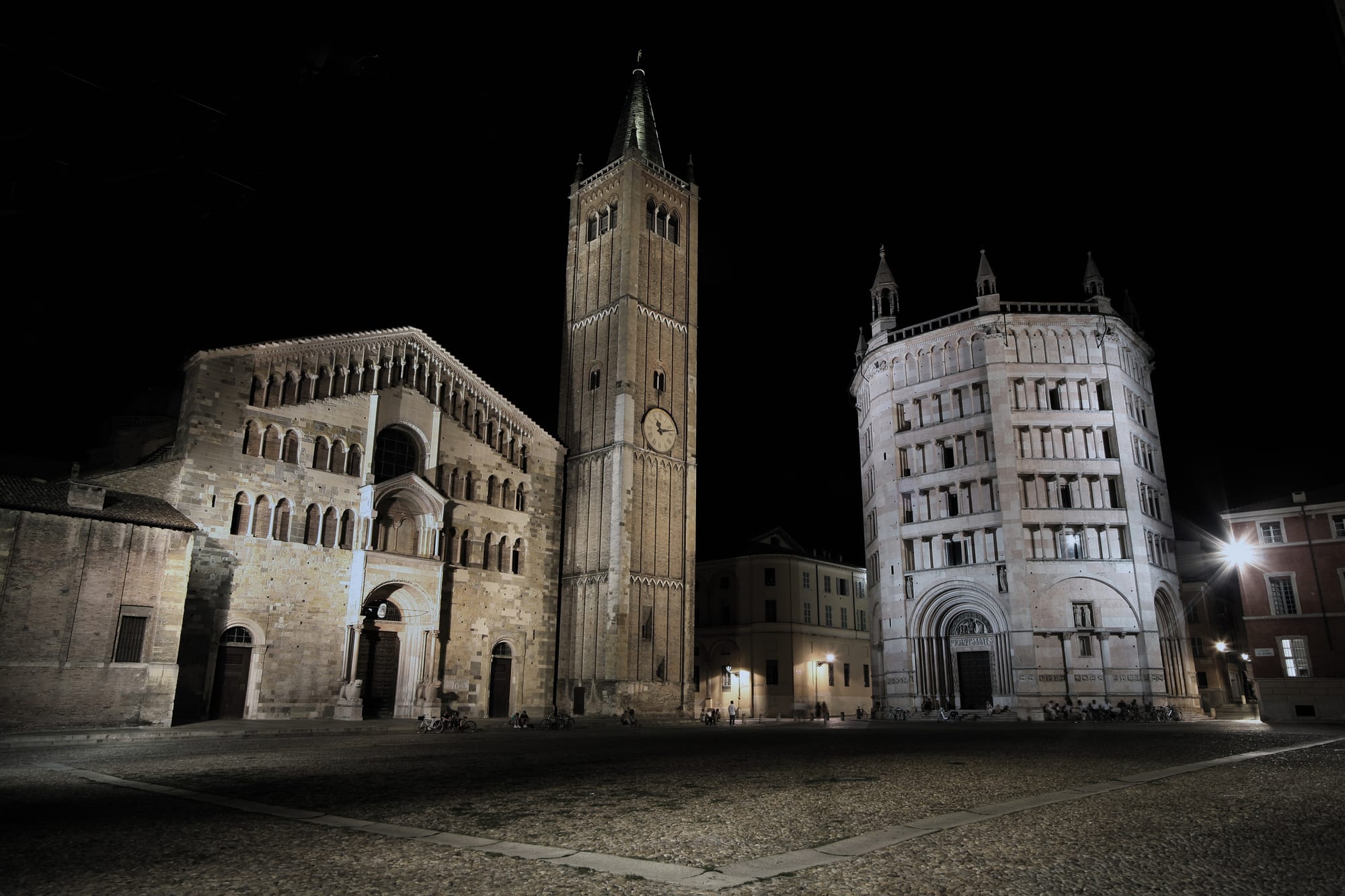
Floodlit Romanesque cathedral façade, tall bell tower and octagonal marble baptistery on an empty square at night

Emilia-Romagna, Italy

Parma

Parma Cathedral, its bell tower and the baptistery on Piazza Duomo by night. (Filippo Aneli / Wikimedia Commons · CC BY 3.0)

Emilia-Romagna's second city, about 200,000 people on the Via Emilia where the Parma stream divides the old centre from the Oltretorrente. A Roman colony that became the capital of the Farnese and Bourbon dukes, it keeps their palaces, Correggio's painted domes and a great opera house, and gives its name to a ham and a cheese.

Neighbourhoods

  • Piazza Garibaldi and the centre
    • First-time visitors
    • Shopping
    • Close to public transport

    The central square stands on the site of the Roman forum, overlooked by the Palazzo del Governatore and the town hall. Strada Garibaldi runs off it, and the Steccata church is close by.

    Open in Maps
  • Piazza Duomo
    • Historic district
    • Art and churches

    A quiet square a few minutes' walk from the centre where the Romanesque cathedral, Antelami's pink marble baptistery and the Bishop's Palace stand together, with the abbey church of San Giovanni Evangelista just behind the cathedral's apse.

    Open in Maps
  • The Pilotta and the Ducal Park
    • Museums
    • Parks

    On the east bank of the stream, the vast Farnese palace of the Pilotta holds the national gallery, the Palatine Library and the wooden Teatro Farnese. Across the bridge the Ducal Park, laid out in French style in 1749, surrounds the Palazzo del Giardino.

    Open in Maps
  • Oltretorrente
    • Local life
    • Best for food

    The historic popular quarter on the west bank of the Parma — 'the other side of the stream' — known for turning back Italo Balbo's Fascist squads in 1922. Strada D'Azeglio runs through it, lined with small eateries, and the old hospital and the elliptical Annunziata church are here.

    Open in Maps
  • The Cittadella
    • Parks
    • Quiet and residential

    The 16th-century fortress of Duke Alessandro Farnese was turned into a large public park after the Second World War, and is much used by Parma's residents.

    Open in Maps

Things to do

Cathedral square and churches

  • Parma Cathedrallandmark

    A Romanesque cathedral begun in 1090, whose dome Correggio covered in 1526–30 with an influential illusionistic fresco of the Assumption; it also holds a 12th-century relief by Benedetto Antelami.

    Open in Maps
  • Parma Baptisterylandmark

    Antelami's octagon of pink Verona marble, begun in 1196, with four tiers of open loggias and carvings of animals, centaurs, mermaids and unicorns around its base.

    Open in Maps
  • San Giovanni Evangelistalandmark

    The abbey church behind the cathedral, whose cupola holds Correggio's Vision of St John the Evangelist, a landmark of illusionistic ceiling painting.

    Open in Maps
  • Santa Maria della Steccatalandmark

    An octagonal Renaissance church begun in 1521 near Piazza Garibaldi, known for the frescoes of its dome.

    Open in Maps
  • Camera di San Paolomuseum

    The private room of the abbess of a wealthy Benedictine convent, whose vault Correggio painted around 1519.

    Open in Maps

The Farnese palaces and museums

  • Palazzo della Pilottamuseum

    The 16th-century ducal palace complex, partly destroyed in 1944, that now houses the national gallery, the archaeological museum, the Bodoni museum of printing and the Palatine Library.

    Open in Maps
  • Teatro Farneselandmark

    A wooden theatre built in 1618 by Giovanni Battista Aleotti for Duke Ranuccio I, wrecked by bombing in 1944 and reopened in 1962; one of only three Renaissance theatres still in existence.

    Open in Maps
  • Galleria Nazionalemuseum

    The picture gallery in the Pilotta, founded in the 18th century under the Bourbon dukes.

    Open in Maps
  • Biblioteca Palatinamuseum

    The ducal library founded in the 18th century, holding the largest collection of Hebrew manuscripts in Italy.

    Open in Maps
  • Palazzo del Giardino and the Ducal Parkpark

    Vignola's palace of 1561 for Duke Ottavio Farnese, in a park laid out in the French style in 1749, now a favourite place to walk.

    Open in Maps

Music and sport

  • Teatro Regioattraction

    The 1,400-seat opera house inaugurated in 1829, with an opera season from January to April and the Verdi Festival each October.

    Open in Maps
  • Stadio Ennio Tardiniattraction

    The football ground opened in 1923, home of Parma Calcio, seating up to about 23,000.

    Open in Maps

Short trips from the city

  • Torrechiara Castlelandmark

    A 15th-century castle built for Pier Maria II de' Rossi on a terraced hill above the Parma valley, south of the city.

    Open in Maps
  • Labirinto della Masoneattraction

    At Fontanellato, a maze of bamboo covering about eight hectares, built by the publisher Franco Maria Ricci with a museum of his art collection and Bodoni typefaces.

    Open in Maps
  • Bussetoattraction

    The small town that was for centuries the capital of the Pallavicino state, near which Giuseppe Verdi was born.

    Open in Maps

Seasonal events

  • Opera season at the Teatro RegioJanuary to April

    About four operas a season, before an audience with a reputation as particularly demanding.

  • Verdi FestivalOctober

    An annual festival of Verdi's operas, held each year since 2003 at the Teatro Regio, in honour of the composer born near Busseto.

Eat and drink

Long-standing places and food districts in Parma. Hours, ratings and directions come from your maps app, always current.

Parma classics

  • Prosciutto di Parmarestaurant

    The protected air-cured ham, made only from pigs' hind legs, sea salt and lard, sold by the slice in delicatessens across the city.

    Open in Maps
  • Anolini in brodo and tortelli d'erbettarestaurant

    Parma's own stuffed pastas: small anolini served in broth, and tortelli filled with greens, staples of the city's trattorias.

    Open in Maps
  • Torta frittarestaurant

    Fried dough eaten as a starter with Parma ham, coppa and other cured meats.

    Open in Maps

Food streets and cafés

  • Strada D'Azeglioneighborhood

    A street running through the Oltretorrente, lined with small, everyday places to eat.

    Open in Maps

Experience Parma

History

A Bronze Age settlement of the terramare people stood here, and the city was probably founded and named by the Etruscans, whose word for a round shield, parma, the Romans borrowed. Rome established its colony in 183 BC, the same year as Modena, at the junction of the Via Aemilia and the Via Claudia, with a forum on today's Piazza Garibaldi. Destroyed in 43 BC and rebuilt by Augustus, it was sacked by Attila and later by Totila, served the Byzantines as Chrysopolis, the "Golden City", and in the Middle Ages became a stage on the pilgrims' Via Francigena.

A self-governing commune from about 1140, Parma generally sided with the emperors, though it defeated Frederick II's siege in 1248. Lordships and Milanese rule followed, then in 1545 the Farnese pope Paul III made Parma and Piacenza a duchy for his son, Pier Luigi Farnese. The family ruled until 1731 and built the Pilotta, the Teatro Farnese and the Cittadella. The Bourbons followed: under the minister Guillaume du Tillot the Palatine Library, the picture gallery, the botanic garden and Giambattista Bodoni's royal printing works were founded.

Napoleon annexed Parma to France; the duchy was restored after his fall, passed back to the Bourbons in 1847, and joined the Kingdom of Italy after a plebiscite in 1860. Strong unions led a general strike in 1908, and in August 1922 the people of the Oltretorrente barricaded their streets and drove back Italo Balbo's Fascist squads, an episode seen as the first act of Italian resistance. Allied bombing in 1944 destroyed parts of the Pilotta and almost destroyed the Teatro Farnese, and on 26 April 1945 partisans and the Brazilian Expeditionary Force liberated the city.

Culture & Customs

Painting gave Parma its golden age. Correggio, who was working in the city by 1516, frescoed the abbess's chamber of San Paolo, the cupola of San Giovanni Evangelista and the cathedral dome, ceilings that changed illusionistic painting, and Parmigianino is the other great painter associated with the city. Benedetto Antelami's baptistery and sculpture are among the great medieval works of northern Italy, and Bodoni's typefaces made the city a name in printing.

Music is the other passion. Giuseppe Verdi was born near Busseto, about thirty kilometres away, and the Teatro Regio stages a Verdi Festival each October; Arturo Toscanini was born in the city in 1867, and the violinist Niccolò Paganini is buried here. Parma's opera audiences are known across Italy for their severity. The city is also associated with the film directors Bernardo and Giuseppe Bertolucci, the poet Attilio Bertolucci and the writer Giovannino Guareschi.

Food is a matter of civic identity: Parma is a UNESCO City of Gastronomy and the seat of the European Food Safety Authority. In sport, Parma Calcio plays in Serie A at the Tardini, the Zebre rugby union club competes in one of the top international club competitions, and the Parma Panthers American football team inspired John Grisham's novel Playing for Pizza.

Daily Life

About 200,000 people live in Parma, the second city of Emilia-Romagna, and about a fifth of them were born abroad, most often in Moldova, Albania, the Philippines, Tunisia or Romania. The university, one of the oldest in the world, brings a student population to the centre.

The economy is prosperous and built around food. Barilla is based in the city, Parmalat is another of its food multinationals, the countryside produces Parmigiano Reggiano and Parma ham, and the province's "Food Valley" companies sit alongside the pharmaceutical firm Chiesi and the European Food Safety Authority. Parma's politics have been less predictable than its region's: centre-right mayors governed from 1998 to 2011, leaving heavy debts, and in 2012 it elected the first Five Star Movement mayor of a provincial capital.

Daily life moves at a comfortable pace: bicycles in the centre, shopping on Strada Garibaldi, an evening aperitivo and walks in the Ducal Park or the Cittadella. The Oltretorrente keeps a more popular, mixed character than the elegant east bank. Winters bring fog and opera, and summers are hot and muggy.

Food

Two of Italy's most famous products carry the city's name. Prosciutto di Parma, a protected air-dried ham, is made only from pigs' hind legs, sea salt and lard; it has a slightly nutty flavour, sometimes credited to the Parmesan whey fed to the pigs. Parmigiano Reggiano, made in the provinces of Parma and Reggio Emilia, is the protected hard cheese the world calls Parmesan.

Parma claims its own stuffed pastas. Anolini in brodo are small filled pasta served in broth, and tortelli d'erbetta are filled with greens. Tortelli are made across Emilia-Romagna and neighbouring regions, and come square, half-moon or folded into rounded shapes. Torta fritta, fried dough, is eaten as a starter with prosciutto, coppa and the other cured meats of the province, culatello among them.

Wine and the aperitivo matter here as everywhere in Emilia: the evening drink is a city habit, and the trattorias of the Oltretorrente serve the everyday food of the quarter. Food producers just outside the city, from ham curers to cheese dairies, are part of many visits to Parma.

Planning tools

Budget

Parma is good value for its standard, cheaper than the big art cities. Food is the main pleasure and not a costly one: trattoria lunches and delicatessen counters are excellent. Rooms fill during the Verdi Festival in October and around the big food trade fairs.

Daily Budget Midrange
USD 150–280 (mid-range hotel, sit-down dinners, museum tickets, a ham or cheese producer visit)
Daily Budget Shoestring
USD 70–110 (simple hotel or hostel, delicatessen sandwiches and trattoria lunches, buses)

Book Verdi Festival weekends early, and arrange visits to ham and cheese producers in advance.

Best Time to Visit

Spring and early autumn are the most pleasant. Summer is hot and muggy, and winter cold and often foggy, but winter is also opera season at the Teatro Regio, and October brings the Verdi Festival.

Suggested Number of Days

One or two days cover the centre and its museums. Three or four allow time for castles, the maze at Fontanellato, the Verdi country and the food producers in the surrounding countryside, where a car makes things easier.

First Visit
1–2 days
With Surroundings
3–4 days

Transportation

The centre is compact and flat, and many residents cycle. Trolleybuses, in service since 1953, run four routes alongside the city's buses. A car helps for the castles and the dairy and ham country but is restricted in the historic centre.

Explore the centre on foot or by bike and keep a car for the countryside.

Airport & Station Connections

Parma station is on the Milan–Bologna railway, with frequent trains along the Via Emilia. The small Giuseppe Verdi airport, about 2.4 km north-west of the city, has a limited number of European flights; the nearest major airport is Bologna's, about 94 km east. By road Milan is less than two hours away on the A1 motorway.

Walkability

Very walkable. Piazza Garibaldi, Piazza Duomo, the Steccata and the Pilotta are all within a few minutes of one another, and the bridges over the stream lead straight into the Oltretorrente and the Ducal Park. The Cittadella is a short walk south of the centre.

Safety

Italy is generally safe, with low levels of violent crime against visitors. Parma is a calm, prosperous city; the usual care with bags around the station and in crowds is enough, and winter fog on the surrounding roads is the bigger hazard for drivers.

Watch for bicycles in the centre, and drive with care in winter fog. Check current official travel advice before travelling.

Climate

A humid subtropical climate with strong continental influence, as the Apennines block the milder sea air from the Ligurian coast. Summers are hot and muggy, winters cold, and about 45 cm of snow falls in an average winter.

Summer
hot and humid — July averages about 26°C, daytime highs pass 30°C, and 40.4°C was recorded in August 2023
Winter
cold — January averages about 4°C, and the record low in the city is −18.0°C, from January 1985

Local Customs

Tipping is not customary in Italy: restaurants usually add a small coperto, a cover charge, and leaving a euro or two for good service is plenty. Coffee is drunk standing at the bar, and the aperitivo is part of the evening. Parma takes opera seriously, and its audiences at the Regio are known for their severity.

Dress respectfully in churches, keep quiet during services, and arrive on time for opera performances.

Common Payment Methods

The currency is the euro. Cards are accepted almost everywhere, but a little cash is useful for markets, small bars and tips, which cannot be added to a card payment. A per-night tourist tax may be collected by accommodation.