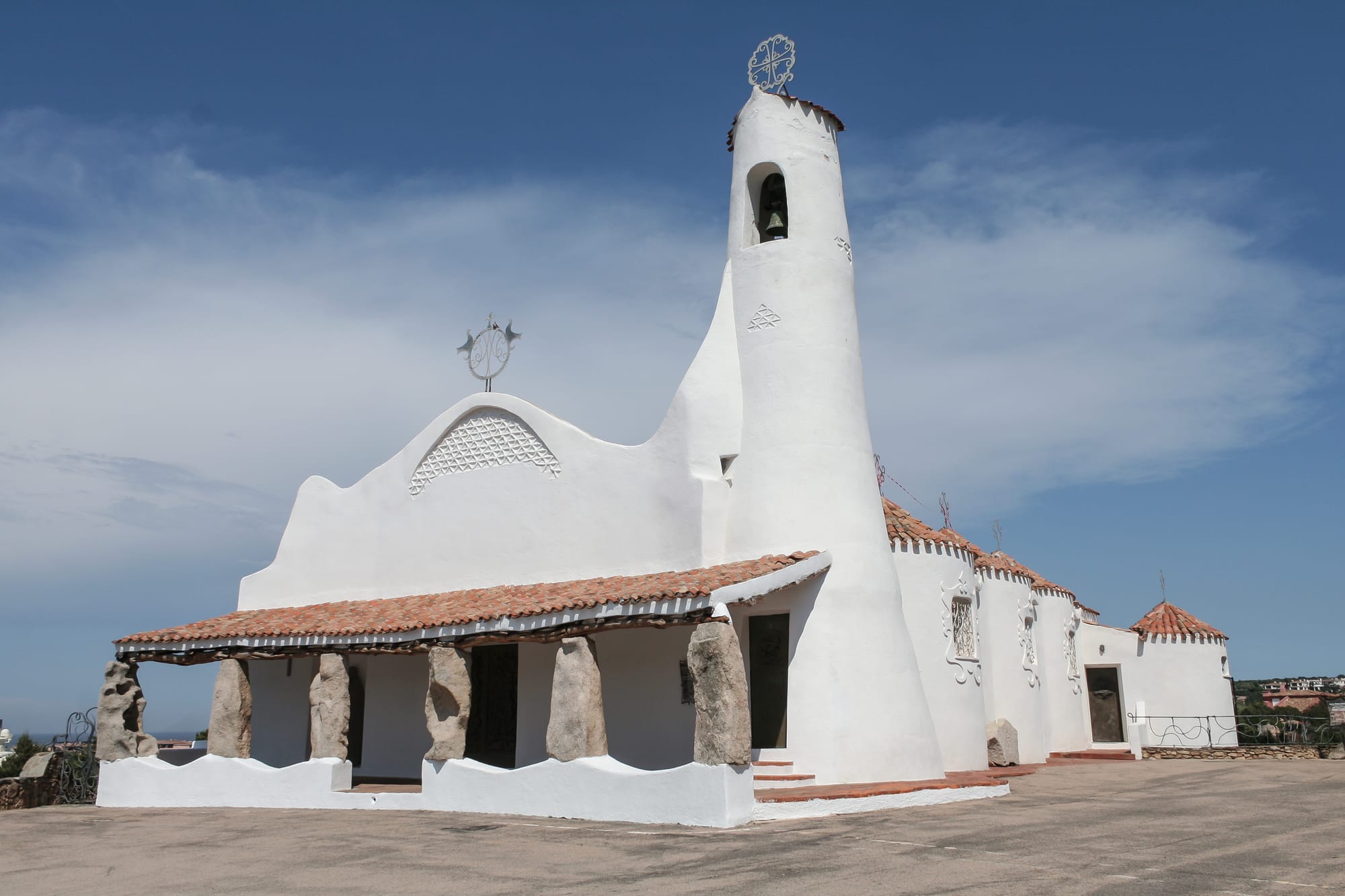
The white church of Stella Maris with a tall tapering bell tower, a tiled porch on granite pillars and a blue sky

Sardinia, Italy

Porto Cervo

The church of Stella Maris in Porto Cervo, designed by Michele Busiri Vici. (Heinz-Josef Lücking / Wikimedia Commons · CC BY-SA 3.0 de)

A purpose-built resort village on a deep natural harbour in Sardinia's north-east, laid out from the early 1960s by a consortium led by Prince Karim Aga Khan as the centre of the Costa Smeralda. Its two marinas, red-brick piazzetta and granite coves draw superyachts and wealthy summer visitors, while only a few hundred people live here all year.

Neighbourhoods

  • Porto Cervo village and the Porto Vecchio
    • First-time visitors
    • Shopping
    • Historic district

    The original 1960s village on a raised terrace above the old port, built around the red-brick piazzetta and the quayside promenade. Designer boutiques, bars and restaurants fill its arcades, and the Stella Maris church stands close by.

    Open in Maps
  • Porto Cervo Marina
    • Sailing
    • Yachts

    The newer marina village on the western side of the bay, with around 700 berths, many of them for very large yachts, the clubhouse of the Yacht Club Costa Smeralda and a shipyard for luxury yachts at its far end. A small ferry crosses the harbour to the old village.

    Open in Maps
  • Liscia di Vacca
    • Quiet and residential
    • Villas

    A bay about 3 km from Porto Cervo whose name means 'beach of the cows', from the shepherds who once grazed flocks here. It is now a residential area of large summer villas.

    Open in Maps
  • Cala di Volpe
    • Beaches
    • Bays

    A bay and small community about 4 km from Porto Cervo, between the broad Juncu beach and Capriccioli, with a natural harbour where large yachts moor on buoys in summer and a small wooden pier.

    Open in Maps
  • Baja Sardinia
    • Beaches
    • Nightlife

    A resort village about 4 km from Porto Cervo on the Gulf of Arzachena, facing the island of Caprera. Developed in the 1960s, it has a permanent population of under 200 and fills with visitors in summer.

    Open in Maps

Things to do

The village and the harbour

  • Stella Maris churchlandmark

    A whitewashed 1960s church by Michele Busiri Vici, with a tapering bell tower, bronze doors by the sculptor Luciano Minguzzi, an 18th-century organ and a Mater Dolorosa by El Greco.

    Open in Maps
  • The Porto Vecchio and the piazzettaneighborhood

    The old port, built in the 1960s as a fishing harbour, and the paved square and promenade beside it that became the symbol of the resort from its first years.

    Open in Maps
  • Porto Cervo Marinaattraction

    The modern marina west of the village, where large yachts berth in summer beside the clubhouse of the Yacht Club Costa Smeralda, founded in 1967.

    Open in Maps

Beaches and bays

  • Cala di Volpebeach

    A bay with a natural harbour where scenes from the James Bond film The Spy Who Loved Me were filmed.

    Open in Maps
  • Capricciolibeach

    Counted among the best beaches of the Costa Smeralda, and easy to reach on foot.

    Open in Maps
  • Liscia Rujabeach

    A beach on the Costa Smeralda, counted among the best on the coast.

    Open in Maps
  • Spiaggia del Principebeach

    A beach on the Costa Smeralda named after Prince Karim Aga Khan, who led the consortium that developed the area.

    Open in Maps

Nuragic sites near Arzachena

  • Giants' grave of Coddu Vecchiulandmark

    A Bronze Age Nuragic collective tomb near Arzachena, with a carved stele, standing megaliths and a gallery grave — one of the larger giants' graves in Sardinia.

    Open in Maps
  • Nuraghe La Prisgionalandmark

    A nuraghe and a village of around 90–100 buildings in the Capichera valley, occupied from the 14th to the 9th century BC.

    Open in Maps
  • Necropolis of Li Murilandmark

    An archaeological site in the municipality of Arzachena, associated with the local prehistoric Arzachena culture.

    Open in Maps

Short trips from the village

  • Caprerapark

    An island in the La Maddalena Archipelago National Park where Giuseppe Garibaldi lived from 1854 until his death in 1882.

    Open in Maps
  • Maddalena archipelagopark

    A group of granite islands in the Strait of Bonifacio between Sardinia and Corsica, reached by ferry from Palau.

    Open in Maps

Seasonal events

  • Sardinia CupSeptember

    A sailing regatta held off the Costa Smeralda each September.

  • Polo season at GershanApril to October

    Polo matches held through the warmer months at Gershan, near Arzachena.

Eat and drink

Long-standing places and food districts in Porto Cervo. Hours, ratings and directions come from your maps app, always current.

Porto Cervo food

  • Restaurants around the piazzettaneighborhood

    Cafés, bars and restaurants under the arcades of the old village and along the quayside of the Porto Vecchio, where the evening passeggiata watches the yachts come in.

    Open in Maps
  • Porto Cervo Marinaneighborhood

    Bars and restaurants on the western side of the harbour around the newer marina village.

    Open in Maps

Gallurese cooking nearby

  • Trattorie of Arzachenaneighborhood

    The inland town to which Porto Cervo belongs, a place to look for trattorias serving Gallurese cooking away from the marina.

    Open in Maps
  • Baja Sardinianeighborhood

    Restaurants and beach bars in the neighbouring resort village on the Gulf of Arzachena.

    Open in Maps

Experience Porto Cervo

History

Before the resort existed, this stretch of granite coast in the Gallura region was known as Monti di Mola, and local people called the deep natural inlet Poltu mannu, and its shape is said to recall a deer — Porto Cervo means "deer's port". In the early 1960s Prince Karim Aga Khan IV bought land along the coast and, with a consortium of companies, began developing it; the Consorzio Costa Smeralda, founded in 1962, planned each stage of building. The old port dates from 1962 and the village was inaugurated in 1964.

The Aga Khan turned first not to an architect but to a stage designer, the Frenchman Jacques Couelle, whose sketches were turned into plans by the Piedmontese architect Luigi Vietti — who also proposed the name Costa Smeralda, after the colour of the sea. The Roman architect Michele Busiri Vici and his son Giancarlo designed the Stella Maris church, apartment buildings and villas from 1962. Because Sardinia's airports at Alghero and Cagliari were far away, the airline Alisarda was created and a modern airport opened at Olbia.

The Yacht Club Costa Smeralda was founded in 1967 and challenged for the America's Cup in 1983 with Azzurra, finishing third. Expansion of the port began in the 1980s, and the newer marina grew up on the western side of the bay. The resort became one of the most expensive in the world. After the Aga Khan's death on 4 February 2025, Olbia's airport was renamed in his honour.

Culture & Customs

Porto Cervo's look is its most distinctive feature. Its designers wanted buildings that kept continuity with the simple rural architecture of Gallura and blended into the landscape, and the result — a so-called Mediterranean style that spread along the whole north-east coast — mixes Sardinian forms with elements borrowed from Capri, Amalfi, Apulia, Sicily, the Cyclades, Provence, Andalusia and the Maghreb. Rough stucco walls, irregular arches, tiled roofs and the red-brick paving of the piazzetta were meant to look as if they had grown there.

The Stella Maris church, in a style inspired by Nuragic monuments, Greek island architecture and Byzantine churches, holds a Mater Dolorosa by El Greco and is the village's best-known building. Sailing defines the resort's sporting identity: the Yacht Club Costa Smeralda hosted the 1984 World 12-Metre championship and twice challenged for the America's Cup, and the Sardinia Cup regatta is held off the coast each September. Polo is played at Gershan near Arzachena from spring to autumn.

From the start the Costa Smeralda drew celebrities, business and political leaders and other wealthy visitors, and summer nightlife — the club Pedro's at Liscia di Vacca was among the first businesses to open — is part of its image. Beneath the resort, the surrounding countryside keeps its Gallurese language and identity.

Daily Life

Porto Cervo is not a municipality but a frazione of Arzachena, which has about 13,500 inhabitants. The village itself has a resident population of only about 420, and for much of the year it is quiet; in summer it fills with visitors. Since the 1960s tourism has replaced agriculture as the main source of work across the Arzachena area.

The resort's development changed the wider region. Many of the families who had sold farmland near the beaches moved to Olbia in the 1960s, built new houses and started businesses, and Olbia's port, airport and economy grew with the Costa Smeralda. Today the economy of the village revolves around luxury hotels, villa rentals, the marina and its shipyard, which repairs large yachts, and the boutiques of the old village.

Property prices are among the highest anywhere: Romazzino Bay has been named the most expensive location in Europe, and prime home prices on the Costa Smeralda rose by 18 per cent in 2023. The gap between the summer resort and the year-round life of the inland towns is a constant feature of the area.

Food

Porto Cervo's own restaurants serve seafood and international cooking to a wealthy summer crowd, but the food of the surrounding Gallura is rooted in the countryside. Suppa cuatta, or Gallurese soup, layers Sardinian bread with casizolu cheese, spices and pecorino, softens it with broth and bakes it in the oven. Chiusòni, the Gallurese name for macarrones cravàos, are small cylinders of durum wheat semolina pasta, made across Sardinia but especially in Gallura.

Seafood from the island's coasts includes bottarga, salted and cured roe, usually from mullet. Seadas, discs of thin dough filled with fresh, slightly sour pecorino and flavoured with lemon, are fried and covered with melted honey, preferably a bitter one such as strawberry-tree honey.

The area's best-known wine is Vermentino di Gallura, a white made from the light-skinned Vermentino grape, which is said to have been grown here since the 14th century; it holds DOCG status. Meals often end with mirto, a liqueur popular in Sardinia and Corsica.

Planning tools

Budget

Porto Cervo is one of the most expensive resorts in the world, and the Costa Smeralda is among the costliest places in Italy in summer, when August prices peak. Rooms, restaurant meals on the harbour, boat hire and beach parking all add up, and a hire car is close to essential. Staying inland or in the cheaper coastal villages nearby lowers the cost.

Daily Budget Midrange
USD 250–450 (resort-area hotel, restaurant dinners, a hire car, a boat trip)
Daily Budget Shoestring
USD 100–170 (campsite bungalow or inland B&B, supermarket and bakery food, buses and a lot of walking)

Visit in June or September for lower prices and quieter beaches; the beaches themselves are free, though many have paid parking.

Best Time to Visit

June and September are the best months — warm sea, open restaurants and far fewer crowds. July and August are the peak, when the superyachts arrive, prices are highest and the roads to the beaches are busy. Most international flights to the area run only in the summer season, and the village is very quiet in winter.

Suggested Number of Days

The village itself is small and can be seen in a day or two. Most visitors base themselves here for longer to work through the beaches, the archaeological sites inland and a boat trip to the islands; time also depends on whether a car is available.

First Visit
1–2 days
With Surroundings
4–6 days

Transportation

A car is the practical way to get around: the best beaches lie down bumpy tracks with no public transport. Regional buses link Porto Cervo with Olbia and Arzachena, and a small ferry crosses the harbour between the old village and the marina. Mopeds cope poorly with the unpaved roads to the beaches.

Hire a car at Olbia airport; on busy summer days arrive at the beaches early, as parking fills quickly.

Airport & Station Connections

Porto Cervo is about 28 km from Olbia, whose airport — renamed in 2025 Olbia-Costa Smeralda-Prince Karim Aga Khan IV Airport — is the nearest, with mostly seasonal flights from across Europe. Ferries reach Olbia from Civitavecchia, Livorno, Genoa and Piombino. From Olbia the drive takes well under an hour, and buses also run.

Walkability

The old village, the piazzetta and the Porto Vecchio are compact, traffic-free in places and easy to walk, with the Stella Maris church close by. The marina is across the bay, reached by the harbour ferry or by road. Beyond the village, distances, hills and narrow roads without pavements make walking impractical.

Safety

Italy is generally safe, with low levels of violent crime against visitors. Porto Cervo is a quiet, well-kept resort. The main concerns are natural: strong sun and summer heat, the maestrale wind that can whip up the sea, and valuables left on beaches or in parked cars.

Do not leave valuables on the beach or in a car while swimming, drink plenty of water and seek shade in the hottest hours. Check current official travel advice before travelling.

Climate

A Mediterranean climate, as in nearby Olbia, with mild winters, warm springs and autumns and hot summers. The maestrale, or mistral, a north-westerly wind, is the dominant wind across Sardinia, most frequent in winter and spring.

Summer
hot and almost rainless — on Sardinia's coasts July temperatures typically range from 23 to 31°C
Winter
mild — on Sardinia's coasts January temperatures typically range from 9 to 16°C — and quiet, with many businesses closed

Local Customs

Porto Cervo is a frazione, or outlying village, of the municipality of Arzachena, and the local language besides Italian is Gallurese, in which the village is Poltu Celvu. The evening stroll along the quay and through the piazzetta is part of resort life in summer. The Stella Maris church is a working church, and visitors are expected to dress modestly inside.

Cover shoulders and swimwear before entering the church, and keep to marked tracks and paid car parks near the beaches.

Common Payment Methods

The currency is the euro. Cards are accepted in shops, restaurants and bars throughout the resort; a little cash is useful for beach parking, kiosks and small purchases, and ATMs are found in the village.