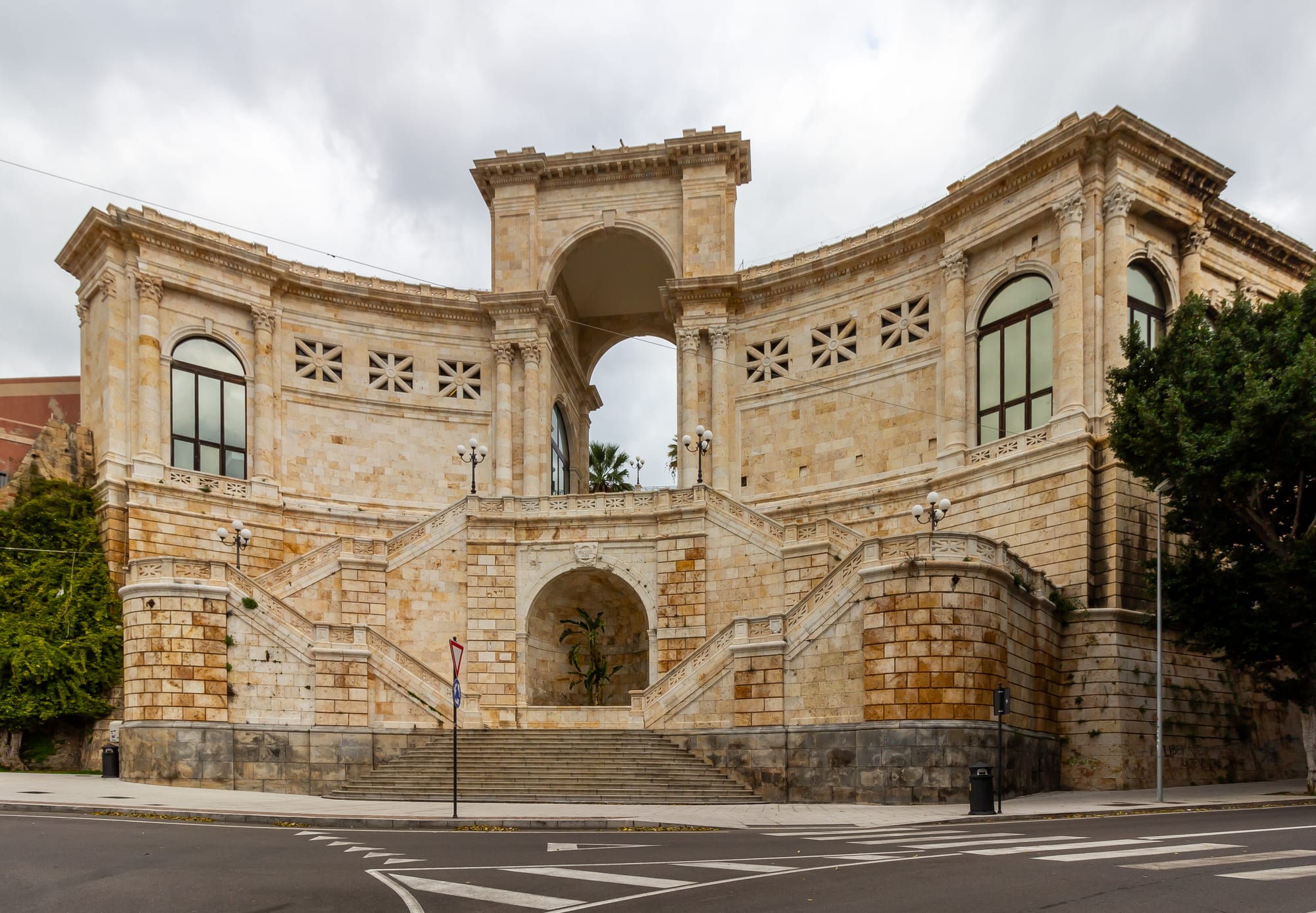
A grand pale limestone terrace with a central arch, Corinthian pilasters and twin flights of steps rising from a street

Sardinia, Italy

Cagliari

The Bastion of Saint Remy, the monumental stairway up to the Castello quarter from Piazza Costituzione. (Mike Peel / Wikimedia Commons · CC BY-SA 4.0)

Sardinia's capital and largest city, on the Gulf of Cagliari in the island's south. A Phoenician and Roman port, it became the walled Pisan and Aragonese town of Castello on its limestone hill, and capital of the Kingdom of Sardinia from 1324 to 1848. Today it is the island's administrative and commercial hub, with lagoons full of flamingos and the long Poetto beach on its doorstep.

Neighbourhoods

  • Castello
    • First-time visitors
    • Historic district
    • Views

    The walled medieval quarter on its hilltop, Casteddu de susu, 'the upper castle', with the cathedral, the viceroys' palace, the university rector's seat and two white limestone Pisan towers. Its ramparts and terraces look out over the port and the Gulf of Angels.

    Open in Maps
  • Marina
    • Best for food
    • Nightlife
    • Close to public transport

    The old port quarter between Castello and the waterfront, once walled, with narrow streets full of restaurants — especially along Via Sardegna and Via Napoli — and Via Roma facing the harbour. The station and the main bus terminal are at its edge.

    Open in Maps
  • Stampace
    • Historic district
    • Nightlife
    • Churches

    The historic district west of Castello, with the Pisan Torre dello Sperone, the churches of Sant'Anna and San Michele, and Corso Vittorio Emanuele II, a narrow street of pubs and bars. The Roman amphitheatre, west of Castello, is close by.

    Open in Maps
  • Villanova
    • Quiet and residential
    • Local life

    The old quarter east of Castello, historically the home of farm workers and never walled, now a residential district of the historic centre.

    Open in Maps
  • Poetto
    • Beaches
    • Summer stays
    • Water sports

    The district on the strip between the long town beach and the Molentargius salt pans, reached by bus from the centre. Free stretches of sand alternate with beach clubs, and flamingos nest in the lagoons behind.

    Open in Maps

Things to do

Castello

  • Bastion of Saint Remyviewpoint

    A monumental limestone terrace built in 1896–1903, with a grand stairway from Piazza Costituzione and a covered walk now used for exhibitions; its terraces give wide views over the city.

    Open in Maps
  • Torre di San Pancraziolandmark

    A white limestone tower built in 1305 by the architect Giovanni Capula during Pisan rule, who designed the Torre dell'Elefante two years later; the Aragonese used it as a jail.

    Open in Maps
  • Cagliari Cathedrallandmark

    A 13th-century Pisan-Romanesque cathedral, remodelled in Baroque style and given its present neo-Romanesque facade in the 1930s; inside is a 12th-century pulpit first carved for Pisa Cathedral.

    Open in Maps
  • Palazzo Regiolandmark

    The palace of the viceroys who governed Sardinia for the Aragonese, Spanish and Savoy kings, now the seat of the Metropolitan City.

    Open in Maps
  • National Archaeological Museummuseum

    Sardinia's most important archaeological museum, in the Citadel of Museums, with Nuragic bronze statuettes, the Phoenician Nora Stone, Carthaginian gold and a celebrated set of anatomical waxworks by Clemente Susini.

    Open in Maps

Ancient Cagliari and churches

  • Roman Amphitheatrelandmark

    A 2nd-century amphitheatre half carved into the rock below Castello, used for centuries as a stone quarry and excavated in the 19th century.

    Open in Maps
  • Tuvixeddu necropolislandmark

    A hill inside the city honeycombed with Carthaginian rock-cut tombs, the largest Punic necropolis in the Mediterranean.

    Open in Maps
  • Basilica of San Saturninolandmark

    An early Christian church whose domed core dates from the 5th–6th centuries, dedicated to the city's patron, the martyr Saturninus.

    Open in Maps
  • Shrine of Our Lady of Bonarialandmark

    The sanctuary built by the Catalans in 1324–26 during their siege of Castello, home to a wooden Madonna said to have washed ashore, from which Buenos Aires takes its name.

    Open in Maps

Parks, lagoons and beaches

  • Poetto beachbeach

    The city beach, about 8 kilometres of sand from the Devil's Saddle headland to Quartu Sant'Elena, with free stretches and beach clubs.

    Open in Maps
  • Molentargius - Saline Regional Parkpark

    A wetland of about 1,600 hectares of old salt pans and freshwater ponds between the city and Poetto, listed under the Ramsar Convention since 1977 and a regional park since 1999; flamingos have nested here since the 1990s.

    Open in Maps
  • Castle of San Micheleviewpoint

    A medieval castle on the hilltop park of San Michele in the north of the city, now used for exhibitions.

    Open in Maps
  • Botanical Gardenpark

    The university's botanical garden, rich in subtropical plants that thrive in the mild climate.

    Open in Maps
  • Terramaini Parkpark

    A park of about 13 hectares with a small pond where flamingos and other wading birds can be seen.

    Open in Maps

Markets and nights out

  • San Benedetto marketmarket

    The market of the San Benedetto district, one of the largest fish markets in Italy, selling to traders and the public alike.

    Open in Maps
  • Teatro Liricoattraction

    The opera house opened in 1993, which gave the city a true theatre for its long opera tradition.

    Open in Maps

Short trips from the city

  • Noralandmark

    The ruins of a pre-Roman and Roman town on a peninsula near Pula, where the Sant'Efisio procession ends each May.

    Open in Maps
  • Villasimiusbeach

    A resort at the south-eastern corner of the island, one of the beach towns for which Cagliari is the gateway.

    Open in Maps

Seasonal events

  • CarnivalFebruary

    A parade of masks and hand-made floats to the beat of the ratantira drums, with costumes that parody traditional Cagliari dress.

  • Sa die de sa Sardignalast weekend of April

    The Day of Sardinia, recalling the late 18th-century uprising in which the people of Cagliari expelled the Piedmontese rulers.

  • Feast of Sant'Efisio1 May

    Thousands in traditional costume from all over Sardinia escort the saint's statue on an ox-drawn cart from Stampace towards Nora, in a procession held every year since a vow made during the plague of the 1650s.

  • Sea procession of Our Lady of BonariaJuly

    A procession on the water in honour of Our Lady of Bonaria, invoked by sailors as Our Lady of Fair Winds, one of two sea processions in the city's calendar.

Eat and drink

Long-standing places and food districts in Cagliari. Hours, ratings and directions come from your maps app, always current.

Cagliari classics

  • Marina's trattoriasneighborhood

    The restaurants of the old port quarter, especially along Via Sardegna and Via Napoli, for the seafood that sets Cagliari's cooking apart from the rest of the island.

    Open in Maps
  • Poetto beach clubsneighborhood

    Beach clubs along the city beach, with umbrellas, loungers, showers and bars for a day by the sea.

    Open in Maps

Markets

  • San Benedetto marketmarket

    One of the largest fish markets in Italy, with a wide choice of fish for traders and the public alike.

    Open in Maps

Bars and nights out

  • Corso Vittorio Emanuele IIneighborhood

    A narrow street in Stampace lined with pubs and bars, the heart of the city's nightlife together with Marina and Castello.

    Open in Maps

Experience Cagliari

History

People have lived around Cagliari since the Neolithic, but the city began as Karaly, one of a string of Phoenician colonies founded in Sardinia around the 8th or 7th century BC, beside the lagoon of Santa Gilla. It grew under Carthage, which buried its dead in the great necropolis of Tuvixeddu, and passed to Rome in 238 BC, after the First Punic War. As Caralis it became the capital of Roman Sardinia, its naval station and the seat of its governor, with an amphitheatre carved into the hill.

After the Vandals and Byzantines it became, around 1020, the capital of the independent Judicate of Cagliari, centred on Santa Igia. In 1215 Pisan merchants founded the fortress of Castel di Castro on the hill; in 1258 Pisa and its allies destroyed Santa Igia, and Castello, Marina, Stampace and Villanova became the city. The Crown of Aragon besieged it from the hill of Bonaria in 1324–26, made it the capital of the new Kingdom of Sardinia and resettled Castello with Aragonese settlers. Spanish viceroys ruled from the Palazzo Regio, the bastions were strengthened, and in 1606 the university was founded.

Sardinia passed to the House of Savoy in 1718. Late in the 18th century a French revolutionary army landed at Poetto and was beaten back; when the Savoyards refused any concession in return, the people rose and expelled the Piedmontese officials. From the 1870s the city grew fast, gaining Art Nouveau streets and a white marble city hall under mayor Ottone Bacaredda. Allied bombing in February 1943 killed more than 2,000 people and damaged about 80 per cent of the buildings, and the city was awarded the Gold Medal of Military Valour. It was rebuilt and spread towards Poetto and Monte Urpinu after the war.

Culture & Customs

The great day of Cagliari's year is 1 May, the feast of Sant'Efisio. During the plague of the 1650s the city vowed a procession to the saint if the epidemic ended, and it has walked every year since, even through the bombed streets of 1943. Thousands of people from folk groups across Sardinia, in traditional dress, escort the saint on an ox-drawn cart from Stampace to Nora, near Pula — about 70 kilometres of walking over four days, one of the oldest and longest religious processions in Italy. Carnival brings masks and floats to the beat of the ratantira drums in February.

The city's language is Sardinian in its Campidanese form, casteddaju, official alongside Italian, but Italian now dominates daily life and many young people only understand it. Writers have long been drawn here: D. H. Lawrence compared the white limestone city to a "white Jerusalem" in Sea and Sardinia, and Sergio Atzeni set many of his stories in ancient and modern Cagliari. Opera has a solid tradition, housed since 1993 in the Teatro Lirico, and the comic-book school founded by the creators of Nathan Never has worked here for decades.

Sport means Cagliari Calcio above all, champions of Italy in 1970 with Gigi Riva and now playing at the Unipol Domus. G.S. Amsicora has won more men's field hockey titles than any other Italian club, and steady winds make the gulf a centre for windsurfing, kitesurfing and sailing.

Daily Life

About 146,000 people live in the city itself and some 536,000 in the Metropolitan City of Cagliari. The population is old — almost a third of residents are over 65 — as younger families move to the suburbs. Immigrants make up about 7 per cent, the largest groups born in the Philippines, Ukraine, Bangladesh, Senegal and Kyrgyzstan.

As the regional capital, Cagliari lives largely from public administration, the courts and the university, founded in 1606, whose science faculties and hospital have moved to a new campus at Monserrato. Its port is among the busiest in Italy for freight, with a container terminal at Giorgino, and the metropolitan area holds the industrial zone of Macchiareddu and the Saras oil refinery at Sarroch. The Banco di Sardegna and the telecoms company Tiscali have their headquarters here, and with cruise ships and summer visitors, tourism is one of the major industries.

People live in the historic quarters, in the 20th-century districts of San Benedetto, Fonsarda, Bonaria and Monte Urpinu, and in Pirri, a former village of about 30,000 absorbed after the war. Cagliari is one of Italy's greenest cities, with large hill parks such as Monte Urpinu. In summer much of the city's life moves to Poetto, and evenings fill the bars of Stampace, Marina and Castello.

Food

Unlike the rest of Sardinia, Cagliari's cuisine is built on the wide variety of local seafood, with traces of Catalan and Ligurian influence. The classic dishes include fregula cun cocciula, fregola with clams; cocciula e cozzas a schiscionera, clams and mussels cooked in a pan; sa burrida a sa casteddaia, catshark dressed with vinegar and walnuts; and sa cassola, a soup of fish, shellfish and molluscs.

Among the pasta dishes are malloreddus a sa campidanesa, spaghetti with clams and bottarga, and spaghittus cun arrizzonis, spaghetti with sea urchins, sometimes with artichokes or wild asparagus. Su mazzamurru is stale home-made bread cooked in sauce or broth and topped with grated pecorino. Main courses are mostly roast meats, and the best-known sweets, found across the island, are pardulas, seadas, candelaus and papassinu.

The San Benedetto market, one of the largest fish markets in Italy, supplies both restaurants and home cooks, and the old Marina quarter, especially Via Sardegna and Via Napoli, is where many of the city's trattorias cluster. Wines come from the nearby vineyards of the Campidano plain: Cannonau, Nuragus, Nasco, Monica, Moscau, Girò and Malvasia.

Planning tools

Budget

Cagliari is good value compared with the coast of the north-east, with B&Bs in the historic quarters, plentiful seafood and a compact centre. Prices rise in July and August and around the feast of Sant'Efisio on 1 May. A hire car is needed only for beaches and sights beyond the city.

Daily Budget Midrange
USD 140–290 (central hotel, seafood dinners, museum tickets, a hire car for beach days)
Daily Budget Shoestring
USD 65–100 (B&B, market and trattoria meals, buses)

Use the free stretches of Poetto rather than the beach clubs, and book rooms early for the first days of May.

Best Time to Visit

May, June and September are the best months, warm enough for the beach without the peak crowds. July and August are hot and dry, with rain rare from mid-June to mid-September, and heat waves from Africa can start in June. The feast of Sant'Efisio on 1 May is the year's great spectacle. Winters are mild, and the first cold days arrive in December.

Suggested Number of Days

Two or three days cover the historic quarters, the museums and an afternoon at the beach. Four to six days allow trips to the ancient sites and beaches of the south coast. Summer heat and beach time stretch any stay.

First Visit
2–3 days
With Surroundings
4–6 days

Transportation

CTM runs more than 30 bus and trolleybus lines across the city and to Poetto, and ARST buses serve the metropolitan area. The MetroCagliari light rail runs from Piazza Repubblica to the university campus at Monserrato and on towards Settimo San Pietro. Trenitalia's suburban trains link the central station with the airport. There is also a bike-sharing scheme.

Castello is steep, so allow time and energy for the climb; Poetto is a short bus ride from the centre.

Airport & Station Connections

Cagliari Elmas Airport, Sardinia's busiest, lies a few kilometres north-west of the centre; walkways join its terminal to a railway station with trains into the city, and ARST buses run to Piazza Matteotti. Ferries sail to Civitavecchia, Naples and Palermo. Trains from the central station run to Iglesias, Carbonia, Oristano, Sassari, Olbia and Golfo Aranci.

Walkability

Almost everything in a short visit can be reached on foot. The four historic quarters sit close together, but Castello is on a steep hill, and its best views of the gulf are from terraces that cars cannot reach. Poetto and the lagoons are a bus ride from the centre.

Safety

Italy is generally safe, with low levels of violent crime against visitors. Cagliari is a very safe city by day and night; the area around the main station and bus terminal is the one place to be alert. The main natural risks are summer heat, strong mistral winds and rough seas at the beach.

Watch belongings around the station, check wind and sea conditions before swimming at Poetto, and carry water in summer. Check current official travel advice before travelling.

Climate

Dry and mild — a semi-arid climate with hot, dry summers and mild winters. The rainy season begins in September. Winds are frequent, especially the mistral and the sirocco, and in summer a sea breeze called s'imbattu brings relief from the heat. Snow is rare.

Summer
hot and dry — August averages about 25°C, and extremes can pass 40°C, sometimes with high humidity
Winter
mild — January averages about 10°C, and the temperature drops slightly below zero only rarely

Local Customs

Sardinian, in its local Campidanese form, is the city's own language, official alongside Italian, though younger people mostly speak Italian. The feast of Sant'Efisio is a matter of deep civic pride. Beach clubs charge for entry and loungers, while other stretches of Poetto are free. Churches expect covered shoulders and knees.

Service is usually included in the bill, and rounding up is enough. Coffee is cheapest standing at the bar.

Common Payment Methods

The currency is the euro. Cards and contactless payment are widely accepted in hotels, restaurants and shops; carry some cash for market stalls, beach kiosks and small bars. ATMs are found throughout the centre.