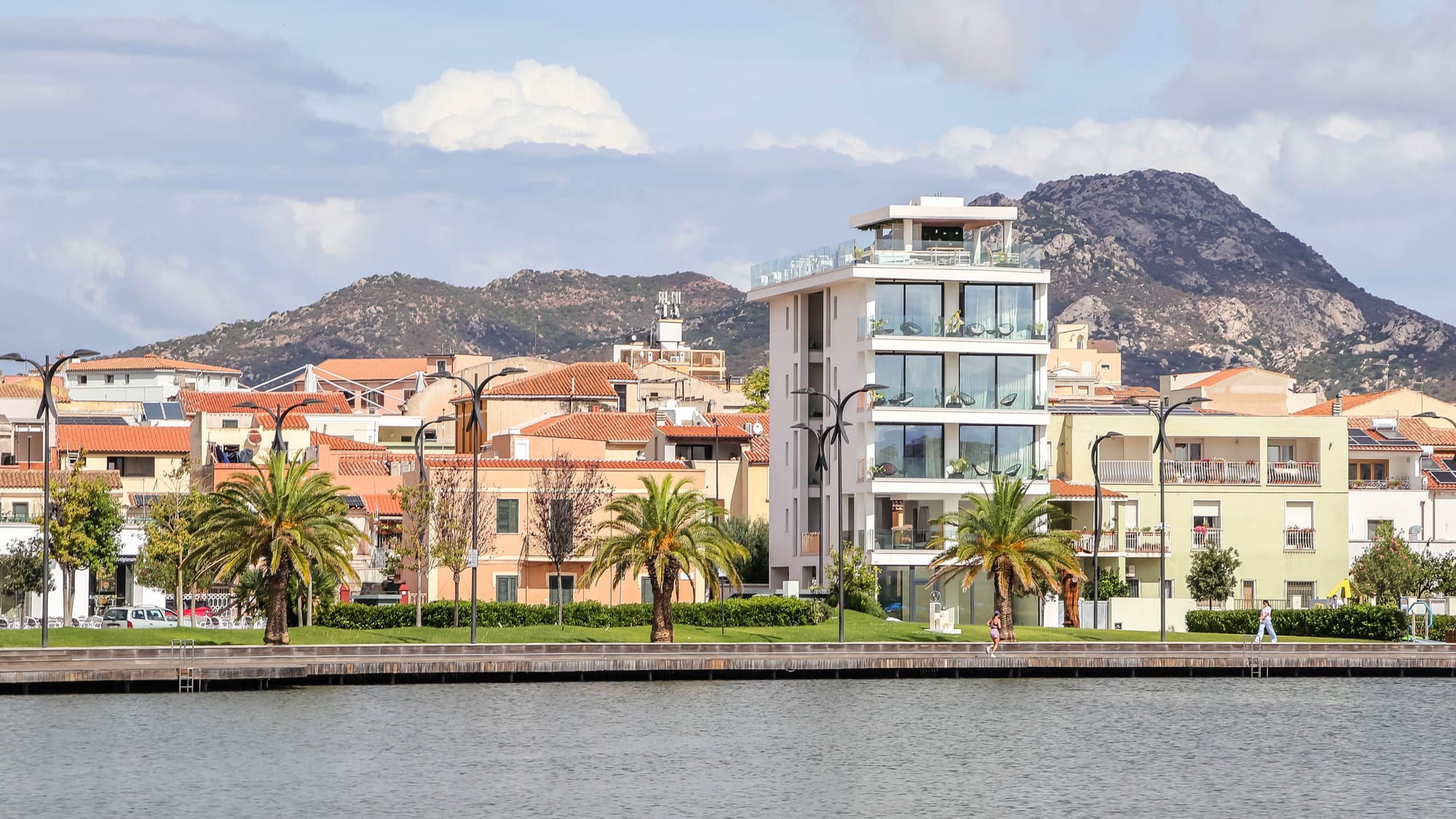
Palm trees and pastel houses along a waterfront promenade, with a modern glass block and rocky granite hills behind

Sardinia, Italy

Olbia

The Lungomare, Olbia's waterfront on the inner gulf, with the granite hills of Gallura behind. (Dr. Thomas Liptak / Wikimedia Commons · CC BY-SA 4.0)

The port and airport city of Gallura in north-east Sardinia, at the head of a sheltered gulf facing the Italian mainland. A Punic and Roman port and later capital of the medieval Judicate of Gallura, it was a small, malarial town as late as the 19th century. Since the 1960s the Costa Smeralda next door has made it a major gateway to the island and a fast-growing city of about 62,000.

Neighbourhoods

  • Historic centre
    • First-time visitors
    • Best for food
    • Close to public transport

    A regular grid of streets laid out by the Pisans near the site of the Punic and Roman town, centred on Corso Umberto I with its Liberty-style town hall, bars and shops, and the baroque church of San Paolo. Much of it is a limited traffic zone, pleasant on foot in the evening.

    Open in Maps
  • Lungomare and the old port
    • Waterfront walks
    • Museums

    The promenade along the inner gulf, where the archaeological museum stands on the Peddona islet by the old port. The ferry quay of Isola Bianca, linked to the city road network by a tunnel and elevated roads, lies further out in the bay.

    Open in Maps
  • Pittulongu
    • Beaches
    • Summer stays

    A coastal village of the municipality about 10 kilometres north of the centre, stretching some 4 kilometres along the shore towards Golfo Aranci, with a string of sandy beaches: La Playa, Lo Squalo, Il Pellicano, Mare e Rocce and Bados.

    Open in Maps
  • Porto Rotondo
    • Marina
    • Luxury
    • Nightlife

    A resort village within Olbia's municipality on the Costa Smeralda, one of the island's major summer destinations, known for drawing Italian and international celebrities.

    Open in Maps

Things to do

Historic Olbia

  • Basilica of San Simpliciolandmark

    A granite Romanesque basilica of the late 11th century, built over a Punic and Roman cemetery outside the old walls, where the martyr Simplicius was buried; it is the finest monument in Gallura.

    Open in Maps
  • San Simplicio necropolis museummuseum

    Beneath the basilica, a museum of some 450 tombs used from the 8th century BC to the Middle Ages, with grave goods and the remains of the ramp to a Roman temple of Ceres.

    Open in Maps
  • Archaeological Museummuseum

    The city museum on the Peddona islet at the old port, best known for the Roman and medieval shipwrecks found in the harbour in 1999.

    Open in Maps
  • Church of San Paololandmark

    A church first recorded in the 15th century and rebuilt in baroque taste in the mid-18th century, with a granite bell tower and a dome added in 1939 and later tiled.

    Open in Maps
  • Roman aqueductlandmark

    Remains of the 1st–2nd-century aqueduct that carried water about 7 kilometres from the springs of Cabu Abbas to the baths of the Roman city.

    Open in Maps

Nuragic and medieval sites

  • Sa Testa sacred welllandmark

    A Nuragic sacred well dating from between about 1200 and 1000 BC, near Pittulongu on the road to Golfo Aranci.

    Open in Maps
  • Castello di Pedreslandmark

    The ruins of a castle recorded between 1296 and 1388, probably built by Pisan masons, on the road towards Loiri south of the city.

    Open in Maps
  • Su Monte 'e s'Abe giants' tomblandmark

    A Nuragic collective tomb next to the Castello di Pedres, considered one of the largest and best preserved of Sardinia's giants' tombs.

    Open in Maps

Beaches

  • Pittulongu beachesbeach

    Olbia's own beaches, a chain of sandy bays along the coast north of the city towards Golfo Aranci.

    Open in Maps

The coast and islands

  • Tavolara Islandviewpoint

    A limestone massif off the coast with steep cliffs, rising to 565 metres, part of the Tavolara and Punta Coda Cavallo marine preserve created in 1997, with a beach at each end.

    Open in Maps
  • Golfo Aranciattraction

    A small port town about 13 kilometres north-east of Olbia, with a second ferry terminal and the end of the railway line.

    Open in Maps
  • San Teodorobeach

    A beach town about 20 kilometres south-east of Olbia, known for the long sands of La Cinta and the clear water of Lu Impostu.

    Open in Maps
  • Costa Smeralda and Porto Cervoattraction

    The coast developed from 1961 by a consortium led by Prince Karim Aga Khan, with granite coves and the purpose-built resort of Porto Cervo, one of the most expensive places in Europe.

    Open in Maps

Short trips from the city

  • La Maddalenaattraction

    The town of the Maddalena archipelago, a national park of granite islands, listed among the most beautiful villages of Italy.

    Open in Maps

Seasonal events

  • Feast of San Simpliciomid-May

    The festival of the patron saint of Olbia and Gallura, held on 15 May with religious celebrations beginning nine days before, concerts, fireworks and fairground rides.

  • Feast of San Giovanni and the Madonna del Marelate June

    A traditional popular festival of the city, celebrated on the feast of St John.

Eat and drink

Long-standing places and food districts in Olbia. Hours, ratings and directions come from your maps app, always current.

Olbia classics

  • Historic-centre restaurantsneighborhood

    The streets around Corso Umberto I hold most of the city's restaurants and bars, the place to try local mussels and Gallurese dishes.

    Open in Maps
  • Porto Rotondoneighborhood

    The marina village's waterfront restaurants and bars, at their busiest in summer.

    Open in Maps

Bars and the waterfront

  • Lungomareneighborhood

    Cafés along the waterfront promenade of the inner gulf, for an evening stroll and an aperitivo.

    Open in Maps

Experience Olbia

History

Olbia was first settled by Nuragic people or Phoenicians; its Greek name points to Greek contact in the 7th century BC. Carthage walled the town, and when Rome took Sardinia in 238 BC it became a commercial centre and an important naval base. Roman Olbia had more than 5,000 people, a forum, paved streets, baths and an aqueduct, and Acte, the freedwoman of Nero, owned estates and a brickworks here. The martyr Simplicius was killed in 304. Vandal raiders later sank ships in the harbour, whose wrecks came to light in 1999.

In the Middle Ages, under the name Civita, it was the walled capital of the Judicate of Gallura, one of Sardinia's four independent states. Judge Costantino III built the basilica of San Simplicio around 1100, and Elena of Gallura became the first woman to rule a Sardinian throne in her own right. After the death in 1296 of the last judge, Nino Visconti, remembered by Dante, Pisa took over and built a new walled town, Terranova.

War, revolt, plague and malaria brought centuries of decline; in 1837 a French traveller found an unhealthy village of fewer than 2,000 people. A rebuilt port in 1870 and the railway in 1881 began its revival, though in 1880 the mainland steamers moved to Golfo Aranci and returned only after a popular uprising in 1920. Renamed Olbia in the Fascist period, the town drained its marshes and defeated malaria, and from the 1960s the tourist discovery of the Costa Smeralda drove rapid growth; the airport opened in 1974. In November 2013 floods from Cyclone Cleopatra killed nine people.

Culture & Customs

Olbia is an island of Sardinian speech within Gallura: many residents speak Olbiese, a local form of Logudorese Sardinian, as well as Gallurese and Italian, and the city's old name survives as Terranoa and Tarranoa. The patron saint, Simplicius, is honoured on 15 May with a traditional town feast of religious celebrations, concerts and fireworks, and the feast of San Giovanni and the Madonna del Mare in June is another popular tradition. The basilica of San Simplicio, built of local granite, is the symbol of the city's medieval past.

The city's architecture reflects its growth from a small town, from the Liberty-style Palazzo Colonna, now the town hall, and the Neoclassical Villa Tamponi of 1870 to the open-air theatre designed by Giovanni Michelucci and modern churches.

Sport has grown with the city. Olbia Calcio 1905 plays in Serie D, the fourth tier of Italian football, and from 2004 Olbia hosted the headquarters of the Rally di Sardegna, a round of the World Rally Championship, later alternating with Alghero. Powerboat racing and the 100th International Six Days Enduro in 2013 have also brought international events. The Costa Smeralda next door adds a summer layer of celebrity visitors.

Daily Life

About 62,000 people live in Olbia, making it the fourth-largest town in Sardinia and the co-capital, with Tempio Pausania, of the province of Gallura North-East Sardinia. Immigrants make up about 12 per cent of residents, the largest groups born in Romania, Senegal, Argentina, Morocco and Germany.

Olbia is the main economic centre of Gallura and the north-east. Mussels are farmed in licensed beds in the semi-lagoon of the inner gulf, the food industry is important, and the city is the main service centre for the Costa Smeralda, less than 30 kilometres away. New and expanded hotels have been opening in recent years. Since the 2024–25 academic year the city has hosted university courses in naval engineering and nursing.

Most people live in the town and its expanding suburbs; outlying villages in the municipality include San Pantaleo, Berchiddeddu, Pittulongu, Murta Maria and Porto Rotondo. Life follows the tourist calendar: the summer brings traffic, full ferries and crowds at the airport, while winter, with few flights, is quieter and local.

Food

Olbia's signature product is the mussel. The city's cozze are raised in licensed beds in the sheltered, semi-lagoon waters of the inner gulf, and they are a source of local pride.

The inland cooking of Gallura is built on bread, cheese and broth. Suppa cuatta, Gallurese soup, layers Sardinian bread with casizolu cheese, spices and pecorino, softened with broth and baked in the oven. Small cylinders of durum-wheat pasta, called chiusòni in Gallurese, are found across the island but especially here. Island classics are everywhere too: porceddu, suckling pig cooked slowly on a spit and flavoured with myrtle or rosemary; pane carasau, the thin, crisp double-baked flatbread; and seadas, fried pastry discs filled with fresh pecorino and covered with honey.

Gallura's most famous wine is the DOCG Vermentino di Gallura, a white made from a grape said to have been grown in this part of the island since the 14th century. Meals often end with mirto, the myrtle liqueur of Sardinia and Corsica.

Planning tools

Budget

Olbia itself is moderately priced, but it sits beside the Costa Smeralda, one of the most expensive places in Europe, and summer prices across the area rise sharply. A hire car or ferry tickets for a car are the main extra costs.

Daily Budget Midrange
USD 160–330 (city hotel, seafood dinners, a hire car or a boat trip)
Daily Budget Shoestring
USD 70–110 (B&B or campsite, bakery and pizzeria meals, buses)

Book ferries and hire cars months ahead for July and August, or travel in June or September.

Best Time to Visit

May, June and September are the best months for the beaches without the peak crowds and prices. July and August are hot and very busy, with the airport and ferry port at full stretch. Winters are mild, and most flights run only in the holiday season. Mid-May brings the feast of San Simplicio.

Suggested Number of Days

The city itself needs a day or two. Most visitors use Olbia as a base or gateway for the beaches and islands of the north-east, which call for four days to a week. Sea conditions and the summer crowds affect boat trips.

First Visit
1–2 days
With Surroundings
4–7 days

Transportation

ASPO runs the city buses, including lines between the airport and the centre, and ARST regional buses serve the towns of Gallura and the island. Trains run from Olbia station to Golfo Aranci, Porto Torres and Cagliari. Much of the centre is a limited traffic zone, and a hire car is the easiest way to reach the beaches and the Costa Smeralda.

Stay out of the centre's limited traffic zones — cameras fine hire cars too — and expect potholes on some roads.

Airport & Station Connections

Olbia Costa Smeralda Airport, renamed in 2025 after Prince Karim Aga Khan IV, lies within the city and mostly handles seasonal holiday flights from across Europe, with hourly city buses to the centre and direct coaches to resorts across the north-east. The Isola Bianca port has the most passenger traffic in Italy, excluding short crossings, with ferries to Civitavecchia, Genoa, Livorno and Piombino, and nearby Golfo Aranci has more sailings.

Walkability

The historic centre and the Lungomare are compact and flat, easy to walk, with Corso Umberto I largely free of traffic. The Isola Bianca ferry quay, the airport, the beaches and the archaeological sites outside town are best reached by bus, taxi or car.

Safety

Italy is generally safe, with low levels of violent crime against visitors. Olbia's practical risks are poor road surfaces and fast drivers, rough seas and strong winds on exposed beaches, summer heat and wildfires, and violent autumn storms: in November 2013 Cyclone Cleopatra flooded the city and killed nine people.

Drive carefully, check wind and sea conditions before swimming or boating, avoid walking alone late at night in empty areas, and follow flood and fire warnings. Check current official travel advice before travelling.

Climate

A Mediterranean climate, with mild winters, warm springs and autumns and hot, dry summers. The mistral blows from the north-west, and heavy autumn rain can bring floods, as in November 2013.

Summer
hot and dry — at the airport weather station August averages about 24°C, and a record 47.4°C was reached in July 2023
Winter
mild — January averages about 10°C at the airport, and the lowest temperature recorded there is −4.2°C, in December 2001

Local Customs

Many people speak a local form of Sardinian as well as Gallurese, and the city's old name, Terranova, survives as Terranoa in Sardinian and Tarranoa in Gallurese. Mussels from the inner gulf are a point of local pride. Churches expect covered shoulders and knees.

Service is usually included in the bill, and rounding up is enough. Coffee is cheapest standing at the bar.

Common Payment Methods

The currency is the euro. Cards and contactless payment are widely accepted, and city bus fares can be paid by contactless card on board; carry some cash for small bars and kiosks. ATMs are found in the centre, at the port and at the airport.