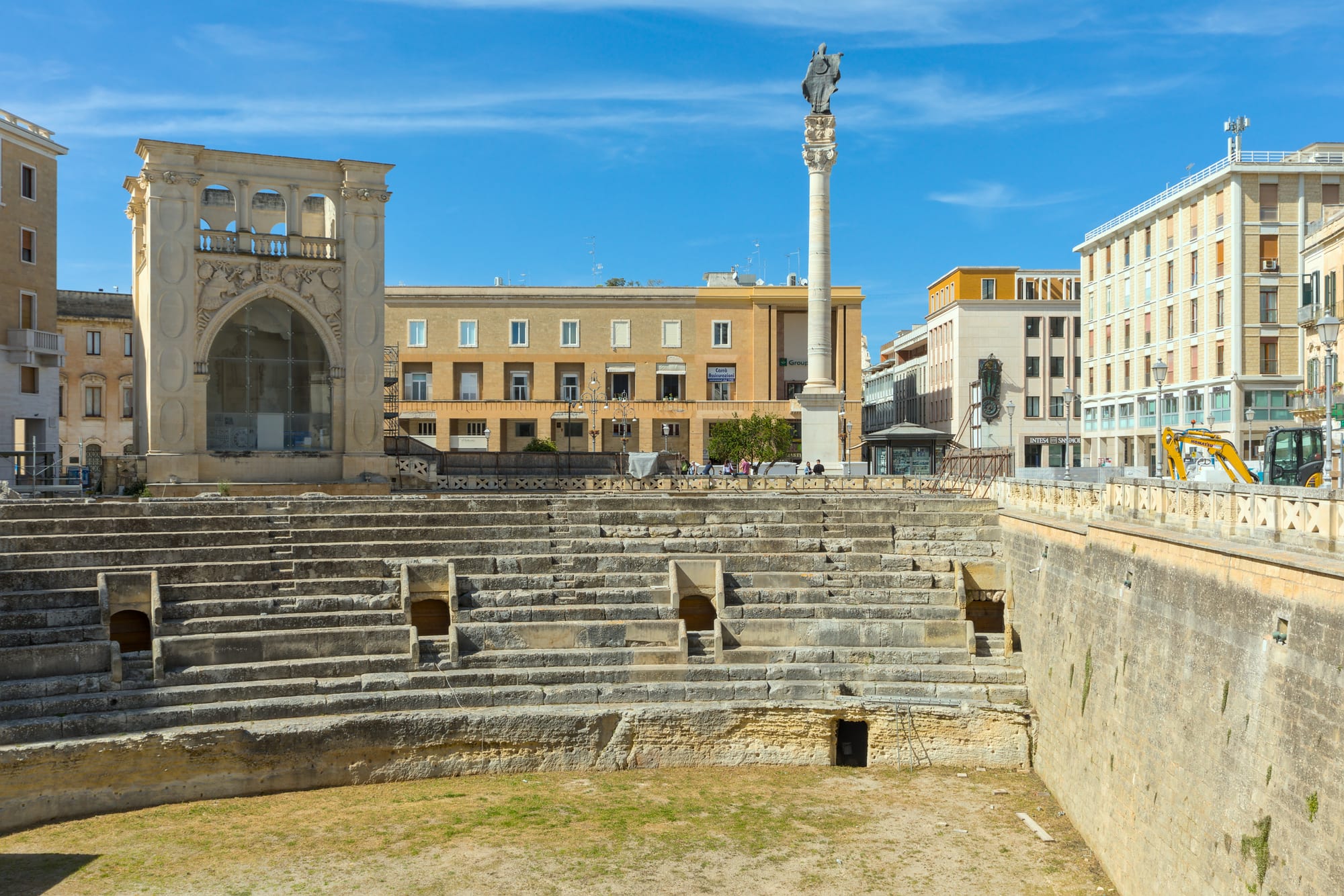
Stone tiers of the excavated Roman amphitheatre below street level, with an arched pavilion and a tall column topped by a statue behind

Puglia, Italy

Lecce

The Roman amphitheatre in Piazza Sant'Oronzo, with the Palazzo del Seggio and the column of Saint Orontius. (Benjamin Smith / Wikimedia Commons · CC BY-SA 4.0)

The capital of its province on the Salentine Peninsula, at the heel of Italy, nicknamed the Florence of the South for the Baroque churches and palaces carved from its soft local limestone from 1630 onwards. A Roman amphitheatre lies half-buried in its main square, and today it is a university city of about 94,000 living from services, crafts, olive oil, wine and tourism.

Neighbourhoods

  • Centro storico
    • First-time visitors
    • Historic district
    • Best for food

    The old city inside the line of the former walls, entered through Porta Napoli, Porta Rudiae and Porta San Biagio. Its lanes of honey-coloured stone link Piazza Sant'Oronzo, the cathedral square and the Basilica of Santa Croce, and most restaurants, cafés and pastry shops are here.

    Open in Maps
  • Ferrovia and the station area
    • Close to public transport

    The district around the railway station, about a kilometre from the centre, where trains from Bari, Brindisi and the rest of the Adriatic line end. It is a practical, residential base within walking distance of the old town.

    Open in Maps
  • San Cataldo and the coast
    • Beaches
    • Summer

    The municipality reaches the Adriatic about 12 kilometres east of the city at San Cataldo, the site of the Roman Hadrian Port, where a lighthouse marks the point and residents head for the sea in summer.

    Open in Maps

Things to do

Baroque churches

  • Basilica of Santa Crocelandmark

    Begun in 1353, halted until 1549 and completed in 1695, with a facade crowded with animals, grotesque figures and plants around a large rose window; the former convent beside it is now the seat of the province.

    Open in Maps
  • Lecce Cathedrallandmark

    First built in 1144 and remodelled in 1659–70 by Giuseppe Zimbalo, who added the 70-metre bell tower that rises over Piazza del Duomo.

    Open in Maps
  • Santi Niccolò e Cataldolandmark

    A church founded by Tancred in 1180, a rare Italo-Norman survival whose Romanesque portal was kept when the facade was rebuilt with statues in 1716.

    Open in Maps
  • Church of San Matteolandmark

    A Baroque church of 1667 whose facade has two columns, only one of them decorated, and that only partially.

    Open in Maps

Roman Lecce and the old city

  • Roman amphitheatrelandmark

    A 2nd-century amphitheatre that held more than 25,000 people, now half-buried beneath later buildings in Piazza Sant'Oronzo and used for religious and arts events.

    Open in Maps
  • Column of Saint Orontiuslandmark

    One of the pair of columns that marked the end of the Appian Way, given to Lecce by Brindisi and topped with a statue of the city's patron saint.

    Open in Maps
  • Porta Napolilandmark

    The triumphal arch raised in 1548 in honour of Charles V, one of the three gates into the old city.

    Open in Maps
  • Castle of Charles Vlandmark

    A medieval fortress reinforced from 1539 for Charles V by Gian Giacomo dell'Acaya, used as a military district until 1979 and now a venue for cultural events.

    Open in Maps

Museums

  • Museo Faggianomuseum

    A small private archaeological museum in the old town.

    Open in Maps
  • Museo Sigismondo Castromedianomuseum

    The provincial archaeological museum, named after Sigismondo Castromediano.

    Open in Maps

Parks and sport

  • Orto Botanico di Leccepark

    A two-hectare botanical garden run by the university, begun in 1994 on the road to Monteroni.

    Open in Maps
  • Stadio Via del Mareattraction

    The stadium built in 1966 on the road to the sea, home of US Lecce, who play in Serie A.

    Open in Maps

Short trips from the city

  • Rudiae archaeological parklandmark

    The remains of the Messapian town identified as the home of the poet Ennius, with its own amphitheatre, a necropolis and walls, about 3 km south-west of the centre.

    Open in Maps
  • Punta San Cataldo Lighthouselandmark

    An active lighthouse on the Adriatic shore at San Cataldo, about 12 km from the city.

    Open in Maps
  • Acayaneighborhood

    One of the few fortified villages left in Puglia, with a 16th-century street grid and a castle built in 1535–36 by Gian Giacomo dell'Acaya.

    Open in Maps
  • Grecìa Salentinaneighborhood

    A group of villages near Lecce where the Griko people still speak a variety of Greek.

    Open in Maps
  • Otrantoneighborhood

    A port on the Salento's east coast facing Albania across the strait that bears its name, with a cathedral consecrated in 1088 and known for its mosaic pavement of 1166.

    Open in Maps
  • Gallipolineighborhood

    A town on the Ionian coast of the Salento whose old quarter stands on an island, and one of the places where Griko is spoken.

    Open in Maps

Seasonal events

  • Feast of Saints Oronzo, Giusto and Fortunato24–26 August

    Three days for the city's patron saints, peaking on 24 August with a procession from the cathedral through the old city and Piazza Sant'Oronzo, which is hung with illuminations.

  • Fiera dei Presepi e dei PupiDecember

    The Christmas fair of handmade crib figures in papier-mâché, Lecce stone and terracotta, also called the Fiera di Santa Lucia.

Eat and drink

Long-standing places and food districts in Lecce. Hours, ratings and directions come from your maps app, always current.

Lecce classics

  • Pastry shops of the centro storicocafe

    Bars and pastry shops serving the pasticciotto, a shortcrust pastry filled with custard, warm at breakfast, and the rustico, a puff-pastry round of tomato and mozzarella.

    Open in Maps
  • Trattorias of the old townneighborhood

    Restaurants in the lanes around Piazza Sant'Oronzo and Santa Croce serving Salento dishes such as ciceri e tria with Negroamaro wine.

    Open in Maps

By the sea

  • San Cataldoneighborhood

    The city's seaside, where summer bars and fish restaurants serve the beach crowd.

    Open in Maps

Experience Lecce

History

Legend tells of a Messapian town called Sybar, founded at the time of the Trojan War and conquered by the Romans in the 3rd century BC, who renamed it Lupiae. Under Hadrian, in the 2nd century AD, the town moved about 3 km to the north-east and took the name Licea or Litium; it had a theatre and an amphitheatre and was linked to the Hadrian Port at today's San Cataldo. Saint Orontius, Sant'Oronzo, is considered its first bishop and is still its patron.

Totila's Ostrogoths sacked Lecce during the Gothic Wars, and from 549 it was part of the Eastern Roman Empire for five centuries. After the Norman conquest in the 11th century it regained commercial and political weight — Count Tancred of Lecce became the last Norman king of Sicily — and it flourished under the Hohenstaufen and Angevins as one of the largest fiefs in the kingdom. In the first half of the 16th century Charles V gave it new walls and a castle against Ottoman attack.

From 1630 the city was rebuilt and embellished in its own Baroque, carved in the soft local stone by architects such as Giuseppe Zimbalo. A plague in 1656 killed a thousand people; tradition tells of a miracle through Saint Orontius's intercession. Between 1895 and 1915 the city first spread beyond its walls. During the Second World War Lecce was an air base, used in 1944–45 by American B-24 bombers. The university was founded in 1955, and in 2015 Lecce was Italian Capital of Culture.

Culture & Customs

Lecce's culture is written in stone. The local limestone is very soft and workable, which allowed the dense ornament of facades such as Santa Croce, where animals, grotesque figures and plants crowd around a large rose window. The stone is still one of the city's main exports and a material for local craftsmen.

The other great craft is papier-mâché, cartapesta, a tradition unique to the region: most of the statues in Lecce's churches are made of it, the city has a museum devoted to it, and in December the Fiera dei Presepi e dei Pupi fills the centre with crib figures in papier-mâché, stone and terracotta. The year's main feast honours the patron saints Oronzo, Giusto and Fortunato from 24 to 26 August, with a procession from the cathedral through squares hung with illuminations.

Lecce is the capital of the Salento, with its own dialects and the pizzica, the folk dance that began on the peninsula; nearby, the villages of the Grecìa Salentina still speak Griko. The University of Salento gives the old town a young population, and football is a passion: US Lecce, founded in 1908, play in Serie A, and fans call themselves giallorossi or lupi, the wolves.

Daily Life

About 94,400 people live in the municipality, the largest city in its province, with an older population than the national average — roughly a quarter are over 65. Around nine in ten were born in Italy; the largest groups born abroad come from Albania, India, Senegal, the Philippines and Romania. The city is divided into ten districts, from the Centro and Mazzini to Santa Rosa, Rudiae-San Pio and Ferrovia-Casermette, with outlying villages and a stretch of Adriatic coast.

The economy rests on agriculture, above all olive oil and wine, on crafts such as papier-mâché and stone carving, on ceramics, building, services and tourism. The University of Salento is based here, and a national nanotechnology laboratory works alongside it. Adriana Poli Bortone has been mayor since June 2024.

Days follow the southern rhythm of a long lunch, quiet afternoons and a lively evening walk through the old town. In summer much of the city decamps to the coast, while in August Italian holidaymakers and emigrants returning home fill the Salento, and the old town is crowded until late.

Food

Lecce's own sweet is the pasticciotto, a small shortcrust pastry about 2.5 cm thick filled with lemon-flavoured custard, eaten at breakfast and ideally warm; the city has named it its typical cake. Its invention is credited to Andrea Ascalone, a pastry cook in nearby Galatina, in 1745, though later research has questioned the date. The savoury counterpart is the rustico, two discs of puff pastry filled with tomato and mozzarella (or a frankfurter in a popular variant), brushed with egg and baked, a mid-morning or evening snack found in every bar and bakery of the Salento.

Ciceri e tria is described as the emblematic dish of Salentine cooking: pasta with chickpeas, part of the pasta fried for crunch. Taralli, ring-shaped crackers made with olive oil or lard, are common across southern Italy.

The wine of the Salento is made from Negroamaro, a red grape grown almost exclusively in Puglia and especially on the peninsula, producing deeply coloured wines; olive oil and wine are both mainstays of the local economy.

Planning tools

Budget

Lecce is good value by Italian standards, cheaper than the Amalfi Coast or the big northern cities. Rooms in the old town cost most in August, when the Salento fills with Italian holidaymakers; the rest of the year B&Bs and restaurants are reasonably priced.

Daily Budget Midrange
USD 140–270 (B&B in the old town, restaurant dinners, church and museum tickets, a hire car for the coast)
Daily Budget Shoestring
USD 65–110 (hostel or simple B&B, pasticciotti and rustici, trains and buses)

Many of Lecce's best sights — the squares, the gates, church facades and the amphitheatre seen from above — cost nothing.

Best Time to Visit

Spring and autumn are warm and comfortable for walking the old town. Summer is hot but brings the beaches within reach and the patron saints' feast in late August; August is the busiest and most expensive month. Winter is mild and quiet, with the crib fair in December.

Suggested Number of Days

Two days are enough for the old city at an unhurried pace. Allow four to six to use Lecce as a base for the rest of the Salento, its two coasts and its villages; a hire car makes the surrounding area far easier.

First Visit
2 days
With Surroundings
4–6 days

Transportation

The old town is best on foot. Local buses and a trolleybus network, introduced in 2012, serve the wider city. Lecce station is the southern end of the Adriatic railway from Ancona and Bari, and Ferrovie del Sud Est trains run to Martina Franca and Otranto. For the coast and the villages most visitors hire a car.

A hire car makes the coasts and villages of the Salento far easier to reach than public transport.

Airport & Station Connections

The nearest airport is Brindisi, about 39 km away. Trains on the Adriatic line arrive from Bari, Brindisi and cities further north, and the station is about a kilometre from the centre. By car, the SS613 runs from Brindisi.

Walkability

The centro storico is compact, flat and largely pedestrian, and walking is the way to see it: Piazza Sant'Oronzo, the cathedral, Santa Croce and the gates are all within a few minutes of one another. Paving can be slippery after rain, and summer afternoons are hot.

Safety

Italy is generally safe, with low levels of violent crime against visitors. Lecce is a calm university city; the practical concerns are petty theft in crowds, break-ins to parked cars and summer heat.

Leave nothing visible in parked cars and carry water in summer. Check current official travel advice before travelling.

Climate

A Mediterranean climate, with hot, dry summers and mild winters, on the flat plain of the Salento.

Summer
hot and dry — August, the warmest month, averaged about 26°C at the Lecce Galatina station in 1971–2000
Winter
mild — January, the coldest month, averaged about 9°C in 1971–2000

Local Customs

Churches are active places of worship: shoulders and knees should be covered and visits paused during services. Lunch is long and afternoons quiet, and the evening walk through the old town is the social hour.

Ask before photographing artisans at work, and avoid flash in churches.

Common Payment Methods

Italy uses the euro. Cards are accepted almost everywhere; keep a little cash for small bars, markets and rural spots.