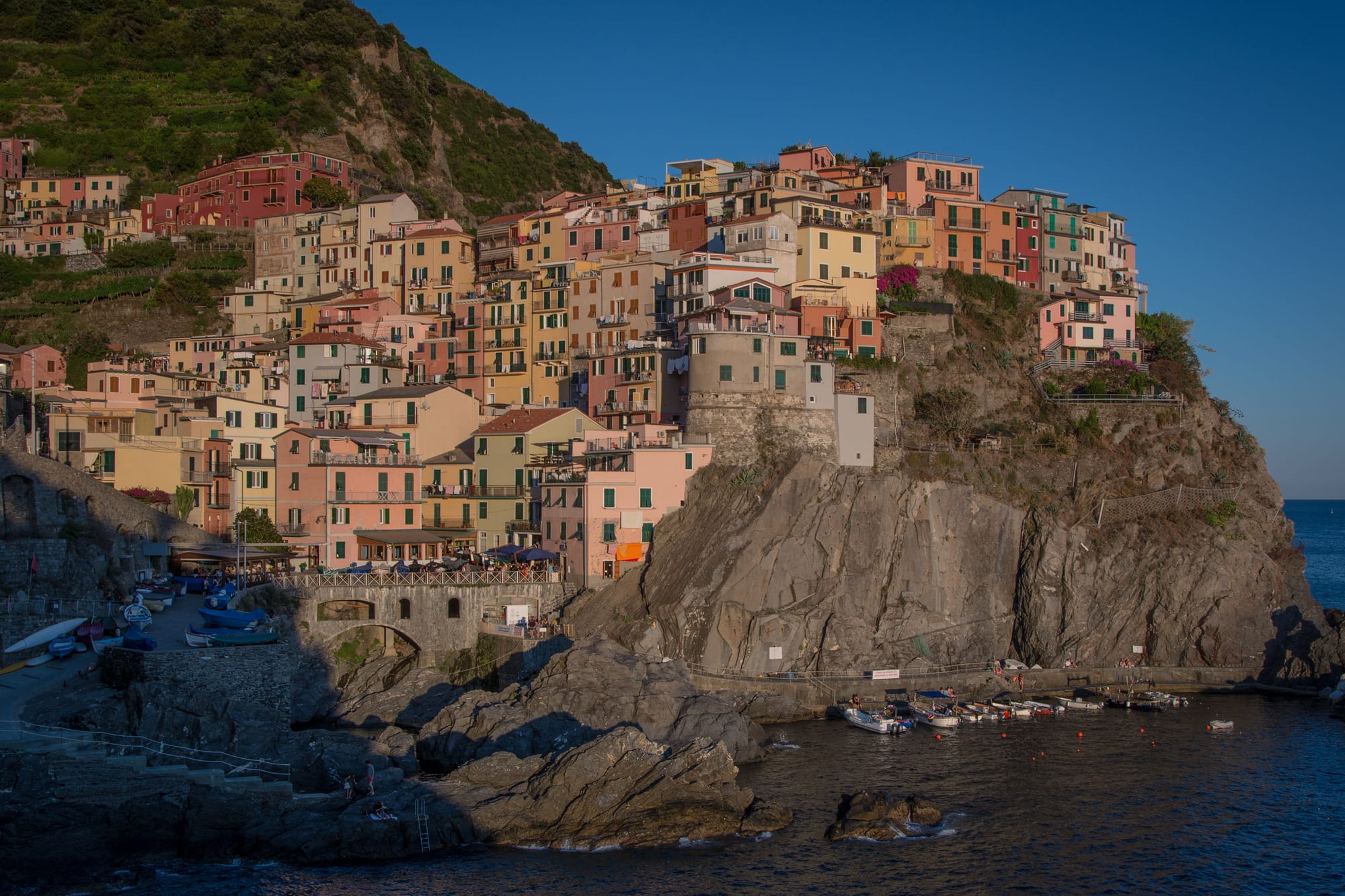
Pastel houses stacked on a dark rocky headland above a small harbour with boats, lit by low evening sun

Liguria, Italy

Cinque Terre

Manarola, one of the five villages of the Cinque Terre, in the evening light. (kuhnmi / Wikimedia Commons · CC BY 2.0)

Five villages — Monterosso al Mare, Vernazza, Corniglia, Manarola and Riomaggiore — on a steep stretch of the Ligurian coast west of La Spezia. Centuries of terracing for vines and olives shaped the cliffs; today the villages, the hillsides and the sea form a national park and UNESCO World Heritage Site, linked by footpaths, trains and boats rather than roads.

Neighbourhoods

  • Monterosso al Mare
    • Beaches
    • Families
    • Close to public transport

    The northernmost village, with a partly ruined Genoese castle in the old village and, beyond the Capuchin hill, the newer resort of Fegina with a large sandy beach. Lemon trees grow all over town, and some intercity trains stop here.

    Open in Maps
  • Vernazza
    • Historic district
    • Nightlife

    The only natural harbour of the Cinque Terre, a car-free fishing village of tall houses around a small square and beach, watched over by the 15th-century Doria Castle tower. It is lively into the evening.

    Open in Maps
  • Corniglia
    • Quiet
    • Views

    The only one of the five not beside the sea, set on a promontory about 100 metres high and surrounded by vineyards. About 150 people live along its narrow main street, and a terrace in the rock looks out over all four other villages. From the station, a long stairway of several hundred steps or a park bus climbs to the village.

    Open in Maps
  • Manarola
    • Views
    • Swimming

    A village of about 350 people whose houses climb a rocky headland above a tiny harbour, where boats are pulled up along the main street. Its church of San Lorenzo dates from 1338, and the hamlet of Volastra lies among the vineyards above.

    Open in Maps
  • Riomaggiore
    • First-time visitors
    • Best for food
    • Close to public transport

    The southernmost village, dating from the early 13th century, built up a narrow valley to a small beach and a wharf framed by tower houses. Via Colombo, the main street, holds most of its restaurants, bars and shops.

    Open in Maps

Things to do

Walks and viewpoints

  • Via dell'Amoretrail

    The paved clifftop path of just over a kilometre between Riomaggiore and Manarola, part of the Blue Trail, reopened in 2024–25 after more than a decade of closures and repairs that followed a rockslide in 2012.

    Open in Maps
  • Sentiero Azzurrotrail

    The Blue Trail, the most popular path in the park, linking the five villages; the steeper sections between Corniglia, Vernazza and Monterosso climb through olive groves and vineyards, and landslides often close parts of it.

    Open in Maps
  • Volastraviewpoint

    One of the oldest villages in the park, above Manarola among terraced vineyards and olive groves, with the church of Nostra Signora della Salute and higher paths with fewer walkers.

    Open in Maps

Village landmarks

  • Doria Castle, Vernazzalandmark

    A 15th-century lookout tower built to protect the village from pirates.

    Open in Maps
  • Santa Margherita d'Antiochialandmark

    Vernazza's church on the main square by the harbour, recorded in 1318 and probably older, with an octagonal bell tower rising from the apse.

    Open in Maps
  • Monterosso Giantlandmark

    A huge statue of Neptune by Arrigo Minerbi and Francesco Levacher near Fegina beach, holding up a terrace.

    Open in Maps
  • San Pietro, Corniglialandmark

    The parish church built of local stone between 1334 and 1351.

    Open in Maps

The coast and the park

  • Cinque Terre National Parkpark

    Created in 1999, the smallest national park in Italy and the most densely inhabited, protecting the terraces, trails and villages, with a protected marine area offshore since 1998.

    Open in Maps
  • Fegina beachbeach

    Monterosso's large sandy beach with rows of colourful umbrellas and beach-side restaurants and cafés.

    Open in Maps

Short trips

  • Porto Venereattraction

    The village at the western tip of the Gulf of La Spezia, with the islands of Palmaria, Tino and Tinetto, part of the same UNESCO World Heritage Site and reached by boat.

    Open in Maps
  • La Speziaattraction

    The naval city on its gulf, a significant railway junction with train and boat links to the villages and a base for exploring them.

    Open in Maps

Seasonal events

  • Feast of San Lorenzo10 August

    The feast of Manarola's patron saint, when a lit figure of the saint with his gridiron shines on the hillside.

  • Grape harvestearly to mid-September

    The harvest on the steep terraces, where grapes are still carried by hand much as they were centuries ago.

  • Manarola's lighted NativityDecember to late January

    Since 1961, the hillside above Manarola has been lit with a Nativity scene of lights, said to be the largest in the world.

Eat and drink

Long-standing places and food districts in Cinque Terre. Hours, ratings and directions come from your maps app, always current.

Cinque Terre classics

  • Via Colombo, Riomaggioreneighborhood

    Riomaggiore's main street, lined with cafés, bars, restaurants, gelaterie and grocery shops selling fruit, cured meats, cheese and olives.

    Open in Maps
  • Vernazza harbourneighborhood

    Bars and restaurants around the harbour square and along the main street, where Vernazza's lively evenings are spent.

    Open in Maps
  • Corniglia's honey gelatocafe

    Corniglia is particularly known for a gelato made with local honey, miele di Corniglia.

    Open in Maps

Wine

  • Cinque Terre wine cooperativemarket

    The Cooperativa Agricoltura di Cinque Terre, between Manarola and Volastra, makes both the Cinque Terre white and the sweet Sciacchetrà.

    Open in Maps

Experience Cinque Terre

History

The Cinque Terre appear in documents from the 11th century. Monterosso and Vernazza were settled first, and the other villages grew up later within the territory of the Republic of Genoa; Riomaggiore dates from the early 13th century, and Manarola's church of San Lorenzo from 1338. Like the rest of the Ligurian coast, the villages suffered frequent pirate raids, first Saracen and then Turkish, and in the 16th century their people strengthened old forts and built new defensive towers against Turkish attacks; Vernazza's Doria Castle had been built as a lookout tower in the 15th century.

Over the centuries the inhabitants cut terraces into the steep slopes right up to the cliffs, growing grapes and olives, and their wine was known far beyond the coast — Boccaccio mentions the vernaccia of Corniglia in the Decameron. From the 17th to the 19th centuries the area declined, recovering when an arsenal was built at La Spezia and the railway arrived from Genoa. The railway also took people away, and traditional farming declined. Bombing and fighting in the Second World War caused extensive damage.

Tourism grew from the 1970s, and the brightly painted fishermen's houses were conceived as an attraction in the late 1970s. UNESCO listed the Cinque Terre, with Porto Venere and its islands, as a World Heritage Site in 1997; a protected marine area followed in 1998 and the national park in 1999. Abandoned terraces worried conservationists, and on 25 October 2011 torrential rain brought floods and mudslides that killed nine people. The Via dell'Amore, closed by a rockslide in 2012, reopened in 2024–25 after major engineering work.

Culture & Customs

The villages are Ligurian to the core, each with its own dialect name — Rimazzô for Riomaggiore, Vernassa for Vernazza — and a strong sense of separate identity despite the shared label. Daily life still follows the fishing and farming year, and every village celebrates its patron saint between late May and August with a mix of religious ceremony and popular festivity; Manarola's feast of San Lorenzo falls on 10 August. Vernazza stages a pirates' attack in midsummer, recalling the town's defence against a Saracen raid.

Since 1961 the hill above Manarola has carried a Nativity scene of lights each Christmas, said to be the largest in the world. The landscape has drawn writers for centuries: Dante compared the coast's cliffs to the slopes of Purgatory, the Nobel laureate Eugenio Montale described Monterosso in his poetry, and Gabriele D'Annunzio praised Sciacchetrà. Telemaco Signorini of the Macchiaioli painted Riomaggiore. More recently the villages inspired the fictional Portorosso in Pixar's Luca.

The terraces themselves are the great collective work: dry-stone walls built by hand over centuries, with the heavy stones carried up on men's shoulders and women's heads. Their upkeep matters for more than looks, since abandoned terraces have been linked to the landslides that threaten paths and villages. The park asks visitors to stay on marked paths and wear proper footwear, and walking the Blue Trail requires a pass.

Daily Life

About 5,000 people live permanently in the national park, which at roughly 4,300 acres is the smallest in Italy and the most densely inhabited. The villages are tiny: Manarola has about 350 residents and Corniglia about 150. Administratively, Monterosso, Vernazza and Riomaggiore are municipalities in the province of La Spezia, while Corniglia belongs to Vernazza and Manarola to Riomaggiore.

Tourism dominates the economy, with millions of visitors a year. Alongside it, the old activities continue: Monterosso's fishermen still go out for the anchovy run with lamps at night, traditionally around the feast of St Peter on 29 June, and salt part of the catch; and the terraces are still worked for olives, lemons and the grapes of the Cinque Terre DOC, which the cooperative between Manarola and Volastra makes into wine.

The pressure of crowds is the central issue. In summer the trains and narrow streets are packed, while terraces have been abandoned for decades, raising the risk of landslides. The area appeared on the World Monuments Watch in 2000 and 2002, and a management plan followed. Life is quieter from late autumn to spring, when the mild climate still draws walkers.

Food

Seafood is plentiful, and Monterosso's anchovies are the local speciality, with Protected Designation of Origin status from the European Union. They are fished at night with lamps and preserved in salt, a practice recognised by Slow Food, and are also served fresh, simply dressed with lemon, olive oil and crusty bread.

As across Liguria, pesto — basil, garlic, salt, olive oil, pine nuts and pecorino — is the signature sauce, and focaccia is the everyday bread. Farinata, a savoury, crunchy pancake made from chickpea flour, is sold in bakeries and pizzerias. Corniglia is particularly known for a gelato made with local honey, and lemon trees grow all over Monterosso.

Two wines come from the terraces, both made from Bosco, Albarola and Vermentino grapes: the dry white Cinque Terre, a DOC since 1973, with a straw-yellow colour and a delicate aroma; and Sciacchetrà, a sweet wine that D'Annunzio praised. Grappa, made from the pomace left after winemaking, and limoncino, a sweet, creamy lemon liqueur served chilled after meals, round off the table.

Planning tools

Budget

The Cinque Terre are expensive in summer: rooms in the villages are small and charge premium rates, and parking is scarce and costly. Staying in La Spezia or Levanto and coming in by train saves a good deal. Walking the main coastal path requires a park pass, which can be bought combined with train travel between the villages.

Daily Budget Midrange
USD 180–340 (room in one of the villages, fish dinners, Cinque Terre train and trail card, a boat trip)
Daily Budget Shoestring
USD 90–140 (room in La Spezia or Levanto, focaccia and farinata, regional trains)

Buy focaccia from a bakery for a cheap lunch on the trail, and carry water — the hillsides have little shade.

Best Time to Visit

April to June and September are the best months: warm enough for the sea by late spring, with open paths and fewer people than in July and August, when the trains and villages are packed. Autumn storms can bring heavy rain and path closures, as in October 2011. Winter is mild and quiet, and the lighted Nativity shines above Manarola.

Suggested Number of Days

Two or three days allow time for the five villages and some of the coastal walking without rushing. Four or five suit longer hikes on the higher trails and trips along the neighbouring coast. Crowded trains and closed paths can slow things down in high season.

First Visit
2–3 days
With Surroundings
4–5 days

Transportation

Frequent regional trains on the Genoa–Pisa line stop at all five villages and run to La Spezia and Levanto, though most long-distance trains do not stop at every village. A scheduled ferry runs between Levanto and La Spezia, calling at every village except Corniglia, which has no landing point. Cars can reach the villages only with difficulty on narrow mountain roads, and parking lies outside the villages.

Check which paths are open before setting out — landslides close sections often — and wear proper walking shoes, as flip-flops and sandals are banned on the park trails.

Airport & Station Connections

The nearest airports are Pisa and Genoa, with Florence another option. From Genoa's Principe or Brignole stations, local trains run along the coast to the villages; Milan is about two hours from Genoa by train. From La Spezia, the drive to Riomaggiore or Manarola takes 20 to 30 minutes, but most visitors leave the car in La Spezia and take the train.

Walkability

Inside each village everything is a short walk, but the streets are steep and stepped, and Corniglia sits high above its station. Between the villages, the coastal paths range from the easy, paved Via dell'Amore to demanding climbs over uneven rock and hundreds of steps between Vernazza and Monterosso.

Safety

Italy is generally safe, with low levels of violent crime against visitors. Here the main risks are accidents on steep coastal paths, pickpockets on crowded trains and platforms, and landslides and flash floods after heavy rain — in October 2011 floods and mudslides killed nine people and badly damaged Vernazza and Monterosso.

Wear proper shoes, carry water and sun protection, start summer walks early, and take autumn weather alerts seriously. Check current official travel advice before travelling.

Climate

A Mediterranean climate with warm summers and mild winters. Apart from parts of the western Riviera and the coast just east of Genoa, this is the mildest part of Liguria in winter, and temperatures very rarely fall below 0°C or rise above 35°C.

Summer
warm — in nearby La Spezia, July averages about 29°C by day and 20°C at night
Winter
mild, with average temperatures close to 9°C

Local Customs

These are small working villages with a few hundred residents each, about 5,000 people in the whole park, and they carry very large numbers of visitors. Fishing for anchovies and tending vines and olives on the terraces still matter. Patron saints' feasts from late May to August mix church ceremonies with village parties.

Dress modestly in the churches, stay on marked paths, and wear proper walking shoes on the trails.

Common Payment Methods

The currency is the euro. Cards are accepted in most restaurants and shops, and trail and train passes are sold at La Spezia, Levanto and Monterosso stations; small bars and grocery shops may prefer cash.