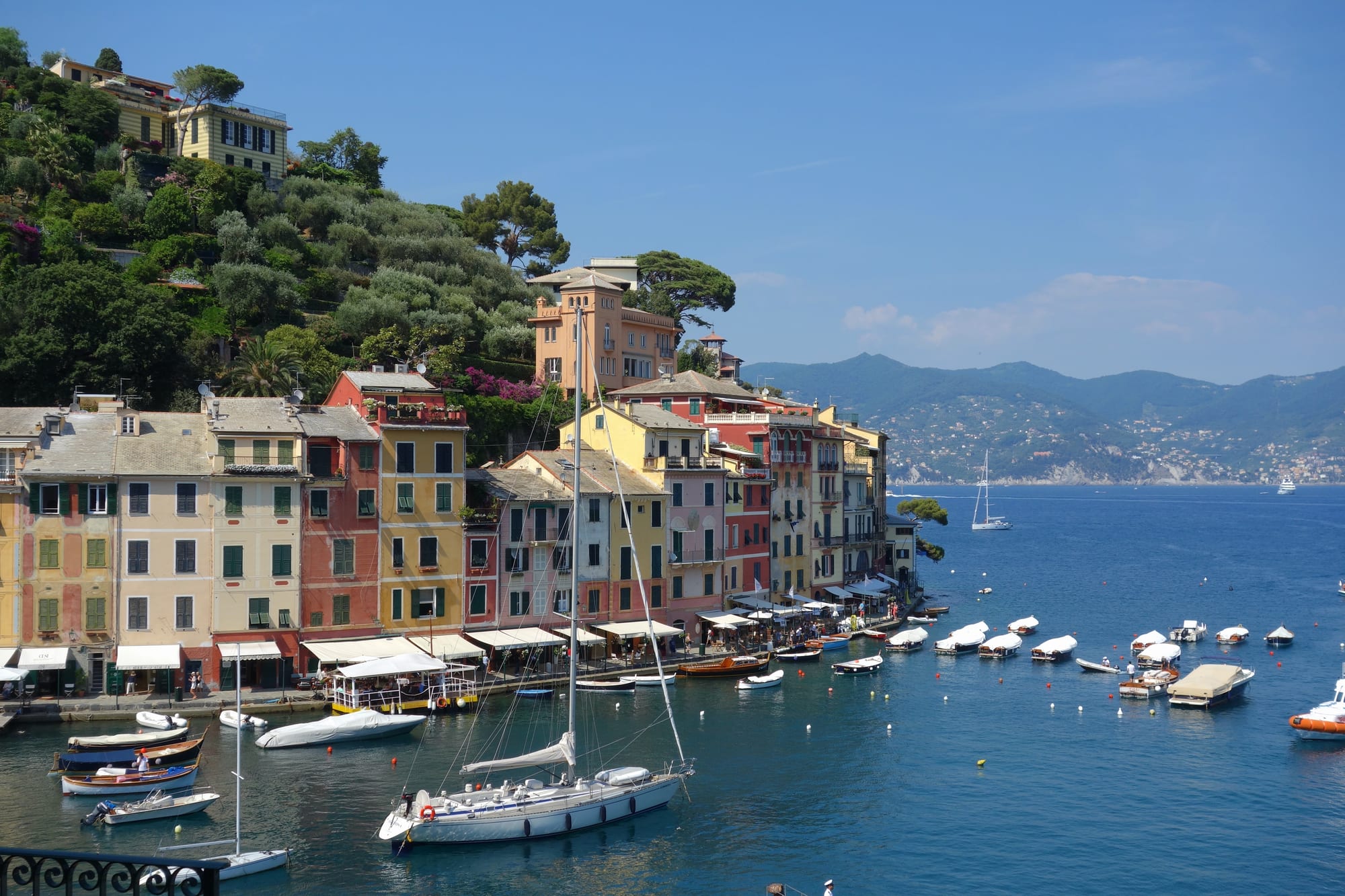
Pastel houses lining a small harbour full of moored boats, below wooded hills, with the coast of the gulf beyond

Liguria, Italy

Portofino

Portofino's harbour, looking north. (Luka Peternel / Wikimedia Commons · CC BY-SA 4.0)

A village of a few hundred people clustered around a small harbour on the wooded Portofino promontory, east of Genoa on the Riviera di Levante. A fishing port under the Republic of Genoa, it was discovered by British and other northern European aristocrats in the late 19th century and is now a resort for yachts and the jet set, inside a regional natural park.

Neighbourhoods

  • The harbour and the Piazzetta
    • First-time visitors
    • Best for food
    • Shopping

    The heart of the village: the little square known as the Piazzetta, officially Piazza Martiri dell'Olivetta, framed by tall arcaded houses painted in the Genoese style along the Calata Guglielmo Marconi, with boats moored along the Molo Umberto I. Restaurants, cafés and small boutiques fill the waterfront.

    Open in Maps
  • San Giorgio and the headland
    • Views
    • Walks

    Paths climb from the harbour to the church of San Giorgio, Castello Brown and on along the headland to the lighthouse, with views over the harbour and the Gulf of Tigullio.

    Open in Maps
  • Paraggi
    • Beaches
    • Families

    A bay on the road and footpath towards Santa Margherita Ligure, with the only sandy beach near Portofino, clear water, mostly paid beach clubs and a small free area.

    Open in Maps

Things to do

In the village

  • Castello Brownmuseum

    A Genoese coastal fort above the harbour, once the Castello di San Giorgio, remodelled into a villa by an English consul and owned by the village since 1961; it was the setting of Elizabeth von Arnim's novel The Enchanted April.

    Open in Maps
  • San Giorgiolandmark

    A church on a cliff overlooking the sea above the village, first built in 1154, enlarged in 1760 and rebuilt after its destruction in the Second World War, holding relics of saints.

    Open in Maps
  • Divo Martinolandmark

    The parish church just around the corner from the harbour, first built in 986 to replace an early chapel by the quay and much altered since.

    Open in Maps
  • Oratory of Santa Maria Assuntalandmark

    A small Gothic oratory in the village.

    Open in Maps
  • Portofino lighthouseviewpoint

    The lighthouse at the tip of the promontory, built in 1917 and owned by the Italian Navy, at the end of a walk from the village.

    Open in Maps

The promontory and the sea

  • San Fruttuoso Abbeylandmark

    A Romanesque abbey in a secluded bay between Camogli and Portofino, protected by a Doria watchtower of 1562 and reachable only by boat or on steep wooded trails.

    Open in Maps
  • Christ of the Abyssattraction

    Guido Galletti's bronze statue of Christ, placed 17 metres underwater off San Fruttuoso in 1954 in memory of the diver Dario Gonzatti.

    Open in Maps
  • Paraggi beachbeach

    The only sandy beach near Portofino, known for its clear blue water.

    Open in Maps

Short trips

  • Cervara Abbeylandmark

    A former abbey on the coast road to Portofino, a designated National Monument of Italy with an Italian garden facing the sea, now open for concerts and cultural performances.

    Open in Maps
  • Santa Margherita Ligureattraction

    The neighbouring resort town with a port used by fishing boats and pleasure craft, the nearest railway station and a public beach.

    Open in Maps
  • Camogliattraction

    A fishing village and resort on the western side of the Portofino promontory, on the Golfo Paradiso.

    Open in Maps

Eat and drink

Long-standing places and food districts in Portofino. Hours, ratings and directions come from your maps app, always current.

Portofino classics

  • Harbour restaurantsneighborhood

    Since the mid-20th century the waterfront has been a continuous ring of restaurants and cafés facing the boats; prices are high, and weekends are busy.

    Open in Maps
  • Village bakerycafe

    The bakery sells focaccia, small pizzas and cakes — the inexpensive way to eat lunch in the village.

    Open in Maps
  • Gelato on the harbourcafe

    Gelato stalls along the harbour, where hazelnut, nocciola, is a favourite flavour.

    Open in Maps

Experience Portofino

History

Pliny the Elder mentioned a Portus Delphini, the Port of the Dolphin, on this stretch of the Ligurian coast between Genoa and the Gulf of Tigullio. The village appears in a diploma of 986 by Adelaide of Italy, which assigned it to the nearby abbey of San Fruttuoso di Capodimonte; its inhabitants beat off an attack by the Pisan fleet recorded in 1072. In 1171 it came under the commune of Rapallo, together with Santa Margherita Ligure, and after 1229 it belonged to the Republic of Genoa.

The natural harbour sheltered a fleet of fishing boats but was too cramped to serve the Genoese merchant marine as more than a temporary haven. In 1409 Charles VI of France, then ruling Genoa, sold Portofino to Florence, which returned it after he was ousted; in the 15th century it was held as a fief by families such as the Fieschi, Spinola, Adorno and Doria. In 1815 it passed to the Kingdom of Sardinia and in 1861 to the Kingdom of Italy.

In the late 19th century British and then other northern European aristocrats began to arrive, by horse and cart from Santa Margherita Ligure. Elizabeth von Arnim's 1922 novel The Enchanted April, based on her stay at Castello Brown, is credited with making Portofino fashionable, and expatriates built holiday houses. By 1950 tourism had replaced fishing as the main industry. The church of San Giorgio, bombed in the Second World War, was rebuilt, and in 1954 the Christ of the Abyss was lowered into the sea off San Fruttuoso.

Culture & Customs

Portofino's image was made by writers, film-makers and celebrities. Guy de Maupassant, Guglielmo Marconi and the actors Rex Harrison and Lilli Palmer lived here; Richard I of England stopped in 1190. Between 1957 and 1962 several Italian films were shot in the village, and the 1991 film of The Enchanted April was filmed at Castello Brown. Dalida's 1959 song 'Love in Portofino' became a hit and came to be closely linked with the village's name, and Andrea Bocelli gave two concerts in the Piazzetta in 2012.

The village has been copied abroad: Portofino Bay at Universal Orlando and the Mediterranean Harbor at Tokyo DisneySea recreate it, and the Welsh architect Clough Williams-Ellis, while denying that Portmeirion was a copy, admitted he had fallen for Portofino. Ferrari named a car after it in 2017.

Behind the glamour, Portofino keeps the traditions of a Ligurian fishing village. Its churches — San Giorgio above the harbour, Divo Martino and the Gothic oratory of Santa Maria Assunta — remain centres of local life, and the whole municipality lies within the Portofino regional natural park and marine protected area. A trail running race through the park, starting from Santa Margherita Ligure, uses the promontory's paths.

Daily Life

Portofino has only about 360 residents. The houses cluster around the harbour and up the slopes behind it, and the whole territory falls within the regional natural park and the marine protected area.

Tourism is the economy. Since about 1950 it has replaced fishing as the main industry, and the harbour is a continuous ring of restaurants, cafés and boutiques selling fashion, craft items and Murano glass jewellery, most of them open from late February to late October. Yachts moor in the harbour and off the coves, cruise passengers and day-trippers arrive by ferry from Genoa and the towns of the Gulf of Tigullio, and weekends are especially busy.

The rhythm of the day follows the visitors: quiet mornings, busy middays around the Piazzetta, late lunches and dinners after eight. The sun disappears behind the promontory early in the evening and the harbour cools. Out of season, with the boutiques closed, the village returns to its small resident community, and the park's paths to San Fruttuoso and the lighthouse belong largely to walkers.

Food

Portofino eats as the rest of the Riviera di Levante does. Pesto, which belongs to this coast, is made by pounding fresh basil with pine nuts, grated Parmesan and pecorino, garlic and olive oil, and the harbour restaurants serve it with pasta and in lasagne. Focaccia is the everyday bread, and the village bakery sells it with small pizzas and cakes, the cheapest way to have lunch here.

Eating out in Portofino is famously expensive: the harbour restaurants have a view and prices to match, and weekend tables fill with yacht and cruise passengers. Many visitors settle instead for gelato from the stalls along the harbour, hazelnut being a favourite flavour, or buy regional foods and wines from the small shops around the port.

The wines served are Ligurian, mostly white, with some reds. After the meal, limoncino, a sweet, creamy lemon liqueur served chilled, is the local digestif, sold in shops around the harbour. The wider Gulf of Tigullio adds its own specialities, and the focaccia of nearby Recco, two paper-thin layers of dough with prescinsêua cheese between them, is a short trip away.

Planning tools

Budget

Portofino is one of the most expensive places on the Italian coast. Restaurant prices around the harbour are very high, parking is limited and costly, taxis are expensive, and the few rooms in the village are at luxury rates. Staying in Santa Margherita Ligure, Rapallo or Genoa and coming in by bus, ferry or on foot keeps costs down.

Daily Budget Midrange
USD 220–400 (hotel in Santa Margherita Ligure, a harbour lunch, ferries, a beach club at Paraggi)
Daily Budget Shoestring
USD 90–140 (room in Genoa or a nearby town, bakery focaccia, buses, trains and walking)

Bring a picnic or buy focaccia from the bakery, and walk the coastal path from Santa Margherita Ligure rather than driving.

Best Time to Visit

Late spring and early autumn are the most pleasant: warm, with fewer day-trippers than in July and August. Most boutiques open from the end of February to the end of October. In the evening the sun drops behind the promontory early and the harbour cools quickly.

Suggested Number of Days

The village itself is small and suits a day or an overnight stay. Allow three or four days to include the walks and coves of the promontory and the neighbouring towns of the Gulf of Tigullio, using boats and buses between them.

First Visit
1 day
With Surroundings
3–4 days

Transportation

Portofino is best explored on foot; hotels and beaches are a short walk from the harbour, though streets are cobbled and stepped. The road from Santa Margherita Ligure is narrow, winding and often only one lane wide, with heavy traffic in season. Small local buses run from the station at Santa Margherita Ligure, ferries link the harbour with the towns of the gulf, and boats can be hired in the harbour.

Use the ferry or bus rather than a car; parking in the village is very limited and expensive.

Airport & Station Connections

The nearest international airport is Genoa, and the drive from Genoa, about 36 km, takes a little over an hour. The nearest railway station, Santa Margherita Ligure-Portofino, is about 5 km away, with frequent buses to the village. In summer ferries run directly from Genoa, and the region's boat network connects through Santa Margherita Ligure. A shore road and a hiking trail through Paraggi link Portofino with Santa Margherita in just over an hour on foot.

Walkability

The village is tiny and entirely walkable, with the harbour, the Piazzetta and the churches a few minutes apart and the castle and lighthouse reached by footpaths. Streets are cobbled with many steps. The walk along the shore road to Santa Margherita has sections without pavements and heavy traffic.

Safety

Italy is generally safe, with low levels of violent crime against visitors. Portofino is a small, quiet village; the main hazards are the narrow, busy road from Santa Margherita, the steep footpaths of the promontory and summer heat on the trails.

Take care on the shore road where there is no pavement, wear proper shoes on the promontory trails and carry water. Check current official travel advice before travelling.

Climate

A Mediterranean climate moderated by the sea, mild in winter and warm in summer. The whole municipality lies within the Portofino regional natural park, where wooded hillsides fall straight to the water. Autumn can bring heavy rain to this coast.

Summer
warm — in nearby Genoa, July and August average about 28°C by day and 22°C at night
Winter
mild — in nearby Genoa, the coldest months average about 12°C by day and 6°C at night

Local Customs

Portofino runs on Italian time, especially in summer: lunch is usually between two and four in the afternoon and dinner rarely starts before eight. Yachts, boutiques and celebrity visitors are part of the scene, but the village is also a home to a few hundred residents and a working church community.

Carry something to cover the shoulders, both for the churches and for the cooler evenings once the sun has gone behind the promontory.

Common Payment Methods

The currency is the euro. Cards are widely accepted in hotels, boutiques and restaurants, but it is wise to carry cash for small purchases, bakeries and gelato stalls.