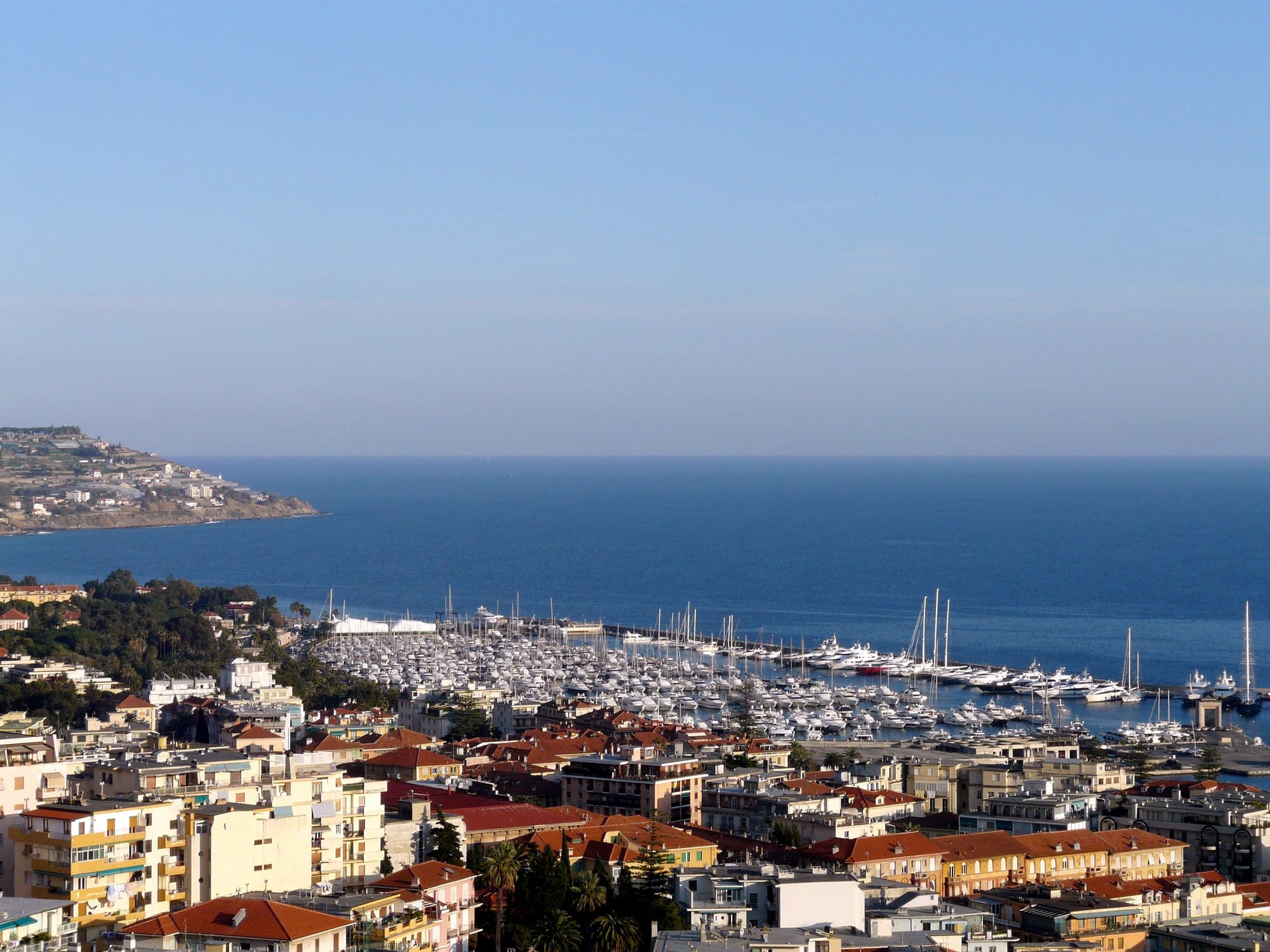
Rooftops of Sanremo above a harbour packed with yachts, with a headland and the calm blue sea behind

Liguria, Italy

Sanremo

Sanremo and its harbour seen from the sanctuary of the Madonna della Costa above the old town. (Davide Papalini / Wikimedia Commons · CC BY-SA 3.0)

A resort town of about 53,000 on the western Ligurian coast near the French border, the 'City of Flowers' of the Riviera dei Fiori. A Roman settlement that grew around the walled hill village of La Pigna, it became a winter retreat for European royalty in the 19th century and today is known for its casino, its flower growing and Italy's most popular song festival.

Neighbourhoods

  • La Pigna
    • Historic district
    • Walks and viewpoints

    The medieval core, built in tight rings around a hill behind walls raised against Saracen raids. Steep lanes climb towards the sanctuary of the Madonna della Costa, with views over the town and its two harbours.

    Open in Maps
  • The centre and the seafront
    • First-time visitors
    • Close to public transport
    • Shopping

    The flat town below La Pigna, with the cathedral of San Siro, the shopping streets, the Ariston theatre and the station beside the town hall. The palm-lined seafront Corso Imperatrice, the casino and the Russian Orthodox church are close by.

    Open in Maps
  • The harbours
    • Waterfront
    • Cycling

    The old commercial port, which locals call the Porto Vecchio, and the newer Portosole marina, home to some 900 boats, sit beside the fortress of Santa Tecla. The seaside cycle and walking path on the old railway line passes right by.

    Open in Maps
  • Bussana and the hill hamlets
    • Quiet and residential
    • Countryside

    Sanremo's territory reaches well inland and east. Bussana, the most populous hamlet, was rebuilt near the sea after the 1887 earthquake; above the town, Poggio and Coldirodi sit on the headlands, and San Romolo's chestnut woods are where Sanremesi go for summer outings.

    Open in Maps

Things to do

Landmarks of the resort

  • Sanremo Casinolandmark

    An Art Nouveau gaming house by the French architect Eugène Ferret, opened in 1905; it hosted the song festival from 1951 to 1976 and still stages concerts and theatre.

    Open in Maps
  • Russian Church of Christ the Saviourlandmark

    A late 19th-century Orthodox church built by the Russian nobility who wintered here and still used for worship, near the casino.

    Open in Maps
  • Teatro Aristonattraction

    The theatre and cinema, opened in 1963, that has been home to the Sanremo Music Festival since 1977 and also hosts the Premio Tenco for songwriters.

    Open in Maps
  • Villa Nobelmuseum

    The Moorish Revival villa where Alfred Nobel lived from 1891 until his death in 1896, now an exhibition on 19th-century discoveries.

    Open in Maps

Old town and viewpoints

  • La Pignaneighborhood

    The walled medieval village on its hill, the original core of the town, above the modern centre.

    Open in Maps
  • Sanctuary of the Madonna della Costaviewpoint

    The church that crowns La Pigna, with a panorama over the rooftops, the harbours and the coast.

    Open in Maps
  • Monte Bignoneviewpoint

    The 1,299-metre summit directly behind the town, inside the San Romolo natural park, whose woods are crossed by footpaths and mule tracks.

    Open in Maps

The coast

  • Corso Imperatricetrail

    The seafront promenade lined with palms given to the town by Empress Maria Alexandrovna of Russia after she spent the winter of 1874 here.

    Open in Maps
  • Riviera dei Fiori cycle pathtrail

    The former coastal railway line, converted into a walking and cycling route of about 32 km between Ospedaletti and Imperia, with bike hire along the way.

    Open in Maps

Short trips from the town

  • Bussana Vecchiaattraction

    A hilltop village abandoned after the 1887 earthquake and resettled by an international community of artists from the early 1960s, with craft shops among the ruins, about 5 km from the town centre.

    Open in Maps
  • Bordigheraattraction

    A neighbouring Riviera resort to the west, another 19th-century winter haven, also known for flower growing.

    Open in Maps
  • Dolceacquaattraction

    An inland village near the French border known for its medieval bridge, which Claude Monet painted.

    Open in Maps
  • Giardini Botanici Hanburypark

    Major botanical gardens on the coast west of Ventimiglia, run by the University of Genoa.

    Open in Maps

Seasonal events

  • Sanremo Music FestivalLate winter, usually February

    Italy's most popular song contest, held since 1951 and broadcast live by RAI from the Ariston, often the route to the country's Eurovision entry.

  • Milan–San RemoMarch, usually the third Saturday

    Traditionally the first of the season's five Monuments of cycling, about 298 km from Milan, finishing in Sanremo after the climbs of the Cipressa and the Poggio.

  • Flowers ParadeMarch

    Towns of the Riviera parade floats decorated with original flower compositions through the streets.

  • International fireworks contestAugust, around Ferragosto

    A summer fireworks competition over the sea in the second week of August.

  • Premio TencoAutumn

    A songwriting award dedicated to the memory of Luigi Tenco, held at the Ariston.

Eat and drink

Long-standing places and food districts in Sanremo. Hours, ratings and directions come from your maps app, always current.

Sanremo classics

  • Sardenairarestaurant

    Sanremo's cheese-free Ligurian pizza, topped here with salted anchovies, local olives, garlic cloves and capers, sold by bakeries and focaccerie.

    Open in Maps
  • Farinata and focacciarestaurant

    Chickpea-flour farinata and Ligurian focaccia, including the onion-topped version, are the everyday baked snacks of the town.

    Open in Maps

Food districts and cafés

  • La Pigna's lanesneighborhood

    Small trattorias tucked into the old town's alleys and stairways, above the busier centre.

    Open in Maps
  • Cafés and gelato in the centrecafe

    Cafés and ice-cream parlours selling their own gelato line the pedestrian shopping streets below La Pigna.

    Open in Maps

Experience Sanremo

History

Sanremo began as the Roman settlement of Matutia, or Villa Matutiana, and its people still sometimes call themselves matuziani. In the early Middle Ages, under the threat of Saracen raids, the population moved to higher ground, where the nobility built a castle and the walled village of La Pigna, named for the way its houses wind around the hill. The name Sanremo is not from a Saint Remus, as is often said, but a contraction of Sant'Eremo di San Romolo, the hermitage of Romulus of Genoa.

The town passed from the counts of Ventimiglia to the bishops of Genoa, who sold it to the Doria and De Mari families in 1297, and became a free town in the second half of the 15th century. It resisted Genoese control: in 1753, after years of conflict, it rose against the republic, which then built the fortress of Santa Tecla by the port, long used as a prison. After French rule it passed to the Kingdom of Sardinia at the Restoration.

Tourism, drawn by the mild climate, transformed it. Empress Maria Alexandrovna of Russia wintered here in 1874, Empress Elisabeth of Austria and Nicholas II also stayed, and Alfred Nobel made Sanremo his home and died here in 1896. In April 1920 the San Remo conference of the Allied powers allocated League of Nations mandates over former Ottoman lands in the Middle East, Palestine, Syria and Mesopotamia; the last Ottoman sultan, Mehmed VI, died in the town in 1926. In 1972 Sanremo saw the first public demonstration for gay rights in Italy.

Culture & Customs

Song is Sanremo's national fame. The Festival della Canzone Italiana has been held here since 1951, first in the casino and since 1977 at the Ariston; it inspired the Eurovision Song Contest, and Domenico Modugno's "Nel blu, dipinto di blu" — "Volare" — was first presented on its stage. In autumn the Premio Tenco honours songwriters, and the town has a state-recognised symphony orchestra that gives some 120 concerts a year, most in the casino's theatre.

Sport puts the town on screens too. Milan–San Remo, the longest professional one-day race in modern road cycling in Europe, finishes here each March after the climb of the Poggio, and the Rallye Sanremo was a round of the World Rally Championship from 1973 to 2003. The casino, open since 1905, is one of the few in Italy, and the town is widely accepted as the birthplace of telesina, a five-card stud poker game.

Literature and exile left their mark. Italo Calvino grew up here, and his novels, including Il Barone Rampante, carry the memory of the town; Edward Lear lived and died here, and Luigi Pirandello was briefly the casino's artistic director. Each 10 December flowers sent from Sanremo decorate the Nobel Prize ceremony in Stockholm. Locals distinguish sanremaschi, from old Sanremo families, from sanremesi, residents with roots elsewhere.

Daily Life

About 53,000 people live in the municipality, which stretches from the coast up to chestnut woods and pastures on the slopes of Monte Bignone. Some 7,800 residents are foreign nationals, the largest groups from Romania, Morocco and Bangladesh.

The economy rests on tourism and on flowers. The first band of hills behind the town is covered in greenhouses, and Sanremo, with neighbouring Taggia, Bordighera and Ospedaletti, grows cut flowers for the international market. Olive oil is the other crop: the hills grow the Taggiasca olive, and the area's extra virgin oil has protected designation of origin. The casino, the festival and the harbours, including the Portosole marina, bring employment of their own.

The rhythm is that of a resort: busy summer beaches, a winter season of mild days, and festival week in February, when the town fills with television crews. Daily life moved closer to the sea's edge after the railway was rerouted inland and its old seaside line became a cycle path, now used by residents for exercise and short trips along the coast.

Food

Sanremo eats the Ligurian way, with herbs, vegetables, olive oil and baked goods at the centre. Its own speciality is sardenaira, a cheese-free pizza older than the Neapolitan kind and close to the Provençal pissaladière; in Sanremo it is topped with salted anchovies, local olives, garlic cloves and capers. Its name is linked to the admiral Andrea Doria, whose favourite food is said to have been bread with oil, garlic and salted anchovy.

Bakeries and focaccerie sell focaccia, plain or with onions, and farinata, a thin, unleavened pancake of chickpea flour baked in wide pans and also eaten across the border in Nice as socca. Torta verde, a savoury pie of greens, belongs to the same tradition of vegetable tarts that runs along the Ligurian coast.

Taggiasca olives are grown in the hills around the town and served whole or pressed into the local oil. Pesto, the basil sauce that is uniquely Ligurian, is a staple here too, and the wines of the western Riviera, including Vermentino, Pigato and the red Rossese di Dolceacqua from the valley just inland, are poured in the town's restaurants.

Planning tools

Budget

Sanremo is a seaside resort and prices follow the season: rooms cost most in summer and above all during festival week in February, when the town fills with media and visitors. Outside those times it is better value than the eastern Riviera, and bakeries make cheap meals easy.

Daily Budget Midrange
USD 160–300 (sea-view hotel or apartment, fish dinners, bike hire, short train trips)
Daily Budget Shoestring
USD 80–130 (guesthouse or simple hotel, focaccia and farinata, regional trains)

Avoid festival week unless the festival is the reason for the visit, and use the coastal cycle path and trains rather than a car.

Best Time to Visit

The town has one of the mildest winters in northern Italy, so it suits almost any season. Spring and early autumn are warm and calmer than July and August, when the beaches are busy; February brings the song festival, March the flower parade and the finish of Milan–San Remo.

Suggested Number of Days

A day or two covers the town itself. Three or four allow time for the hill villages, the neighbouring resorts and the gardens near the border; travelling by train or bike rather than car adds a little time.

First Visit
1–2 days
With Surroundings
3–4 days

Transportation

The centre is small and walkable. The seaside cycle and pedestrian path on the old railway line runs about 32 km from Ospedaletti to Imperia, with bike hire along it. Local buses serve the hamlets; the trolleybus line along the Via Aurelia to Ventimiglia closed in early 2024. The coast road is often congested, and the A10 motorway above the town is a toll road.

Rent a bike for the coastal path, and leave a car outside the centre.

Airport & Station Connections

The nearest airport is Nice Côte d'Azur in France, about 45 minutes away by car. Sanremo's station, moved inland and underground beside the town hall, has regional trains to Ventimiglia and the French border and to Genoa, and connections to Turin, Milan and Rome; the bus terminal is also in the centre.

Walkability

Very walkable. The centre, the seafront and the harbours are flat and close together, and the casino, the Russian church and the Ariston are a few minutes apart. La Pigna is steep, and the climb to the Madonna della Costa is a stiff one.

Safety

Italy is generally safe, with low levels of violent crime against visitors. Sanremo is a quiet resort; the main concerns are petty theft in crowds, especially during festival week, and the short, violent autumn rainstorms that can cause flash floods along the Ligurian coast.

Keep bags closed in crowds and on trains, watch for cyclists on the coastal path, and follow autumn weather alerts. Check current official travel advice before travelling.

Climate

A hot-summer Mediterranean climate, sheltered by the mountains directly behind the town, which give it the mildest climate recorded in Liguria and much of northern and central Italy. Frost and snow are rare.

Summer
warm and breezy — July and August average about 24°C, with highs around 28°C and lows near 20°C
Winter
mild — daily averages around 10–11°C, with January and February lows near 7°C and highs close to 13°C

Local Customs

Tipping is not customary in Italy: restaurants usually add a small coperto, a cover charge, and leaving a euro or two for good service is plenty. Coffee is drunk standing at the bar, cappuccino is a morning drink, and the evening passeggiata along the seafront is part of the day. The local dialect has its own name for the town, Sanrèm.

Dress respectfully and keep quiet in churches, including the Orthodox church near the casino, and ask before photographing people in La Pigna's residential lanes.

Common Payment Methods

The currency is the euro. Cards are accepted almost everywhere, but a little cash is useful for bakeries, small bars and market stalls, and for tips, which cannot be added to a card payment. A per-night tourist tax may be collected by accommodation.