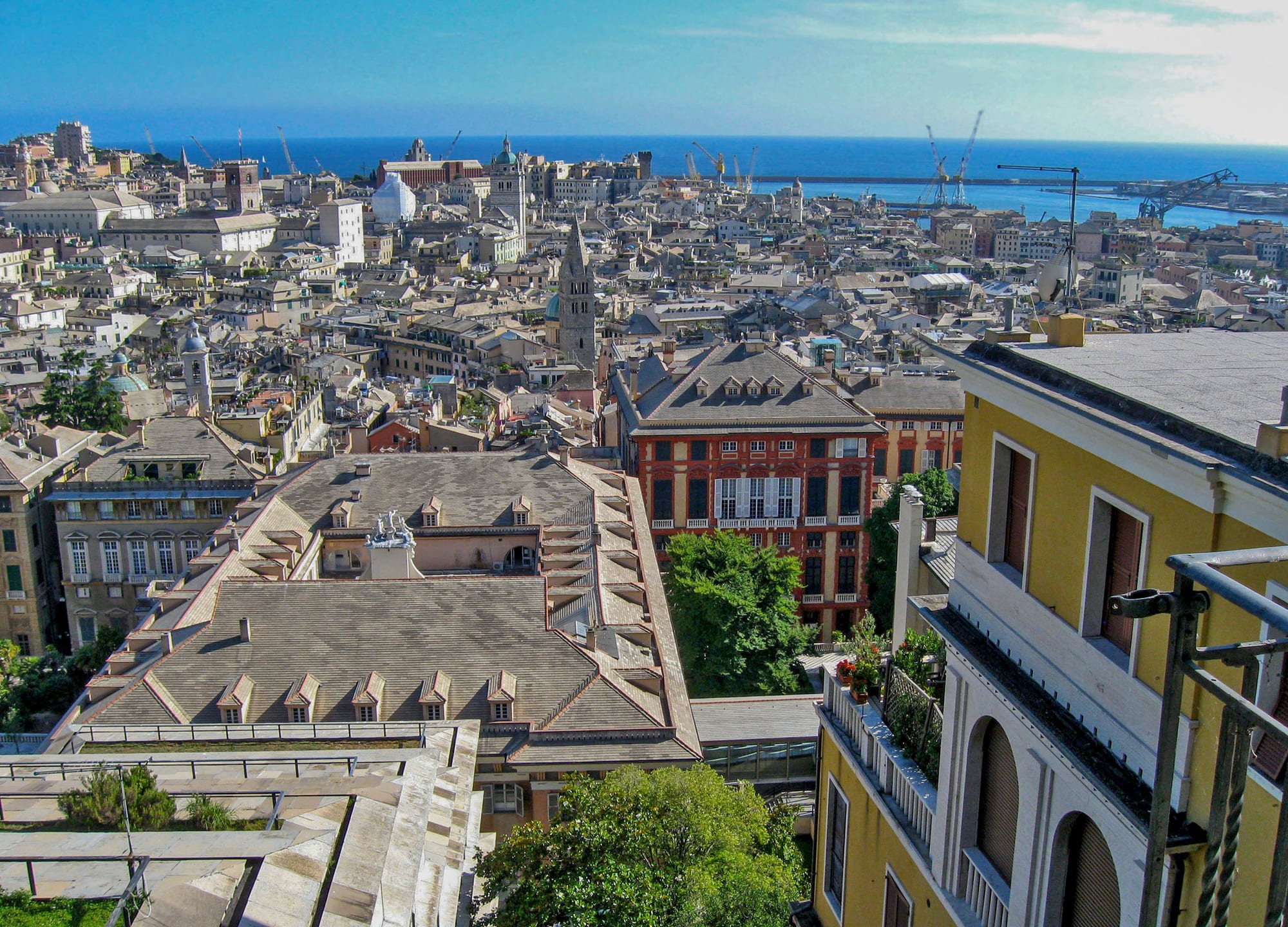
Slate roofs, bell towers and pastel palaces of central Genoa stretching down to a blue sea, with port cranes on the right

Liguria, Italy

Genoa

Central Genoa and the port seen from the Belvedere Castelletto. (EvelinaRibarova / Wikimedia Commons · CC BY-SA 4.0)

The capital of Liguria, squeezed between the Ligurian Sea and the Apennines, and Italy's busiest port. For seven centuries it ruled a maritime republic whose bankers financed Spain, leaving one of Europe's largest medieval old towns and streets of Renaissance palaces. Today it is a working port city of about 566,000 people, with a remodelled old harbour and a long seafront.

Neighbourhoods

  • The historic centre
    • First-time visitors
    • Historic district
    • Best for food

    One of the largest and most densely populated medieval centres in Europe, a 113-hectare maze of caruggi — narrow alleys — that open suddenly onto small squares. Historic shops, palaces and churches stand side by side, and street names such as Via degli Orefici recall the old craft guilds.

    Open in Maps
  • Via Garibaldi and the Strade Nuove
    • Architecture
    • Museums

    The mid-16th-century street laid out for the palaces of Genoa's leading families, part of the UNESCO-listed Palazzi dei Rolli with Via Cairoli and Via Balbi. Palazzo Rosso, Palazzo Bianco and Palazzo Doria-Tursi form the Strada Nuova museums.

    Open in Maps
  • Porto Antico
    • Families
    • Waterfront

    The old harbour, redeveloped in 1992 to designs by Renzo Piano into a waterfront promenade of interconnected quays, with the aquarium, the maritime museum, the Bigo lift and the glass Biosphere.

    Open in Maps
  • Castelletto
    • Views
    • Quiet and residential

    A hillside residential quarter above the centre, outside the city until the 17th-century New Walls were built, named after a fort that was dismantled in the late 19th century to make way for housing and the panoramic Spianata di Castelletto.

    Open in Maps
  • Carignano
    • Quiet and residential
    • Views

    A residential district on a hill at the eastern edge of the historic centre, once a secluded place of convents and patrician villas, crowned by the Renaissance basilica of Santa Maria Assunta.

    Open in Maps
  • Albaro and Boccadasse
    • Seafront
    • Quiet and residential

    An affluent neighbourhood about 3 km east of the centre, where the Genoese upper class once spent their summers in villas and Byron and Dickens stayed. The Corso Italia promenade runs along its shore to the old fishing village of Boccadasse.

    Open in Maps
  • Nervi
    • Seafront
    • Parks

    A former fishing village and resort about 7 km east of the centre, now part of the city, with a 2-km seafront promenade and the Parchi di Nervi, a park made from the gardens of historic villas, some of which now house art museums.

    Open in Maps

Things to do

Famous landmarks

  • Genoa Cathedrallandmark

    San Lorenzo, consecrated in 1118, with a Gothic façade, a 15th-century chapel holding relics of St John the Baptist, a dome by Galeazzo Alessi and the British naval shell that struck it in 1941 without exploding.

    Open in Maps
  • Doge's Palacelandmark

    The seat of the Republic's government, begun after the victory over Pisa in 1284 and rebuilt after a fire in 1777, restored in 1992 and now a museum and a centre for exhibitions and cultural events.

    Open in Maps
  • Piazza De Ferrarilandmark

    The city's main square, with its monumental fountain, the Teatro Carlo Felice and the Doge's Palace close by.

    Open in Maps
  • Porta Sopranalandmark

    One of the two surviving gates of the 12th-century Barbarossa Walls, whose inscription warns those who come seeking war that they will retreat sad and defeated.

    Open in Maps
  • Lighthouse of Genoalandmark

    La Lanterna, the port's main light and the symbol of the city, rebuilt in its present shape in 1543 and the tallest lighthouse in Italy and the Mediterranean.

    Open in Maps
  • Palazzo San Giorgiolandmark

    The medieval palace on the old harbour that was the headquarters of the Bank of Saint George, in whose prisons Marco Polo and Rustichello da Pisa composed The Travels of Marco Polo.

    Open in Maps
  • Santa Maria Assuntalandmark

    The Renaissance basilica on top of the Carignano hill.

    Open in Maps

Palaces and museums

  • Palazzo Rossomuseum

    One of the three Strada Nuova museums on Via Garibaldi, a house museum keeping the furnishings and art collections of the Brignole-Sale family, left to the city by the Duchess of Galliera in 1874.

    Open in Maps
  • Palazzo Biancomuseum

    A palace on Via Garibaldi housing one of the larger city art galleries, part of the Strada Nuova museums.

    Open in Maps
  • Palazzo Doria-Tursimuseum

    The city hall on Via Garibaldi, where Paganini's violin, Il Cannone, is kept.

    Open in Maps
  • Palazzo Realemuseum

    The Royal Palace, also known as Palazzo Stefano Balbi, one of the major palaces of the city, on Via Balbi.

    Open in Maps
  • Villa del Principemuseum

    Andrea Doria's palace, with interiors painted by Perino del Vaga, which began the Genoese Renaissance.

    Open in Maps
  • Galata – Museo del maremuseum

    The largest maritime museum in the Mediterranean, in the old Darsena district of the Porto Antico where the Republic's galleys were built.

    Open in Maps
  • Edoardo Chiossone Museum of Oriental Artmuseum

    More than 15,000 pieces collected by Edoardo Chiossone during 23 years in Japan, in a building by Mario Labò inside the Villetta Di Negro park overlooking Via Garibaldi.

    Open in Maps
  • D'Albertis Castlemuseum

    The Gothic Revival home of the sea captain Enrico Alberto d'Albertis, now the Museum of World Cultures, reached by a combined funicular and lift.

    Open in Maps

The harbour and the seafront

  • Aquarium of Genoaattraction

    The largest aquarium in Italy and one of the most significant in Europe, built for Expo '92 on the old harbour and visited by more than a million people a year.

    Open in Maps
  • Bigoviewpoint

    Renzo Piano's panoramic lift on the Porto Antico, its design inspired by shipyard cranes.

    Open in Maps
  • Corso Italiatrail

    A seafront promenade of about 2.5 km through Albaro, built after the First World War, linking Foce with Boccadasse.

    Open in Maps
  • Boccadasseneighborhood

    An old mariners' village at the end of Corso Italia, with pastel-coloured houses around a small cobblestone beach.

    Open in Maps
  • Passeggiata Anita Garibalditrail

    A 2-km promenade above the sea at Nervi, beside the parks of its historic villas.

    Open in Maps

Views, walks and the hills

  • Spianata di Castellettoviewpoint

    The panoramic terrace over the old town and the port, reached from the centre by a public lift.

    Open in Maps
  • Zecca–Righi funiculartransit hub

    A funicular climbing from Largo della Zecca, on the edge of the historic centre, to stations on the slope of the Righi hill.

    Open in Maps
  • Monumental Cemetery of Staglienolandmark

    A hillside cemetery of more than a square kilometre, famous for its sculpture and the tombs of Giuseppe Mazzini and Fabrizio De André.

    Open in Maps
  • Villa Durazzo-Pallavicinipark

    A historic villa at Pegli, in the west of the city, with a romantic garden and a botanical garden.

    Open in Maps

Short trips from the city

  • Genoa–Casella railwaytransit hub

    A narrow-gauge line running from the city to Casella, a village in the mountains inland.

    Open in Maps
  • Camogliattraction

    A fishing town on the Riviera di Levante on the west side of the Portofino peninsula, reached by boat services from the Porto Antico.

    Open in Maps

Seasonal events

  • Feast of St John the Baptist24 June

    The feast of the city's patron saint, whose relics are kept in the cathedral.

  • Eurofloralate April to early May, every four or five years

    A large international exhibition of flowers and ornamental plants, first held in 1966 and staged at intervals of several years, at the Fiera di Genova or the Parchi di Nervi.

Eat and drink

Long-standing places and food districts in Genoa. Hours, ratings and directions come from your maps app, always current.

Genoa classics

  • Antica Friggitoria Caregarestaurant

    A frying shop on Via di Sottoripa, by the old harbour.

    Open in Maps
  • Sà Pestarestaurant

    A trattoria in the old town known for savoury torte and farinata, the thin chickpea-flour pie.

    Open in Maps
  • Pietro Romanengocafe

    The Confetteria Romanengo, a confectioner founded in 1780.

    Open in Maps

Food districts and markets

  • Mercato Orientalemarket

    Genoa's main market, opened in 1899 in a former convent cloister on Via XX Settembre, with a food hall on its upper floor; 'orientale' refers to its position in the east of the city.

    Open in Maps
  • Caruggi of the old townneighborhood

    The alleys of the historic centre are lined with bakeries selling focaccia, trattorias serving pasta with pesto, and historic shops.

    Open in Maps
  • Via XX Settembreneighborhood

    Genoa's main shopping street, with Art Nouveau buildings, cafés and high-street fashion shops.

    Open in Maps

Experience Genoa

History

The site has been inhabited since the fifth or fourth millennium BC. In the fifth century BC the Ligures founded an oppidum on the hill now called Castello, and the town became known as the emporium of the Ligurians. Allied with Rome, it was destroyed by the Carthaginians in 209 BC and rebuilt. After Rome fell it was held by the Ostrogoths and then the Byzantines, the bishop of Milan took refuge here from the Lombards in 568, and in 934–35 a Fatimid fleet sacked and burned it. Genoa's rise began with the First Crusade, when its galleys and crossbowmen fought at Antioch and Jerusalem and won trading rights across the eastern Mediterranean.

As a maritime republic Genoa competed with Venice and Pisa, held Chios, Lesbos and the Crimean colony of Caffa, and annexed Corsica in 1347. In 1407 it founded the Bank of Saint George, and Christopher Columbus was born here around 1451. Families such as the Doria, Grimaldi, Balbi, Pallavicini and Serra grew rich financing the Spanish crown — the historian Fernand Braudel called 1557 to 1627 the 'age of the Genoese' — and built the palaces of the Strade Nuove. Decline followed: plague killed as many as half the inhabitants in 1656–57, France bombarded the city in 1684, and Corsica was ceded to France in 1768.

Napoleon ended the republic in 1797, and in 1800 a siege killed 30,000 of its 160,000 people. In the 19th century Genoa became a great port and a steel and shipbuilding centre. Recent decades brought the 1970 flood, Expo '92 and the rebuilding of the old harbour, the 2001 G8 summit, and in 2018 the collapse of the Morandi bridge, which killed 43 people; the replacement Genoa-Saint George Bridge opened in 2020.

Culture & Customs

Genoa was the European Capital of Culture in 2004 and the European Capital of Sport in 2024, and its culture is tied to the sea and to song. Niccolò Paganini was born here, and his violin, Il Cannone, is kept in Palazzo Tursi; the Teatro Carlo Felice, built in 1828 on Piazza De Ferrari, is the opera house. Italy's national anthem, written by Goffredo Mameli and set to music by the Genoese composer Michele Novaro in 1847, is believed to have had its first public performance in Genoa. The trallalero, polyphonic singing of Genoese dock workers, and the nostalgic songs in dialect fed the Scuola Genovese of singer-songwriters — Gino Paoli, Luigi Tenco, Bruno Lauzi, Fabrizio De André, Ivano Fossati — and De André's album Crêuza de mä of 1984 is sung entirely in Genoese.

Genoese, zeneize, is the main dialect of the Ligurian language and is still commonly spoken alongside Italian. Many street names recall the guilds of the old town, where botteghe storiche, historic shops, still trade beside palaces and churches. The city's patron is St John the Baptist, celebrated on 24 June, and its churches range across Romanesque, Gothic, Renaissance and Baroque styles.

Football is a passion and a division. Genoa C.F.C., whose football section was founded in 1893 by an English doctor, is the oldest club still playing in Italy; Sampdoria was formed in 1946 and won the league in 1991. Both play at the Luigi Ferraris stadium, and their derby, the Derby della Lanterna, is named after the lighthouse. The Genoa sail takes its name from the city, which also hosts one of the world's leading boat shows.

Daily Life

About 566,000 people live within the city limits, according to the 2026 figure, and more than 1.5 million in the wider metropolitan area along the Riviera. The population is old — seniors make up almost 29 per cent — and has been declining for a long time, though more slowly in the last decade. Immigrants make up about 15 per cent of residents, the largest groups born in Ecuador, Albania, Morocco, Romania and Bangladesh.

The port is the busiest in Italy, handling containers, ferries to the islands and cruise ships, and Genoa forms the southern corner of the industrial triangle with Milan and Turin. Steel faded after the late 1980s, but shipbuilding continues at Sestri Ponente, and Fincantieri, Leonardo, Ansaldo Energia, Costa Cruises and the Mediterranean Shipping Company are based in the city, along with the University of Genoa and the Istituto Italiano di Tecnologia.

The city is long and steep: it covers about 30 km of coast and climbs the Polcevera and Bisagno valleys, so daily life involves stairs, lifts and long commutes — the average public-transport journey to and from work takes 54 minutes. Flood defences on the Bisagno and Ferreggiano streams have been rebuilt since the floods of 2010, 2011 and 2014, and the Waterfront di Levante project designed by Renzo Piano is transforming the old trade-fair grounds.

Food

Genoa is the home of pesto: fresh Genoese basil, pine nuts, grated Parmesan and pecorino, garlic and olive oil pounded together and served with trofie, trenette or gnocchi, probably the city's most famous dish. Other sauces include agliata, a garlic sauce, salsa di noci, a walnut sauce, and tócco, a meat sauce — not to be confused with the Neapolitan Genovese. Prescinsêua, a fresh curd cheese, goes into a savoury spinach pie and into focaccia col formaggio.

The original focaccia is topped simply with olive oil, salt and a little white wine, and there are versions with onions. Farinata is a thin, crisp pie of chickpea flour, water, salt and olive oil. The sea supplies anchovies, stuffed or salted, sardines, octopus, squid and mussels, as well as stockfish for brandacujun and fish stews such as ciuppin, the forerunner of San Francisco's cioppino, and buridda. Cima alla genovese and cappon magro are the elaborate set pieces of the Genoese table, and pandolce began in 16th-century Genoa as a Christmas cake.

The city's 19th-century iron market halls include the Mercato del Ferro, Dinegro, Via Prè and Piazza Sarzano, while the circular Mercato Orientale on Via XX Settembre is the city's main market. The wines served are Ligurian: Pigato, Vermentino, Sciacchetrà, Rossese di Dolceacqua and Ciliegiolo del Tigullio.

Planning tools

Budget

Genoa is good value for a big Italian city, and cheaper than the Riviera resorts around it. Focaccia and farinata make cheap meals, and many of the best sights — the caruggi, the seafront promenades and the views from the hills — cost nothing.

Daily Budget Midrange
USD 170–320 (mid-range hotel, trattoria dinners, palace and aquarium tickets, ferries along the coast)
Daily Budget Shoestring
USD 80–130 (hostel or guesthouse, focaccia, farinata and market food, buses, metro and lifts)

Lifts and funiculars are part of the city transport network and the easiest way up the hills.

Best Time to Visit

April to June and September are the most comfortable months, warm but not hot. July and August are warm and humid. From September to November sudden violent thunderstorms have caused floods in parts of the city. Winters are mild by the sea, though cold northern winds blow from the Po Valley.

Suggested Number of Days

Two or three days cover the old town, the palaces, the harbour and a seafront district. With four to six days Genoa becomes a base for the Riviera by train or ferry. The hills and stairs make sightseeing slower than distances on a map suggest.

First Visit
2–3 days
With Surroundings
4–6 days

Transportation

The city stretches for about 30 km along the coast, from Voltri to Nervi, and climbs steep valleys. AMT runs buses, trolleybuses and a single light-metro line from Brin through Principe to the centre; 23 local railway stations serve the coast and the Polcevera valley. The hills are served by two funiculars, a rack railway from Principe to Granarolo, an inclined lift and ten public lifts.

Use local trains to reach Nervi, Pegli and the seafront districts quickly; driving and parking in the centre are difficult.

Airport & Station Connections

Genoa's Cristoforo Colombo Airport is built on an artificial peninsula about 7 km west of the centre, linked by the Volabus to Principe and Brignole stations. Principe, near the port and the old town, and Brignole, near the business district, are the main stations, with trains to Turin, Milan and Rome, and to France with a change at Ventimiglia. Ferries sail from the port to Sicily, Sardinia, Corsica and Barcelona, and cruise ships call at the old harbour's terminals.

Walkability

The historic centre is best explored on foot, though the caruggi are narrow, steep in places and easy to get lost in. Most central sights are within walking distance of Piazza De Ferrari. The hills behind are climbed by stairways and the old crêuze paths, or by the lifts and funiculars.

Safety

Italy is generally safe, with low levels of violent crime against visitors. In Genoa the main risk is pickpocketing in crowded places and in the old port area and the darker caruggi at night. The city has a history of serious floods in autumn storms, when weather alerts are issued.

Keep bags closed in crowds and on buses, stick to busier lanes in the old town late at night, and take autumn weather alerts seriously. Check current official travel advice before travelling.

Climate

A hot-summer Mediterranean climate bordering on humid subtropical, with plentiful rain because the city sits on a common storm track. The sea moderates temperatures, the daily range is small, and every neighbourhood has its own microclimate between the sea and mountains over 1,000 metres high. Snow falls most years but rarely settles in the centre.

Summer
warm and humid — July and August average about 28°C by day and 22°C at night, with about eight days a year above 30°C
Winter
mild — about 12°C by day and 6°C at night in the coldest months, with cool northerly winds

Local Customs

Genoese, zeneize, the main dialect of the Ligurian language, is still commonly spoken alongside Italian. The city's football is divided between Genoa, the oldest club in Italy, and Sampdoria, and the derby between them, the Derby della Lanterna, is deeply felt. Genoa also claims a share in the birth of the aperitivo.

Dress modestly in churches, with shoulders and knees covered; ask before photographing people in the residential lanes of the old town.

Common Payment Methods

The currency is the euro. Cards and contactless payment are widely accepted, while small bakeries, frying shops and market stalls may prefer cash for small sums. ATMs are easy to find in the centre.