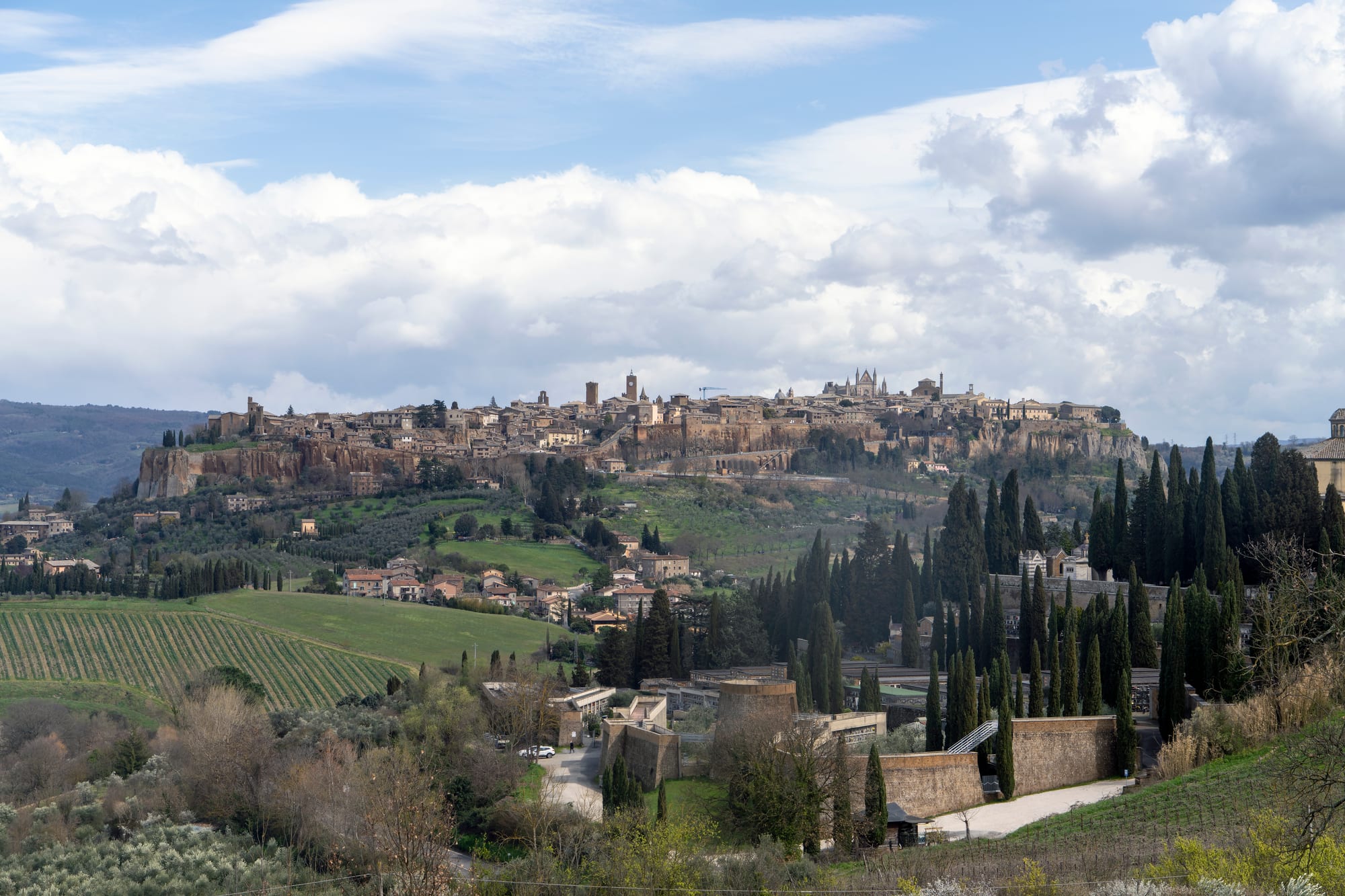
Orvieto's towers and rooftops along a tuff cliff above vineyards and cypresses, under a cloudy sky

Umbria, Italy

Orvieto

Orvieto on its tuff cliff, seen across the vineyards and cypresses of the valley below. (NikonZ7II / Wikimedia Commons · CC BY-SA 4.0)

A small Umbrian town on the flat summit of a volcanic tuff butte in the south-west of the region, ringed by sheer cliffs and walls of the same stone. Etruscan Velzna, then a medieval commune and papal refuge, it is crowned by a striped Gothic cathedral and riddled with wells, cellars and tunnels cut into the rock beneath.

Neighbourhoods

  • Piazza del Duomo and the papal palaces
    • First-time visitors
    • Historic district
    • Museums

    The eastern side of the rock, where the cathedral faces a square lined by the Palazzo Faina and the medieval papal palaces that now hold the town's main museums. Tours of the underground start here, and it is the busiest part of town by day.

    Open in Maps
  • Corso Cavour and Piazza del Popolo
    • Best for food
    • Shopping
    • Evening stroll

    The main street runs across the rock past the Torre del Moro, lined with shops, restaurants and wine bars. Off it lie Piazza del Popolo and its 13th-century palace, and Piazza della Repubblica with the church of Sant'Andrea.

    Open in Maps
  • The medieval quarter
    • Quiet and residential
    • Historic district
    • Walks

    The western end of the rock, a district of narrow lanes and stone houses around the old church of San Giovenale, quieter than the centre and close to the cliff-edge walks and the Pozzo della Cava.

    Open in Maps
  • Orvieto Scalo
    • Close to public transport
    • Practical base

    The modern lower town on the plain below, around the railway station and the bottom of the funicular, with free parking and everyday shops. It is a small working suburb rather than a place to linger.

    Open in Maps

Things to do

Famous landmarks

  • Orvieto Cathedrallandmark

    Begun in 1290 to house the relic of the Miracle of Bolsena, with a facade of rose window, gold mosaics and bronze doors, and Luca Signorelli's Last Judgement frescoes in the Chapel of San Brizio.

    Open in Maps
  • Palazzo del Capitano del Popololandmark

    A late 13th-century civic palace on Piazza del Popolo, once the seat of the Captain of the People, which now holds municipal offices and a hall used for cultural events and meetings.

    Open in Maps
  • Torre del Moroviewpoint

    The tower of the Palazzo dei Sette at the centre of the main street, called the Torre del Papa until the 16th century and then renamed, perhaps after a local nobleman nicknamed the Moor.

    Open in Maps
  • Sant'Andrealandmark

    A 12th-century church beside the town hall on Piazza della Repubblica, known for its ten-sided bell tower, on a site traditionally held to be the ancient forum.

    Open in Maps
  • San Giovenalelandmark

    A church first built in 1004 at the western tip of the rock, its walls covered with frescoes of the 12th and 13th centuries.

    Open in Maps

Wells and the underground

  • St Patrick's Wellattraction

    A deep well commissioned by Pope Clement VII after he took refuge in Orvieto during the Sack of Rome in 1527, designed by Antonio da Sangallo the Younger and finished in 1537.

    Open in Maps
  • Pozzo della Cavaattraction

    A well dug on Clement VII's orders by reusing an Etruscan shaft, with an Etruscan cistern, a medieval cellar and a 15th-century pottery kiln around it.

    Open in Maps
  • Orvieto Undergroundattraction

    Guided tours from Piazza del Duomo into the network of tunnels, wells and chambers cut into the tuff since Etruscan times and reused in the Middle Ages.

    Open in Maps

Museums

  • Museo Claudio Fainamuseum

    An Etruscan collection in the Palazzo Faina facing the cathedral, strong on Attic and Etruscan pottery, with the civic museum's finds from Etruscan Orvieto below.

    Open in Maps
  • National Archaeological Museum of Orvietomuseum

    Finds from the town and its necropolises in the papal Palazzo Martino IV behind the cathedral, including the wall paintings from the Golini tombs at Porano.

    Open in Maps
  • Museo Emilio Grecomuseum

    Sculpture by Emilio Greco, maker of the cathedral's bronze doors, in Palazzo Soliano, the papal palace on Piazza del Duomo.

    Open in Maps

Etruscan sites and walks

  • Crocifisso del Tufoattraction

    An Etruscan necropolis on the northern slope of the rock, laid out in blocks of cube-shaped family tombs with the families' names carved over the entrances.

    Open in Maps
  • Belvedere Templeattraction

    The best-preserved monument of Etruscan Orvieto, the base of a temple on a panoramic terrace at the northern edge of the town.

    Open in Maps
  • Orvieto Funiculartransit hub

    A funicular from the railway station through the ramparts to Piazza Cahen, 157 metres higher, first opened in 1888 and rebuilt in 1990.

    Open in Maps

Short trips from the town

  • Lake Bolsenapark

    A large lake of volcanic origin south-west of Orvieto, across the border in Lazio, with the town of Bolsena on its north-eastern shore.

    Open in Maps
  • Civita di Bagnoregioattraction

    A village on an eroding spur of tuff just east of Bagnoregio, reached only by a footbridge over the badlands.

    Open in Maps

Seasonal events

  • Festa della PalombellaPentecost, May or June

    A Pentecost tradition dating from the 16th century, in which a dove symbolising the Holy Spirit runs down a cable across Piazza del Duomo to set off fireworks on a wooden float.

  • Palio dell'Ocathe Sunday after Pentecost

    A contest of horseback skill between riders of the two old districts of Pistrella and Cava, on a dirt track laid in Piazza del Popolo.

  • Corpus Domini processionCorpus Christi, May or June

    The procession honouring the Miracle of Bolsena, accompanied by a historical parade of about 400 people in costume.

  • Umbria Jazz Winterlate December to early January

    The winter edition of Umbria's international jazz festival, held in Orvieto every year over the New Year.

Eat and drink

Long-standing places and food districts in Orvieto. Hours, ratings and directions come from your maps app, always current.

Orvieto classics

  • Wine bars around Piazza del Duomoneighborhood

    Enotecas across the centre pour Orvieto Classico, the white wine named after the town, alongside Umbrian cured meats and cheeses.

    Open in Maps

Food streets

  • Corso Cavourneighborhood

    The main street of the old town, lined with restaurants, pizzerias, gelaterias and cafés from the Torre del Moro down towards Piazza Cahen.

    Open in Maps
  • Piazza del Popoloneighborhood

    The square and the narrow lanes leading off it hold several trattorias serving Umbrian cooking.

    Open in Maps

Experience Orvieto

History

The rock was the site of Velzna, the Etruscan city the Romans called Volsinii — one of the twelve cities of the Etruscan confederation and among the most prosperous in Etruria, as its necropolises show. Its location was long disputed, but it is now identified with Orvieto's hill, while the Roman Volsinii that replaced it lay at modern Bolsena. Rome destroyed the city in 264 BC and moved the survivors to the lake shore, where the new Volsinii rose.

By the 7th century the town had its own bishops, and in the 13th and 14th centuries it reached its height as a free commune of about 30,000 people, with a ring of palaces and a long relationship with the popes. Martin IV lived here from 1281 to 1284, and the Miracle of Bolsena of 1263, in which a doubting priest is said to have seen the host bleed, led to the institution of the feast of Corpus Domini and in 1290 to the foundation of the cathedral. Factional wars between the Monaldeschi and their rivals divided the city, which submitted to the Papal States after Cardinal Albornoz occupied it in 1354.

Clement VII took refuge here during the Sack of Rome in 1527 and ordered wells cut through the rock to secure water in a siege, the origin of St Patrick's Well and the Pozzo della Cava. In 1860 volunteers forced the papal garrison to surrender, and Orvieto became part of the province of Umbria. The comune grew to just over 25,000 people in 1961 and has shrunk slowly since, while the funicular and the railway bring a steady flow of day visitors.

Culture & Customs

Orvieto's identity is bound to its cathedral and to the Eucharist. The Corpus Domini procession honours the Miracle of Bolsena, whose relic is kept in the cathedral, and is accompanied by a historical parade of about 400 people in costume. At Pentecost the Festa della Palombella, established in the 16th century, sends a dove symbolising the Holy Spirit along a cable across the cathedral square to set off fireworks; animal-rights groups long protested, and since 2005 the bird has travelled inside a transparent tube rather than tied to the emblem. The following Sunday the riders of the town's two old districts compete in the Palio dell'Oca in Piazza del Popolo.

The town's art is concentrated in and around the cathedral: the work of its architect Lorenzo Maitani, Luca Signorelli's Last Judgement in the Chapel of San Brizio, whose decoration Fra Angelico had begun and left unfinished, and the bronze doors finished in 1970 by the Sicilian sculptor Emilio Greco, whose work fills a museum beside it. Orvieto has a long ceramic tradition reaching back to the black Etruscan bucchero ware, fired without oxygen, and a 15th-century kiln survives near the Pozzo della Cava. Each winter the town hosts Umbria Jazz Winter over the New Year.

Daily Life

About 19,000 people lived in the comune of Orvieto in 2025, but fewer than 3,000 of them live on the rock itself. Most live in the newer settlements below: Ciconia, the largest, Orvieto Scalo around the station, and Sferracavallo. The old town has become a place of shops, restaurants, museums and holiday rooms, busy with day visitors from late morning and quiet again at night, while daily errands, schools and most housing are on the plain.

The economy rests on tourism, public services and the countryside. The white wine of the Orvieto district, grown north-east of the town, is highly prized, and red wines are made too. The population has fallen gently since its peak in the 1960s, a pattern shared by many small towns in Umbria, as young people leave for larger cities.

The day follows a familiar Italian rhythm: coffee standing at the bar, a long lunch, shops reopening in the late afternoon and an evening stroll along Corso Cavour, which fills with residents once the tour groups have gone.

Food

Orvieto is above all a wine town. Orvieto DOC wines are mainly white, made largely from Grechetto and Trebbiano grapes and sold as Orvieto and Orvieto Classico, the latter from the historic zone around the town; enotecas across the centre pour it, and a sweeter style, amabile, is also made.

The cooking is Umbrian, with many dishes boiled or roasted with local olive oil and herbs. The black truffle, tartufo nero, is a typical product of the region, and strangozzi are a long, square-sectioned pasta of flour and water. Torta al testo is an unleavened flat bread cooked on a round iron griddle, the testo, and porchetta, roast pork that in Umbria is stuffed with wild fennel, garlic and pepper, is sold from white vans, especially on holidays. Lentils are among the region's traditional products.

Restaurants and pizzerias line Corso Cavour and the lanes around Piazza del Popolo, wine bars cluster near the cathedral, and gelato is eaten on the cathedral square on summer evenings.

Planning tools

Budget

Orvieto is a day-trip favourite from Rome and Florence, so the centre is busiest around midday and quieter in the evenings, when rooms in the old town are reasonably priced for a small Italian art town. Wine by the glass is good value. The main costs are museum and underground-tour tickets, and a car if exploring the surrounding countryside.

Daily Budget Midrange
USD 140–250 (old-town hotel or agriturismo nearby, restaurant dinners with local wine, museum and underground tickets)
Daily Budget Shoestring
USD 70–110 (simple B&B or room in Orvieto Scalo, pizza and trattoria meals, funicular and buses)

Leave the car at the station car park and ride the funicular up; driving in the old town is neither convenient nor necessary.

Best Time to Visit

April to June and September to October are the most comfortable months. Late May or June brings the Pentecost and Corpus Domini festivities, and the turn of the year the winter jazz festival. Midsummer is hot on the exposed rock, and midday crowds from tour coaches are heaviest from spring to autumn.

Suggested Number of Days

Many visitors come for a day, but one or two nights allow the museums, the underground and the town after the day-trippers leave. Three or four days suit those adding the crater lake, the nearby villages and the wine country, which is easier with a car.

First Visit
1–2 days
With Surroundings
3–4 days

Transportation

The funicular climbs from the railway station to Piazza Cahen on the eastern edge of the rock, where town buses continue to Piazza del Duomo and Piazza della Repubblica. The old town itself is small and largely pedestrianised. Buses link Orvieto with Viterbo, Bolsena, Perugia and Todi, but a car is the practical way to reach the countryside.

Parking in the upper town is very limited; use the free car park at the station and the funicular.

Airport & Station Connections

Orvieto station, at Orvieto Scalo at the foot of the rock, is on the main railway with several daily trains to Rome, Chiusi and Florence. The nearest large airports are those of Rome. Buses also run from Rome in about two hours, arriving at Piazza Cahen.

Walkability

The old town is compact and best seen on foot: the main street crosses the rock in a few minutes, and the lanes of the medieval quarter are mostly closed to through traffic. Paving is old stone and there are some steps, and the walk around the walls along the cliff edge gives wide views. Reaching the town from the station on foot means a steep climb, which the funicular avoids.

Safety

Italy is generally safe, with low levels of violent crime against visitors. Orvieto is a quiet small town where crime rarely affects visitors. The practical hazards are worn, uneven stone paving, steep paths below the cliffs and summer heat on the open squares.

Wear sturdy shoes for the stone streets and the stairs of the wells, and carry water in summer. Check current official travel advice before travelling.

Climate

Inland and on a hilltop, Orvieto has hot summers and cool winters, with frost and fog in the valley below in winter. Spring and autumn are mild.

Summer
hot — in nearby Viterbo the warmest month, August, averages about 24°C
Winter
cool — in nearby Viterbo January averages about 6°C, with frost and valley fog

Local Customs

Life follows the Italian rhythm of a long lunch, shops that may close in the afternoon and an evening passeggiata along the main street. Coffee is drunk standing at the bar, and cappuccino is a morning drink. The cathedral and churches are working places of worship, and town life still turns on religious feasts such as Pentecost and Corpus Domini.

Cover shoulders and knees in the cathedral and churches, and keep voices low during services.

Common Payment Methods

The currency is the euro. Cards are accepted almost everywhere, including most restaurants and museums, but a little cash is useful for small bars and shops. There are cash machines in the old town and at the station.