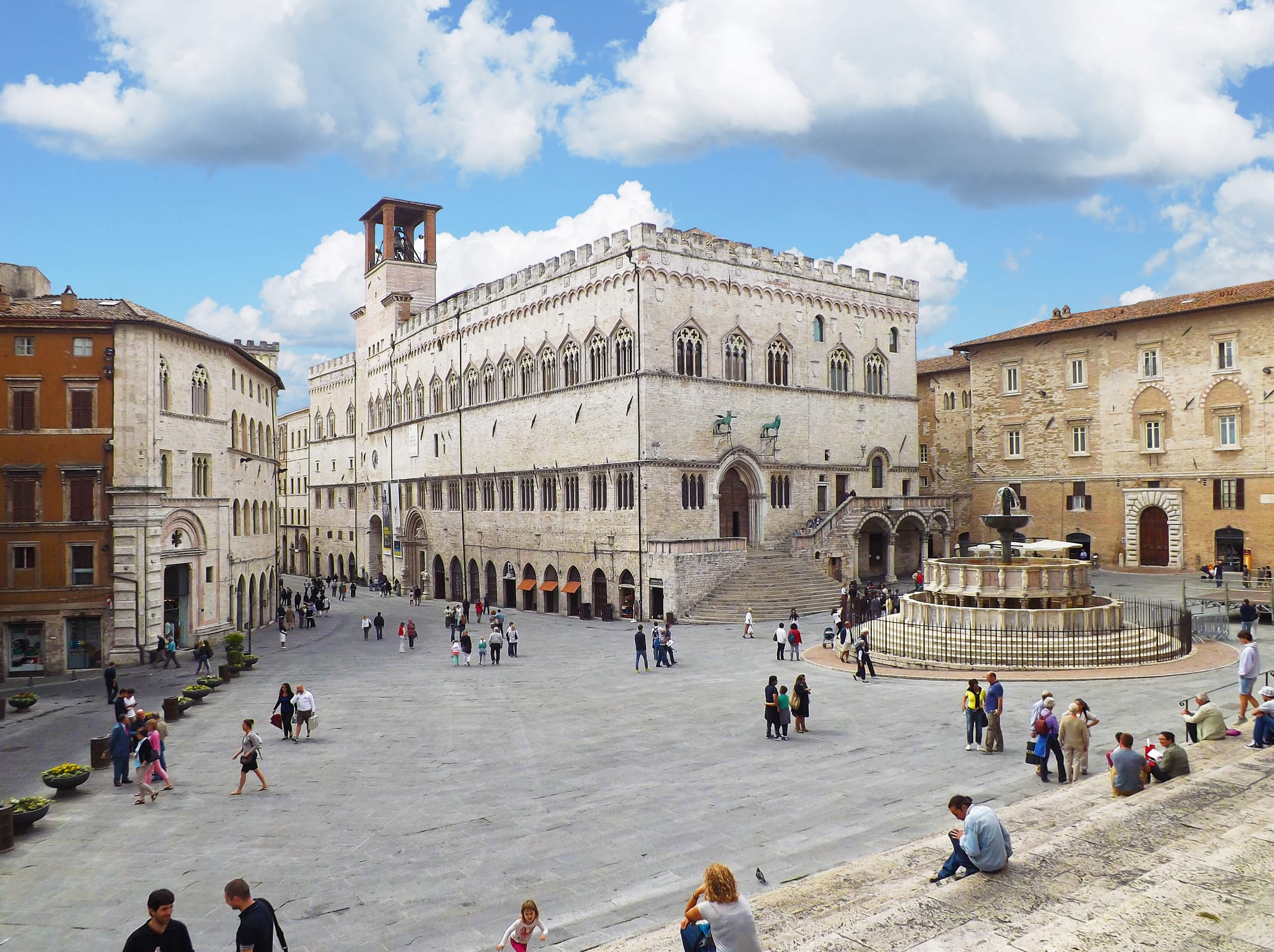
The crenellated Gothic Palazzo dei Priori and the round marble Fontana Maggiore on Perugia's sunny main square

Umbria, Italy

Perugia

Piazza IV Novembre in Perugia, with the Palazzo dei Priori and the Fontana Maggiore. (Claudioas / Wikimedia Commons · CC BY-SA 3.0)

The capital of Umbria, spread over a high hilltop and the valleys below near the Tiber. One of the main Etruscan cities, it became a fiercely independent medieval commune and then a papal stronghold. Today it is a university city of about 160,000 people, known for its medieval squares, Renaissance painting, chocolate and the Umbria Jazz festival.

Neighbourhoods

  • Corso Vannucci and Piazza IV Novembre
    • First-time visitors
    • Historic district
    • Nightlife

    The heart of the old city: the wide, traffic-free Corso Vannucci runs from the cathedral and the Fontana Maggiore past the Palazzo dei Priori to Piazza Italia, where benches look out over the hills. Students gather on the cathedral steps, and the evening stroll fills the street.

    Open in Maps
  • Porta Sole
    • Views
    • Quiet and residential

    The highest of the five historic quarters, rising to about 494 metres just behind the cathedral, with steep lanes, old palaces and some of the widest views over the city and the valley.

    Open in Maps
  • Porta Sant'Angelo
    • Students
    • Local life

    The northern quarter along Corso Garibaldi, ending at the round early Christian church of Sant'Angelo and the battlemented Cassero gate, the most imposing of the city's medieval gates.

    Open in Maps
  • Porta San Pietro
    • Churches
    • Quieter streets

    The south-eastern quarter along Corso Cavour, home to the Dominican basilica of San Domenico and the abbey of San Pietro, whose 70-metre bell tower is the tallest structure in the city.

    Open in Maps
  • Fontivegge
    • Close to public transport
    • Modern city

    The busy district around the main railway station, about three kilometres south-west of the centre, with Aldo Rossi's Centro Direzionale of the 1980s. The Minimetrò runs from here up to the old town.

    Open in Maps
  • Ponte San Giovanni
    • Quiet and residential
    • Etruscan sites

    One of the largest districts of the municipality, down on the plain by the Tiber, with about 11,500 residents and the Etruscan tombs of the Palazzone necropolis.

    Open in Maps

Things to do

Famous landmarks

  • Fontana Maggiorelandmark

    The medieval fountain at the centre of Piazza IV Novembre, built in 1275–77 to mark the arrival of water by a new aqueduct, with marble reliefs by Nicola and Giovanni Pisano; it is the symbol of the city.

    Open in Maps
  • Palazzo dei Priorilandmark

    One of the best examples in Italy of a public palace of the communal era, stretching from the main square along Corso Vannucci, with the bronze griffin and lion over its door; it still houses part of the municipal offices.

    Open in Maps
  • Perugia Cathedrallandmark

    San Lorenzo, begun in 1345 and completed in 1490, whose side wall on the main square keeps a trial section of white and pink marble cladding that was never finished, beside a pulpit where St Bernardino of Siena preached.

    Open in Maps
  • Rocca Paolinalandmark

    The remains of the papal fortress of 1540–43, built over a demolished medieval quarter; public escalators now pass through its vaults and the buried street of Via Bagliona.

    Open in Maps
  • Etruscan Archlandmark

    One of only two surviving gates of the Etruscan walls of Perusia, also called the Arch of Augustus after the Roman rebuilding.

    Open in Maps
  • San Pietrolandmark

    A basilica and abbey at the south end of the city, with a 70-metre bell tower that is one of the city's best-known symbols.

    Open in Maps
  • San Domenicolandmark

    The Dominican basilica, with the tomb of Pope Benedict XI and a 15th-century stained-glass window 23 metres tall in its apse.

    Open in Maps
  • San Michele Arcangelolandmark

    A round early Christian church of the 5th or 6th century, built with Corinthian columns taken from an earlier pagan temple.

    Open in Maps

Museums

  • Galleria Nazionale dell'Umbriamuseum

    The national collection of Umbrian painting on the upper floors of the Palazzo dei Priori, with works by Duccio, Piero della Francesca, Fra Angelico and Perugino.

    Open in Maps
  • Collegio del Cambiomuseum

    The hall of the money-changers' guild in the Palazzo dei Priori, built in 1452–57 and frescoed by Perugino.

    Open in Maps
  • Etruscan Wellattraction

    An ancient well beneath a mansion in the old town, still owned by the Sorbello family and open to the public as a museum.

    Open in Maps
  • Casa del Cioccolato Peruginamuseum

    The Perugina chocolate factory at San Sisto, maker of Baci, with a museum of the company's history and a chocolate school.

    Open in Maps

Sport and nights out

  • Stadio Renato Curiattraction

    The 28,000-seat home of AC Perugia, named after the player Renato Curi, who died of a heart attack during a match in 1977.

    Open in Maps

Short trips from the city

  • Hypogeum of the Volumniattraction

    An Etruscan family tomb of about the 3rd century BC at Ponte San Giovanni, part of the Palazzone necropolis, where other underground tombs can also be entered.

    Open in Maps
  • Assisiattraction

    The home town of St Francis, about 19 kilometres away on the slopes of Monte Subasio, with its frescoed basilica.

    Open in Maps
  • Lake Trasimenopark

    A large, shallow lake of 128 square kilometres on the border with Tuscany, with castles, lakeside towns and three islands.

    Open in Maps
  • Derutaattraction

    A hill town long known for its painted maiolica, still made and exported worldwide.

    Open in Maps
  • Torgianoattraction

    A small town about ten kilometres south-east of Perugia, listed among the most beautiful villages of Italy.

    Open in Maps

Seasonal events

  • Festa di San Costanzolate January

    The feast of one of the city's patron saints, when Perugians make the ring-shaped torcolo cake.

  • International Journalism FestivalApril

    A festival founded in 2006 that brings hundreds of journalists to panels and talks around the city, with free entry to its events.

  • Umbria JazzJuly

    One of the world's leading jazz festivals, held every year since 1973, with ten days of concerts in the city.

  • UmbriaWinesecond weekend of September

    A festival of Umbrian wine and food held in the historic centre since 2023, with tastings, talks and live music.

  • EuroChocolateOctober

    One of Europe's largest chocolate festivals, founded in Perugia in 1993 and held since 2021 at the Umbriafiere grounds in nearby Bastia Umbra.

Eat and drink

Long-standing places and food districts in Perugia. Hours, ratings and directions come from your maps app, always current.

Perugia classics

  • Torta al testoneighborhood

    The Perugia area's flatbread, cooked on a round cast-iron plate called a testo; restaurants and snack bars in the centre serve it with cured meats.

    Open in Maps
  • Baci and Perugina chocolatemarket

    Perugina has made chocolate in the city since 1907, and its Baci are the city's best-known product, sold in shops across the centre and at the factory.

    Open in Maps

Food districts and markets

  • Restaurants of the centro storiconeighborhood

    Trattorias and restaurants in the lanes off Corso Vannucci serve Umbrian cooking: strangozzi, black truffle in season, porchetta and roasted meats.

    Open in Maps
  • Mercato Copertomarket

    The city's covered market building on the edge of the old town, linked by lift to a car park below.

    Open in Maps

Cafés and bars

  • Bars around Corso Vannuccineighborhood

    Cafés and bars along the Corso and in the side streets, busy with students and locals from aperitivo time into the night.

    Open in Maps

Experience Perugia

History

Perugia began as an Umbrian settlement but enters written history as Perusia, one of the twelve cities of the Etruscan League; its massive Etruscan walls and the gate now called the Etruscan Arch still stand. Rome campaigned against the Etruscan League in 310 or 309 BC, and Perugia later helped Rome in the Second Punic War. In 41–40 BC Lucius Antonius took refuge here and Octavian besieged and burnt the city, which was rebuilt almost at once. In 547 Totila's Ostrogoths took it after a long siege, and its bishop Herculanus became the city's patron saint.

In the 9th century the city passed to the popes, but by the 11th its commune was asserting itself, and for centuries Perugia lived an independent life, generally loyal to the Guelph party yet never accepting papal sovereignty. It fought its neighbours, including Assisi at Collestrada in 1202, founded its university in 1308, and passed through the hands of lords such as Biordo Michelotti, Gian Galeazzo Visconti and Braccio da Montone. From 1438 the Baglioni family dominated the city, drawing Piero della Francesca, Pinturicchio and Raphael. In 1540, after a revolt, the city was taken by papal troops, lost its privileges, and Pope Paul III razed a whole quarter to build the Rocca Paolina.

French troops arrived in 1797, and in 1798 Perugia became capital of the short-lived Tiberina Republic. Earthquakes struck in 1832, 1838 and 1854. A rising against papal rule in June 1859 was bloodily crushed, but in September 1860 the city joined the Kingdom of Italy and the fortress was pulled down in 1861. Perugia suffered only some damage in the Second World War and was liberated by the British Eighth Army on 20 June 1944.

Culture & Customs

Perugia's art is its pride. Pietro Vannucci, called Perugino, came from nearby Città della Pieve but worked here, frescoing the Collegio del Cambio and leaving eight paintings now in the National Gallery of Umbria; Raphael, who may have been his pupil, painted the Oddi Altar here in 1502–04, and Pinturicchio lived in the city. Galeazzo Alessi is its most famous architect. The griffin, the city's emblem, appears on plaques and statues everywhere and on the university's seal.

The city's calendar is crowded. Umbria Jazz, held since 1973, is one of the world's major jazz festivals and fills the centre each July; the International Journalism Festival, founded in 2006, brings journalists from around the world every April; the Sagra Musicale Umbra presents classical and chamber music; and UmbriaWine has celebrated the region's wines since 2023. EuroChocolate, born here in 1993, moved to Bastia Umbra in 2021.

Sport has a loyal following. AC Perugia, who play at the Stadio Renato Curi and now compete in Serie C, went unbeaten through the 1978–79 Serie A season yet finished second. The volleyball club Sir Safety Perugia plays at the top level and won its first Italian championship in 2018.

Daily Life

About 162,000 people lived in Perugia in 2026, making it Italy's 23rd-largest city and the most populous Italian city set above 250 metres. Immigrants make up about a sixth of the population, the largest groups born in Albania, Romania, Morocco, Ecuador and Ukraine. The municipality spreads far beyond the hilltop to suburbs such as Ponte San Giovanni and the station district of Fontivegge.

Students shape the city's rhythm. The University of Perugia, founded in 1308, and the University for Foreigners, established in 1925 and attended by Italian and international students, are joined by the Academy of Fine Arts of 1573, a music conservatory, the RAI school of journalism and programmes for American students. Corso Vannucci and the cathedral steps are their meeting places.

The economy combines regional government, universities and services with industry: Perugina's chocolate plant at San Sisto is the largest of Nestlé's nine sites in Italy. Daily life in the centre adapts to the hill, with residents moving between the lower town and the old city by escalator, lift and Minimetrò.

Food

Perugia's everyday food is torta al testo, a round flatbread of flour, water, bicarbonate and salt, cooked on a round cast-iron plate called a testo, from which it takes its name; the name is used above all in and around Perugia, while elsewhere in Umbria it is called crescia or ciaccia. For the feast of San Costanzo, one of the patron saints, commemorated on 29 January, Perugians make the torcolo, a ring-shaped cake.

The rest of the table is Umbrian: a simple cuisine built on its ingredients, with pork and cured meats, truffles and extra-virgin olive oil, which goes into almost every recipe. Strangozzi are long, thick strips of eggless pasta, traditionally rolled out by hand and cut into narrow ribbons; porchetta is a boneless pork roast cooked over wood for hours with its fat and skin on, sometimes stuffed with liver and wild fennel.

Chocolate is the city's sweet signature. Perugina, founded in Perugia in 1907, makes Baci — "kisses" — which are widely exported and popular across Italy, and runs a chocolate school and museum at its factory. Umbrian wines, such as Montefalco Sagrantino from the hills to the south-east, fill the city's wine bars.

Planning tools

Budget

Perugia is good value for a regional capital, with prices lower than in Florence or the Tuscan hill towns. Student life keeps many bars and eateries affordable. Rooms fill and prices rise during Umbria Jazz in July and the big festivals.

Daily Budget Midrange
USD 130–240 (hotel in the old town, sit-down dinners, museum tickets, occasional taxis)
Daily Budget Shoestring
USD 60–100 (hostel or simple B&B, torta al testo and pizza, buses and the Minimetrò)

Book well ahead for Umbria Jazz, and park in the lower town rather than driving into the restricted centre.

Best Time to Visit

Spring and autumn are mild and lively, with the Journalism Festival in April and the wine and chocolate festivals in September and October. July brings Umbria Jazz and crowds; summers are warm to hot and humid. Winters are cold.

Suggested Number of Days

Two days cover the old city at a comfortable pace. Four or five allow time for the hill towns and lake within easy reach, and the city makes a good base for central Umbria by train or car.

First Visit
2 days
With Surroundings
4–5 days

Transportation

Since 1971 the city has limited traffic in the centre, and at certain hours driving there is forbidden. Large car parks in the lower town connect to the hilltop by public escalators — one passes through the Rocca Paolina — lifts, and the Minimetrò, an automated people mover running since 2008 with seven stations between a large car park and the centre. City buses serve the wider municipality.

The escalators from Piazza Partigiani through the Rocca Paolina to Piazza Italia are the classic way up to the centre.

Airport & Station Connections

Perugia station, also called Perugia Fontivegge, opened in 1866 on the Foligno–Terontola line linking Florence with Rome, and lies about three kilometres south-west of the centre, linked by the Minimetrò and buses. The city's airport is Perugia San Francesco d'Assisi – Umbria International Airport. By road, Rome is about 164 km away and Florence about 148 km.

Walkability

The old town is walkable and largely closed to traffic, with Corso Vannucci as its spine, but it sits on a hill and the lanes between quarters are steep, with stepped streets and arches. The escalators and lifts save the climb from the lower town.

Safety

Italy is generally safe, with low levels of violent crime against visitors. Perugia's centre is busy and lively at night thanks to its students. The region is earthquake country, and Perugia itself was hit by quakes in the 19th century.

Watch bags in crowds during the festivals, and take care on steep, worn stone streets in wet weather. Check current official travel advice before travelling.

Climate

A temperate inland climate with a mean annual temperature of a little over 13°C. Summers are warm to hot and humid, winters cold, and rain falls throughout the year.

Summer
warm to hot and humid — July, the warmest month, averages just under 23°C
Winter
cold — January averages 4.2°C

Local Customs

Perugia is a student city as well as a regional capital, with a large international population drawn by the University for Foreigners. The evening stroll along Corso Vannucci is the social centre of the day. The griffin, the city's symbol, appears on buildings all over town.

Dress modestly in churches, keep noise down in residential lanes late at night, and greet shopkeepers on entering.

Common Payment Methods

Italy uses the euro. Cards work widely; keep a little cash for small purchases, bars and market stalls. Many Italian cities levy a per-night tourist tax collected at the accommodation.