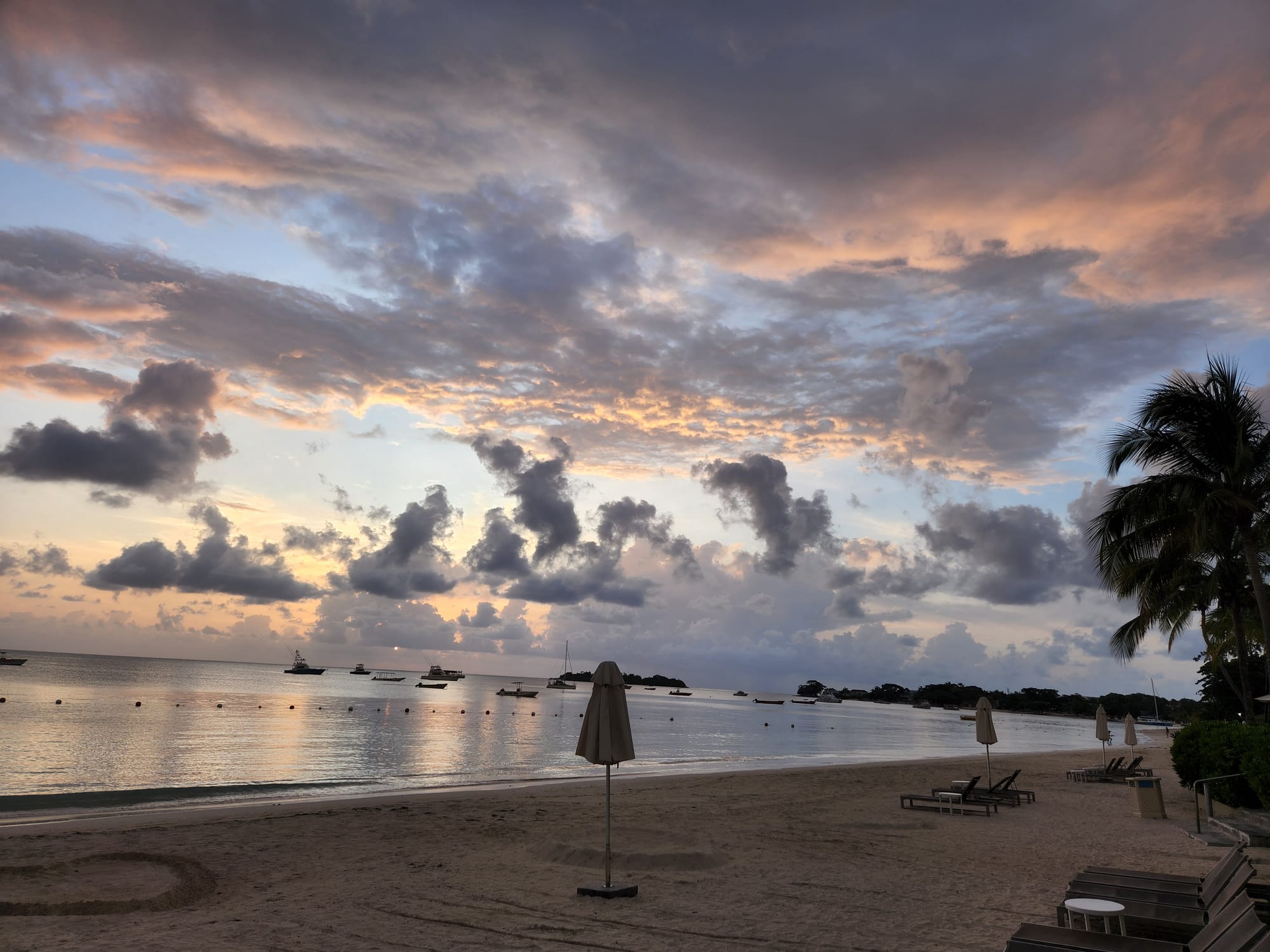
Sunset clouds over calm water and moored boats, seen from a sandy beach with closed parasols and loungers

Jamaica

Negril

Evening on Seven Mile Beach at Negril. (VV Nincic from Toronto, Canada / Wikimedia Commons · CC BY 2.0)

A small, widely spread beach resort at the far western tip of Jamaica, divided between Westmoreland and Hanover parishes. Its tourism began in the late 1950s with guest rooms in local homes and grew into a resort strip along the long beach of Bloody Bay and Long Bay and the sea cliffs of the West End. Hurricane Melissa struck the parish in October 2025.

Neighbourhoods

  • Long Bay
    • Beaches
    • First-time visitors
    • Small hotels

    The southern and longer part of the beach, running north from the edge of town, with all-inclusives alongside smaller, family-run hotels. Most of the vendors and shops are at this end, and the water is shallow far out from the shore.

    Open in Maps
  • Bloody Bay
    • Resorts
    • Beaches

    The northern bay, beyond Long Bay towards Rutland Point and the border with Hanover, home to the large all-inclusive resorts.

    Open in Maps
  • The West End
    • Sunsets
    • Snorkelling and diving
    • Nightlife

    The cliff coast south of downtown along West End Road, also called Lighthouse Road, lined with small hotels, cottages and bars perched above the sea. There is no sand here, but clear water for snorkelling and diving, cliff jumps and the sunset crowds.

    Open in Maps
  • Downtown Negril
    • Local life
    • Markets

    The small town centre around the roundabout where the beach road meets the West End, with the crafts market and shops.

    Open in Maps

Things to do

Beaches and the cliffs

  • Seven Mile Beachbeach

    The long beach of Long Bay and Bloody Bay, a sandbar of white coral sand from the Negril River to Rutland Point, in fact a little over 6 km long despite its name.

    Open in Maps
  • The West End cliffsviewpoint

    Sea cliffs south of town with jumping points more than 12 m high and clear water below, the place most people go to watch the sunset.

    Open in Maps
  • Negril Lighthouselandmark

    A concrete lighthouse of 1894 near the western tip of the island, balanced on a water-filled tank as a precaution against earthquakes, and a well-known landmark of the cliff road.

    Open in Maps

Nature and the reef

  • Negril Marine Parkpark

    About 160 square kilometres of sea declared a marine park in 1998, from Hanover to Westmoreland, protecting the reefs where snorkelling and diving are best; glass-bottom boats take visitors over them.

    Open in Maps
  • Royal Palm Reservepark

    Protected wetland and forest within the Great Morass, the swamp that lies inland of the beach road and is crossed by the Negril River.

    Open in Maps

Markets

  • Negril crafts marketmarket

    The tourist crafts market at the edge of town, where bargaining for carvings and souvenirs is expected.

    Open in Maps

Short trips from the town

  • Savanna-la-Marattraction

    The capital of Westmoreland, a coastal market town with an 18th-century fort built against pirates.

    Open in Maps
  • Luceaattraction

    The capital of Hanover parish, a small coastal town on the road to Montego Bay.

    Open in Maps
  • Mayfield Fallsattraction

    A string of 21 small cascades on the Mayfield River in the Westmoreland hills, walked with local guides.

    Open in Maps

Eat and drink

Long-standing places and food districts in Negril. Hours, ratings and directions come from your maps app, always current.

Negril classics

  • Rick's Caférestaurant

    The best-known cliff-top bar and restaurant on the West End, famous for its sunset crowds and for cliff diving from a platform high above the sea.

    Open in Maps
  • Three Divesrestaurant

    An eatery on the West End serving jerk chicken and pork, lobster and snapper.

    Open in Maps
  • Royal Kitchenrestaurant

    A vegetarian ital restaurant on the West End, serving dishes such as rice and peas, vegetables and ackee.

    Open in Maps

Food districts and stands

  • West End cliff restaurantsneighborhood

    Jerk, goat, fish and lobster at the small restaurants and bars along the cliff road.

    Open in Maps
  • Beach road coconut and cane sellersneighborhood

    Green coconuts cut open for their water and jelly, and sticks of sugar cane, sold from stands near the beach and the market.

    Open in Maps

Experience Negril

History

The Spaniards named the western tip of Jamaica in 1494, and the name Negril is a shortened form of Negrillo. One theory holds that it began as Anguila Negra, after the black eels found along the coast. Until the middle of the 20th century it remained remote and hard to reach.

Tourism began in the late 1950s, when the only practical way in was by ferry, with passengers wading ashore in Negril Bay. The first visitors, many of them hippies, rented rooms in the homes of Jamaican families or camped in their yards, until the first guest house, Palm Grove, opened, followed by the first hotels in the mid to late 1960s. The improvement of the road from Montego Bay in the early 1970s opened the town up; the long straight road to Green Island was so flat that lengths of railway track were stood beside it to stop smugglers landing planes. The Negril Aerodrome followed in 1976, and from the 1980s the beach drew American students on spring break.

Large all-inclusive resorts then spread along Bloody Bay and Long Bay, and concern for the reefs led to the founding of the Negril Coral Reef Preservation Society in 1990 and the Negril Marine Park in 1998. In 2023 the government announced plans for an international airport, a public beach park and a craft village. In October 2025 Hurricane Melissa made landfall in Westmoreland, the parish that holds most of Negril, and flattened much of the parish.

Culture & Customs

Negril's culture grew out of its early visitors and the families who took them in, and it has kept a relaxed, informal reputation, especially on the West End, where cottages and small hotels cling to the cliffs. The sunset is the main event of the day: crowds gather at the cliff-top bars to watch it and to see divers leap from platforms high above the water, a spectacle that has also brought deaths and serious injuries.

Rastafari influence shows in the ital restaurants of the West End, and local guides, some of them Rastafarian, take visitors into the countryside. The Reggae Marathon has been run in Negril every year since 2001.

The town has a long life in fiction and song. Ian Fleming's 1965 novel The Man with the Golden Gun has its villain plan a hotel on a Negril beach, Bob Seger mentioned it in a 1976 song and Jimmy Buffett in another twenty years later, and it appears in the 2008 Mad Men episode "The Jet Set".

Daily Life

Negril is a small and widely dispersed place rather than a single town: downtown and the West End lie in Westmoreland, while the northern end of the beach reaches into Hanover. Tourism drives the economy. Green Island, up the coast, has long been home to many of the Jamaican workers in Negril's hotels; vendors and shops cluster at the southern end of the beach, where there are fewer all-inclusives.

Development along the beach has been heavy in recent decades, including a large development of oceanfront villas, townhouses and studio apartments that is home to some of the wealthiest Jamaican families. The reef has been under pressure from degradation, which the coral reef society and the marine park were set up to address, and the Great Morass behind the beach holds protected wetland and forest.

Hurricane Melissa made landfall near New Hope in Westmoreland on 28 October 2025 as a Category 5 storm, the strongest on record to hit Jamaica, and flattened much of the parish. Recovery, with repairs to housing, roads, water and power continuing into 2026, has shaped life in the area since.

Food

Jerk is everywhere in Negril: chicken and pork rubbed with Scotch bonnet pepper, pimento — allspice — thyme and scallion and smoked over pimento wood. The small restaurants of the West End cliffs serve it alongside goat, snapper and lobster.

Ital food, the cooking of Rastafari, is easier to find here than in most resorts. It avoids meat and processed ingredients, and a typical plate combines rice and peas — rice cooked with kidney beans and coconut milk — with vegetables, stew and sometimes ackee.

Fresh coconut is the local refreshment: green coconuts are cut open with a machete for their water and their soft jelly, and sugar cane is sold beside them. Bottled coconut water is sold almost everywhere on the island, but the fresh nut is the one people seek out. Rum fruit punch and Red Stripe beer are the Jamaican drinks of the sunset bars, with Guinness and Heineken sold wherever there is alcohol, and the plain jerk stands and small cliff restaurants serve the traditional Jamaican dishes alongside the resorts' buffets.

Planning tools

Budget

Negril has the island's widest range of places to stay, from cottages and family-run hotels on the West End to large all-inclusives on Bloody Bay. Independent travellers who use route taxis and eat jerk and ital food spend far less than those in the resorts; boat trips, diving and drinks at the sunset bars are the costs that add up.

Daily Budget Midrange
USD 150–320 (small hotel or resort, restaurant meals, a snorkelling trip, taxis)
Daily Budget Shoestring
USD 55–95 (cottage or guesthouse room, jerk and local food, route taxis)

Agree the price before getting into any taxi, and budget separately for trips beyond the resort if staying all-inclusive.

Best Time to Visit

December to April is the drier, sunnier season and the busiest, when winter visitors from North America and Europe fill the hotels and prices are highest. Late April to June is quieter and cheaper. The wetter months from May to November include the hurricane season.

Suggested Number of Days

Three or four days give time to settle into the beach and the cliffs; most visitors stay a week, as Negril is a place for slowing down. Allow more for trips into Westmoreland and Hanover, which depend on a driver or tour guide.

First Visit
3–4 days
With Surroundings
5–7 days

Transportation

Route taxis run along the beach road and the West End and are the cheapest way to get around; fares rise after dark. Private drivers offer their services everywhere and cost much more. Tour guides can be hired for trips into the countryside, and the main A1 road leads east along the coast to Lucea and Montego Bay; other roads run south-east to Savanna-la-Mar.

Set the fare with the driver before getting in, and use licensed taxis with PPV or JUTA plates or ones arranged by the hotel.

Airport & Station Connections

Sangster International Airport at Montego Bay lies 80.8 km north-east of Negril, about 60 to 90 minutes by shuttle van along the coast road, and most visitors arrive this way. The small Negril Aerodrome, 7 km north of Negril Point, serves the resorts. Sangster was badly damaged by Hurricane Melissa in October 2025, and its traffic in December 2025 was down by more than 48% on a year earlier.

Walkability

The beach itself is the best footpath: it is possible to walk along the shore from the far end of Long Bay to the crafts market at the edge of town. The beach road and the cliff road are long and busy, with little room for walking, so route taxis cover the distances between the beach, town and the West End.

Safety

Jamaica has long had one of the higher homicide rates in the world, though the violence is overwhelmingly gang-related and concentrated in specific inner-city districts of Kingston and Montego Bay that visitors have no reason to enter, and the figures have fallen sharply: in 2025 the country recorded fewer than 700 murders for the first time in more than 30 years. In Negril the everyday concerns are persistent vendors and drivers, drug offers, petty theft and rip currents. Cliff jumping has killed and injured people. Hurricane Melissa made landfall in Westmoreland in October 2025, and repairs to housing, roads, water and power were still under way into 2026, so services can be patchy.

Use common sense at night, avoid walking isolated stretches of beach or road after dark, think hard before jumping from the cliffs, and be firm but friendly with hustlers. Check current official travel advice before travelling.

Climate

Tropical, hot and humid, cooled by sea breezes. Across the island the drier season runs roughly from December to April, and May to November is wetter and more humid, with the most rain around September and October and the risk of hurricanes.

Summer
hot and humid, with heavier showers and the risk of storms; across the island, coastal days in the drier months are around 27–30°C
Winter
the drier season, with coastal days around 27–30°C and less rain

Local Customs

Negril is more laid-back than Montego Bay, and its West End keeps a small-scale character of cottages and family-run places. Everyday speech is Jamaican Patois. Ital food, the meat-free cooking of Rastafari, is easy to find. Vendors and drivers can be insistent; bargaining at the crafts market and roadside stalls is normal.

A polite, firm 'no thanks' works with hustlers; ask before photographing anyone, and keep beachwear for the beach.

Common Payment Methods

The currency is the Jamaican dollar (JMD), but US dollars can be spent almost everywhere in Negril, and roadside sellers usually know the exchange rate. Cards work in hotels and larger restaurants; cash is needed for route taxis, market stalls and small bars, and a supply of Jamaican dollars often gets a better price.