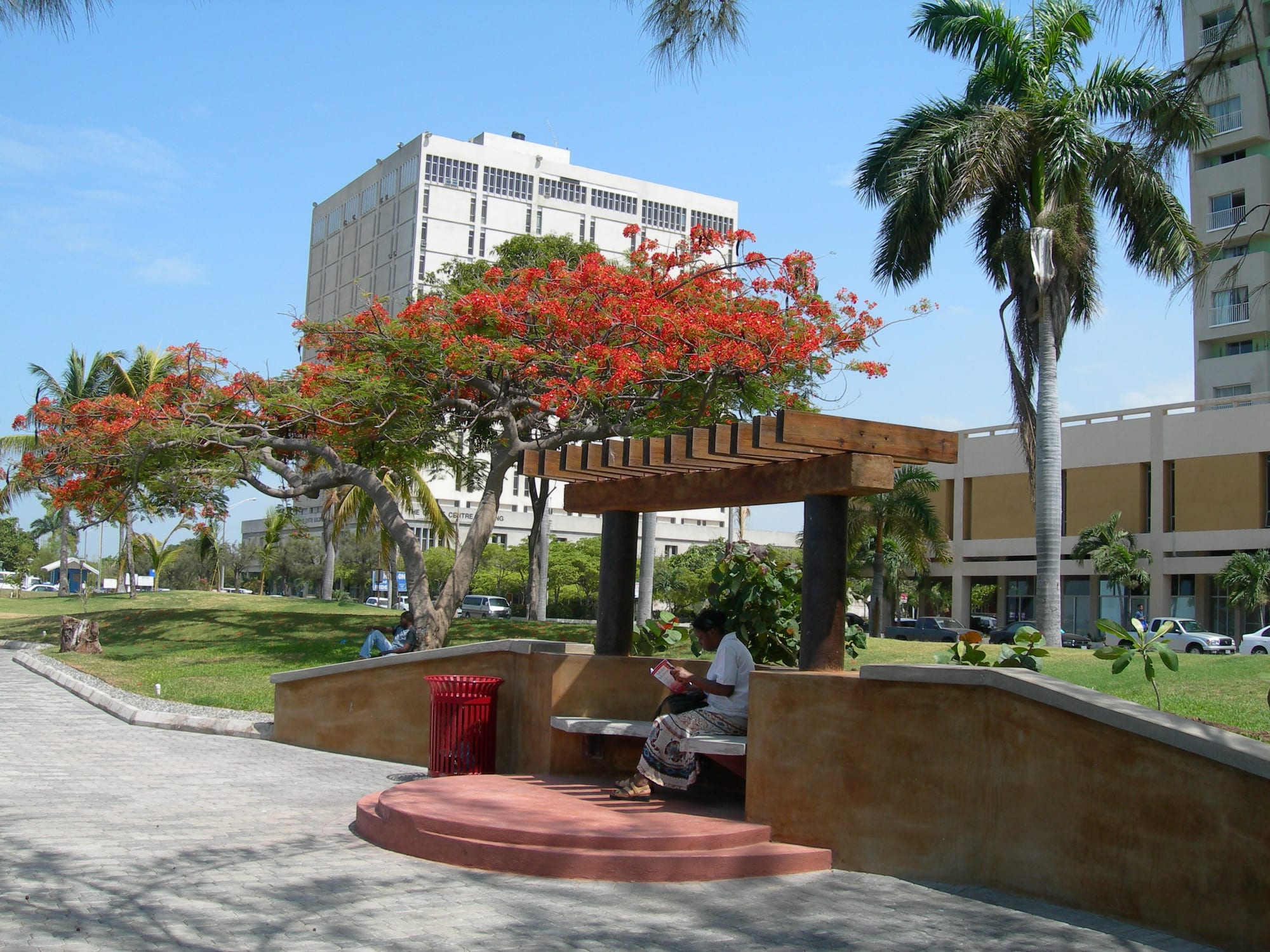
A red-flowering flame tree and palms beside a paved waterfront path, with white office blocks behind

Jamaica

Kingston

Gardens on the Kingston waterfront below the offices of the Urban Development Corporation. (Tillon Aniel / Wikimedia Commons · CC BY-SA 3.0)

Jamaica's capital and largest city, on the south-east coast between the Blue Mountains and one of the world's largest natural harbours. Founded in 1692 for the survivors of the earthquake that destroyed Port Royal, it became the island's trading city and, in the 20th century, the birthplace of ska, rocksteady and reggae — a busy, unequal city of government, business, universities and music.

Neighbourhoods

  • Downtown
    • Historic district
    • Markets
    • Museums

    The old town on a grid of streets running up from the harbour, laid out after 1692. The remodelled waterfront holds banks, government offices and the National Gallery; inland are St William Grant Park, known as the Parade, with a theatre on its north side, the wholesale shopping streets and National Heroes Park.

    Open in Maps
  • New Kingston
    • First-time visitors
    • Nightlife
    • Business

    The post-independence business district of high-rises, banks, insurance companies, embassies and hotels, built around Knutsford Boulevard and Emancipation Park. Its bars and clubs are the centre of the city's nightlife, many of them open until the early morning.

    Open in Maps
  • Half Way Tree
    • Local life
    • Shopping
    • Close to public transport

    A commercial district around a clock tower, and one of the city's main hubs for buses, minibuses and taxis.

    Open in Maps
  • Hope Road, Liguanea and Mona
    • Museums
    • Students
    • Parks

    The corridor running north-east from New Kingston towards the hills, past Devon House, the official residences, the Bob Marley Museum and Hope Botanical Gardens to the University of the West Indies campus at Mona.

    Open in Maps
  • The hill suburbs
    • Quiet and residential
    • Views

    Red Hills, Norbrook, Cherry Gardens, Stony Hill and Jack's Hill, in the foothills to the north, hold some of the most expensive houses in Jamaica, many in gated communities with large gardens.

    Open in Maps

Things to do

Music and museums

  • Bob Marley Museummuseum

    Marley's former home at 56 Hope Road, base of the Tuff Gong label founded by the Wailers in 1970 and the scene of a failed attempt on his life in 1976, opened as a museum in 1986.

    Open in Maps
  • Trench Town Culture Yard Museummuseum

    A National Heritage Site in Trench Town, the birthplace of rocksteady and reggae, presenting the neighbourhood's history and its contribution to Jamaican music.

    Open in Maps
  • National Gallery of Jamaicamuseum

    The national art museum, founded in 1974 and now on the waterfront, with works by Jamaican artists from John Dunkley, Kapo and Edna Manley to Ebony G. Patterson.

    Open in Maps
  • Institute of Jamaicamuseum

    The country's leading cultural and scientific body, founded in 1879, which serves as the national museums authority and sponsors exhibitions.

    Open in Maps
  • Devon Housemuseum

    The 1881 mansion of George Stiebel, Jamaica's first millionaire of colour, saved from demolition in 1965 and now a house museum and National Heritage Site, with shops and restaurants in its grounds.

    Open in Maps

Landmarks

  • National Heroes Parkpark

    A former racecourse and the largest open space in Kingston, about 20 hectares, with monuments and the graves of national heroes, prime ministers and cultural leaders.

    Open in Maps
  • Holy Trinity Cathedrallandmark

    The Byzantine Revival Catholic cathedral downtown, consecrated in 1911 to replace a church destroyed by the 1907 earthquake, visited by Pope John Paul II in 1993.

    Open in Maps
  • Sha'are Shalom Synagoguelandmark

    The synagogue of Kingston's Jewish community, the United Congregation of Israelites.

    Open in Maps
  • Sabina Parkattraction

    Home of the Jamaica cricket team and the only Test cricket ground in Jamaica.

    Open in Maps

Parks and gardens

  • Emancipation Parkpark

    A six-acre park in New Kingston opened in 2002 to mark the end of slavery, known for Laura Facey's bronze sculpture Redemption Song at the entrance and Adinkra symbols at many places in the park.

    Open in Maps
  • Hope Botanical Gardenspark

    The Royal Botanical Gardens at Hope, in the foothills of the Blue Mountains, with a palm grove, a cactus garden, an orchid house, ornamental ponds and a small zoo next door.

    Open in Maps

Short trips from the city

  • Port Royalattraction

    The pirate base and unofficial capital of the 17th century at the end of the Palisadoes, destroyed by the earthquake of 1692.

    Open in Maps
  • Fort Charleslandmark

    The first fort built at Port Royal, between 1650 and 1660.

    Open in Maps
  • Lime Caybeach

    The main islet of the Port Royal Cays, a beach reached by boat with the fishermen of Port Royal.

    Open in Maps
  • Hellshire Beachbeach

    A public beach near Portmore, popular with Kingston families at weekends and famous for its fried fish.

    Open in Maps
  • Spanish Townattraction

    The old capital to the west, which was the seat of government until it moved to Kingston in 1872.

    Open in Maps
  • Blue Mountainspark

    The mountain range rising behind the city, home of Blue Mountain coffee, with coffee factories and the overnight climb to the peak.

    Open in Maps
  • Blue Mountain Peaktrail

    Jamaica's highest mountain at 2,256 m, in the Blue and John Crow Mountains National Park, a UNESCO World Heritage Site since 2015, usually climbed overnight to reach the summit at sunrise.

    Open in Maps

Seasonal events

  • Jamaica Carnivalthe week after Easter, March or April

    A week of fetes and parties, held mainly in Kingston, ending in the costumed Road March through the streets on Carnival Sunday — a tradition brought by Eastern Caribbean students at the University of the West Indies.

Eat and drink

Long-standing places and food districts in Kingston. Hours, ratings and directions come from your maps app, always current.

Kingston classics

  • Hellshire fried fishneighborhood

    Fish fried at the stalls on Hellshire Beach, the weekend outing for many Kingston families.

    Open in Maps
  • Devon Houseneighborhood

    Shops and restaurants in the grounds of the 1881 mansion, including a shop selling premium Blue Mountain coffee beans.

    Open in Maps
  • Red Bones Blues Caférestaurant

    A bar that is also a restaurant.

    Open in Maps

Food districts and bars

  • New Kingston bars and clubsneighborhood

    The city's main nightlife district, with clubs that stay open into the early morning.

    Open in Maps
  • Jamaican cook shopsneighborhood

    Most of Kingston's restaurants serve Jamaican food and are good value, with a few Indian and more Chinese restaurants for a change.

    Open in Maps

Experience Kingston

History

Before 1692 the Liguanea Plains above the harbour were farmland, and Jamaica's chief port was Port Royal on the Palisadoes. On 7 June 1692 an earthquake and tsunami destroyed much of Port Royal, and on 22 July Kingston was founded for the survivors, who first lived in a tented camp, where about 2,000 died of mosquito-borne disease. The town grew after a fire ruined Port Royal again in 1703; the surveyor John Goffe laid out its grid between North, East, West and Harbour Streets, with wide thoroughfares linking the port to the plantations inland. By 1716 it was Jamaica's largest town and centre of trade, and by 1788 it had about 25,000 people, three-fifths of them enslaved.

Merchants lobbied for decades to move the capital from Spanish Town, and in 1872 the government offices finally moved. A great fire in 1882 and the earthquake of 1907, which killed 800 people and destroyed nearly all the historic buildings south of the Parade, reshaped downtown. The labour riots of the 1930s gave rise to the unions and political parties, and the University of the West Indies opened at Mona in 1948.

In the 1960s, as reggae drew world attention, the waterfront was redeveloped, and Kingston hosted the Commonwealth Games in 1966. Political and criminal violence marked the following decades: troops patrolled the streets in 1999, and in May 2010 fighting between the security forces and a drug gang in Kingston killed at least 73 civilians. Hurricane Melissa in October 2025 struck hardest in the west of the island; in Kingston it partly toppled a billboard frame, flooded a basin and caused a landslide that blocked a road in Gordon Town.

Culture & Customs

Kingston is the cultural capital of Jamaica and one of the great music cities of the world. Trench Town, in West Kingston, is the birthplace of rocksteady and reggae and the neighbourhood where Bob Marley spent much of his youth, in the Government Yard on First Street; the Culture Yard there is now a museum. Marley's later home at 56 Hope Road, where the Wailers founded Tuff Gong in 1970, is the city's best-known museum, and the newspapers, radio stations and television channels based here carry the island's music.

The visual arts are strong too: the National Gallery holds the work of John Dunkley and Kapo alongside Edna Manley and contemporary artists. Public art can still cause a stir — Laura Facey's nude bronze figures at Emancipation Park, unveiled in 2003, drew an outcry. Carnival, brought to the city by Eastern Caribbean students at the University of the West Indies, fills the streets in the week after Easter.

Sport matters greatly. Sabina Park hosts Test cricket, five of the National Premier League's football clubs are from the city, and the sprinter Shelly-Ann Fraser-Pryce grew up in Waterhouse. Most people are of African descent, with Chinese Jamaican families prominent in downtown retail, an influential Syrian and Lebanese community, and a small Jewish congregation.

Daily Life

In 2011 the parish of Kingston, which covers only the old downtown and Port Royal, had about 89,000 people, and the parish of St Andrew, which holds most of the city and its suburbs, about 573,000. Most government ministries, the headquarters of many companies and banks, the island's largest seaport — now the container terminal at Newport West — and its largest concentration of schools, hospitals and universities are here.

The city is sharply divided. Wealthy families live in the hill suburbs of Red Hills, Norbrook, Cherry Gardens and Jack's Hill, while about a fifth of the population lives in squatter settlements, and overcrowding has troubled the city since the slums of the 1930s. Downtown has been the subject of repeated redevelopment plans, and call centres and manufacturing have been courted to create jobs.

Daily life moves through the bus hubs at the Parade, Cross Roads and Half Way Tree, and traffic is heavy. Crime has long been the dominant concern, though murders fell sharply across the country in 2025, and recovery from Hurricane Melissa has shaped national life since late 2025.

Food

Most Kingston restaurants serve Jamaican food, and eating out is good value. The staples are those of the whole island — jerk chicken and pork smoked over pimento wood, ackee and saltfish, curry goat, oxtail, brown-stew chicken and rice and peas, with the patty, a flaky turnover of spiced meat, as the everyday snack — and there are also some Indian and more Chinese restaurants.

The classic outing is to Hellshire Beach near Portmore, famous for fried fish eaten by the sea at weekends.

Kingston's drinks are as distinctive. Red Stripe is brewed in West Kingston; Appleton rum is the standard, and Wray & Nephew overproof white rum, known simply as "whites", is the strong local favourite. Coconut water, cane juice, tamarind drink and Irish moss are sold across the city, sorrel appears at Christmas, and Blue Mountain coffee, grown in the hills above the city, is sold at Devon House.

Planning tools

Budget

Kingston is a business city rather than a resort, and eating out is generally affordable, especially in Jamaican restaurants. Taxis are the main extra cost, as visitors are advised to drive rather than walk after dark.

Daily Budget Midrange
USD 150–320 (New Kingston hotel, restaurants, museum entries, taxis)
Daily Budget Shoestring
USD 55–95 (guesthouse room, cook shops, JUTC buses and route taxis)

Many of the city's parks, the cathedral and the street life of downtown cost nothing; boat trips to Lime Cay from Port Royal can be arranged with fishermen.

Best Time to Visit

December to April is the dry season, though cold fronts can bring heavy showers, especially in March. Carnival fills the city in the week after Easter. The wet season runs from May to November, with October the wettest month, and coincides with the hurricane season.

Suggested Number of Days

Two or three days cover the city's museums, music history and parks. Allow four or five to include the coast and an overnight trip into the mountains. Visitors who move only by taxi need a little more time, as traffic is heavy.

First Visit
2–3 days
With Surroundings
4–5 days

Transportation

The Jamaica Urban Transit Company (JUTC) runs a large bus network, backed up by minibuses and route taxis, with the main hubs at the Parade downtown, Cross Roads and Half Way Tree. Most visitors use licensed taxis. There has been no passenger rail since 1992. Highway 2000 runs through Portmore towards Mandeville and Ocho Rios, and its newest section has cut the drive to Montego Bay to about two and a half hours.

Use licensed or dispatched taxis, and travel by car rather than on foot after dark.

Airport & Station Connections

Norman Manley International Airport stands on the Palisadoes, the sand spit enclosing Kingston Harbour, 19 km from the centre of New Kingston; JUTC bus 98 runs from outside the arrivals hall to downtown and to Port Royal. Immigration queues can be long. Buses and route taxis connect the city's transport centres with towns across the island.

Walkability

Kingston is large and spread out, divided into numbered postal districts, and the main districts are far apart. Within New Kingston, Emancipation Park is a short walk from the hotels, but most journeys between districts are made by taxi or bus, and after dark visitors are advised to travel only by car.

Safety

Jamaica has long had one of the higher homicide rates in the world, though the violence is overwhelmingly gang-related and concentrated in specific inner-city districts of Kingston and Montego Bay that visitors have no reason to enter, and the figures have fallen sharply: in 2025 the country recorded fewer than 700 murders for the first time in more than 30 years. In Kingston, crime is concentrated in parts of the east and west of the city. With common sense and precautions, visits to the safer areas of the city are usually trouble-free; petty theft, scams and persistent touts are the everyday concerns.

Avoid the city's inner-city neighbourhoods entirely, visit Trench Town only as part of an organised tour with arranged security, travel by car after dark, and use dispatched or hotel taxis. The emergency number is 119. Check current official travel advice before travelling.

Climate

Tropical wet-and-dry, and drier than most of Jamaica because the Blue Mountains shelter the city from the north-east trade winds; average rainfall is about 813 mm a year. The dry season runs from December to April and the wet season from May to November, which is also the hurricane season.

Summer
hot and the wetter season, with October the rainiest month; temperatures have reached 38.8°C this century
Winter
the dry season, warm, with coastal days around 27–30°C across the island; March is the driest month, though cold fronts can bring heavy showers

Local Customs

Everyday speech is Jamaican Patois; English is used in business and government. Church is central to life for many families, and Protestant, Catholic, Rastafari, Jewish, Hindu, Muslim and Buddhist communities are all found in the city. Touts can be persistent, and women may face catcalls in the street; a firm "no badda me" (don't bother me) is understood.

Ask before photographing people, especially in downtown markets and neighbourhoods, and dress neatly for church.

Common Payment Methods

The currency is the Jamaican dollar (JMD). US dollars are accepted in many places aimed at visitors, often at a poor rate. Cards work in hotels, malls and larger restaurants in New Kingston and Half Way Tree; cash in Jamaican dollars is needed for buses, route taxis, markets and cook shops, and ATMs are widespread.