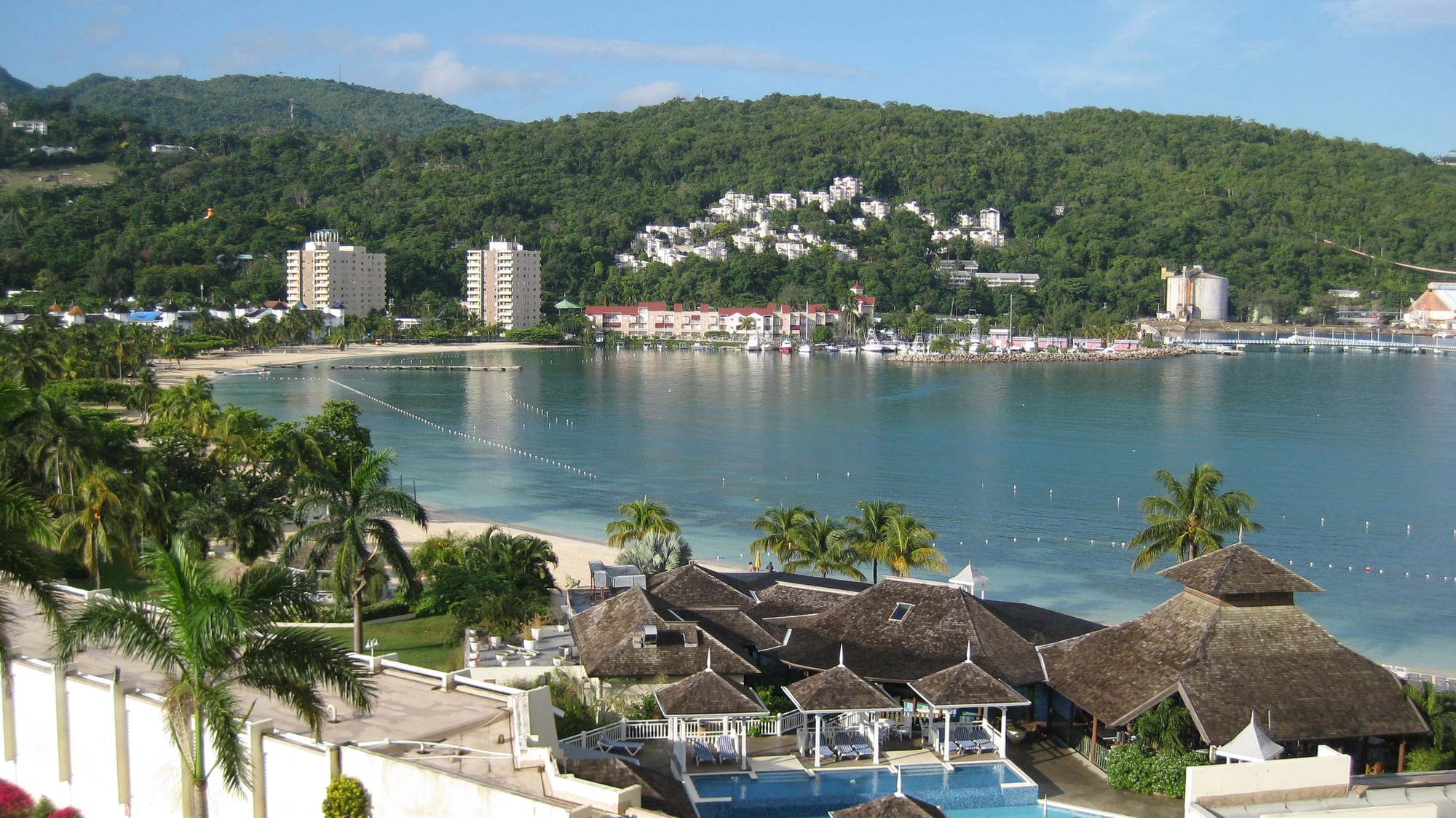
A curving bay of calm turquoise water with a sandy beach, apartment towers, a pier and wooded green hills behind

Jamaica

Ocho Rios

The bay, beach and town of Ocho Rios below the hills of St Ann. (Patricia Edwards / Wikimedia Commons · CC BY-SA 3.0)

A town in the parish of St Ann on Jamaica's north coast, known to Jamaicans as Ochi. A quiet fishing village until the 1960s, it was developed by the government into a resort and cruise port, and now stretches along the shore between Dunn's River Falls and the White River, with Fern Gully and the green hills of St Ann behind.

Neighbourhoods

  • Town centre and the bay
    • First-time visitors
    • Beaches
    • Shopping

    The compact centre around the clock tower and the main cruise pier, where the shore was reclaimed in the 1960s. Turtle Beach, the Island Village shopping and entertainment complex, the craft market, supermarkets, bars and the small hotels in town are all within walking distance.

    Open in Maps
  • The east side
    • Resorts
    • Villas
    • Quiet and residential

    Almost all the development outside the centre lies east of town towards the White River and beyond, where larger hotels and villas with sea or mountain views spread along the coast road towards the airport at Boscobel.

    Open in Maps
  • Mammee Bay and the west
    • Dunn's River Falls
    • Highway access

    The coast west of town, past the Reynolds Pier where cargo ships load, to Dunn's River Falls and Mammee Bay, where Highway 2000 to Kingston begins.

    Open in Maps

Things to do

Waterfalls and rivers

  • Dunn's River Fallsattraction

    A travertine waterfall about 55 m high and 180 m long, climbed in a hand-holding chain behind a guide up its natural terraces to the pools, and one of the very few such falls in the world to empty directly into the sea, at the end of a white-sand beach.

    Open in Maps
  • White Riverattraction

    The river at the eastern edge of town, with a small rafting business a little way upstream.

    Open in Maps
  • Fern Gullytrail

    A rocky gorge about 4.8 km long south of town, formed after an earthquake in 1907 destroyed a river bed, now a road through more than 540 kinds of fern.

    Open in Maps

Gardens and the town

  • Shaw Park Botanical Gardenspark

    Botanical gardens near the town.

    Open in Maps
  • Coyaba River Garden and Museummuseum

    A river garden and museum near Ocho Rios.

    Open in Maps
  • Turtle Beachbeach

    The main town beach on the bay, created when sand was brought in during the development of the 1960s.

    Open in Maps
  • Ocho Rios craft marketmarket

    One of the town's seven craft markets, across from Sonis Plaza, where bargaining is normal.

    Open in Maps

Adventure parks

  • Mystic Mountainattraction

    An attraction opened in 2008 with a bobsled ride inspired by Jamaica's 1988 Olympic bobsled team.

    Open in Maps
  • Dolphin Coveattraction

    An attraction where visitors can swim and interact with dolphins.

    Open in Maps

Short trips from the town

  • Seville Heritage Parklandmark

    A 300-acre site near St Ann's Bay that was a Taíno village, the 16th-century Spanish settlement of Sevilla la Nueva and then a British plantation, with a British great house and the remains of a Spanish sugar mill and church; it is on UNESCO's tentative list.

    Open in Maps
  • St Ann's Bayattraction

    The parish capital, west along the coast, and the birthplace of Marcus Garvey and the singer Burning Spear.

    Open in Maps
  • Oracabessaattraction

    A small town 16 km east, with a covered produce market and a narrow main street of early 20th-century buildings, and James Bond Beach nearby; Ian Fleming wrote the Bond novels while living here.

    Open in Maps
  • Firefly Estatemuseum

    Noël Coward's spartan house of 1956 east of Oracabessa, where the playwright is buried, now a National Heritage Site.

    Open in Maps
  • Port Mariaattraction

    The capital of St Mary, the second town founded by the Spanish in Jamaica, overlooked by the ruins of Fort Haldane of 1759 and with a Georgian courthouse of 1820.

    Open in Maps

Eat and drink

Long-standing places and food districts in Ocho Rios. Hours, ratings and directions come from your maps app, always current.

Ocho Rios classics

  • Fishermen's Beachneighborhood

    A beach in town where cooks serve steamed fish.

    Open in Maps
  • Jerk standsneighborhood

    Jerk chicken and pork, spiced and smoked over a wood fire, sold across town.

    Open in Maps

Food districts and markets

  • Island Villageneighborhood

    The town's major shopping and entertainment complex.

    Open in Maps
  • Passage to Indiarestaurant

    An Indian restaurant in Ocho Rios.

    Open in Maps

Experience Ocho Rios

History

The Taíno, who called the island Xamayca, lived along this coast before Columbus claimed Jamaica for Spain in 1494. The Spanish named the place Las Chorreras — "the waterfalls" — after Dunn's River Falls, and the English, mishearing it, turned the name into Ocho Rios, "eight rivers", though there are not eight rivers here. In 1657 and 1658 Spanish forces sailing from Cuba tried and failed to retake Jamaica in fighting around the town known as the Battle of Las Chorreras; a plaque at the foot of Dunn's River Falls marks the British victory of 1657.

The town had no great role under either power, though pirates used it as a base. After emancipation in 1834 the newly freed people made it a small fishing village, and it never became a fruit port of any importance. Change came in the 1940s, when Reynolds Jamaica Mines built the deep-water Reynolds Pier west of town to ship bauxite, carried from the mines in the hills by an overhead conveyor.

In the 1960s the government's St Ann Development Company dredged the harbour, built a marina, reclaimed the shore, brought in sand for Turtle Beach and built shops and housing. Martin Luther King Jr. stayed in Ocho Rios early in 1967 to write his last book, Where Do We Go From Here: Chaos or Community?. By the early 1980s the resort's character was set, with fast-food franchises, shopping malls and small hotels in town and grander ones to the east, and cruise ships made it a major port of call.

Culture & Customs

Ocho Rios lives largely on its visitors, and its culture is shaped by the meeting of cruise passengers, resort guests and the people of St Ann, a parish with deep roots in Jamaican history: Marcus Garvey was born in nearby St Ann's Bay, and the remains of the Spanish settlement of Sevilla la Nueva lie at Seville just along the coast.

The north coast has a long connection with film and writing. The first James Bond film, Dr. No, was shot partly in Ocho Rios in 1962, and the town returned to the screen in Live and Let Die in 1973; Ian Fleming wrote the Bond novels at his house in Oracabessa a short drive east, and Noël Coward's house, Firefly, stands nearby. Dunn's River Falls appeared in the film Cocktail in 1988, and the British band 10cc put the town in the title of a song.

Climbing Dunn's River Falls in a human chain behind a guide is a ritual for visitors, and the adventure parks draw on Jamaica's own stories, from the bobsled ride at Mystic Mountain, inspired by the 1988 Olympic team, to rafting on the White River.

Daily Life

The estimated population of the town in 2011 was about 16,700, nearly a tenth of the parish of St Ann. The town has grown around tourism — the cruise piers, resorts, villas, attractions and craft markets — and cargo ships still load sugar and limestone at the Reynolds Pier. The town now stretches about 6.4 km along the coast, between Dunn's River Falls to the west and the White River to the east, with almost all the newer building to the east.

The opening of the north–south section of Highway 2000 in 2016 cut the drive to Kingston from over two hours to a little under one and took much of the traffic off the old road through town and Fern Gully. The improved North Coast Highway links the town with Montego Bay in about an hour and 45 minutes.

Cruise days change the town: the falls and the parks are at their busiest when ships are in, and vendors gather just outside the secure area of the main pier. Supermarkets and shops in the centre serve residents and self-catering visitors alike.

Food

Jerk is the town's everyday food, as across the island: chicken and pork rubbed with Scotch bonnet pepper, pimento — allspice — thyme and scallion and smoked over a wood fire, sold at stands and small restaurants around Ocho Rios. The other local speciality is steamed fish, cooked at Fishermen's Beach in town and eaten by the water.

Jamaican home cooking fills the cook shops: ackee and saltfish, the national dish, curry goat, brown-stew chicken and oxtail with rice and peas — rice cooked with coconut milk and kidney beans — and patties, flaky turnovers of spiced meat, as the everyday snack. Festival, a sweet fried dumpling, and bammy, a cassava flatbread, are common sides, and the town also has an Indian restaurant.

Red Stripe beer, rum and fresh fruit juices are the drinks of the beach bars, which include themed bars with beach parties and club nights. At Christmas, sorrel, one of the island's festive mainstays, is the drink of the season.

Planning tools

Budget

Ocho Rios runs from cheap town guesthouses and cook shops to expensive villas and resorts east of town. Entry to the falls, the adventure parks and organised tours is the main extra cost; route taxis and local food keep a day cheap for independent travellers.

Daily Budget Midrange
USD 150–320 (hotel or small resort, restaurants, a tour or park entry, taxis)
Daily Budget Shoestring
USD 55–95 (guesthouse room, jerk and local food, route taxis)

Visit the falls and the parks on days without cruise ships if possible, when they are far less crowded.

Best Time to Visit

December to April is the drier, sunnier and busiest season, with the highest prices. Late April to June is quieter and cheaper. May to November is wetter, with the most rain around September and October and the risk of hurricanes. Cruise ships call all year, and on ship days the main sights are at their busiest.

Suggested Number of Days

Two or three days cover the town, the beaches and the falls. Four or five allow time along the coast to the east and west and into the hills. Cruise passengers usually see the town in a single port call.

First Visit
2–3 days
With Surroundings
4–5 days

Transportation

Route taxis are everywhere and are the cheapest way to get around town and along the coast; minibuses leave from the transport centres. Taxis called by hotels are safe but cost more. Highway 2000 runs from Mammee Bay to Kingston in a little under an hour, and the old road climbs through Fern Gully.

Have the hotel call a taxi rather than accepting a ride in an unmarked car; to reach Port Antonio or the east by route taxi, change at Port Maria.

Airport & Station Connections

Ian Fleming International Airport at Boscobel, 10 km east of Ocho Rios, was built for small jets and private aircraft. Most visitors land at Sangster International Airport at Montego Bay, 97 km to the west, about an hour and 45 minutes by the North Coast Highway. Cruise ships berth at two piers, the main pier near downtown and a more industrial pier farther west.

Walkability

The town centre, the main pier, Island Village and Turtle Beach are close together and easy on foot. The falls, the adventure parks and the resorts east of town lie along the busy coast road, so taxis are the practical way to reach them; from the western pier it is a long walk into town.

Safety

Jamaica has long had one of the higher homicide rates in the world, though the violence is overwhelmingly gang-related and concentrated in specific inner-city districts of Kingston and Montego Bay that visitors have no reason to enter, and the figures have fallen sharply: in 2025 the country recorded fewer than 700 murders for the first time in more than 30 years. In Ocho Rios the everyday concerns are persistent vendors around the piers, scams, drug offers and petty theft, and rip currents.

Use hotel-called or licensed taxis, keep valuables out of the lockers at the falls, avoid walking isolated roads and beaches after dark, and be firm but friendly with hustlers. Check current official travel advice before travelling.

Climate

Tropical, hot and humid, cooled by sea breezes. Across the island the drier season runs roughly from December to April, and May to November is wetter and more humid, with a peak of rain around September and October and the risk of hurricanes.

Summer
hot and humid, with heavier showers and the risk of storms; across the island, coastal days in the drier months are around 27–30°C
Winter
the drier season, with coastal days around 27–30°C and less rain

Local Customs

Everyday speech is Jamaican Patois, and the town is always called Ochi. Vendors around the piers and at the craft markets can be insistent; bargaining is normal at the stalls. Church is central to life for many families.

A polite, firm 'no thanks' works with hustlers; ask before photographing anyone, and keep beachwear for the beach.

Common Payment Methods

The currency is the Jamaican dollar (JMD). US dollars are widely accepted in tourist areas, often at a poor rate. Cards work in hotels, larger restaurants and shops; cash is needed for route taxis, market stalls and some rafting businesses, which take no cards.