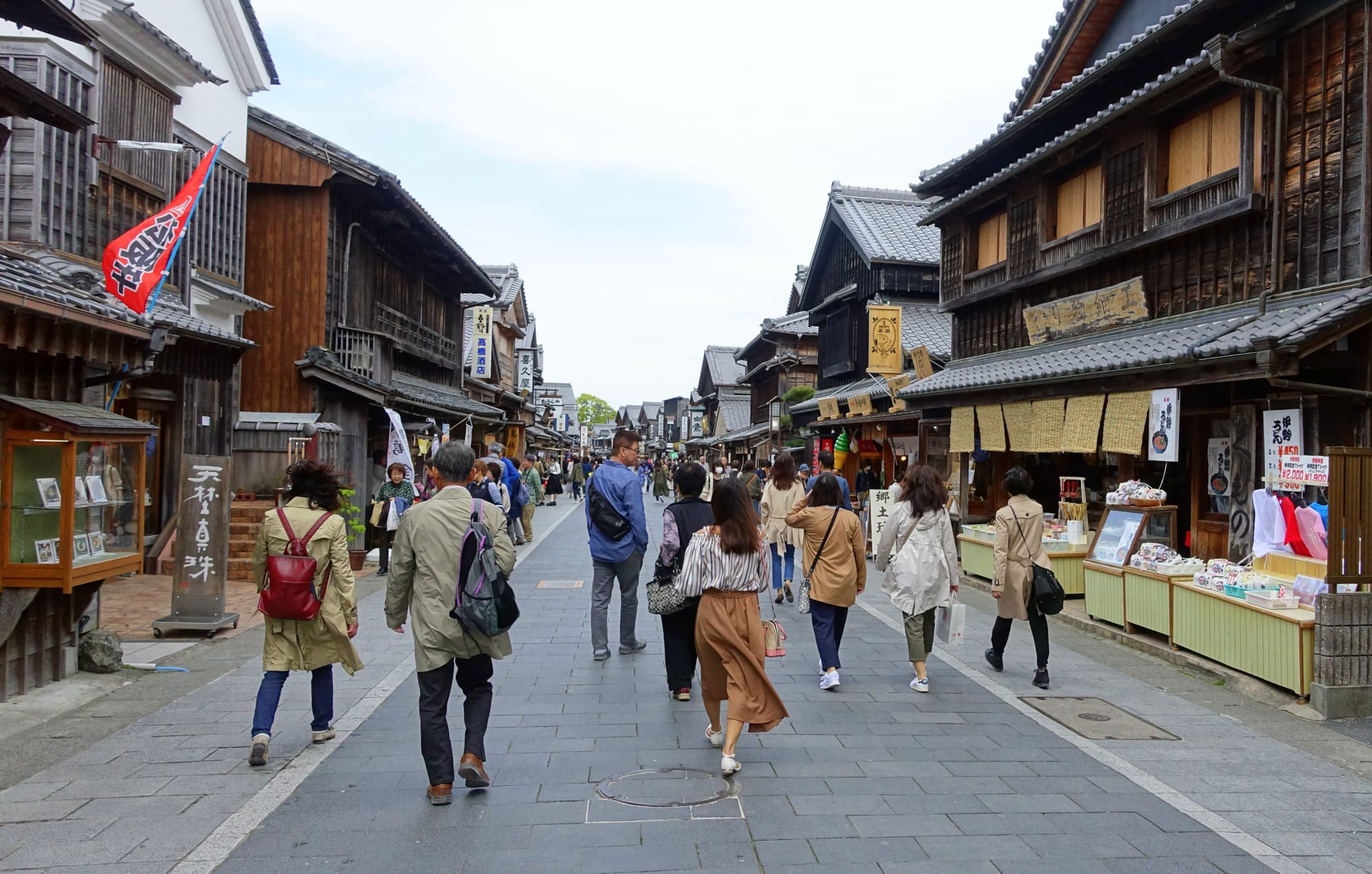
A paved pedestrian street lined with dark wooden two-storey merchant houses, shop banners and stalls, with people walking

Kansai, Japan

Ise

The rebuilt merchant street of Okage Yokocho on the approach to the inner shrine at Ise. (Daderot / Wikimedia Commons · CC0)

A city on the coast of Mie Prefecture, at the mouth of the Isuzu River, built around the Ise Grand Shrine — the holiest complex in Shinto, whose inner and outer sanctuaries are rebuilt in plain cypress every twenty years. Pilgrim roads, merchant streets and a fishing coast make up the rest of it.

Neighbourhoods

  • Naiku and Oharai-machi
    • First-time visitors
    • Historic district
    • Best for food

    The inner shrine stands in cedar forest across the Isuzu River, and the kilometre of stone-paved street leading to it is lined with wooden shopfronts, sweet shops and the reconstructed lanes of Okage Yokocho. It is the busiest part of the city and the reason most people come.

    Open in Maps
  • Geku and the station area
    • Close to public transport
    • Practical base
    • Shrines

    The outer shrine sits a few minutes' walk from Iseshi and Ujiyamada stations, so trains, buses, hotels and everyday restaurants are all close together. Pilgrims traditionally visit here first, and the approach street has been steadily restored.

    Open in Maps
  • Kawasaki
    • Quiet and residential
    • Architecture
    • Cafés

    An old merchants' quarter of warehouses and townhouses along the Seta River, north of the outer shrine, which supplied the pilgrim inns by boat. Its wooden frontages now hold small cafés, galleries and craft shops and see few crowds.

    Open in Maps
  • Futami and the coast
    • Sea views
    • Quiet and residential

    About eight kilometres east, where the city meets Ise Bay, an old bathing and purification village faces the two linked rocks of Meoto Iwa. Pilgrims once washed in the sea here before going on to the shrine.

    Open in Maps
  • Mount Asama and the southern hills
    • Walks and viewpoints
    • Temples

    Wooded hills rise behind the city towards the Shima peninsula, crossed by a toll road along the ridge. A mountain temple long tied to the shrine stands near the top, with views over the bay and, in clear weather, far along the coast.

    Open in Maps

Things to do

The Grand Shrine

  • Ise Grand Shrinelandmark

    The holiest site in Shinto, a complex of more than a hundred shrines centred on the inner sanctuary of Amaterasu and the outer sanctuary of Toyouke, rebuilt in new cypress every twenty years.

    Open in Maps
  • Okage Yokochoattraction

    A reconstructed quarter of Edo and Meiji period shopfronts beside the inner shrine approach, opened in 1993, with food stalls, craft shops and a museum of the pilgrimage.

    Open in Maps
  • Sarutahiko Shrinelandmark

    A shrine between the two sanctuaries dedicated to the deity of guidance and crossroads, visited for blessings before journeys and new ventures.

    Open in Maps
  • Tsukiyomi Shrinelandmark

    One of the principal auxiliary shrines of the complex, standing quietly among trees in a residential quarter of the city.

    Open in Maps

Streets, stations and museums

  • Ujiyamada Stationtransit hub

    The grand prewar railway station built to receive pilgrims arriving from Osaka and Nagoya, with a tiled roof and a high-ceilinged hall.

    Open in Maps
  • Iseshi Stationtransit hub

    The city's main station, a short walk from the outer shrine and the start of the traditional route between the two sanctuaries.

    Open in Maps
  • Jingu Chokokanmuseum

    The shrine's museum of history and culture, opened in 1909 as Japan's first private museum, holding treasures, ritual objects and records of the rebuilding cycle.

    Open in Maps

The coast and the hills

  • Meoto Iwalandmark

    The wedded rocks at Futami, a large and a small rock joined by a heavy straw rope that is renewed in ceremonies several times a year.

    Open in Maps
  • Futami Okitama Shrinelandmark

    The shrine on the shore facing the wedded rocks, associated with frogs and with the seawater purification pilgrims once performed here.

    Open in Maps
  • Kongosho-jilandmark

    A Buddhist temple near the summit of Mount Asama, long regarded as guarding the shrine from the north-east, reached from the ridge road above the city.

    Open in Maps
  • Ise-Shima National Parkpark

    The park covering the shrine forests, the ria coastline and the pearl-farming bays of the Shima peninsula south of the city.

    Open in Maps

Short trips from the city

  • Tobaneighborhood

    A fishing and pearl-farming port about 12 kilometres east, with an aquarium and the island where cultured pearls were first produced.

    Open in Maps
  • Mikimoto Pearl Islandattraction

    The islet at Toba where Kokichi Mikimoto perfected pearl culture in the 1890s, with demonstrations by ama, the women who dive for shellfish.

    Open in Maps
  • Saikuattraction

    The excavated site of the palace of the imperial princess who served the shrine, west of the city, with a museum and reconstructed halls.

    Open in Maps
  • Matsusakaneighborhood

    A castle town about 20 kilometres north, famous for its heavily marbled beef and for the merchant houses of its trading past.

    Open in Maps

Seasonal events

  • Hatsumode at the Grand Shrineearly January

    The first shrine visit of the year draws enormous crowds to both sanctuaries, with park-and-ride schemes run to handle the traffic.

  • Kagura performances at the shrinespring and autumn

    Sacred music and dance are offered at the shrine's kagura halls, with other traditional arts performed by visiting schools.

  • The rope-changing at Meoto IwaMay, September and December

    Villagers wade into the sea at Futami to replace the heavy straw ropes linking the two rocks, a ceremony held three times a year.

  • KannamesaiOctober

    The shrine's harvest festival, when the first rice of the year is offered to Amaterasu in overnight rites, the most solemn of the ritual calendar.

Eat and drink

Long-standing places and food districts in Ise. Hours, ratings and directions come from your maps app, always current.

Ise classics

  • Ise udonrestaurant

    Very soft, thick wheat noodles served without soup in a small pool of dark, sweetish tamari sauce — a dish shaped by pilgrims who wanted something quick and easy to digest.

    Open in Maps
  • Tekone-zushirestaurant

    Slices of tuna or bonito marinated in soy sauce and laid over vinegared rice, originally a fisherman's meal from the Shima coast.

    Open in Maps
  • Akafuku mochicafe

    Soft rice cakes under a wave-shaped coating of sweet red bean paste, made on the shrine approach by a confectioner founded in the early 18th century and eaten with green tea.

    Open in Maps

Food streets and markets

  • Oharai-machi and Okage Yokochoneighborhood

    The stone-paved approach to the inner shrine, where stalls sell grilled scallops and oysters, skewers, croquettes, beer and sweets to be eaten while standing.

    Open in Maps
  • Geku approach and the station streetsneighborhood

    Noodle shops, izakaya and small restaurants around the outer shrine and the two stations, where residents rather than pilgrims eat.

    Open in Maps
  • Futami seafoodneighborhood

    The coastal village serves the shellfish, spiny lobster and dried seaweed of Ise Bay, much of it grilled in front of the customer.

    Open in Maps

Experience Ise

History

Tradition places the founding of the inner shrine in the reign of Emperor Suinin, when the princess Yamatohime is said to have carried the sacred mirror of Amaterasu from the capital and settled it beside the Isuzu River, with the outer shrine of Toyouke, the deity of food and harvest, established later. Whatever its origins, the complex was firmly tied to the imperial house by the 7th century: an unmarried imperial princess, the saio, was sent to serve at a palace at Saiku, west of the city, and the practice of rebuilding the sanctuaries every twenty years is traced to the late 7th century and has been carried out more than sixty times.

For centuries ordinary people were discouraged from approaching. That changed in the medieval and Edo periods, when shrine agents known as oshi travelled the country signing up parishioners and lodging them at Ise. Mass pilgrimages, the okage mairi, swept Japan roughly every sixty years, and in the largest of them millions walked to Ise in a single season, many without their employers' leave. The twin towns that served them — Uji at the inner shrine, Yamada at the outer — grew into a merchant city of inns, theatres and a licensed quarter.

The towns merged as Ujiyamada in 1906, were bombed in 1945, and took the name Ise in 1955. Pilgrimage revived with the railways, and the approach streets were rebuilt in traditional style from the 1970s, with Okage Yokocho opening in 1993. The sanctuaries were last renewed in 2013, the sixty-second rebuilding, with the next due in 2033, and in 2016 the G7 summit was held on the Shima peninsula nearby.

Culture & Customs

Ise's culture is the culture of pilgrimage. The rebuilding cycle, the shikinen sengu, governs everything: every twenty years the sanctuaries are rebuilt on an adjoining plot to identical plans in untreated hinoki cypress, the deities are moved at night, and the old timbers are distributed to shrines across the country. The practice keeps carpentry, thatching and metalwork skills alive and gives the buildings their look of being both ancient and brand new.

Ritual life is constant rather than occasional, running from the daily offering of food prepared on a sacred fire to the harvest rites of October, the most important of the shrine's year. The white-robed priests, the gravel courts, the plain architecture with its forked finials and the absence of paint or ornament are deliberately austere, and the crowds on the approach street fall silent at the inner gate.

Around this solemnity the city is cheerful and commercial, as pilgrim towns usually are. Sweet shops, sake bars, taiko drumming and puppetry on the approach streets belong to a tradition of pilgrimage as holiday, an old idea captured in the word okage, gratitude. The coast adds its own identity: the ama, women who free-dive for shellfish, still work the shore towards Toba, and the wedded rocks at Futami have become a symbol of marriage across Japan.

Daily Life

About 120,000 people live in Ise, a number that has held fairly steady over recent decades, spread between the flat land around the two shrines, the Kawasaki and station districts, hillside suburbs and the fishing villages of the coast. The city is a regional centre for southern Mie, with the prefecture's hospitals, schools and offices for the surrounding towns.

The shrine is the largest single force in the economy, directly and through the hotels, coach companies, confectioners and souvenir makers that live off the millions of visitors who come each year. Beyond that, the working city has food processing, pearl and seaweed cultivation, fishing out of Futami and the Shima ports, a little light manufacturing, and farms on the plain to the west. Many residents commute north to Tsu or Matsusaka.

Daily rhythms are provincial and early. Shops on the approach streets open for the morning pilgrims and shut in the late afternoon, and locals walk in the shrine forest before work — visiting the sanctuary on the first of the month is a common habit. The pressures are those of the whole region: an ageing population, young people leaving for Nagoya and Osaka, traffic and coach parking around the inner shrine on festival days, and the long-term preparation for a major offshore earthquake, which shapes building rules and the evacuation drills held along the coast.

Food

Ise udon is the city's own dish and divides opinion elsewhere in Japan: thick wheat noodles boiled until very soft, drained, and turned in a little dark, sweet-salty tamari sauce with chopped spring onion, with no broth at all. It was made for pilgrims who arrived hungry and needed something gentle after days of walking, and it is still served in plain shops on both approach roads.

The sea provides the rest. Tekone-zushi, tuna or bonito marinated in soy and laid over vinegared rice, comes from the fishing boats of the southern Shima peninsula; Ise-ebi, the spiny lobster that takes the city's name, is grilled or served raw; oysters and scallops from Ise Bay are cooked on hot plates at the stalls on Oharai-machi; and the bay's seaweed is dried for soups and rice. Matsusaka beef, one of the most prized wagyu, comes from the town up the line and appears in the better restaurants here.

The sweet tradition belongs to the pilgrims. Akafuku, a rice cake wrapped in sweet red bean paste shaped to suggest the ripples of the Isuzu River, has been made on the approach road since the early 18th century and is eaten with green tea in a riverside shop. Other stalls sell rice-flour dumplings, grilled mochi and, in warm weather, shaved ice, and local breweries in southern Mie supply the sake offered at the shrine and drunk in the town.

Planning tools

Budget

Ise is inexpensive by Kansai standards. Entry to the shrine is free, most of the pleasure is walking and eating, and business hotels near the stations are cheap; a seafront ryokan at Futami or Toba is the splurge. Train fares from Osaka or Nagoya and the bus between the sanctuaries are the other regular costs.

Daily Budget Midrange
USD 100–190 (business hotel or coastal ryokan, seafood dinners, museum entry, regional trains)
Daily Budget Shoestring
USD 45–75 (guesthouse or budget business hotel, udon and street stalls, local trains and buses)

Shrine entry costs nothing, and the private Kintetsu railway's regional passes usually undercut separate tickets for anyone combining Ise with Nara, Osaka or Nagoya.

Best Time to Visit

Spring and autumn are the most comfortable, with cherry blossom along the Isuzu River in early April and clear, cool days from October to early December. The New Year days are extraordinary but extremely crowded. Summer is hot, humid and exposed to typhoons, and winter is mild by Japanese standards, with the shrine forests at their quietest.

Suggested Number of Days

Both sanctuaries and the approach streets fill a full day, and an overnight stay allows an early start before the coaches arrive. Three or four days take in the Futami coast, the hills behind the city and the pearl bays of the Shima peninsula.

First Visit
1–2 days
With Surroundings
3–4 days

Transportation

Trains link the two stations near the outer shrine with Futami, Toba and the cities to the north, and frequent buses run the six kilometres between the outer and inner sanctuaries and on to the coast. Walking the old pilgrim route between the two shrines takes about an hour and a half. Hired bicycles work well on the flat riverside streets.

Roads and car parks around the inner shrine are heavily congested at New Year and on autumn weekends, when buses and trains are much faster than driving.

Airport & Station Connections

Kintetsu limited-express trains reach Ujiyamada and Iseshi stations in about an hour and a half from Nagoya and a little over two hours from Osaka and Kyoto, and JR trains run on a slower parallel line. Chubu Centrair International Airport near Nagoya is the usual arrival point, with a bus and boat or train connection onward.

Walkability

The shrine approaches are flat, paved and made for walking, and the outer sanctuary, Kawasaki and the stations form a compact walkable cluster. The two sanctuaries are six kilometres apart, so most people take the bus one way. Gravel paths inside the shrine precincts are broad but uneven, and the hill temple and the ridge road need transport.

Safety

Ise is a quiet city with very little crime, and the main risks are natural: typhoons and heavy rain between August and October, summer heat on the unshaded approach streets, and the earthquake and tsunami hazard of this stretch of the Pacific coast, for which the coastal districts are signposted with evacuation routes.

On the coast at Futami and Toba, note the tsunami evacuation signs and move inland and uphill immediately after strong or long shaking rather than waiting for an official warning. Check current official travel advice before travelling.

Climate

Humid subtropical, warmed by the Kuroshio current offshore. Summers are hot and sticky, the June rainy season is heavy, autumn brings typhoons, and winters are mild with little snow but a cold wind off the bay.

Summer
hot and humid, typically 28–34°C, with high humidity and frequent afternoon cloud
Winter
mild and mostly dry, typically 3–11°C, with rare snow

Local Customs

The shrine has its own etiquette: visitors bow at each torii, keep to the sides of the path rather than the centre, which is reserved for the deities, and rinse hands at the basin or in the Isuzu River before approaching. Photography is prohibited beyond the steps of the main sanctuaries. Tradition puts the outer shrine before the inner one.

Dress modestly for the sanctuaries, do not photograph the innermost halls or priests at ritual, and hand payment to shopkeepers on the tray provided rather than into the hand.

Common Payment Methods

The currency is the Japanese yen. Hotels, larger restaurants and station shops take cards and IC travel cards, but many stalls on the shrine approach, small noodle shops and shrine offices are cash only. Cash machines that accept foreign cards are in convenience stores and the post office near the stations.