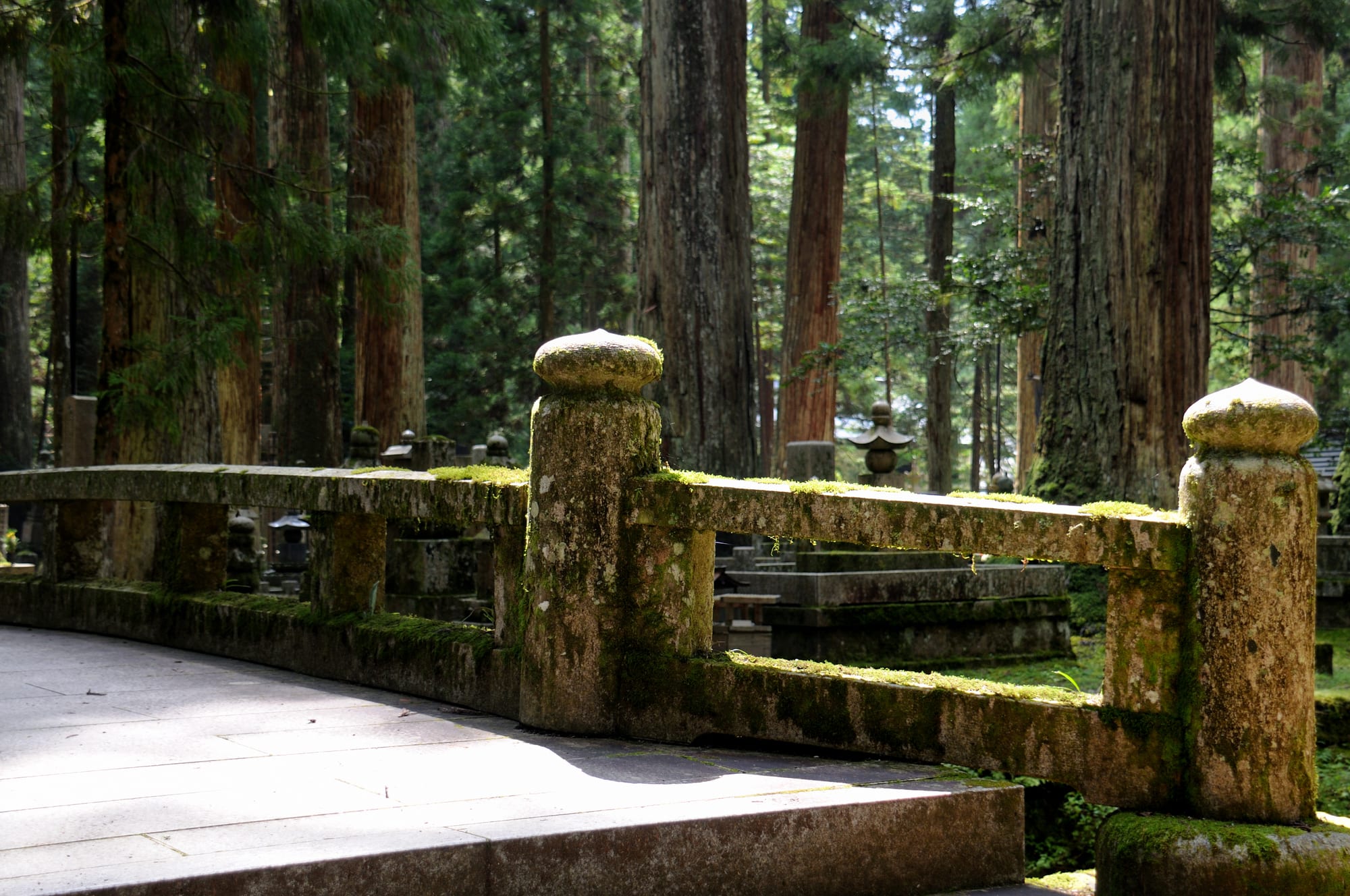
A moss-covered stone bridge and railing on a paved path among tall cedar trunks, with old stone graves behind

Kansai, Japan

Koyasan

A mossy stone bridge on the path through the Okunoin cemetery at Koyasan. (Josep M. Gracia / Wikimedia Commons · CC BY-SA 4.0)

A monastic settlement on a wooded plateau about 800 metres up in the Kii Mountains of Wakayama Prefecture, founded by the monk Kukai in 816 as the headquarters of Shingon Buddhism. More than a hundred temples remain, many of them taking overnight guests, and the vast Okunoin cemetery fills the cedar forest at its eastern end.

Neighbourhoods

  • The Garan and the central crossroads
    • First-time visitors
    • Temples
    • Close to public transport

    The middle of the plateau, where the Danjo Garan compound and the head temple of Kongobu-ji stand a few minutes apart. Around them are the treasure museum, the main bus stops, shops selling incense and prayer beads, and many of the temples that take overnight guests.

    Open in Maps
  • Okunoin and the eastern approach
    • Quiet and contemplative
    • Walks
    • Historic district

    East of the centre the road runs to Ichinohashi bridge and into two kilometres of cemetery under giant cedars, ending at Kukai's mausoleum. The temples along this stretch are quieter, and the lanes are almost empty after dark, when lanterns light the path.

    Open in Maps
  • Daimon and the western end
    • Viewpoints
    • Quiet and residential

    The great vermilion gate of Daimon, rebuilt in 1705, is the main gate of the monastery, at the western edge of the plateau where the ground falls away towards the valleys. Several ridge paths begin nearby.

    Open in Maps
  • The cable car and the lower town
    • Close to public transport
    • Practical base

    The railway ends at Gokurakubashi in the gorge below, and a steep cable car climbs to a station on the rim, from where buses run into the settlement; the connecting road is closed to walkers. Little is up there beyond the station itself, but everyone arriving by train passes through.

    Open in Maps

Things to do

The monastery and the plateau

  • Kongobu-jilandmark

    The head temple of Koyasan Shingon Buddhism, with painted sliding screens, a great kitchen and Banryutei, the largest rock garden in Japan.

    Open in Maps
  • Konpon Daitolandmark

    The tall vermilion pagoda at the centre of the Danjo Garan, the compound consecrated in 819, rebuilt in the 20th century after repeated fires.

    Open in Maps
  • Reihokanmuseum

    The mountain's treasure museum, opened in 1921, holding Buddhist paintings, statues and scrolls gathered from the temples, many of them national treasures.

    Open in Maps
  • Koyasan Stationtransit hub

    The cable-car terminus on the rim of the plateau, where trains from Osaka connect with the buses into the settlement.

    Open in Maps

Okunoin and the forest

  • Okunoinattraction

    The largest cemetery in Japan — a two-kilometre path through cedar forest past more than two hundred thousand memorials to the mausoleum of Kukai, with the lantern hall of Toro-do standing before it.

    Open in Maps

Short trips from the town

  • Jison-inlandmark

    The temple at the foot of the mountain marking the entrance to the pilgrim road, and one of the places where women could worship in the centuries when the plateau was closed to them.

    Open in Maps
  • Niutsuhime Shrinelandmark

    A Shinto shrine in the Amano valley below the plateau, dedicated to the deities said to have granted Kukai the mountain.

    Open in Maps
  • Kudoyamaneighborhood

    The small town in the valley at the start of the pilgrim path, associated with the exiled warrior family of Sanada.

    Open in Maps

Seasonal events

  • Ceremonies for Kobo DaishiJune

    Ceremonies at the main halls in June mark the traditional date of Kukai's birth, with processions through the settlement.

  • Obon candle-lighting in OkunoinAugust

    Candles and lanterns are lit along the Okunoin path during the mid-August Obon observances, when the dead are remembered.

  • Autumn colourlate October to early November

    Maples turn early at this altitude, and the Garan and the cemetery paths draw their largest crowds of the year.

  • Winter in the snowDecember to February

    Snow settles on the plateau for weeks at a time, muffling the cemetery and leaving the temples very quiet.

Eat and drink

Long-standing places and food districts in Koyasan. Hours, ratings and directions come from your maps app, always current.

Koyasan classics

  • Shojin ryorirestaurant

    The Buddhist vegetarian cooking served at temple lodgings — several small dishes of vegetables, tofu, pickles and rice, without meat, fish, onion or garlic.

    Open in Maps
  • Goma-dofurestaurant

    Sesame tofu, a dense, smooth block of ground sesame set with kudzu starch and eaten with wasabi and soy, made on the mountain for centuries and sold in the shops along the main street.

    Open in Maps
  • Koya-dofumarket

    Freeze-dried tofu, said to have been discovered here when tofu was left out in the winter cold, now a pantry staple across Japan and a common souvenir.

    Open in Maps

Where people eat

  • The main street between the Garan and Ichinohashineighborhood

    The handful of noodle shops, cafés and sweet shops on the central road, which mostly close early; temple guests eat their evening meal in their lodgings.

    Open in Maps

Experience Koyasan

History

The monastery began with a grant of land. In 816 the emperor Saga gave the plateau to Kukai, the monk known after his death as Kobo Daishi, who had returned from study in Tang China with the teachings of esoteric Buddhism and wanted a mountain retreat far from the capital. Local legend has it that the deities of the Niu shrine in the valley below led him to the site, a ring of eight peaks around a level basin. Building began at the Garan in 819, and Kukai entered his mausoleum at Okunoin in 835; Shingon tradition holds that he did not die but sits there in eternal meditation, awaiting the future Buddha.

Belief in that presence made Okunoin the most sought-after burial ground in Japan. Emperors, warlords, poets and, later, companies had memorials raised among the cedars, including the graves of enemies lying within sight of each other. The monastery grew rich on donations and, by the medieval period, on its own estates and armed men, and at its height it counted many hundreds of temples.

Fire destroyed much of it repeatedly — the Konpon Daito pagoda has burned and been rebuilt several times — and in 1581 Oda Nobunaga's forces threatened the mountain before his death spared it. The Meiji government stripped the monastery of land and forced the separation of Shinto and Buddhist worship, and the ban that had kept women off the plateau was given up in the Meiji period, formally in 1906. In 2004 Koyasan and its pilgrim roads were inscribed by UNESCO with the other sacred sites of the Kii Mountain Range, and temple lodging has since become the mountain's main contact with the outside world.

Culture & Customs

Life here runs on the monastic day. Bells sound before dawn, monks file into halls for morning service, and the goma fire ritual — in which wooden sticks carrying written wishes are burned before a flaming altar while a priest chants — is performed at several temples. Guests at a shukubo, a temple lodging, sleep on futons in tatami rooms, eat what the monks eat, and are welcome, though not obliged, to attend the service.

The mountain's social character is unusual: a town of around three thousand people in which a large share of adults are clergy, temple staff or work in related trades, with a university of Shingon studies and its own school run for the community. Families have served particular temples for generations, and the funeral and memorial business that fills Okunoin sustains stonemasons and undertakers as well as priests.

Ritual objects are made and sold here — incense, rosaries, brocade, lacquer — and the mountain keeps a strong calendar of observances, from the June ceremonies for Kukai to the candle-lit Obon nights in August and the initiation rites open to lay people. Visitors are asked to behave as pilgrims do: bowing at the bridge that marks the entrance to the cemetery, walking quietly, and remembering that the graves are tended by families, not preserved as scenery.

Daily Life

About three thousand people live in the town of Koya, which covers a large area of forest and valley but is concentrated on the plateau. The population has fallen steadily, as it has across rural Wakayama, and the primary school and shops serve a community that empties in winter and fills with visitors in the autumn weeks.

Almost the whole economy is religious. Around 120 temples remain, many of them taking overnight guests, and their kitchens, gardens and offices employ much of the working population. Around them are the stone carvers, Buddhist goods shops, bus drivers and cable-car staff, the university, and a small amount of forestry in the surrounding cedar plantations. Tourism revenue has grown sharply since the UNESCO listing, which has brought income, crowding on the autumn weekends and a debate about how far a monastery should go to accommodate guests.

The rhythm is early and quiet. Shops shut in the late afternoon, temple gates close at dusk, dinner is eaten before seven and the settlement goes dark, so that the only movement after nightfall is on the lit path through the cemetery. The mountain's isolation is real: hospitals, high schools and supermarkets are down in the valley, the road up is narrow and snowbound in winter, and residents plan around the cable car much as elsewhere people plan around a bus.

Food

Food on the mountain is monastic. Shojin ryori, the vegetarian cooking of Japanese Buddhism, is served at temple lodgings as a set of small lacquered dishes: rice, miso soup, simmered vegetables, pickles, tempura of mountain plants, and tofu in several forms. It is cooked without meat or fish and without the pungent vegetables — onion, garlic, leek — that the precepts discourage, and it relies on kombu and mushroom for depth where other Japanese cooking would use fish stock.

Two local specialities come from that tradition. Goma-dofu, sesame tofu, is ground sesame set with kudzu starch into a dense, faintly sweet block eaten with wasabi and soy; it contains no soya beans at all, and shops along the main street sell it fresh. Koya-dofu, or kōridōfu, is tofu frozen and dried, said to have been discovered when blocks were left out overnight in the mountain cold; reconstituted in broth it has a spongy texture and a long shelf life, and it is sold across Japan under the mountain's name.

Beyond the lodgings the choice is small: noodle shops and cafés on the central road, sweet shops selling mochi and yaki-mochi filled with bean paste, and tea made from local plants. Wakayama's persimmons, mountain vegetables and kudzu appear in season, and the shops stock the prefecture's umeboshi and sake for anyone taking food back down.

Planning tools

Budget

Koyasan costs more than an ordinary Japanese town because nearly everyone stays in a temple lodging with dinner and breakfast included, and there is no budget hotel alternative on the plateau. Rail and cable-car fares up from Osaka, temple and museum entry, and the local bus add to it. Day visitors can see a great deal for very little.

Daily Budget Midrange
USD 140–260 (temple lodging with vegetarian dinner and breakfast, temple and museum entry, rail and cable car)
Daily Budget Shoestring
USD 60–100 (simplest temple lodging or a day trip from Osaka, noodle lunches, trains and local buses)

Temple rooms are limited and fill months ahead for autumn weekends and holidays; the combined rail, cable car and bus tickets sold by the railway are usually cheaper than separate fares.

Best Time to Visit

Late April to early June and October to mid-November are the most comfortable, with fresh green or maple colour and cool nights. Summer is noticeably cooler than the lowlands and is a refuge from the Kansai heat, though the rainy season brings mist and downpours. Winter is cold and snowy, and the mountain is at its quietest and most severe.

Suggested Number of Days

A night on the mountain is the point: an overnight stay allows the cemetery after dark and the morning service, which day visitors miss. Two nights suit anyone who wants the walking paths, and three if the pilgrim road from the valley is walked rather than ridden.

First Visit
1–2 days
With Surroundings
3 days

Transportation

Everything on the plateau is reached on foot or by the local bus that runs the length of the main road between the cable-car station, the Garan and Ichinohashi. Cars are allowed but parking is limited, and part of the Okunoin path is closed to vehicles. Buses are less frequent in the evening, after which walking is the only option.

A one-day bus pass covers the local route; the last cable car down the mountain runs in the early evening, so plan departures around it rather than the bus.

Airport & Station Connections

The Nankai Koya Line runs from Namba in Osaka to Gokurakubashi in about an hour and a half to two hours, where a steep cable car climbs the last 800 metres of track to the rim and a bus completes the journey. Limited-express trains with reserved seats run part of the way. Kansai International Airport is about two and a half hours away by train with a change.

Walkability

The settlement is a single road a few kilometres long, flat by the standards of the Kii Mountains and easy to walk from end to end in about an hour. Paths through Okunoin are paved but uneven, with tree roots, steps and moss that is slippery when wet, and there is no lighting for much of the way. Trails off the plateau are steep and forested.

Safety

Koyasan is very safe and crime is close to non-existent. The hazards are those of a mountain: cold and snow in winter, poor footing on wet stone, heavy rain and landslides in the typhoon season, and darkness in the cemetery, where a torch is worth carrying. Medical facilities are limited and the nearest hospitals are down in the valley.

Carry a layer more than the lowlands seem to need, watch for ice from December to March, and treat the whole plateau as consecrated ground — it is a working monastery, not a museum. Check current official travel advice before travelling.

Climate

A mountain climate several degrees cooler than Osaka all year, with mist common in the forest, heavy rain in the June rainy season and again in autumn typhoons, and reliable winter snow.

Summer
mild for Japan, generally 20–28°C by day and cool at night, with frequent cloud and mist
Winter
cold, often around -3 to 6°C, with snow lying on the plateau for long spells

Local Customs

This is a monastery before it is a destination. Shoes come off at temple entrances, voices stay low, and photography is not allowed around Kukai's mausoleum beyond the lantern hall or of monks without asking. Temple lodgings have set meal and bath times, a curfew, and an optional early morning service; meals are vegetarian and alcohol is sold but drunk discreetly.

Bow at Ichinohashi bridge before entering the cemetery, as pilgrims do, stay off the graves and keep to the path, and do not tip — an offering at a temple hall is the local equivalent.

Common Payment Methods

The currency is the Japanese yen. Some temple lodgings, small shops and the bus prefer cash, and cash machines on the mountain are few, so drawing money before arriving is sensible. Cards and IC travel cards work on the railway and in the larger shops, and temple stays are often paid on departure.