💰 Budget
Osaka is one of the better-value big cities in Japan. Business hotels are plentiful and cheaper than in Kyoto, street food and standing bars keep eating costs low, and many of the best things — the canal, the arcades, the castle park, the markets — cost nothing. Prices rise during large conventions and in the cherry-blossom weeks.
- Daily Budget Midrange
- USD 130–250 (business hotel, restaurant dinners and izakaya, attraction entries, trains and the occasional taxi)
- Daily Budget Shoestring
- USD 50–85 (hostel or capsule bed, street food and konbini meals, subway day tickets)
Staying here and travelling out to Kyoto, Nara, Kobe and Himeji by train is usually cheaper than the reverse; a subway day pass pays for itself quickly.
📅 Best Time to Visit
Late March and April for cherry blossom in the castle park, and October and November for dry, mild weather and autumn colour, are the pleasant seasons. July brings the Tenjin Matsuri in heavy heat and humidity, and September can be disrupted by typhoons. Winter is cool, bright and the cheapest time to visit.
⏳ Suggested Number of Days
Two or three days are enough for the two centres, the castle and the markets. Most visitors use the city as a base for several more days, since the rest of Kansai is within an hour by train, which is what pushes a stay towards five or six.
- First Visit
- 2–3 days
- With Surroundings
- 5–6 days
🚆 Transportation
Eight subway lines and a dense network of JR and private railways — Hankyu, Hanshin, Kintetsu and Nankai — make a car pointless. The JR Loop Line circles the central districts, the Midosuji subway line links Umeda, Shinsaibashi, Namba and Tennoji, and an IC card works on all of them. Taxis are easy to find, and the flat centre suits cycling.
Umeda's stations belong to several companies and are connected by long underground passages, so allow extra time when changing there; in Osaka people stand on the right of escalators, the opposite of Tokyo.
🛬 Airport & Station Connections
Kansai International Airport sits on an artificial island in the bay, about 40 kilometres south-west, with fast trains to Namba on the Nankai line and to Tennoji and central stations by JR. Itami airport, closer to the north, handles domestic flights. Shin-Osaka station takes Shinkansen trains from Tokyo in about two and a half hours and from Hiroshima in about an hour and a half.
🚶 Walkability
The two centres are compact and flat, and Minami in particular is best seen on foot, with several kilometres of covered arcades that stay dry in rain and shaded in summer. Umeda and Namba each have large underground shopping networks that link stations. The three or four kilometres between Kita and Minami are quicker by subway than on foot.
🛡️ Safety
Osaka is safe by international standards, though its recorded crime rate is among the higher ones in Japan and pickpocketing and bag-snatching are more common in the nightlife streets of Minami than elsewhere in the country. Touts outside bars in some districts are best ignored. Typhoons and earthquakes are the natural risks.
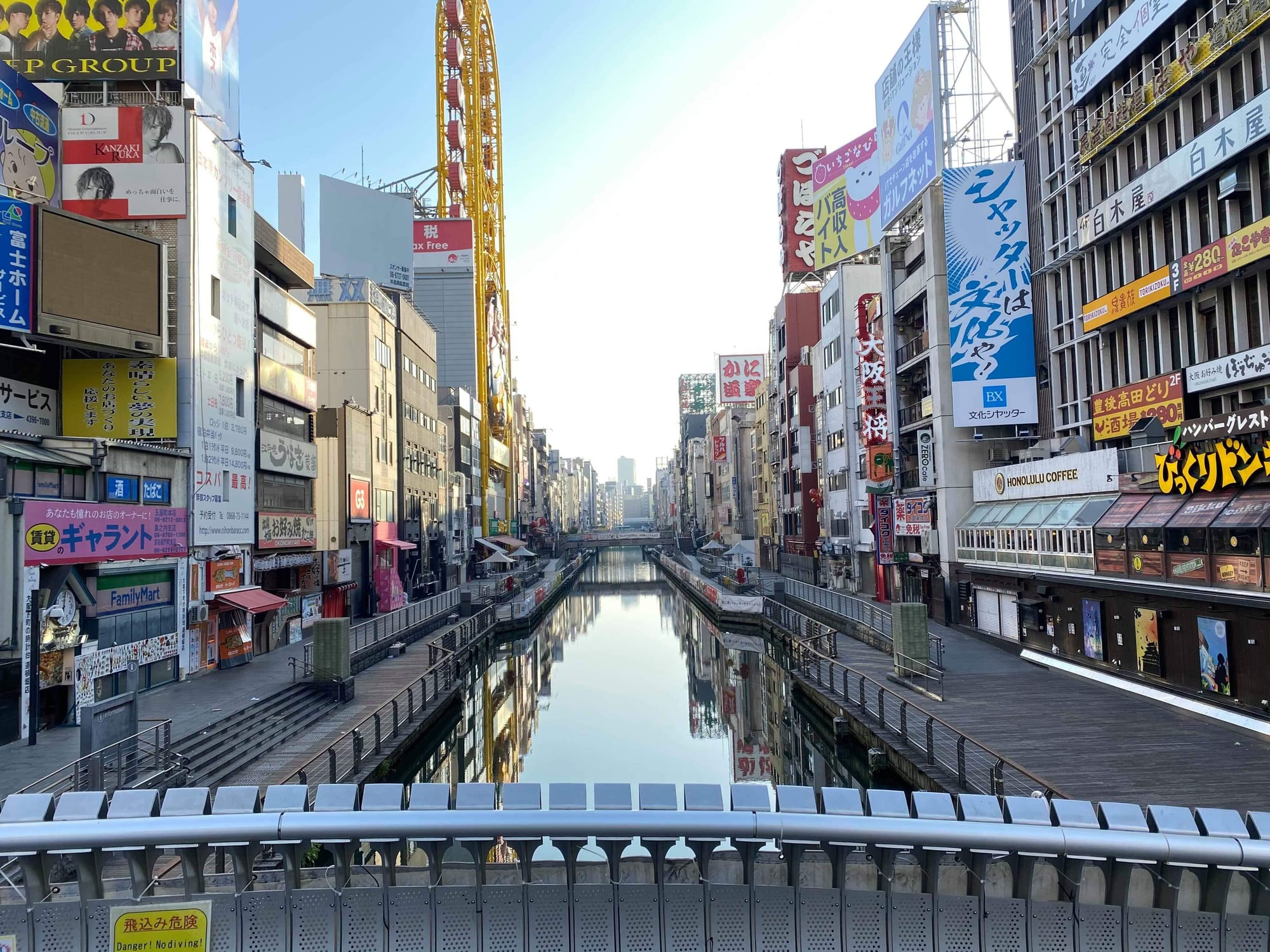
Keep valuables secure in crowded Dotonbori and Shinsaibashi, decline street touting for bars and clubs, and note tsunami and evacuation signage near the bay. Check current official travel advice before travelling.
🌦️ Climate
Humid subtropical, hot in summer and mild in winter, with heat held in by the surrounding built-up plain. The rainy season falls in June and early July, typhoons are possible from August to early October, and the driest and clearest weather comes between November and March.
- Summer
- hot and very humid, usually 32–35°C by day, with warm nights
- Winter
- mild to cool, typically 3–10°C, with little snow
🤝 Local Customs
Osakans have a reputation across Japan for directness, humour and haggling over price, and conversation with strangers comes more easily here than in Tokyo or Kyoto. Local custom holds that kushikatsu sauce is never double-dipped and that eating while standing at a stall is entirely normal, though eating while walking is frowned on in crowded markets.
Tipping is not practised anywhere. Shoes come off in traditional restaurants and homes, tattoos may bar entry to public baths, and queues at stalls and platforms are orderly and should be joined at the back.
💳 Common Payment Methods
The currency is the Japanese yen. Cards and IC cards are widely accepted in shops, chains and hotels, and code payment is common, but small bars, market stalls and older restaurants still work in cash. Convenience-store machines accept foreign cards around the clock.