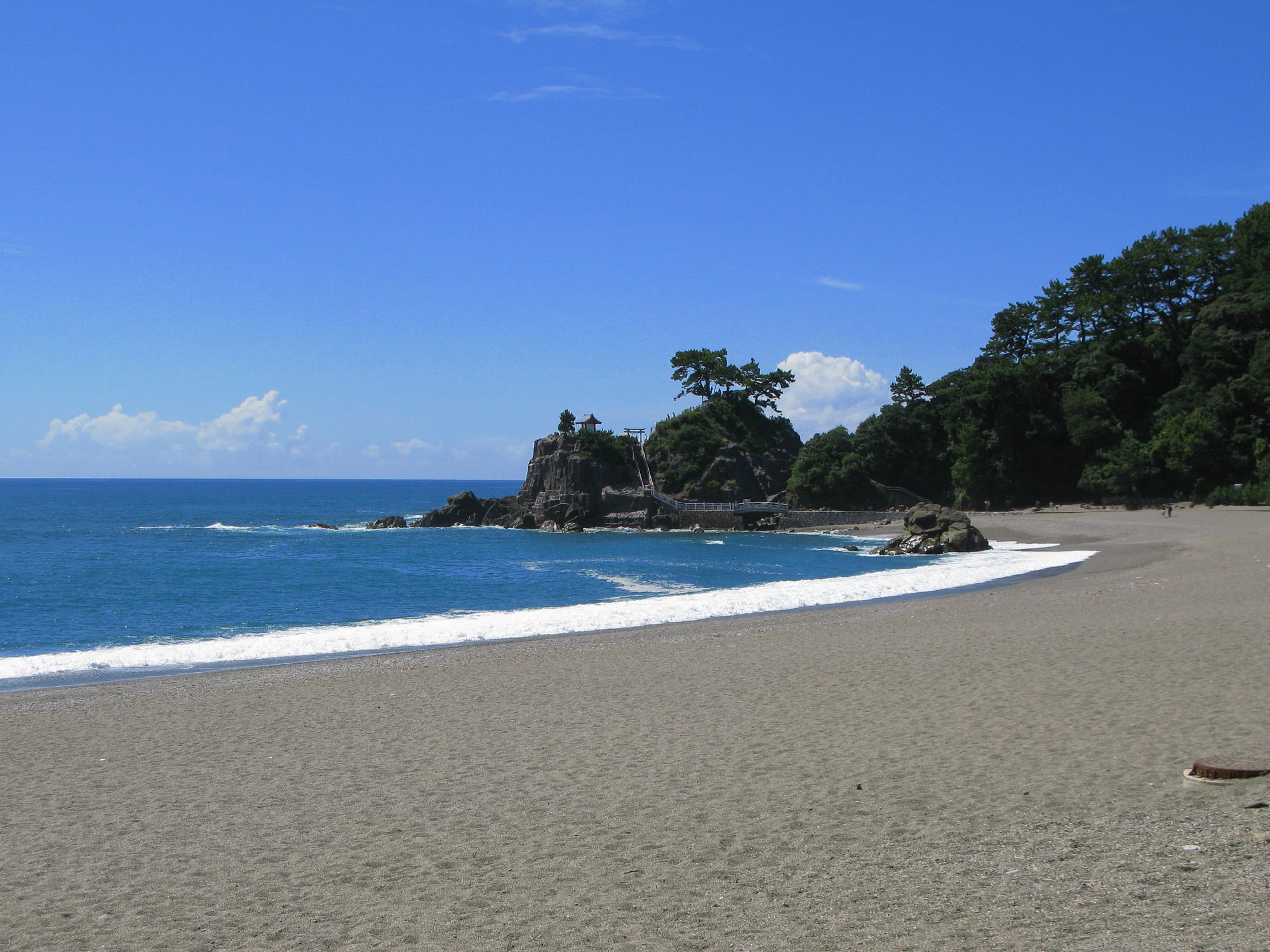
A curving grey sand beach with breaking white surf, deep blue sea and a pine-covered rocky headland with a small shrine

Shikoku, Japan

Kochi

The beach at Katsurahama, on the Pacific coast of Kochi. (京浜にけ / Wikimedia Commons · CC BY-SA 3.0)

The capital of Kochi Prefecture, on Shikoku's Pacific coast between steep mountains and a wide bay. Capital of the old Tosa domain, it keeps one of Japan's few original castle keeps, a street market held every Sunday for centuries, and a reputation for seared bonito, strong drinking and the summer Yosakoi dance festival.

Neighbourhoods

  • Obiyamachi and the central arcades
    • First-time visitors
    • Best for food
    • Nightlife

    The covered shopping streets in the middle of town, a few minutes from the castle, with department stores, cafés and the food hall of Hirome Market. The blocks around them hold hundreds of small bars and izakaya, and the tram lines cross at the eastern end.

    Open in Maps
  • The castle quarter
    • Historic district
    • Museums
    • Quiet and residential

    The hill and moat at the centre of the old samurai town, with the keep, a history museum across the road and broad streets of offices and prefectural buildings around them. It is a short walk from the arcades and from the Sunday market street.

    Open in Maps
  • Around Kochi station
    • Close to public transport
    • Hotels

    The northern edge of the centre, rebuilt around a station with a high timber roof, where most trains and long-distance buses arrive. Business hotels cluster here and a tram runs south to the castle and the arcades in a few minutes.

    Open in Maps
  • Godaisan and the eastern hills
    • Views
    • Gardens
    • Temples

    A wooded hill across the Kagami River from the centre, with a pilgrimage temple, a botanical garden and a lookout over the city and the bay. Below it the river runs down to the port, and the slopes are quiet and residential.

    Open in Maps
  • Katsurahama and the coast
    • Beaches
    • Views
    • Day trips

    About twenty minutes south of the centre by bus, where the city meets the Pacific at a pine-backed beach with a shrine on the headland. The shore is visited for the view, the statue of Sakamoto Ryoma, the aquarium and the memorial museum above the bay rather than for swimming.

    Open in Maps

Things to do

Famous landmarks

  • Kochi Castlelandmark

    One of only twelve castles in Japan to keep an original wooden keep, and the only one where the keep and the lord's palace inside the inner bailey both survive.

    Open in Maps
  • Katsurahamabeach

    A crescent of grey sand under pines where the Pacific meets the city's southern edge, with a small shrine on the rock at one end and a large statue of Sakamoto Ryoma above the beach.

    Open in Maps
  • Harimaya Bridgelandmark

    A short red-railed bridge in the centre of town, famous from a Kochi song about the forbidden love of a Buddhist priest.

    Open in Maps
  • Chikurin-jilandmark

    The thirty-first temple of the Shikoku pilgrimage, on the wooded slope of Godaisan, with a five-storey pagoda and late Edo-period gardens designated a Natural Monument.

    Open in Maps

Museums and gardens

  • Kochi Prefectural Makino Botanical Gardenpark

    A large hillside garden on Godaisan named after the botanist Tomitaro Makino, born in the prefecture, with native plants, glasshouses and a museum of his work.

    Open in Maps
  • Kochi Prefectural Sakamoto Ryōma Memorial Museummuseum

    A museum above Katsurahama devoted to the Tosa samurai who helped bring down the shogunate, with letters, documents and the story of his life and death.

    Open in Maps
  • Kochi Castle Museum of Historymuseum

    A museum opened in 2017 beside the main gate of the castle, holding the Yamauchi family's armour, documents and household objects from the Tosa domain.

    Open in Maps
  • Museum of Art, Kochimuseum

    The prefectural art museum east of the centre, known for a collection of works by Marc Chagall and for a theatre used for Noh and contemporary performance.

    Open in Maps

Markets and city life

  • Hirome Marketmarket

    A covered hall of small food stalls and shared tables near the castle, opened in 1998, where bonito is seared over straw and eaten with local sake.

    Open in Maps
  • Sunday Marketmarket

    A street market held every Sunday along Otesuji, the kilometre-long avenue leading to the castle gate, selling vegetables, fruit, plants, knives and cooked food.

    Open in Maps

Short trips from the city

  • Ryugadoattraction

    One of the three largest limestone caves in Japan, east of the city, with lit galleries, flowstone and traces of Yayoi-period occupation.

    Open in Maps
  • Cape Murotoviewpoint

    A rugged headland of raised rock platforms and subtropical plants on the eastern arm of Tosa Bay, recognised as a UNESCO Global Geopark.

    Open in Maps

Seasonal events

  • Yosakoi FestivalAugust

    Thousands of dancers in teams move through the streets of the city with clappers called naruko, in the festival that began here in 1954 and has since spread across Japan.

  • Cherry blossom at the castlelate March to early April

    The trees inside the castle walls and along the moat flower for a short season, with evening lighting and crowds on the approach to the keep.

  • Bonito seasonspring and autumn

    Skipjack tuna is landed on the Tosa coast in two seasons, and the markets and food halls make a point of the first spring catch and the fattier autumn fish.

Eat and drink

Long-standing places and food districts in Kochi. Hours, ratings and directions come from your maps app, always current.

Kochi classics

  • Katsuo no tatakirestaurant

    Bonito seared hard over a straw fire, sliced thick and eaten with salt, garlic, ginger and citrus — the dish the city is known for, served everywhere from stalls to formal restaurants.

    Open in Maps
  • Sawachi plattersrestaurant

    The Tosa way of feasting — one large platter of sashimi, sushi, fried food and sweets set in the middle of the table for everyone to share, usually with plenty of sake.

    Open in Maps

Markets and food districts

  • Hirome Marketmarket

    A roofed hall of small stalls and communal tables where visitors and office workers eat bonito, fried chicken, gyoza and noodles side by side.

    Open in Maps
  • Obiyamachi and the bar streetsneighborhood

    The arcades and the lanes east of them hold a dense concentration of izakaya, sake bars and small restaurants, busy from early evening in a city with a reputation for drinking.

    Open in Maps
  • Sunday Market on Otesujimarket

    A market street where growers from the surrounding valleys sell yuzu, ginger, vegetables and pickles, with stalls cooking snacks and pressing citrus juice.

    Open in Maps

Experience Kochi

History

The plain at the mouth of the Kagami and Enokuchi rivers was marshy and flood-prone, and the area was known as Kochi only after the town was built on it. In 1601 Yamauchi Kazutoyo, rewarded with the province of Tosa for his part at the battle of Sekigahara, began a castle on the low hill of Otakayama and laid out a town around it; the city took its name from the castle. The Yamauchi ruled Tosa until the end of the shogunate.

The domain's society was unusually divided. Retainers brought in by the Yamauchi held the senior posts, while the descendants of the previous Chosokabe lords formed a lower class of goshi, country samurai with land but little standing. Many of the men who pushed Tosa into national politics came from that group, among them Sakamoto Ryoma, who left the domain without permission, helped broker the alliance between Satsuma and Choshu that undermined the shogunate, and was assassinated in Kyoto in 1867. The domain's final lord advised the shogun to return power to the emperor the same year.

Much of the castle burned in 1727 and was rebuilt between 1729 and 1753, which is why its keep and palace, both surviving today, are eighteenth-century work. In the Meiji period Kochi became a prefectural capital and a centre of the Freedom and People's Rights Movement led by Itagaki Taisuke. Bombing in July 1945 destroyed much of the city but spared the castle. Post-war Kochi rebuilt as a market and administrative town, and it has since lived with the twin realities of a shrinking rural hinterland and the expectation of a great earthquake.

Culture & Customs

Kochi's self-image is built on Tosa independence: a place on the far side of the mountains, loyal to its own, and quick to produce troublemakers and reformers. Sakamoto Ryoma is everywhere, from the statue at Katsurahama to souvenir shops, and the Freedom and People's Rights Movement is remembered as the prefecture's second contribution to modern Japan. The dialect, Tosa-ben, is distinctive and freely used.

The Yosakoi festival dominates the summer. First held in 1954, it sets teams of dancers carrying wooden naruko clappers through streets and squares in August, with choreography and music reworked every year, and versions of it are now danced from Hokkaido to Okinawa. Pilgrims on the 88-temple circuit pass through on the long, thinly populated stretch of the route that Kochi people call the training ground.

Drinking is a social institution here, with cup-exchanging customs, the shared sawachi platter and a long-standing reputation for sake drinking. The Sunday market, running for about a kilometre along the avenue to the castle gate, is as much a weekly meeting as a place to shop. Paper-making at Ino, coral working and Tosa cutlery are the local crafts, and a long tradition of dog and bull contests survives in reduced form.

Daily Life

About 310,000 people live in Kochi, more than two-fifths of the population of a prefecture that is among Japan's most mountainous and most rapidly shrinking. The city is the administrative, retail and hospital centre for that whole area, and prefectural government, services and distribution employ far more people than factories do.

Agriculture and fishing shape the surrounding economy: greenhouse vegetables, aubergines, ginger and yuzu from the valleys, and skipjack tuna landed along the Tosa coast. Forestry covers the interior, where cedar and cypress plantations run up steep slopes. Tourism has grown around the castle, the markets and the rivers, but it is smaller than in the prefectures across the mountains.

Daily life is flat, low-rise and unhurried — trams every few minutes through the middle of town, bicycles on the grid of old streets, shutters down early in the outer arcades and the bar lanes filling after dark. The Sunday market marks the week. Behind it, two issues run through local conversation: the steady loss of young people to Osaka and Tokyo, which has left the prefecture with one of the oldest populations in the country, and preparation for a Nankai Trough earthquake and tsunami, which has brought evacuation towers, signed routes and regular drills to the low ground where most of the city sits.

Food

Kochi is a fish prefecture, and its emblem is katsuo no tataki: a loin of skipjack tuna seared hard over a fire of burning rice straw so that the outside chars while the centre stays raw, then sliced thick and eaten with coarse salt or a citrus and soy dressing, with garlic, ginger and sliced onion. Spring fish are lean and fragrant, autumn fish fatter. Straw-fired searing is done in the open at Hirome Market and at restaurants along the coast.

The Tosa table is a shared one. Sawachi ryori piles sashimi, sushi, fried food, boiled dishes and sweets onto one large platter for the whole party, a style tied to the region's drinking culture. Other local foods include utsubo, moray eel, fried or stewed; whitebait served raw or on rice; dried bonito flakes and the broth made from them; and the kombu-and-citrus dressing known as tosa-zu. Chicken and gyoza stalls fill the food halls.

Yuzu is Kochi's great crop, grown in the mountain valleys and squeezed over fish, noodles and shochu, along with other citrus such as buntan pomelo. Ginger from the prefecture flavours pickles and drinks. Local sake breweries supply the dry style that suits raw fish, and the city keeps a fondness for aisukurin, a light, icy dairy sweet sold at kiosks at Katsurahama and around the castle.

Planning tools

Budget

Kochi is one of the cheaper prefectural capitals. Business hotels near the station and the arcades are inexpensive, market food and set meals cost little, and the castle grounds, the Sunday market and Katsurahama cost nothing to visit. Reaching the prefecture's coasts and rivers is the main expense, since it usually means a hire car.

Daily Budget Midrange
USD 95–180 (business hotel or ryokan with dinner, restaurants and sake, limited-express trains or a hire car)
Daily Budget Shoestring
USD 45–70 (guesthouse or budget business hotel, market food and set meals, trams and city buses)

Trams and buses take IC cards; a hire car pays for itself only for the Shimanto River, the capes or the mountain valleys.

Best Time to Visit

Spring and autumn are the most comfortable, and both are bonito seasons. August brings the Yosakoi festival and great heat and humidity. Late summer and early autumn are the typhoon months on this coast, when heavy rain can close roads and trains. Winter is mild, sunny and quiet.

Suggested Number of Days

Two days are enough for the city, better if one is a Sunday for the market. Four to six allow the coasts and the rivers of the prefecture, which are far apart and slow to reach. Weather and car hire change the number more than anything else.

First Visit
2 days
With Surroundings
4–6 days

Transportation

A tram network run by Tosaden Kotsu, the second longest in Japan, crosses the city on three lines, running east to west through the centre and south from the station towards the port, and city buses reach Katsurahama, Godaisan and the suburbs. The centre is flat and suited to cycling. Distances within the prefecture are long, and public transport thins out quickly beyond the city.

Buses to Katsurahama and Godaisan are not frequent, so check return times; a car is the practical way to see the rest of Kochi Prefecture.

Airport & Station Connections

Limited-express trains cross the mountains from Okayama in about two and a half hours, using the Shinkansen connection there, and others run from Takamatsu and Tokushima. Kochi Ryoma Airport lies about thirteen kilometres east of the centre, with a bus link and flights to Tokyo, Osaka, Nagoya and Fukuoka. Overnight buses run from Osaka and Tokyo.

Walkability

The central grid of the old castle town is flat and compact: the castle, the arcades, Hirome Market and the Sunday market street are within fifteen minutes of each other on foot, and the station is a short tram ride or a twenty-minute walk north. Katsurahama, Godaisan and the airport need a bus or a car.

Safety

Kochi is a very safe city with little street crime, and the nightlife district is busy but calm. Natural hazards matter more: this coast takes direct hits from typhoons, rainfall here is among the heaviest in Japan, and the shore lies in the zone expected to be affected by a Nankai Trough earthquake and tsunami. The Pacific surf on this open coast is strong.

Note the tsunami evacuation signs and towers along the coast, avoid rivers and mountain roads during heavy rain, and take care in the surf on the open Pacific shore. Check current official travel advice before travelling.

Climate

The Pacific side of Shikoku is warm and very wet. Sunshine hours are high, but so is rainfall: the rainy season in June and July and the typhoon months of August to October bring torrential downpours, and the mountains behind the city record some of the country's highest totals.

Summer
hot and humid, generally 27–34°C, with heavy rain and typhoons
Winter
mild, generally 5–13°C, with frequent sunshine and rare snow on the coast

Local Customs

Tipping is not practised. Kochi people have a national reputation for hospitality and for drinking: sake is poured for others rather than for oneself, and cups are refilled readily, so it is normal and accepted to slow down or decline. Shoes come off in temples and traditional restaurants, and pilgrims in white are treated with courtesy.

Take the kenpai and henpai cup-exchange customs lightly if offered, ask before photographing people at the Sunday market, and keep quiet inside pilgrimage temples.

Common Payment Methods

The currency is the Japanese yen. Cards and IC cards work in hotels, shops and the trams, but market stalls, small izakaya and rural buses often take cash only. Convenience store and post office cash machines accept foreign cards.