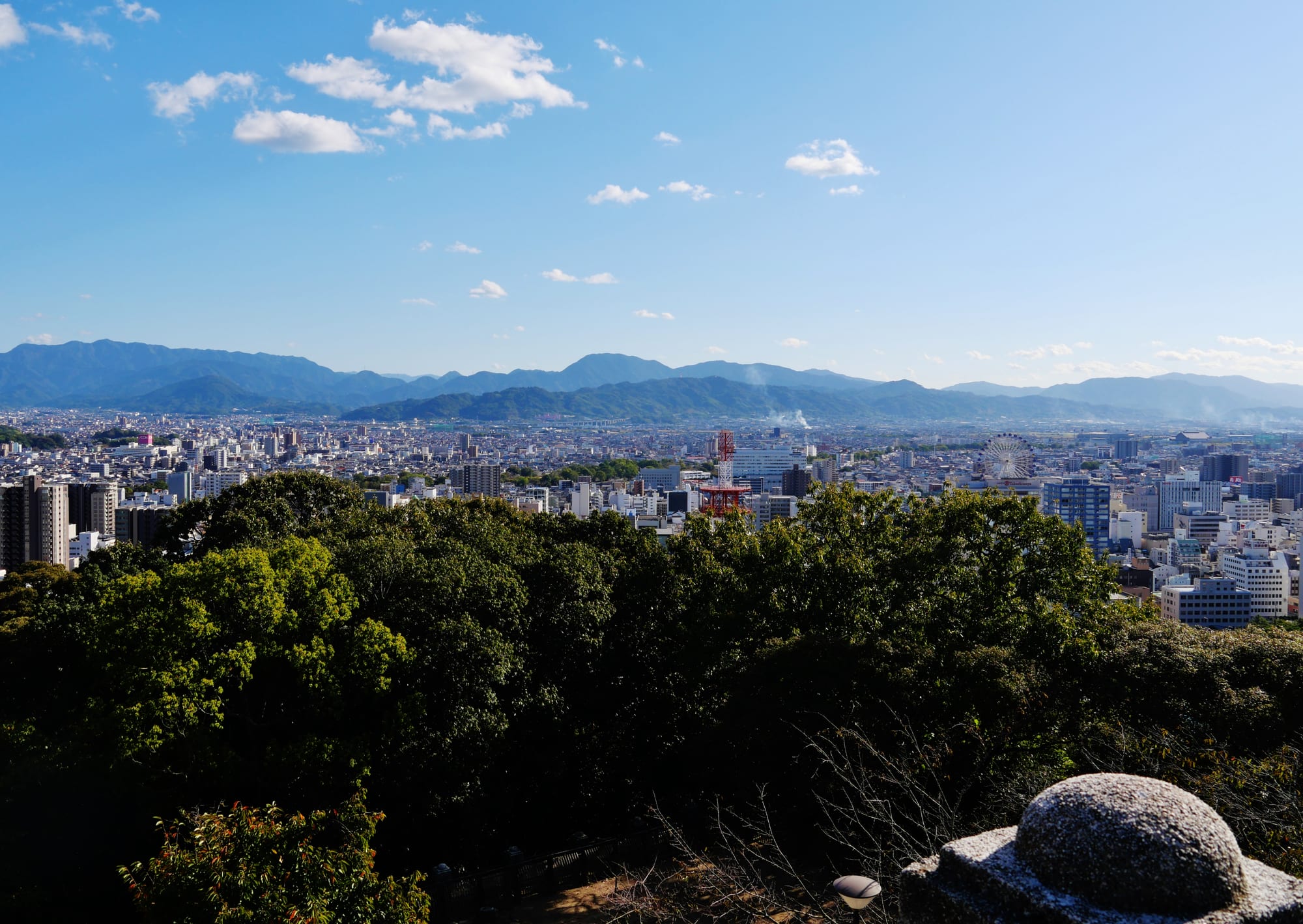
A low city of white and grey buildings spreading across a plain towards blue mountain ridges, seen over dark treetops

Shikoku, Japan

Matsuyama

Matsuyama and the mountains of Ehime, seen from the castle grounds. (Zairon / Wikimedia Commons · CC BY 4.0)

The largest city on Shikoku and the capital of Ehime Prefecture, on a plain between the Inland Sea and the mountains of Iyo. An early seventeenth-century castle still stands on the hill at its centre, the hot spring quarter of Dogo has been bathed in for centuries, and the city claims a haiku tradition unmatched in Japan.

Neighbourhoods

  • Okaido and Ichibancho
    • First-time visitors
    • Best for food
    • Close to public transport

    The commercial centre below the castle hill, built around covered shopping arcades that run south from the ropeway street. Department stores, izakaya, bars and most of the city's hotels are here, and the tram lines and the private railway's city terminus meet a few minutes away.

    Open in Maps
  • Dogo
    • Hot springs
    • Historic district
    • Relaxed evenings

    The hot spring quarter about three kilometres east of the centre, reached by tram. A covered shopping street runs from the tram terminus to the old wooden bathhouse, with inns, souvenir shops and cafés around it and a wooded park on the hill behind.

    Open in Maps
  • Around Matsuyama Station
    • Close to public transport
    • Quiet and residential

    The JR station sits west of the centre, away from the main shopping streets, in a plainer district of offices, business hotels and small restaurants. It is the arrival point for trains from Okayama and the rest of Shikoku, and trams connect it to the castle and Dogo.

    Open in Maps
  • Mitsuhama and Takahama
    • Seafood
    • Local life
    • Ferries

    The coastal districts north-west of the city, where the fishing harbour, fish shops and the passenger port face the Inland Sea. Ferries and fast boats to Hiroshima and the nearby islands leave from here, and the beach and island views are close by.

    Open in Maps

Things to do

The castle and the city centre

  • Matsuyama Castlelandmark

    A hilltop castle begun in 1602 whose connected keep, rebuilt in 1854, is one of twelve in Japan surviving from the feudal era, reached on foot, by chairlift or by ropeway.

    Open in Maps
  • Ninomaru Historical Gardenpark

    The second bailey of the castle, laid out as a garden below the keep on the site of the lords' residence, whose foundations are traced in stone and planting.

    Open in Maps
  • Saka no Ue no Kumo Museummuseum

    A concrete and glass museum by Tadao Ando devoted to Shiba Ryotaro's novel about three Matsuyama men and the Meiji era they lived through.

    Open in Maps
  • Shiki Memorial Museummuseum

    A museum in Dogo Park on the life and work of Masaoka Shiki, the poet who reshaped haiku and died at thirty-four.

    Open in Maps

Dogo and the hot springs

  • Dogo Onsen Honkanlandmark

    The three-storey wooden public bathhouse of 1894, with a bath reserved for the imperial family, at one of the oldest hot springs recorded in Japanese literature.

    Open in Maps
  • Isaniwa Shrinelandmark

    A vermilion shrine of 1667 above Dogo, reached by a long stone stairway, built in the hachiman-zukuri style and modelled on Iwashimizu Hachiman-gu in Kyoto.

    Open in Maps
  • Dogo Parkpark

    A wooded hill in the middle of Dogo that was the moated castle of the Kono clan, with excavated foundations, a small museum and cherry trees.

    Open in Maps

Pilgrimage temples

  • Ishite-jilandmark

    The fifty-first temple of the Shikoku pilgrimage, a short walk from Dogo, with a Kamakura-period gate and three-storey pagoda.

    Open in Maps
  • Taisan-jilandmark

    The fifty-second temple, on a wooded hillside north-west of the city, whose main hall, a National Treasure, dates from the early fourteenth century.

    Open in Maps
  • Joruri-jilandmark

    The forty-sixth temple, in the rice fields south of the city, known for its old trees and for stones inscribed with haiku by Shiki.

    Open in Maps

Short trips from the city

  • Imabari Castlelandmark

    A rare sea castle north-east of Matsuyama whose moats fill with tidal salt water from the Inland Sea.

    Open in Maps
  • Shimanami Kaidotrail

    The chain of bridges and island roads from Imabari towards Onomichi, carrying a cycling and walking path across almost all of its crossings.

    Open in Maps
  • Uchikoneighborhood

    A town south of the city that grew rich on wax-making, keeping a street of plastered merchant houses and a restored wooden kabuki theatre.

    Open in Maps
  • Ozu Castlelandmark

    A castle above the Hiji River in a small riverside town, its wooden keep rebuilt in 2004 using traditional methods.

    Open in Maps
  • Mount Ishizuchitrail

    The highest mountain in western Japan, a sacred peak east of the city climbed by chain ladders and served by a ropeway.

    Open in Maps

Seasonal events

  • Dogo Onsen FestivalMarch

    Three days of processions, drumming and dancing in the hot spring quarter, opening with a rite at the bathhouse.

  • Cherry blossom at the castlelate March to early April

    Blossom on the castle hill and in Dogo Park, when the grounds stay open in the evening and fill with picnics.

  • Matsuyama Summer FestivalAugust

    Dance troupes, street stalls and fireworks over the city centre in the hottest weeks of the year.

  • Matsuyama Autumn FestivalOctober

    Neighbourhood shrine festivals in which teams carry heavy portable shrines through the streets before dawn and charge them into one another.

Eat and drink

Long-standing places and food districts in Matsuyama. Hours, ratings and directions come from your maps app, always current.

Matsuyama classics

  • Nabeyaki udon shopsneighborhood

    A local habit of udon served in a small aluminium pot in a sweet, light broth, sold in a handful of long-standing shops in the central arcades.

    Open in Maps
  • Taimeshi restaurantsneighborhood

    Sea bream with rice, cooked together in a pot in the Matsuyama manner, is on the menu of seafood restaurants across the centre and at the port.

    Open in Maps

Food districts and markets

  • Okaido and Ginten-gai arcadesneighborhood

    The covered shopping streets and the lanes behind them hold izakaya, sushi counters, ramen shops and bars, and are where the city eats at night.

    Open in Maps
  • Dogo Haikara-dorineighborhood

    The covered street between the tram terminus and the bathhouse, lined with sweet shops, cafés, citrus juice stands and souvenir sellers.

    Open in Maps
  • Mitsuhama fish shopsmarket

    The old fishing quarter by the harbour, with fishmongers and small restaurants working from the day's landings in the Inland Sea.

    Open in Maps

Experience Matsuyama

History

The hot spring at Dogo is the oldest thing here: it appears in the eighth-century chronicles and in the Man'yoshu poetry collection, and legend has visiting princes and the regent Shotoku bathing in it. Through the medieval centuries the plain was held by the Kono clan from Yuzuki Castle, a moated fortress on the low hill in what is now Dogo Park, and the district grew up around the bath and the pilgrimage temples.

The city proper began in 1602, when Kato Yoshiaki started a castle on Mount Katsuyama and gave the new town the name Matsuyama. He was moved on before it was finished; the Gamo family followed, and from the 1630s a branch of the Matsudaira, relatives of the Tokugawa shoguns, ruled the Iyo-Matsuyama domain until the Meiji Restoration. Lightning burned the keep in 1784, and the rebuilt one, completed in the 1850s, is the one that stands today — among the last castle keeps raised in the feudal era.

The modern city took shape around the castle and the silk, cotton and kasuri-weaving trades. Masaoka Shiki was born here in 1867 and remade Japanese haiku before his early death, and his friend Natsume Soseki taught at the middle school here in the 1890s, drawing on the experience for the comic novel Botchan, which the city has traded on ever since. An air raid in July 1945 destroyed much of the centre and burned several castle buildings, though the keep survived. Rebuilt, merged with neighbouring towns and given a university and a port, Matsuyama became Shikoku's largest city and the island's commercial centre.

Culture & Customs

Matsuyama calls itself a city of haiku, and means it. Shiki's insistence on writing from direct observation changed the form nationally, and his disciples Takahama Kyoshi and Kawahigashi Hekigoto carried the work on. Post boxes shaped for haiku submissions stand at the castle, the station and Dogo, verses are carved on stones along temple paths, and school and national competitions keep the habit alive.

Bathing is the other local ritual. Dogo's public baths are used by residents as much as by visitors, with a code of conduct learned in childhood, and the quarter's inns, sweet shops and evening strolls in cotton yukata belong to the same tradition. Literary tourism runs alongside it: Botchan's name is attached to an antique tram on the city tramway, to three-coloured dumplings and to the city's baseball stadium.

The 88-temple pilgrimage passes straight through the city, and eight of its temples lie within the boundaries, so white-clad walkers are part of ordinary street life and osettai, the custom of giving pilgrims food or small gifts, survives. Ehime is proud of its crafts — indigo-dyed kasuri cotton, Tobe porcelain from the town just to the south — and of its clubs, the Ehime Mandarin Pirates in baseball and Ehime FC in football. People here are considered easygoing by Japanese standards, and the local speech, Iyo-ben, is soft and drawn out.

Daily Life

About 500,000 people live in Matsuyama, making it the largest city on Shikoku and a good deal bigger than the other prefectural capitals. Most of them live on the plain between the castle and the sea, in a spread of low houses and flats that reaches the foothills, with the arcades, offices and department stores of the centre at its core.

The economy is built on administration, retail, health care and education — Ehime University and a medical school are here — along with chemical and paper plants on the coast, the port and a farming belt of mandarin orchards on the hillsides. Ehime grows some of the country's best-known citrus, and juice, jelly and dried peel are made in the city's factories. Tourism, centred on the castle and Dogo, employs many, and the growth of cycling on the Shimanami Kaido has drawn more visitors to the region.

Daily rhythms are those of a mid-sized Japanese city, but slower: trams every few minutes through the centre, school children cycling on the flat streets, shops in the arcades shutting in the early evening while the izakaya fill. Ageing and the drift of young people to Osaka and Tokyo are the persistent worries, along with preparing for a Nankai Trough earthquake and keeping rural bus and rail links to the rest of Ehime running.

Food

Sea bream is the city's fish. Taimeshi in the Matsuyama manner is a whole bream cooked with rice in a pot and then flaked through it, a dish tied to the Inland Sea and distinct from the Uwajima version further south, where raw slices are dressed with a soy and egg sauce and poured over rice. Jakoten, small fish blended to a paste and fried, is a speciality of Uwajima in southern Ehime and is eaten right across it, and the same waters supply octopus, conger and sweet shrimp for the counters at Mitsuhama.

The everyday dish is nabeyaki udon: soft noodles in a sweet, clear broth served in a small aluminium pot, a Matsuyama style that has been sold in the same few shops in the arcades for generations. Goshiki somen, fine wheat noodles dyed in five colours and dried in bundles, is a Matsuyama speciality and as much a gift as a meal.

Sweets are a local strength. Botchan dango, three skewered rice dumplings in green tea, egg and red bean, take their name from Soseki's novel; Matsuyama taruto is a thin sponge rolled around sweet bean paste, said to derive from a Portuguese cake brought through Nagasaki; and Dogo's shops sell both to bathers. Above all there is citrus: mandarins, iyokan, and dozens of crossbred varieties grown on the terraces around the city, squeezed into juice at stands and taps across Dogo and sold by the box in autumn and winter.

Planning tools

Budget

Matsuyama is inexpensive for a regional capital. Business hotels near the station and the arcades are cheap, a bowl of udon or a set lunch costs little, and the castle, the bathhouse and the temples all charge modest entry. A night in a Dogo ryokan with dinner is the main splurge, and trains or a hire car for the rest of Shikoku add the most to a budget.

Daily Budget Midrange
USD 95–180 (business hotel or ryokan with dinner, restaurants, limited-express trains or a hire car)
Daily Budget Shoestring
USD 40–65 (hostel or budget business hotel, udon and set lunches, trams)

Day tickets for the city trams pay for themselves quickly, and the public baths at Dogo cost a fraction of a ryokan stay.

Best Time to Visit

Spring and autumn are the best seasons: blossom on the castle hill in late March and early April, and clear, mild days from October to November when the citrus ripens. Summer is hot and humid, with typhoons possible in late summer. Winter is mild on this coast and suits hot spring bathing, though the mountains inland hold snow.

Suggested Number of Days

Two days is the usual length of stay in the city itself. Four or five allow the rest of Ehime and the Inland Sea coast, and pilgrims following the temple circuit stay longer. Slow rural transport is the main reason to allow extra time.

First Visit
2 days
With Surroundings
4–5 days

Transportation

Matsuyama runs on trams. Private Iyotetsu lines cross the centre and loop around the castle, linking the JR station, the city-centre terminus and Dogo, and a small steam-style tourist tram runs on the same tracks. Suburban trains reach the port and the countryside, and city buses fill the gaps. Bicycles are widely used on the flat plain, and a hire car helps for the mountains and the southern towns.

The JR station and the private Matsuyama City station are different places about a kilometre and a half apart — check which one a ticket or hotel refers to.

Airport & Station Connections

Matsuyama Airport lies about six kilometres west of the centre, with flights to Tokyo, Osaka, Fukuoka and Okinawa and a bus into town in around twenty minutes. Limited-express trains reach Okayama, on the Shinkansen line, in under three hours by way of the Great Seto Bridge. Express buses run to Osaka and other cities, and ferries and fast boats cross the Inland Sea to Hiroshima from the port at Takahama.

Walkability

The centre is flat, compact and easy to walk, with covered arcades that keep off sun and rain; the castle hill is the only climb, and a ropeway and chairlift take the strain. Dogo is a pleasant walking quarter in itself but too far from the centre to walk comfortably, so most people take the tram between the two.

Safety

Matsuyama is a very safe city with little violent crime, and pilgrims passing through are traditionally treated with kindness. The hazards are natural: typhoons and torrential rain in late summer, landslides on mountain roads inland, and the long-term risk of a major Nankai Trough earthquake and tsunami affecting the coasts of Shikoku.

Note tsunami and evacuation signs near the coast, check for road and rail closures after heavy rain, and take care with trams when crossing central streets. Check current official travel advice before travelling.

Climate

A mild Inland Sea climate, sheltered by mountains and drier and sunnier than the Pacific side of Shikoku. Rain comes mainly in the June rainy season and with autumn typhoons; snow in the city is rare and light.

Summer
hot and humid, generally 28–34°C, with muggy nights
Winter
mild, generally 3–11°C, with frost but little lasting snow on the plain

Local Customs

Tipping is not practised in Japan. Bathing etiquette matters at Dogo: wash and rinse thoroughly before entering the water, take in only a small towel, keep it out of the bath, and expect tattoos to be refused at some baths. Shoes come off at inns, temples and many restaurants. Pilgrims in white vests and sedge hats are a normal sight and are given way to.

Photography is discouraged inside bathhouses and temple halls, greetings are a small bow rather than a handshake, and rubbish is usually carried away, as public bins are rare.

Common Payment Methods

The currency is the Japanese yen. Cards and code payments work at hotels, department stores, chains and larger restaurants, and on the trams, but small shops, older bathhouses and rural buses may want cash. Post office and convenience store machines take foreign cards; many bank machines do not.