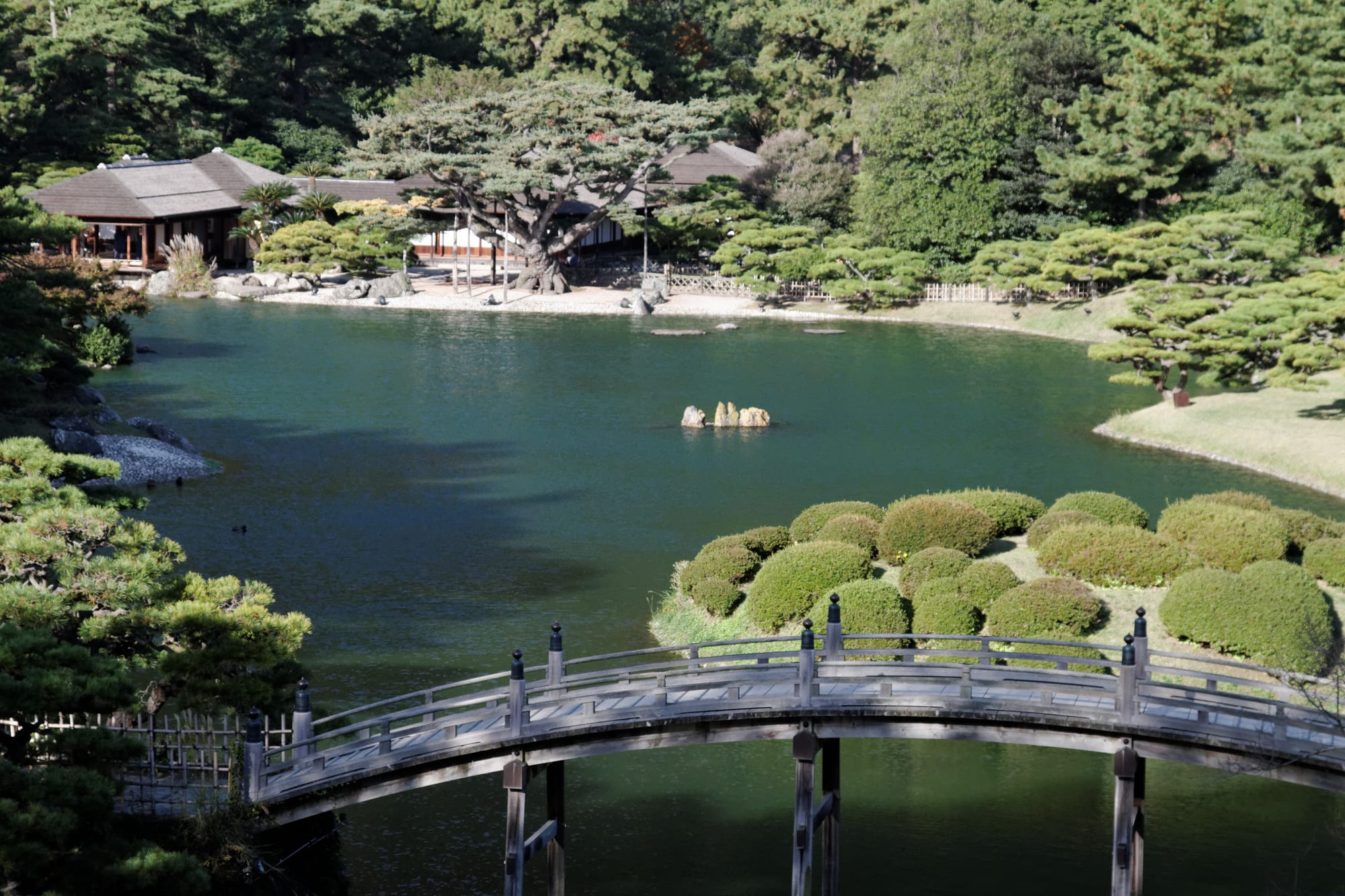
An arched wooden bridge over a dark green pond in a Japanese garden, with clipped shrubs, pines and a wooden teahouse on the far shore

Shikoku, Japan

Takamatsu

The Engetsukyo bridge over the South Pond in Ritsurin Garden, Takamatsu. (KimonBerlin / Wikimedia Commons · CC BY-SA 2.0)

The capital of Kagawa Prefecture, on Shikoku's northern coast facing the Seto Inland Sea. A castle town that became the island's main port and gateway from Honshu, it is known for the great strolling garden of Ritsurin, for cheap and serious Sanuki udon, and for the ferries that leave its harbour for the art islands offshore.

Neighbourhoods

  • Central arcades — Marugamemachi and Kawaramachi
    • First-time visitors
    • Shopping
    • Close to public transport

    The covered shopping streets that run south from the castle grounds form one of the longest arcade networks in the country, with department stores, udon counters, standing bars and small shops. Most of the city's hotels are within a few minutes' walk, and the private Kotoden railway and the city's buses meet at its edges.

    Open in Maps
  • Sunport and the harbour
    • Ferries and islands
    • Close to public transport
    • Waterfront

    The redeveloped waterfront beside JR Takamatsu station, with a tall symbol tower, open plazas and a long breakwater walk out to a red glass lighthouse. Ferries and fast boats to the Inland Sea islands leave from the piers here, so a great many visits begin and end in this square kilometre.

    Open in Maps
  • Around Ritsurin Garden
    • Quiet and residential
    • Gardens
    • Close to public transport

    A calmer district about three kilometres south of the harbour, where the garden's pine-covered hillside backs onto ordinary streets of houses, schools and small restaurants. Two railway stations serve it, and it suits travellers who want space and greenery rather than the arcades.

    Open in Maps
  • Yashima and the eastern coast
    • Views
    • History
    • Day trips

    The flat-topped lava plateau east of the centre rises straight from the sea, with a temple of the 88-temple pilgrimage on top and views over the islands. Below it are the villages of the old Mure and Aji stone-cutting district, long associated with granite quarrying and sculpture.

    Open in Maps
  • Kita-hama and the old warehouses
    • Cafés and bars
    • Nightlife
    • Waterfront

    A short row of converted timber and tin warehouses on the harbour front north-east of the station, now holding cafés, bars, galleries and small shops. It is one of the few places in the city where the working port and the evening crowd meet.

    Open in Maps

Things to do

Gardens, landmarks and museums

  • Ritsurin Gardenpark

    One of Japan's largest and most admired strolling gardens, laid out by the lords of Takamatsu over most of a century, with ponds, small artificial hills, clipped pines and the wooded slope of Mount Shiun as a borrowed backdrop.

    Open in Maps
  • Takamatsu Castlelandmark

    The remains of one of only three castles in Japan with seawater moats, with restored turrets and gates in the park beside the harbour.

    Open in Maps
  • Yashima-jilandmark

    The eighty-fourth temple of the Shikoku pilgrimage, on top of the steep Yashima plateau, the site of a decisive battle of the Genpei War in 1185, with wide views over the Inland Sea.

    Open in Maps
  • Shikoku Muramuseum

    An open-air museum at the foot of Yashima where more than twenty farmhouses and working buildings of the Edo to Taisho periods, four of them Important Cultural Properties, have been moved from across the island and rebuilt on a wooded hillside.

    Open in Maps

Islands and the sea

  • Megijimaattraction

    A small island twenty minutes out of the harbour, with a sandy beach, thousands of cherry trees and a hilltop cave linked in local legend to the tale of Momotaro.

    Open in Maps
  • Ogijimaattraction

    A steep fishing island of narrow lanes and stacked houses, with art works and a lighthouse of unpainted granite at its northern tip.

    Open in Maps
  • Shodoshimaattraction

    The largest island off Takamatsu, known for olive groves, soy sauce breweries, a gorge that colours in autumn and a sandbar that appears at low tide.

    Open in Maps
  • Port of Takamatsutransit hub

    The ferry harbour at Sunport, with services to Shodoshima, Naoshima, Megijima, Ogijima and Kobe leaving from piers beside the station.

    Open in Maps

Short trips from the city

  • Kotohira-gulandmark

    The great shrine of the sea gods at Kotohira, about thirty kilometres south-west, reached by a stone stairway of 785 steps to the main shrine and 1,368 to the inner one.

    Open in Maps
  • Zentsu-jilandmark

    The seventy-fifth temple of the pilgrimage and the reputed birthplace of Kukai, with a five-storey pagoda, in the town of the same name west of the city.

    Open in Maps
  • Marugame Castlelandmark

    One of the twelve castles in Japan that keep an original wooden keep, standing on very high stone walls above the town of Marugame.

    Open in Maps
  • Naoshimaattraction

    The contemporary art island in the Inland Sea, an hour by ferry from the harbour, with concrete museums, installation houses and outdoor sculpture.

    Open in Maps

Seasonal events

  • Setouchi Triennalespring, summer and autumn sessions, every three years

    A contemporary art festival spread across the islands of the Inland Sea and the Takamatsu waterfront, with the city as its main mainland gateway.

  • Cherry blossom in the castle and gardenlate March to early April

    The trees in Tamamo Park and around Ritsurin's ponds draw evening crowds for the short flowering season.

  • Autumn colour at RitsurinNovember to early December

    The maples on the garden's slopes and around the South Pond turn, and the grounds open into the evening with lighting.

Eat and drink

Long-standing places and food districts in Takamatsu. Hours, ratings and directions come from your maps app, always current.

Takamatsu classics

  • Sanuki udon countersrestaurant

    The city and the countryside around it are full of plain, often self-service shops serving thick, firm wheat noodles hot in dashi or cold with a dipping sauce, with tempura chosen from a tray.

    Open in Maps
  • Honetsuki-dori grillsrestaurant

    Whole chicken legs roasted on the bone with garlic and pepper, a dish from Marugame that has become Kagawa's best-known food after udon, served in small, smoky restaurants around the central arcades.

    Open in Maps

Food districts and markets

  • Marugamemachi and the central arcadesneighborhood

    Covered shopping streets lined with noodle counters, coffee shops, izakaya and confectioners selling wasanbon, the fine-grained sugar made in the prefecture.

    Open in Maps
  • Kawaramachi and Furubabacho at nightneighborhood

    The blocks east of the arcades hold most of the city's small bars and izakaya, where Inland Sea fish, olive-fed beef and local sake are the usual order.

    Open in Maps
  • Kita-hama Alleyneighborhood

    Converted harbour warehouses with cafés, a bakery and bars looking onto the water, busiest in the early evening.

    Open in Maps

Experience Takamatsu

History

The bay that Takamatsu sits on was a natural harbour on the Inland Sea route between the capital region and Kyushu, and the plateau of Yashima above it was fortified in the seventh century with one of the Korean-style mountain fortresses raised after the court's defeat on the continent. In 1185 the shore beneath Yashima was the scene of one of the decisive battles of the Genpei War, when Minamoto forces drove the Taira from their camp and out to sea; the episode is retold in the Tale of the Heike and has kept the hill famous ever since.

The city proper begins in 1588, when Ikoma Chikamasa built a castle with its walls lapped by the sea and laid out a town around it. From 1642 Takamatsu was held by a branch of the Matsudaira, relatives of the ruling Tokugawa, who governed Sanuki province from here for more than two centuries and turned a lakeside villa south of the town into the garden now called Ritsurin, adding to it for roughly a hundred years.

The castle keep was taken down in 1884, and the town became the capital of the new Kagawa Prefecture and the island's administrative centre. Its harbour carried the railway ferry from Uno on Honshu, which made Takamatsu the front door to Shikoku. Much of the built-up area was destroyed by an air raid in July 1945 and rebuilt on a wider grid. The Great Seto Bridge, opened in 1988, ended the ferry's monopoly and reshaped the city's role, and the waterfront it left behind has since been rebuilt as the Sunport district.

Culture & Customs

Takamatsu's culture is shaped by the sea in front of it and the pilgrimage behind it. White-clad henro walking the 88-temple circuit pass through the eastern suburbs on their way to Yashima-ji and the temples beyond, and the custom of osettai — giving pilgrims food, drink or a small gift — is still practised in Kagawa. Kotohira-gu, the shrine of the sea gods a short way inland, drew pilgrims from all over Japan in the Edo period, and its stairway remains one of the region's set journeys.

The city has an unusually strong connection with modern art and design. Kenzo Tange's prefectural office of 1958 was an early landmark of post-war Japanese architecture, the sculptor Isamu Noguchi's studio and garden in the granite quarrying district of Mure on the city's eastern edge is now a museum, and since 2010 the Setouchi Triennale has used Takamatsu's port as the gateway to island venues, bringing large numbers of visitors to boats that once carried only commuters and freight.

Older crafts survive alongside. Kagawa lacquerware, also called Takamatsu lacquerware, is made in the prefecture, wasanbon sugar is still made by hand there, and Marugame's round paper fans are made nearby. Village kabuki stages recall a tradition of amateur theatre in the farming districts. Locals are direct, informal and proud of their noodles to a degree that outsiders find comic.

Daily Life

About 400,000 people live in Takamatsu, making it the second-largest city on Shikoku after Matsuyama and the island's business centre. Many national companies run their Shikoku branch offices here, and government, banking, retail and logistics employ far more people than manufacturing. The port still handles freight and island traffic, and the surrounding plain grows rice, wheat, olives and vegetables.

The pattern of the day is provincial and steady. Commuters ride the Kotoden or drive in from suburbs that spread across the flat land towards the mountains, the arcades fill at lunchtime and again after work, and many people eat udon for breakfast or lunch without thinking it unusual. The waterfront at Sunport is used for walking, running and school trips as much as for ferries.

Like the rest of Shikoku, the city is ageing and its wider region is losing people, which shows in closed shops at the far ends of the arcades and in thinning bus timetables in the villages. Takamatsu itself has held up better than most of the island, helped by its administrative role and by tourism around the Inland Sea art islands, which has brought foreign visitors to a city that saw very few a generation ago. Water supply — an old problem in a dry prefecture — and disaster preparation for a Nankai Trough earthquake are steady local concerns.

Food

Kagawa calls itself the udon prefecture, and Takamatsu is where most visitors meet Sanuki udon: thick wheat noodles with a firm, almost springy bite, made with local wheat and salt and served in many styles. Kake udon comes in a light dashi broth made from iriko, the local dried sardines; bukkake is dressed with a small amount of concentrated sauce; kamatama mixes noodles straight from the pot with raw egg and soy; zaru udon is cold with a dipping sauce. Many shops are self-service, with customers rinsing their own noodles and picking tempura or rice balls from a counter.

The other local dish is honetsuki-dori, a whole chicken leg seasoned with salt, pepper and garlic and roasted on the bone, first sold in Marugame in the 1950s and now on menus across the prefecture, ordered from an older bird for chew or a young one for tenderness. Fish from the Inland Sea is a constant: sea bream, hamachi yellowtail farmed off the Kagawa coast, sawara mackerel eaten raw in spring, and anago conger eel. Olives from Shodoshima flavour oil and pickles, and some cattle and yellowtail are fed on the pressed olive fruit.

For sweets, wasanbon — a pale, fine-grained sugar made from a local cane and pressed into small moulded shapes — is served with tea, and anmochi zoni, a New Year soup of white miso with a rice cake stuffed with sweet bean paste, is a Kagawa peculiarity that outsiders find hard to believe. Local sake breweries and a growing number of small coffee roasters fill out the rest.

Planning tools

Budget

Takamatsu is inexpensive by Japanese standards. Business hotels near the station and the arcades are cheap, a bowl of udon costs very little, and the castle park, the harbour walk and the arcades cost nothing. Ferries to the islands and museum entry are modest; a hire car is only needed for the countryside.

Daily Budget Midrange
USD 95–180 (business hotel or ryokan with dinner, restaurants, ferries and limited-express trains)
Daily Budget Shoestring
USD 45–70 (hostel or budget business hotel, udon counters and konbini meals, local trains and buses)

Island ferries and a JR Shikoku pass cover most travel here; cash is worth carrying for the smallest udon shops and island boats.

Best Time to Visit

Spring and autumn are the most comfortable seasons, with cherry blossom in the castle park in early April and colour in Ritsurin Garden in November. Summer is hot, humid and bright, but it is the season for the islands and the sea. Winter is mild and dry on this coast, and the garden is at its quietest.

Suggested Number of Days

Two days cover the city itself at an unhurried pace. Four or five allow several of the Inland Sea islands, the shrine and temple towns inland and the eastern coast. Ferry timetables, rather than distance, usually decide how long a stay needs to be.

First Visit
2 days
With Surroundings
4–5 days

Transportation

The centre is served by JR lines and by the private Kotoden network, whose three lines run from the harbour end of town to Ritsurin, Yashima and Kotohira. City buses fill the gaps, ferries serve the islands, and bicycles can be hired cheaply from an underground cycle park near the station, which suits the flat centre.

Buses and rural trains can be an hour or more apart; check the last ferry back from any island before setting out.

Airport & Station Connections

Trains cross the Great Seto Bridge from Okayama in about an hour, putting Takamatsu within reach of the Shinkansen network; limited expresses continue to Matsuyama, Kochi and Tokushima. Takamatsu Airport, about sixteen kilometres south of the centre and linked by bus, handles mainly domestic flights, with a few services to Hong Kong, South Korea and Taiwan. Overnight buses run from Osaka and Tokyo, and a ferry links the port with Kobe.

Walkability

The centre is flat and easy to walk: the station, the castle park, the arcades and the harbour are within twenty minutes of each other. Ritsurin Garden is a longer walk or a short train ride south, and Yashima and the eastern coast need a train or bus. The arcades give shelter from both rain and summer sun.

Safety

Takamatsu is a very safe city, with little street crime and a low-key nightlife district. The real hazards are natural: typhoons and heavy rain in late summer, summer heat, and the long-term risk of a major Nankai Trough earthquake and tsunami affecting the Inland Sea coast.

Note tsunami and evacuation signs near the waterfront, carry water in summer, and check ferry cancellations when a typhoon is forecast. Check current official travel advice before travelling.

Climate

The Inland Sea coast is among the mildest and driest parts of Japan, sheltered by mountains on both sides. Rainfall is low enough that Kagawa has depended on irrigation ponds for centuries, though the June rainy season and late-summer typhoons still bring heavy downpours.

Summer
hot and humid, generally 28–34°C, with high humidity and occasional typhoons
Winter
mild and dry, generally 3–11°C, with snow rare on the coast

Local Customs

Tipping is not practised anywhere in Japan and can cause confusion. Shoes come off in temples, ryokan and some restaurants, and tattoos may be restricted at public baths. Udon shops are often self-service: trays are returned and the bowl is eaten at the counter. Pilgrims in white are a normal sight and are treated with courtesy rather than curiosity.

Be quiet on trains and in the garden, photograph people at shrines and temples only with permission, and follow the posted rules where photography is limited in museums.

Common Payment Methods

The currency is the Japanese yen. Cards and IC transit cards are accepted at hotels, stations, chain shops and larger restaurants, but small udon counters, island boats and rural buses are often cash only. Convenience store cash machines take foreign cards and are the most reliable option.