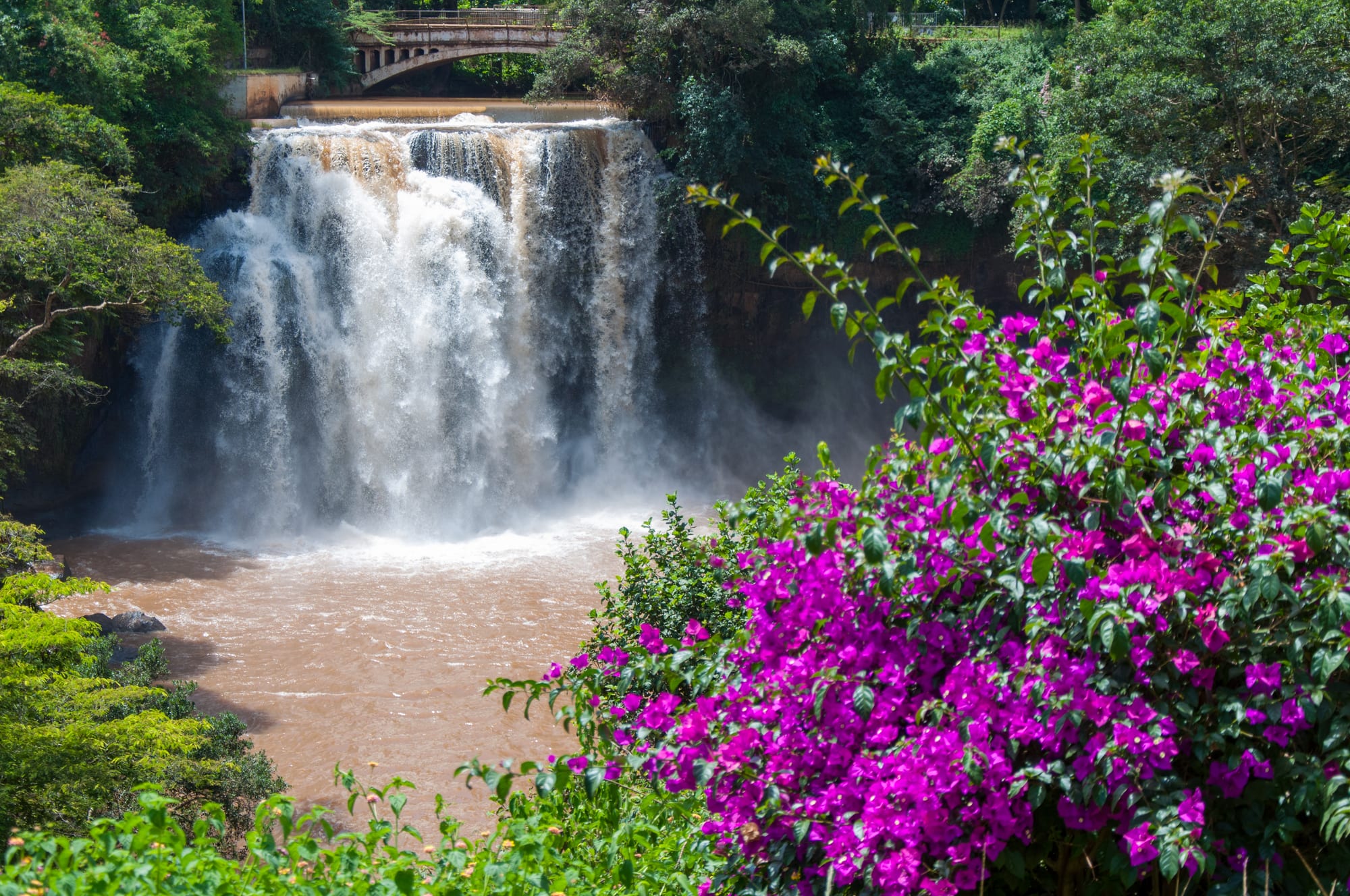
A wide waterfall dropping into a brown pool below a road bridge, with green trees and purple bougainvillea in the foreground

Nairobi & the Central Highlands, Kenya

Thika

The Chania Falls in Thika, where the river drops beside the old road bridge. (Hansueli Krapf / Wikimedia Commons · CC BY-SA 4.0)

An industrial town in Kiambu County about 40 kilometres north-east of Nairobi, where the Chania and Thika rivers meet. Settler farms and canneries made it a centre of pineapple and coffee processing, the dual carriageway from the capital turned it into a commuter town, and waterfalls and the Ol Donyo Sabuk hill lie close by.

Neighbourhoods

  • Town centre
    • First-time visitors
    • Markets
    • Close to public transport

    A dense grid of shops, banks, stalls and matatu stages between the highway and the Chania river, with the main market and most of the town's hotels. It is busy from early morning and loud with matatu touts and traders.

    Open in Maps
  • Makongeni
    • Local life
    • Quiet and residential

    The town's best-known workers' housing estate, built for the factories — a grid of small houses, churches, schools and kiosks that is still where much of industrial Thika lives.

    Open in Maps
  • Juja
    • Students
    • Close to public transport

    A fast-growing town on the highway towards Nairobi, built around Jomo Kenyatta University of Agriculture and Technology, with student flats, cafés and shopping centres along the dual carriageway.

    Open in Maps
  • The riverside and the falls
    • Waterfalls
    • Families

    The northern edge of the town where the Chania and Thika rivers fall over rock ledges a short walk apart, a patch of gardens, trees and picnic ground on the way out towards Murang'a.

    Open in Maps

Things to do

Rivers and waterfalls

  • Chania Fallsattraction

    A broad fall where the Chania river drops several metres beside the old Murang'a road at the edge of the town, set in gardens and trees.

    Open in Maps
  • Thika Fallsattraction

    A fall on the Thika river a short walk from the Chania fall, near the north-western edge of the town where the two rivers meet; the ground between them is a long-standing spot for local visitors.

    Open in Maps

Short trips from the town

  • Fourteen Fallsattraction

    Fourteen distinct waterfalls on a broad stretch of the Athi River, about 25 kilometres east of the town off the Garissa road, where the water breaks over a long rock shelf into separate cascades.

    Open in Maps
  • Ol Donyo Sabuk National Parkpark

    A 20.7-square-kilometre park established in 1967 around the forested hill — Ol Donyo Sabuk, 'big mountain' in Maasai, and Kilimambogo, 'buffalo mountain', in Swahili — with buffalo, colobus monkeys, bushbuck and views towards Mount Kenya and Kilimanjaro.

    Open in Maps

Institutions and landmarks

  • Mount Kenya Universitylandmark

    A private, multi-campus university whose main campus is in Thika, one of the largest private universities in Kenya and a major reason for the town's student population.

    Open in Maps
  • Thika Roadtransit hub

    The eight-lane highway from Nairobi, rebuilt from 2009 and inaugurated in November 2012, which cut the journey to the capital and pulled the town into its commuter belt.

    Open in Maps

Eat and drink

Long-standing places and food districts in Thika. Hours, ratings and directions come from your maps app, always current.

Thika kitchens

  • Town-centre cafésrestaurant

    Hotelis around the market serve the highland staples all day — githeri, mukimo, beans and chapati, stew with ugali — with chai from first light.

    Open in Maps
  • Nyama choma barsrestaurant

    Roast goat and beef by the kilo with kachumbari and ugali, eaten in garden bars on the edges of the town and along the old Nairobi road.

    Open in Maps

Markets

  • Thika marketmarket

    The main produce market, stacked with pineapples, bananas, avocados, mangoes, potatoes and greens from the farms of Kiambu and Murang'a.

    Open in Maps
  • Roadside pineapple stallsmarket

    Stands along the highway sell pineapples from the plantations around the town, cut to order, along with mangoes and passion fruit in season.

    Open in Maps

Experience Thika

History

Thika grew where the Chania and Thika rivers meet, on land farmed by Kikuyu families long before the colonial period and close to the frontier with Kamba and Maasai country. The British built a road and then a branch railway from Nairobi early in the twentieth century, and settlers took farms in the surrounding country. The town that served them acquired a hotel by the falls, a trading street, and a reputation among settlers as the last stop before the frontier districts to the north-east.

That settler world was recorded in The Flame Trees of Thika, Elspeth Huxley's memoir of a childhood on a farm near the town before the First World War, published in 1959 and televised by Thames Television in 1981, and made the name known far beyond Kenya. The farms themselves changed the district: pineapple canning began at Kenya Canners, formed in 1948 and later part of Del Monte, whose plantation and cannery near the town employ several thousand people; canned pineapple is Kenya's largest single manufactured export.

Independence brought land transfers to smallholder cooperatives and a push for industry. Thika became one of Kenya's main manufacturing towns, with textile mills, a tannery, food and cooking-oil processing, cigarettes, vehicle assembly, packaging and chemical works, and a workforce housed in estates such as Makongeni. Some of those industries struggled from the 1980s and 1990s as imports and liberalisation bit. The rebuilding of the Nairobi road as an eight-lane superhighway, completed in 2012, reshaped the town again, turning it into a commuter and college town of the capital's outer belt, and a county government at Kiambu now administers it.

Culture & Customs

Thika's culture is Kikuyu in language and custom but industrial in character, a mixture found in few of the highland towns. Factory shifts, college terms and the daily run to Nairobi set the pattern of the week rather than the farming calendar alone, and the town has long had a working-class social life of estate bars, football clubs, churches and welfare associations built around the workplaces.

Music at weekends is mugithi, the Kikuyu guitar style whose singers work through long chains of songs while the crowd joins in, alongside gospel, benga and the genge and gengetone that the students bring from Nairobi. Churches are numerous and loud, from old mission congregations to large Pentecostal halls, and harambee fundraising for school fees, medical bills and funerals is a constant of community life.

The town is also known for what visitors come to see at weekends: families picnic by the waterfalls, and the gardens above them have been a meeting place for generations. Elspeth Huxley's book has given Thika a literary shadow that local people regard with mixed feelings, since it describes the settler side of a history that cost the surrounding Kikuyu families their land. Manners are formal by regional standards: greetings first, respect for age, and modest dress in town.

Daily Life

Thika had 279,429 residents at the 2019 census, and its built-up area now runs almost continuously along the highway through Juja towards Nairobi. It sits in Kiambu County, whose headquarters are at Kiambu town although Thika has the county's largest economy, and a large share of its working population commutes to the capital or to the industrial zones between the two.

Work is varied by Kenyan standards. The plantations and cannery, textile and food factories, the tannery, vehicle assembly and packaging plants, the wholesale and retail trade of a busy market town, and a large student economy built on Mount Kenya University in the town and the technological university at Juja all provide employment. Farming continues around the edges, with pineapples, coffee, maize, bananas and dairy cattle.

The day begins before dawn, when matatus fill for Nairobi and factory shifts change; the market is at its busiest in the morning, and the highway clogs again in the evening. Housing is a pressing issue as flats rise on former farmland, and so are water supply, the cost of living and jobs for the many young people the colleges turn out. Weekends bring families to the riverside and to the churches, and, for those with land, journeys further upcountry.

Food

Thika's everyday food is the Kikuyu highland kitchen: githeri, boiled maize and beans eaten at home and in every workers' canteen; mukimo, potatoes mashed with maize, beans and green leaves; ugali with sukuma wiki, collard greens braised with tomato and onion; and beef or goat stew with chapati. Uji, a thin millet or maize porridge, is drunk at breakfast, and roasted maize cobs are sold on every corner.

Nyama choma is the weekend meal — goat or beef roasted over charcoal, chopped on a board and eaten by hand with kachumbari, the salad of tomato, onion and chilli — and the garden bars on the edge of town exist largely to serve it. Street food runs to mutura, the grilled sausage of meat and blood, smokies with kachumbari from handcarts, deep-fried potatoes and samosas near the stages.

The town's own product is fruit. Pineapples from the plantations around Thika are sold whole or cut at roadside stands and are the thing most associated with the place, alongside mangoes, avocados, bananas and passion fruit from the surrounding farms. Coffee grown in the district leaves it mostly as beans, while chai, the sweet milky boiled tea, is what people actually drink, and muratina, the traditional fermented sausage-tree brew, appears at family celebrations.

Planning tools

Budget

Thika is much cheaper than Nairobi and is often used as an inexpensive base near the capital. Guesthouses and local cafés cost little, mid-range hotels are modest, and matatus to Nairobi are cheap. Park entry at Ol Donyo Sabuk and transport to the waterfalls are the main extras.

Daily Budget Midrange
USD 80–160 (mid-range hotel, restaurant meals, taxis and a park day)
Daily Budget Shoestring
USD 25–50 (guesthouse, local cafés, matatus)

Park fees at Ol Donyo Sabuk and a taxi or hired car to Fourteen Falls are worth budgeting separately; almost everything in the town itself is inexpensive.

Best Time to Visit

January to March and June to October are dry and easiest for the hill and the falls, though the waterfalls are at their most dramatic during and just after the long rains of March to May, when the rivers run full and brown and the tracks around them are muddy.

Suggested Number of Days

A day is enough for the town and its waterfalls. Two or three make sense for anyone adding the hill park, the plantation country and the road north into Murang'a, or using Thika as a cheaper base near Nairobi.

First Visit
1 day
With Surroundings
2–3 days

Transportation

Matatus and buses run constantly to Nairobi on the dual carriageway, taking roughly an hour outside the peaks and much longer within them, and others serve Murang'a, Garissa and the Kirinyaga towns. Boda-boda motorcycles and tuk-tuks handle local trips. The railway station has only a limited passenger service, with freight the main traffic, and a light-rail link to Nairobi is so far only proposed.

The falls and Ol Donyo Sabuk are beyond matatu routes at their final stretch, so a taxi, a hired car or a boda-boda is needed for the last few kilometres.

Airport & Station Connections

Thika lies about 40 kilometres north-east of Nairobi on the Thika Road superhighway, an hour or so by matatu outside rush hour, and is the first large town on the route to Murang'a, Nyeri and the Mount Kenya counties. Jomo Kenyatta International Airport is on the far side of Nairobi, about an hour and a half away by road.

Walkability

The centre is compact and walkable, with the market, banks and matatu stages within a few blocks, and the riverside falls are within reach on foot from it. Beyond that the town spreads along wide, fast roads with patchy pavements, and the industrial areas and estates are better reached by matatu or motorcycle. Walking after dark is generally avoided.

Safety

Thika is a working town with ordinary urban petty crime — pickpocketing and bag-snatching around the market, the stages and the bus park, and more risk after dark on unlit streets. The highway is the more serious hazard, with heavy traffic and frequent accidents, and the rocks and currents at the waterfalls are dangerous when the rivers are high.

Avoid the northeastern counties and the immediate Somali border, take care in Nairobi's central and eastern districts and after dark, use hotel or app-based transport, and take malaria precautions outside the highlands. Keep well back from the edges at the falls and cross the highway only at the footbridges. Check current official travel advice before travelling.

Climate

Warmer than Nairobi and drier than the higher highlands, at about 1,630 metres, with sunshine most of the year, mild nights and two rainy seasons — the long rains from March to May and the short rains from October to December, both falling mainly as afternoon storms.

Summer
January to March is the warmest and brightest spell, running above the 19.8°C annual average
Winter
June to August is cooler and often overcast, running below the 19.8°C annual average, with cool nights

Local Customs

Thika is a Kikuyu town with a mixed working population drawn by its factories and colleges, so Swahili, Gĩkũyũ and English are all heard. Greetings come before business and elders are addressed first; church life is prominent and Sunday mornings are busy.

Tipping is not expected in small cafés and rounding up is enough elsewhere. Ask before photographing people, factories or plantations, and dress neatly in town.

Common Payment Methods

The currency is the Kenyan shilling, and M-Pesa mobile money is accepted almost everywhere, including by market traders and matatu crews. Banks and ATMs line the main streets, supermarkets and hotels take cards, and small notes are useful for stalls and fares.