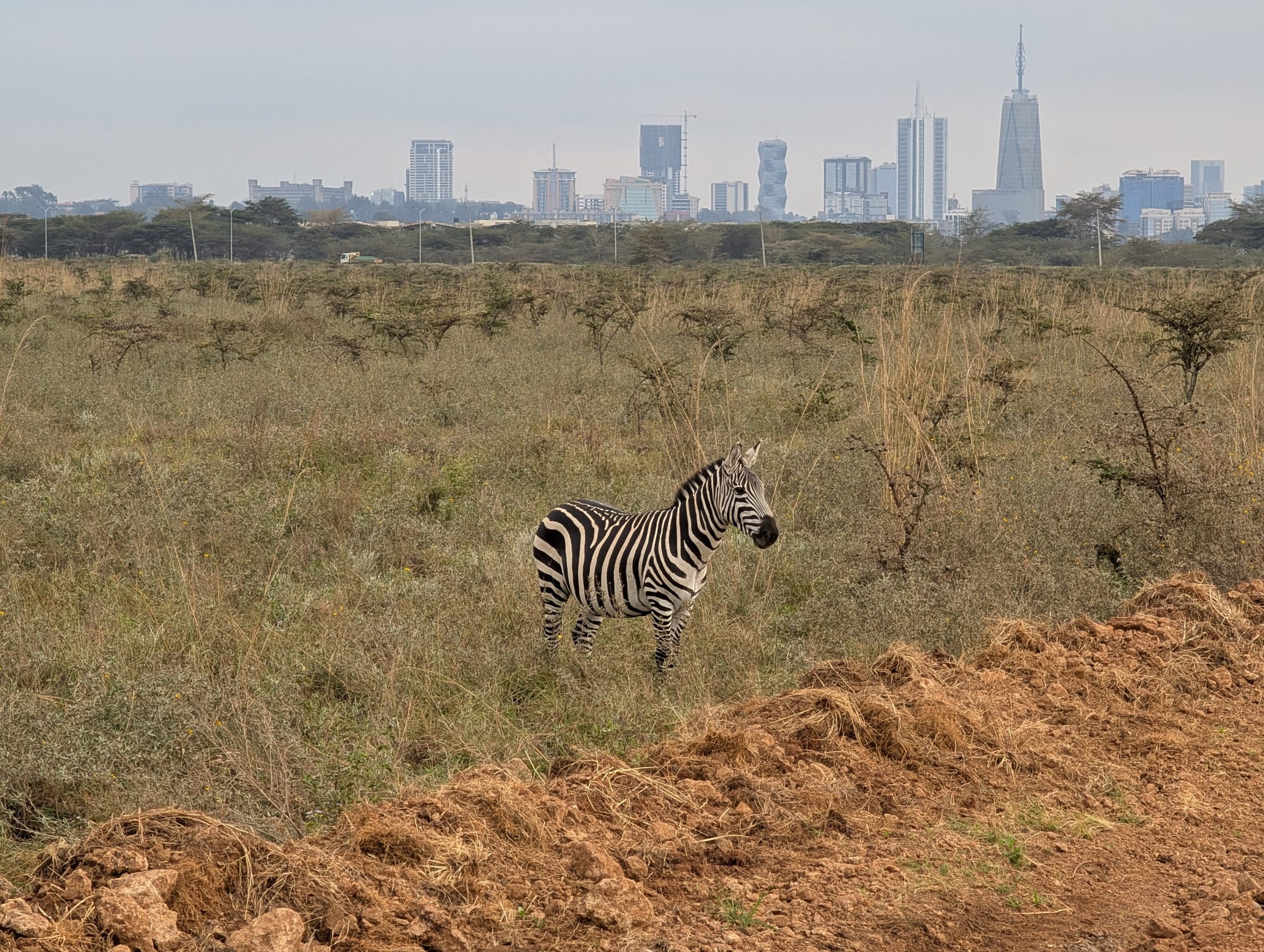
A zebra standing in dry grass and acacia scrub, with the towers of Nairobi's skyline on the horizon

Kenya

Nairobi & the Central Highlands

A zebra in Nairobi National Park, with the city's skyline a few kilometres away. (Addshore / Wikimedia Commons · CC BY-SA 4.0)

The capital and the green, cool highlands to its north — the old Central Province of Kiambu, Murang'a, Nyeri, Kirinyaga and Nyandarua — rising from Nairobi's plains through tea and coffee farms to the Aberdare range and the western slopes of Mount Kenya, heartland of the Kikuyu and of the Mau Mau struggle.

Explore Nairobi & the Central Highlands

History

The highlands were settled by Bantu-speaking farmers, above all the Kikuyu, who cleared the forests on the ridges between the Aberdares and Mount Kenya and farmed them in family land-holdings, trading with Maasai herders on the plains. British rule arrived with the Uganda Railway: Nairobi began in 1899 as a railway depot on a swampy watering place the Maasai called Enkare Nairobi, "cool water", and replaced Mombasa as the capital of the protectorate in the early 1900s.

The fertile land around it became the core of the "White Highlands". Settlers took farms in Kiambu, Nyeri and Nyandarua, where the Wanjohi valley gave its name to the hard-living "Happy Valley" set of the 1920s and 1930s, and many Kikuyu became squatters or labourers on land they regarded as theirs. That grievance fed the Mau Mau rising: the colonial government declared a State of Emergency in 1952, fighters held out in the Aberdare and Mount Kenya forests, and hundreds of thousands of Kikuyu were detained or moved into guarded villages. Dedan Kimathi, the best-known forest leader, was captured in the forest in 1956 and hanged in 1957.

After independence the region supplied Kenya's first president, Jomo Kenyatta, from Gatundu in Kiambu, and its political weight has remained great. Nairobi grew into East Africa's commercial capital, but it also saw the 2007–08 post-election violence spread into its informal settlements, al-Shabaab attacks in 2013 and 2019, and in June 2024 youth-led protests against a finance bill that reached the parliament buildings.

Culture & Customs

The Kikuyu are the largest community in the highlands, and Mount Kenya — Kĩrĩnyaga in Gĩkũyũ — was traditionally held to be the seat of the god Ngai, with homes built facing it. The mugumo fig tree remains a respected symbol. Christianity took deep root here through Scottish, Anglican and Catholic missions, and church life, school fees and land are the great themes of family conversation. Nyeri was the home of Wangari Maathai, who founded the Green Belt Movement and won the Nobel Peace Prize in 2004, and the novelist Ngũgĩ wa Thiong'o came from Limuru in Kiambu.

Kikuyu music has its own sound in mugithi, dance-floor songs sung over electric guitar, which fills bars across the highlands at weekends. Nairobi is a mixing bowl of every community in the country, and its young people speak Sheng, a fast-changing blend of Swahili, English and other languages. The city's arts scene, its matatu decoration, its fashion and its churches both old and new all compete for attention, and the capital's cosmopolitan crowd includes a large international and diplomatic community.

Daily Life

Nairobi County has over four million people, and the wider city spills into Kiambu, whose towns of Ruiru, Thika and Kikuyu have become commuter suburbs. Nyeri, Murang'a, Kerugoya and Ol Kalou are the main county towns. Nairobi's economy runs on government, finance, the offices of the United Nations and international organisations, and a growing technology sector, while the highlands grow tea, coffee, dairy and vegetables, rice on the Mwea irrigation scheme in Kirinyaga and potatoes in Nyandarua.

The day starts early: matatus fill before dawn for the commute, and many families still keep a shamba upcountry alongside a city job, travelling there at weekends and holidays. Nairobi's contrasts are sharp — the leafy gardens of Karen and Muthaiga, and informal settlements such as Kibera and Mathare, where many residents lack secure housing and services. Traffic, the cost of living, youth unemployment and taxes dominate politics, and they were at the heart of the protests of 2024.

Food

The highland kitchen is Kikuyu farm food. Mukimo is a mash of potatoes, green peas or pumpkin leaves and maize, often served beside a meat stew; githeri is boiled maize and beans, the everyday meal of school and home; and irio is a mash of beans, maize and potatoes. Porridge, uji, made from millet or maize flour, is a breakfast staple, and roasted maize cobs are sold at the roadside.

Nairobi eats from the whole country, and nyama choma — roast goat or beef — is the city's social meal, eaten in butcheries, bars and garden restaurants with kachumbari salad and ugali. Street food includes mutura, a grilled sausage stuffed with meat and blood, and smokies with kachumbari from roadside carts.

The highlands also produce the country's best-known coffee, grown on the volcanic soils around Kiambu, Murang'a, Nyeri and Kirinyaga, and Kenyan tea is drunk everywhere as sweet milky chai. Muratina, a traditional Kikuyu brew of fermented honey or sugar with the fruit of the sausage tree, survives at home celebrations.

Attractions & Natural Wonders

Nairobi's own sights begin with Nairobi National Park, gazetted in 1946 as Kenya's first national park, where lions, black rhino, giraffe and buffalo roam the grassland within sight of the skyline. The Sheldrick Wildlife Trust's elephant orphanage sits on its edge. In Lang'ata, the Giraffe Centre lets visitors feed endangered Rothschild's giraffes from a raised platform, and nearby are the Karen Blixen Museum, the farmhouse of the author of Out of Africa, and the Nairobi National Museum. Karura Forest offers walking and cycling trails inside the city.

North of the capital, Thika is the base for Fourteen Falls, where the Athi River breaks over a wide rock shelf into many separate cascades. Nyeri, further up, is the gateway to Mount Kenya's western approaches, with the Naro Moru route climbing to Point Lenana; the town also holds the grave of Robert Baden-Powell, founder of the Scout movement, who spent his last years at the Outspan Hotel.

The Aberdares form the region's high ground. Aberdare National Park covers moorland, bamboo thickets and dense forest, with elephants, buffalo and rare bongo antelope, and waterfalls such as Karuru and Gura dropping into deep gorges. Treetops, where Princess Elizabeth was staying in 1952 when her father died and she became queen, is a lodge built to watch animals at a floodlit waterhole. Lake Ol Bolossat is the only lake in Nyandarua.

Cities in Nairobi & the Central Highlands

Planning basics

Budget

Nairobi is Kenya's most expensive city for accommodation and eating out in the upmarket districts of Westlands, Karen and Kilimani, but cheap local cafés, guesthouses and matatus keep costs low for those who use them. The highland towns of Nyeri, Thika and Murang'a are much cheaper. Park entry and lodges in the Aberdares are the big extra.

Daily Budget Midrange
USD 120–270 (mid-range hotel, restaurant meals, taxis by app, a park day)
Daily Budget Shoestring
USD 40–70 (hostel or guesthouse, local cafés, matatus)

Pay with M-Pesa or card in Nairobi where possible, and budget separately for park entry and a driver for the Aberdares.

Safety

Nairobi has high levels of street crime, including mugging, bag-snatching and carjacking, especially in the central business district and the eastern districts after dark. Al-Shabaab has attacked the city, notably at the Westgate mall in 2013 and the DusitD2 complex in 2019, and security checks at malls and hotels are routine. Street protests, as in 2024, can turn violent. The highland towns and parks are generally calm.

Avoid walking at night in central Nairobi, keep phones out of sight in traffic, steer clear of demonstrations, and treat altitude and cold with respect on Mount Kenya. Check current official travel advice before travelling.

Climate

Altitude makes this the coolest settled part of Kenya. Nairobi, at about 1,700 metres, has warm sunny days and cool nights, and the highlands towards the Aberdares and Nyandarua are colder still, with cloud and rain on the forested slopes. The long rains fall from about March to May and the short rains around November.

Summer
January–March is the warmest spell, 24–28°C by day in Nairobi
Winter
June–August is cool and overcast, often 10–12°C at night in Nairobi and colder in Nyandarua

Transportation

Jomo Kenyatta International Airport serves the whole country, with Wilson Airport handling light aircraft to the parks. The Nairobi Expressway links the airport side of the city with Westlands, and the Thika Superhighway carries traffic north to Thika; from there good roads run to Murang'a, Nyeri and Kirinyaga, about two to three hours from the capital. Matatus reach every town, and Nairobi's traffic is heavy at rush hour.

Use app-based taxis in Nairobi, allow plenty of time for the airport, and hire a 4x4 with a driver for the Aberdares.

Best Time to Visit

June to October and January to February are dry and best for Nairobi National Park, the Aberdares and Mount Kenya walks. July and August are grey but pleasant. The long rains of March to May turn the Aberdare tracks to mud, and some roads in the park can close.