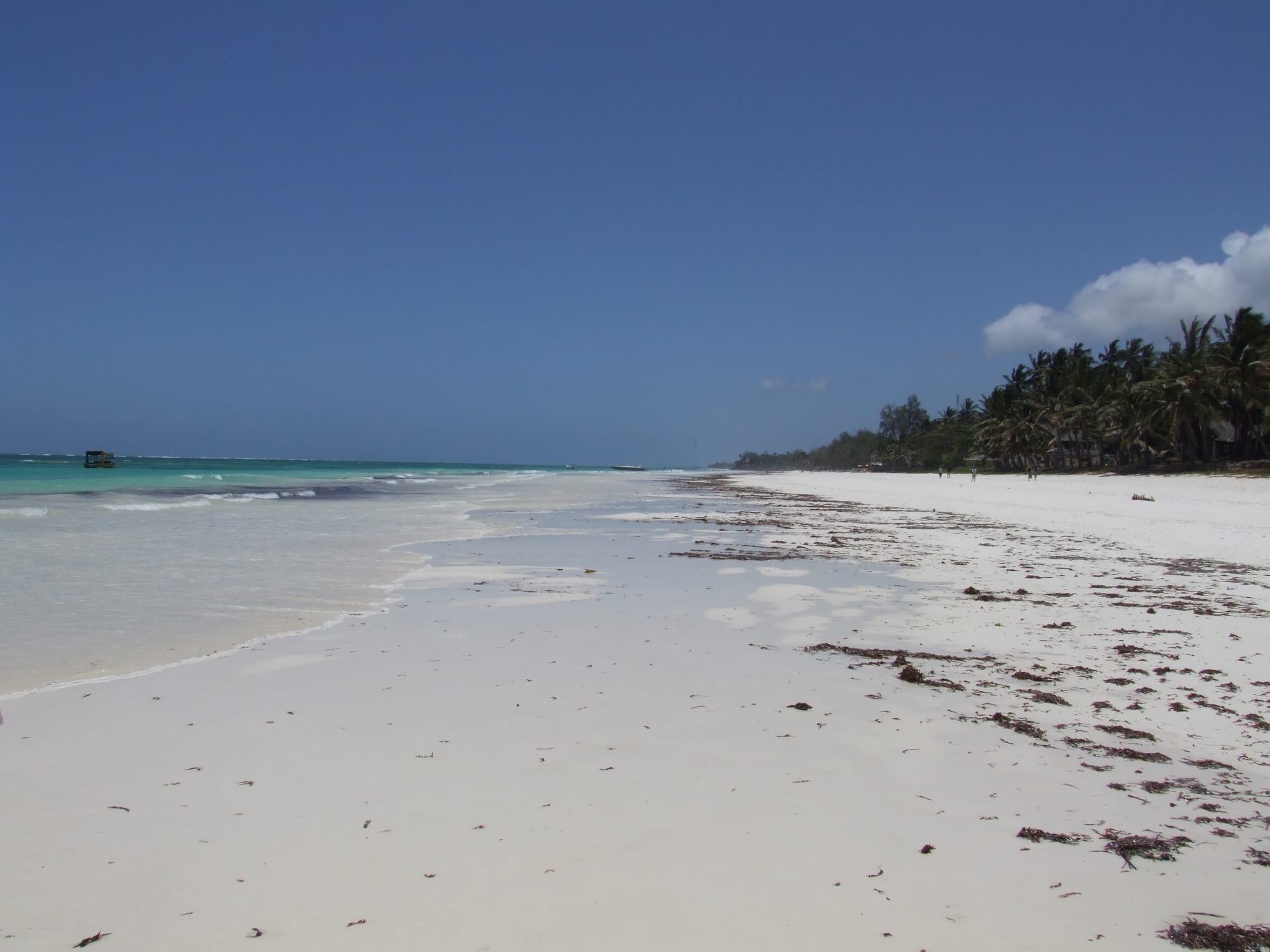
A long white-sand beach lined with palm trees, with turquoise shallows and a small boat offshore

Kenya

Mombasa & the Coast

The white sand and palm-backed shore of Diani Beach, south of Mombasa. (Nicor / Wikimedia Commons · CC BY 3.0)

Kenya's Indian Ocean shore and its hinterland — the old Coast Province of Mombasa, Kwale, Kilifi, Tana River, Lamu and Taita-Taveta — a Muslim, Swahili-speaking world of coral-stone towns, reefs and white beaches, backed by the dry bush of Tsavo and the green Taita Hills.

Explore Mombasa & the Coast

History

The coast was the northern arm of the Swahili world. From around the 8th century African farming and fishing towns traded ivory, mangrove poles and gold with merchants from Arabia, Persia and India, adopted Islam and built in coral stone. Mombasa, Malindi, Lamu, Pate and the town now ruined at Gedi grew into rival city-states, and the Kiswahili language grew with them.

In 1498 Vasco da Gama found a friendly welcome in Malindi, which became Portugal's ally against Mombasa. The Portuguese built Fort Jesus in Mombasa from 1593, but the Omani Arabs besieged it for nearly three years and took it in 1698. Omani governors and local dynasties such as the Mazrui of Mombasa ruled the coast, and in the 19th century it was run from Zanzibar. Britain leased a ten-mile coastal strip from the sultan, began the Uganda Railway at Mombasa in 1896, and made the town the gateway to the new colony; the strip formally joined Kenya only at independence in 1963.

Since then the coast has lived on its port and on tourism, while some residents have argued that it was sidelined by governments in Nairobi, a feeling behind the separatist Mombasa Republican Council. The Tana Delta saw deadly clashes between farming and herding communities in 2012, and attacks in Lamu County from 2014, claimed by al-Shabaab, hit tourism hard. The Lamu Port project, part of a corridor planned towards South Sudan and Ethiopia, is changing the archipelago.

Culture & Customs

This is Kenya's Swahili heartland. The towns are largely Muslim, and life follows the call to prayer, Friday gatherings and the calendar of Ramadan and Eid. Kiswahili here is spoken in its coastal forms — the Kiamu of Lamu is prized for its poetry — and older families trace ancestry across the Indian Ocean. Men wear the white kanzu and embroidered kofia cap, women the black buibui, and the printed kanga cloth carries proverbs along its border.

Inland, the nine Mijikenda peoples, among them the Giriama and Digo, keep the kaya: fortified villages in forest clearings, eleven of which are now listed together as a UNESCO World Heritage Site. The Taita of the hills and the Pokomo and Orma of the Tana are distinct again.

Lamu's Maulidi festival, marking the Prophet's birthday, brings pilgrims from across East Africa, and the Lamu Cultural Festival features traditional dancing, crafts and dhow races. Taarab music, with its Arab and Indian roots, is played at weddings. Modest dress away from the beach, especially in Lamu and old Mombasa, is expected.

Daily Life

Mombasa, an island city joined to the mainland by bridges, causeway and ferry, has about 1.2 million people and is Kenya's main port, handling cargo for Uganda and other landlocked neighbours. Malindi, Kilifi, Ukunda near Diani, Voi and Lamu are the other main towns. Work comes from shipping and logistics, tourism, fishing, cashew and coconut farming, and salt and cement; inland Taita-Taveta mines gemstones and grows fruit and vegetables in the hills.

Days start early before the heat, stall in the afternoon and revive in the cool of the evening, when families walk the Mombasa waterfront. Many young coastal people struggle to find work, and a sense of marginalisation is a long-running grievance. Tourism, heavily seasonal, has recovered since the downturn of the mid-2010s.

Food

Coastal cooking is Kenya's richest, built on coconut, rice, seafood and spices from the Indian Ocean trade. Pilau and biryani are the feast dishes, and grilled fish and coconut-based curries are everyday fare. Breakfast is often mahamri, lightly sweet fried buns made with coconut milk. Street stalls sell viazi karai, potatoes fried in spiced batter, and mishkaki meat skewers.

Sweets reflect the Swahili and Indian heritage: kaimati, small fried dumplings eaten at breakfast, halwa, and coconut kashata. Coconut water is drunk straight from the husk, and palm wine, known on the coast as mnazi, is the traditional brew. Mangoes, cashews and passion fruit fill the markets.

Attractions & Natural Wonders

Mombasa's old town grew around Fort Jesus, a Portuguese fortress begun in 1593 and now a museum and UNESCO World Heritage Site; its narrow lanes, carved doors, mosques and Old Port are best explored on foot. South of the city, Diani Beach runs for kilometres behind a coral reef, with Shimba Hills National Reserve inland and, near the Tanzanian border, Wasini island and the Kisite-Mpunguti marine park.

North of Mombasa, Kilifi sits on its creek, and Watamu and Malindi each have a marine national park with coral gardens and turtles. Near Watamu lie the mangroves of Mida Creek, the Arabuko-Sokoke forest and the ruined Swahili town of Gedi; Malindi keeps the Vasco da Gama Pillar on its seafront.

Lamu Old Town, the best-preserved Swahili town in East Africa and a UNESCO World Heritage Site, has no cars; its Lamu Museum, fort and waterfront lead on to the dunes of Shela and the Takwa ruins on Manda island. Inland, the Taita-Taveta parts of Tsavo East and Tsavo West, famous for their elephants and the man-eating lions of 1898, give way to the Taita Hills around Wundanyi, the Taita Hills Wildlife Sanctuary and Lake Chala on the Tanzanian border.

Cities in Mombasa & the Coast

Planning basics

Budget

The coast is cheaper than the safari circuit but has two price levels. Local guesthouses, matatus, tuk-tuks and Swahili cafés in Mombasa, Malindi and Lamu are inexpensive, while Diani and Watamu beach hotels, Lamu's restored houses and Tsavo lodges charge international rates, especially at Christmas and in August.

Daily Budget Midrange
USD 95–230 (beach hotel, restaurant meals, a boat trip or snorkelling day)
Daily Budget Shoestring
USD 30–60 (guesthouse, local cafés, matatus and tuk-tuks)

Agree tuk-tuk and boat prices before setting off, and budget for park fees in Tsavo and the marine parks.

Safety

Mombasa has street crime, and beaches draw touts and occasional thefts, especially after dark. Militant attacks have hit the coast, including at Mpeketoni in Lamu County in 2014 (claimed by al-Shabaab), and there have been further attacks on the mainland of Lamu County. Governments advise against travel to parts of Lamu and Tana River counties. Swimming carries rip-current risks, and malaria is present along the whole coast.

Avoid walking on beaches or in Mombasa's old town after dark, use malaria prophylaxis, and stay away from the northern Lamu and Tana River border areas. Check current official travel advice before travelling.

Climate

Hot and humid all year at sea level, unlike the temperate highlands. The coast is wettest in April and May, when the long rains bring heavy downpours, and driest and hottest from December to March. Tsavo inland is hot and dry, and the Taita Hills are noticeably cooler and greener.

Summer
December–March is hot and humid, around 30–33°C, with calm seas
Winter
June–September is a little cooler, around 27–29°C, with a stronger breeze and rougher sea

Transportation

Mombasa is reached by the Standard Gauge Railway from Nairobi, by air, or by the busy Nairobi highway. Diani lies south of the Likoni ferry across the harbour entrance, and the road north runs through Kilifi to Watamu and Malindi. Lamu is usually reached by short flight to Manda island and a boat across; on the island itself people walk or take boats and donkeys.

Allow extra time for the Likoni ferry queues, and fly to Lamu rather than drive the northern road.

Best Time to Visit

December to March for beaches, snorkelling and calm water, and July to October for dry, breezy weather and good game viewing in Tsavo. April and May are the wettest months and many beach hotels close or cut prices. Lamu's cultural festival and Maulidi celebrations draw crowds on dates that follow the Islamic calendar.